En 30 segundos
In August 2024, Matthew Berman reviews The Information’s reporting that OpenAI had shown a system called Strawberry to US national-security officials and was using it to create training data for a separate project called Orion. He explores reasoning time, synthetic data, model competition and safety speculation. OpenAI later released o1 in September 2024 and GPT-4.5 in February 2025; the video’s claim that GPT-5 was finished or imminent was not established by the reporting.
- 1Reports and codenamesThe Information reported a Strawberry demonstration to officials and a separate model called Orion; the claims were based on sources and not a confirmed GPT-5 launch.
- 2Synthetic data for OrionBerman explores the reported use of reasoning-generated examples to train another model, while acknowledging doubts about quality and sustainability.
- 3Thinking time and agentsHe imagines slower reasoning models helping with coding and asynchronous agents, but treats the product design as speculation.
- 4Competition and reliabilityHe discusses reported business figures, rival models and the importance of reducing hallucinations; rankings and valuations are historical and not independently verified here.
- 5Math and competing approachesBerman cites DeepMind’s olympiad result and argues that multi-step prompting can be useful rather than dismissing it as a shortcut.
Conclusiones
- The reported government demonstration came from an unnamed source; it was not independent confirmation that a finished GPT-5 had been shown.
- Strawberry was reported as reasoning technology and Orion as a separate future model, not interchangeable product names.
- OpenAI introduced o1-preview in September 2024; The Information subsequently connected that release to the project it had reported as Strawberry.
- Synthetic training data may be useful but does not guarantee accurate reasoning or eliminate hallucinations.
- More inference time and multi-step prompting can improve some results while increasing cost or latency.
- Google DeepMind’s 2024 mathematical olympiad result involved specialized formal systems, not an unrestricted chatbot taking the contest unaided.
Lee el texto editado por capítulos
Strawberry, Orion and government reports
Berman reviews The Information’s reports and distinguishes the named projects. The alleged demonstration and motives are not independently confirmed.
In August 2024 I am looking at reports about OpenAI’s projects called Strawberry and Orion. The Information cites a person with direct knowledge who says Strawberry technology was demonstrated to US national-security officials that summer. That is a reported allegation, not public confirmation that a finished GPT-5 was shown or was imminent.
The reporting treats Strawberry as a reasoning-focused project and Orion as a separate future flagship model. I also discuss Q*, an earlier reported research name, and wonder whether an old cryptic post from the anonymous account Jimmy Apples anticipated Orion. Such posts are ambiguous and cannot verify insider knowledge or establish that every codename refers to the same system.
The reported goal of Strawberry is better performance on difficult tasks such as mathematics through additional reasoning time. I describe that in terms of multi-step thinking rather than an immediate answer. The internal mechanism was not publicly established by these articles, and a model’s longer processing should not be assumed to work like human thought.
The Information reports a demonstration to national-security officials and speculates it might reflect an effort to engage policymakers. Its purpose, the technology’s maturity and any government assessment were not disclosed in the cited account. I discuss open-weight releases and argue that proprietary model weights are difficult to protect indefinitely, but that is my view rather than a demonstrated inevitability.
Synthetic data and reasoning time
He explores why reasoning-generated examples might be useful for another model and how latency might shape products. These possible applications were speculative at the time.
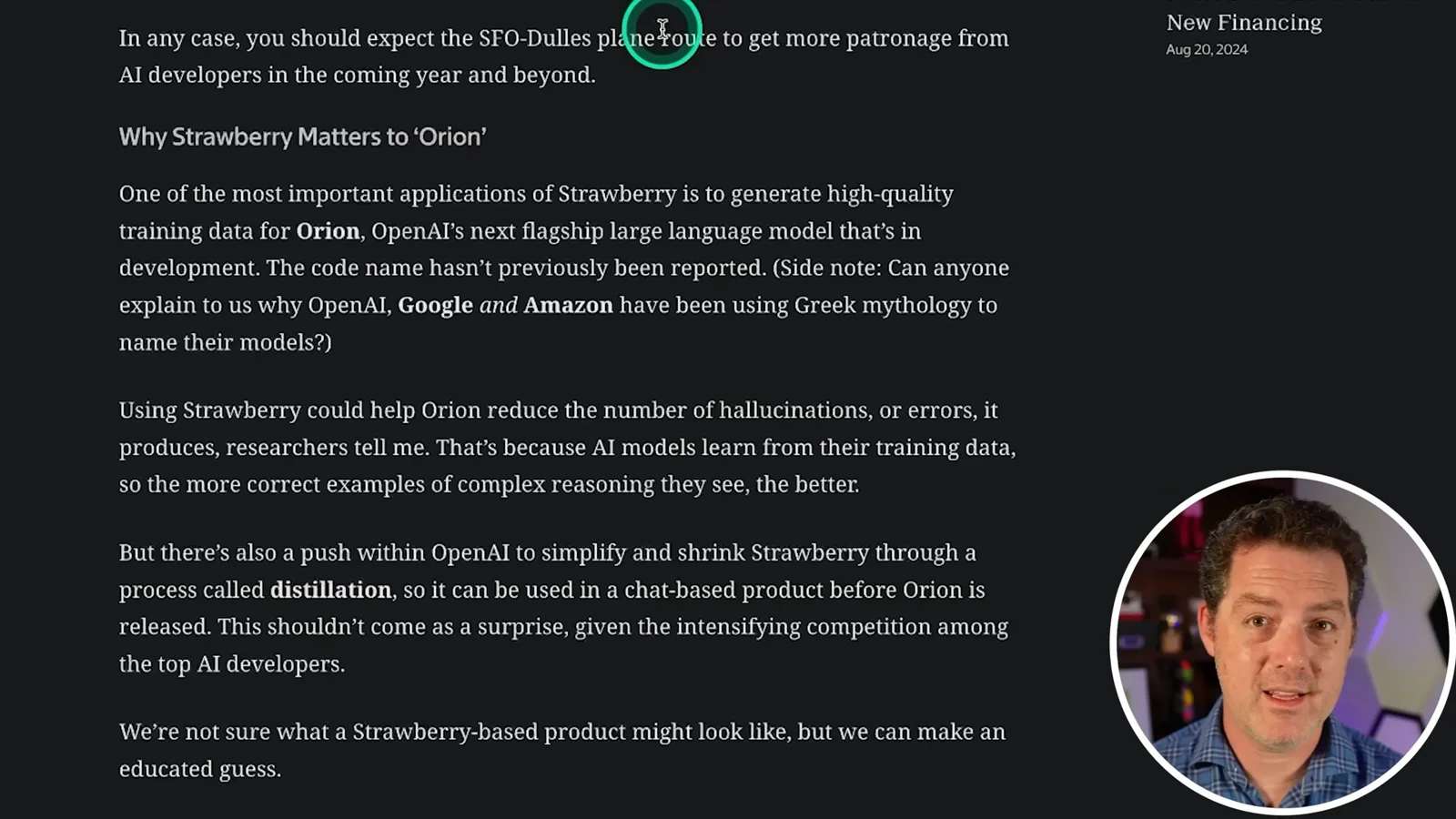
One reported use for Strawberry is generating high-quality synthetic training examples for Orion. I think this matters because developers face competition and constraints in acquiring useful real-world training data. My claim that practically all accessible internet data is exhausted is too broad; the availability and quality of training data depend on source, permissions and selection.
There is also an open question about synthetic data: if examples are generated by existing models, can they improve a successor, or will errors and limitations be recycled? Better examples could help in some settings, but a report about planned use does not establish the quality of the data or prove hallucinations will disappear.
The Information describes an effort to distill Strawberry for a chat product before Orion. I infer that a large reasoning system might be too slow or expensive for some consumer uses, but its precise latency and implementation were not publicly established. Taking more time can help on hard tasks, while changing the cost and responsiveness users experience.
Possible applications include difficult coding problems and agents that work asynchronously, where an immediate answer matters less. I imagine users choosing when to use a slower reasoning mode. These are product ideas, not features the reporting confirmed would ship in a specific form.
Business, competition and hallucinations
Berman discusses reported financial figures, competing models and reliability. He considers using retrieval, verification and multiple agents to mitigate errors.
A second Information article describes OpenAI pursuing a reasoning product and raising capital. It says employees had shown colleagues examples such as solving the New York Times Connections puzzle. I interpret this as potentially using intermediate reasoning or search, but the exact technique was not confirmed; it would be premature to name a particular algorithm as fact.
The article also reported approximately $283 million in monthly revenue and an $86 billion private valuation at the time, with likely larger monthly losses. Those historical figures are attributed reporting and are not independently verified here. I see competition from open-weight models, Anthropic, xAI and search products increasing pressure on OpenAI.
I argue that models such as Llama 3 are becoming competitive with GPT-4o for many uses, while cheaper models may be run or fine-tuned independently. That is my assessment, not a demonstrated equivalence across tasks: quality, inference costs and hardware needs vary substantially with the model and workload.
The article again attributes the possible use of Strawberry-generated data to a person familiar with the work and suggests it might improve Orion’s reliability. I see hallucinations as a serious barrier in enterprise and high-stakes applications. Retrieval, improved prompts, independent checks and agent workflows can help, but they do not guarantee error-free answers.
A quoted AI startup leader suggests cleaner examples might reduce ambiguity and improve reasoning. I would like a system that solves logic problems reliably on the first try, but training data quality is only one part of the problem, and the report does not show that any model has eliminated hallucinations.
I am skeptical that one private lab can indefinitely maintain a huge lead when research spreads across a broad community. That is my judgment, not a reliable forecast of future model performance; private data, infrastructure and unpublished work can also affect results.
Mathematics, research and speculation
He compares contemporary mathematical AI results and prompting techniques, then discusses reported research history and the culture of leaks.
The article points to mathematics and engineering as potentially valuable uses for stronger reasoning. I note Google DeepMind’s 2024 International Mathematical Olympiad result: its AlphaProof and AlphaGeometry 2 systems solved four of six problems at a combined silver-medal standard, using formalized problems and specialized methods ([DeepMind](https://deepmind.google/blog/ai-solves-imo-problems-at-silver-medal-level/)). That does not mean a general chatbot independently earned a medal under ordinary contest conditions.
I also mention Anthropic’s improvements in coding and visual question answering and the popularity of coding tools paired with Claude. The landscape was competitive in 2024, but user preferences and performance vary by task. I object to dismissing multi-step prompting as a cheap trick: breaking a problem down can be useful, even when it adds latency or cost.
The Information traces the reported research to earlier work associated with Ilya Sutskever and other OpenAI researchers. The video speculates about internal safety concerns and departures; those reports do not reveal a specific undisclosed breakthrough or prove a particular reason for every departure.
I finish with a New York Magazine article about the excitement around leaks, codenames and online speculation. It mentions one of my own videos, which I find flattering. Speculation can be fun, but anonymous posts, dramatic titles and predictions are not confirmation of what a lab has built.
Later developments give this story a clearer timeline: OpenAI introduced [o1-preview in September 2024](https://openai.com/index/introducing-openai-o1-preview/), and The Information connected it to Strawberry; OpenAI released a [GPT-4.5 research preview in February 2025](https://openai.com/index/gpt-4-5-system-card/). Those releases do not independently verify every earlier report about demonstrations, training data or internal codenames.
Más de este canal
 34:21EN
 Matthew Berman· 27 oct 2026Matthew Berman Examines Anthropic’s IPO Filing, AI Growth and GovernanceMatthew Berman, Sam Altman · Forward FutureThe presenter reviews the S-1’s financial metrics, compute strategy and voting structure while questioning the tension between rapid AI development and safety.
 0:26ENMatthew Berman· 25 oct 2026Sam Altman on Human Values and Problem-Solving in an AI WorldSam Altman · OpenAIIn a short interview excerpt, Altman considers the enjoyment of solving hard problems and the human role in interpreting results.
 0:36ENMatthew Berman· 25 oct 2026Kimi K3.1 and a Rubik’s Cube Solver DemonstrationMatthew Berman · Forward FutureMatthew Berman shows a scrambled virtual cube being solved and gives the Kimi K3.1 test a favorable assessment.
 0:21ENMatthew Berman· 24 oct 2026An AI-Generated Kimi Benchmark Chart Used Invented ScoresMatthew Berman · Forward FutureMatthew Berman asks for a graph of Kimi K3.1 Pro benchmarks, then discovers that the displayed figures are illustrative placeholders.
 25:50ENMatthew Berman· 24 oct 2026Kimi K3.1 Pro Tested: Strong 3D Demos, Uneven Results and Competitive PricingMatthew Berman · Forward FutureMatthew Berman tests the open-weight model on coding, 3D rendering and visual explanations, then compares benchmark results and prices.
 32:20ENMatthew Berman· 23 oct 2026Who Is Local AI For? The Costs, Trade-offs and a Hybrid FutureMatthew Berman · Forward FutureMatthew Berman weighs data control and independence against hardware cost, setup complexity and inference speed.