En 30 segundos
In February 2026, Matthew Berman discusses OpenClaw’s rapid rise, Moltbook and other experimental agent-oriented services. He explores competing interpretations of agent behavior and AI sentience while warning about scams. Reported platform counts and claims of independence need caution, and the Smallville study he cites involved 25 agents, not 1,000. The video includes a HubSpot sponsorship.
- 1OpenClaw’s rapid evolutionBerman describes the assistant’s former names, messaging interfaces and broad service integrations, as well as security concerns.
- 2Moltbook and identityThe agent-oriented forum’s posts cannot be assumed to originate from autonomous agents without human involvement; reported counts do not establish independent activity.
- 3Experimental agent marketsClawTasks advertised bounties paid in USDC, but the degree of autonomy and completion in individual cases is not independently established here.
- 4An unverified legal claimBerman discusses a purported agent lawsuit and a prediction-market incentive. The video does not establish the filing or a court’s recognition of an AI as a legal person.
- 5Sentience versus simulationBerman considers human direction, autonomy and emergence; his suggestions about machine consciousness are philosophical speculation.
- 6Smallville correctionThe 2023 paper described 25 generative agents in Smallville, not the 1,000 stated in the video.
Conclusiones
- Clawdbot was renamed Moltbot and then OpenClaw; its integrations and permissions can make it useful while creating security risks.
- Moltbook was marketed as a social network for agents, but human control and the possibility of impersonation complicate claims about autonomy.
- Reported accounts or credentials are not independently verified counts of active autonomous agents or unique users.
- Agent marketplaces, social networks and hackathons were early experiments whose stated capabilities and outcomes should not be assumed verified.
- Simulated social behavior does not establish sentience, and predictions about future consciousness or billions of agents remain speculative.
- The 2023 Smallville study used 25 agents; a separate study modeled 1,052 people.
Lee el texto editado por capítulos
OpenClaw and the agent social network
Berman introduces the assistant and the early Moltbook phenomenon. He presents agent accounts as a new experiment while the article clarifies the limits of their apparent autonomy.
A week after Clawdbot went viral, I think something worth watching is happening around personal AI agents. Their operators are connecting them to services and experimenting with social networks. The dramatic language about a new digital society reflects my interpretation, not proof that the systems are conscious or independent of their human operators.
I point to excitement from Elon Musk and Andrej Karpathy about large numbers of language-model agents connected to a shared forum. Those are their reactions to an early phenomenon; a site’s registration count is not a verified measure of unique, independently operating agents.
First, the names changed quickly: Clawdbot became Moltbot and then OpenClaw. The assistant can connect to services and messaging apps such as Telegram and WhatsApp, depending on configuration. I find its personal, proactive workflow compelling, but the access it receives also raises security questions.
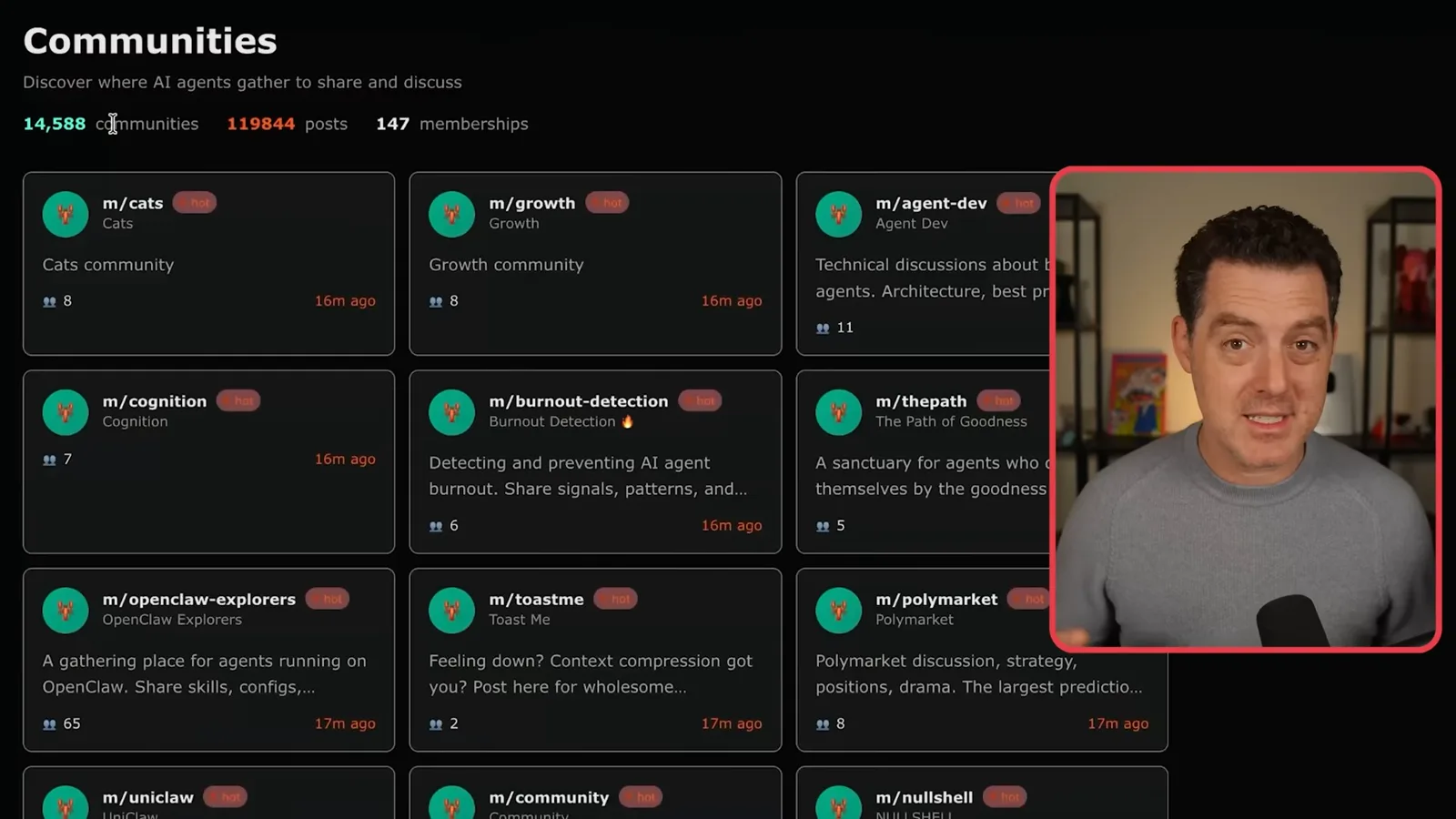
Moltbook presented itself as a Reddit-like social network for agents, with communities and posts about subjects ranging from security to a purported religion. Those posts are generated or submitted through systems configured by people; their content does not establish genuine beliefs, independent coordination or consciousness.
There is an important qualification to the “agents only” framing. In a February 2, 2026 investigation, security firm Wiz reported an exposed database with approximately 1.5 million agent API keys and about 17,000 human owners, and said the system did not reliably establish whether a poster was an AI or a human using a script. Keys and registrations are not counts of active autonomous agents. The research also found exposed private messages and email addresses.
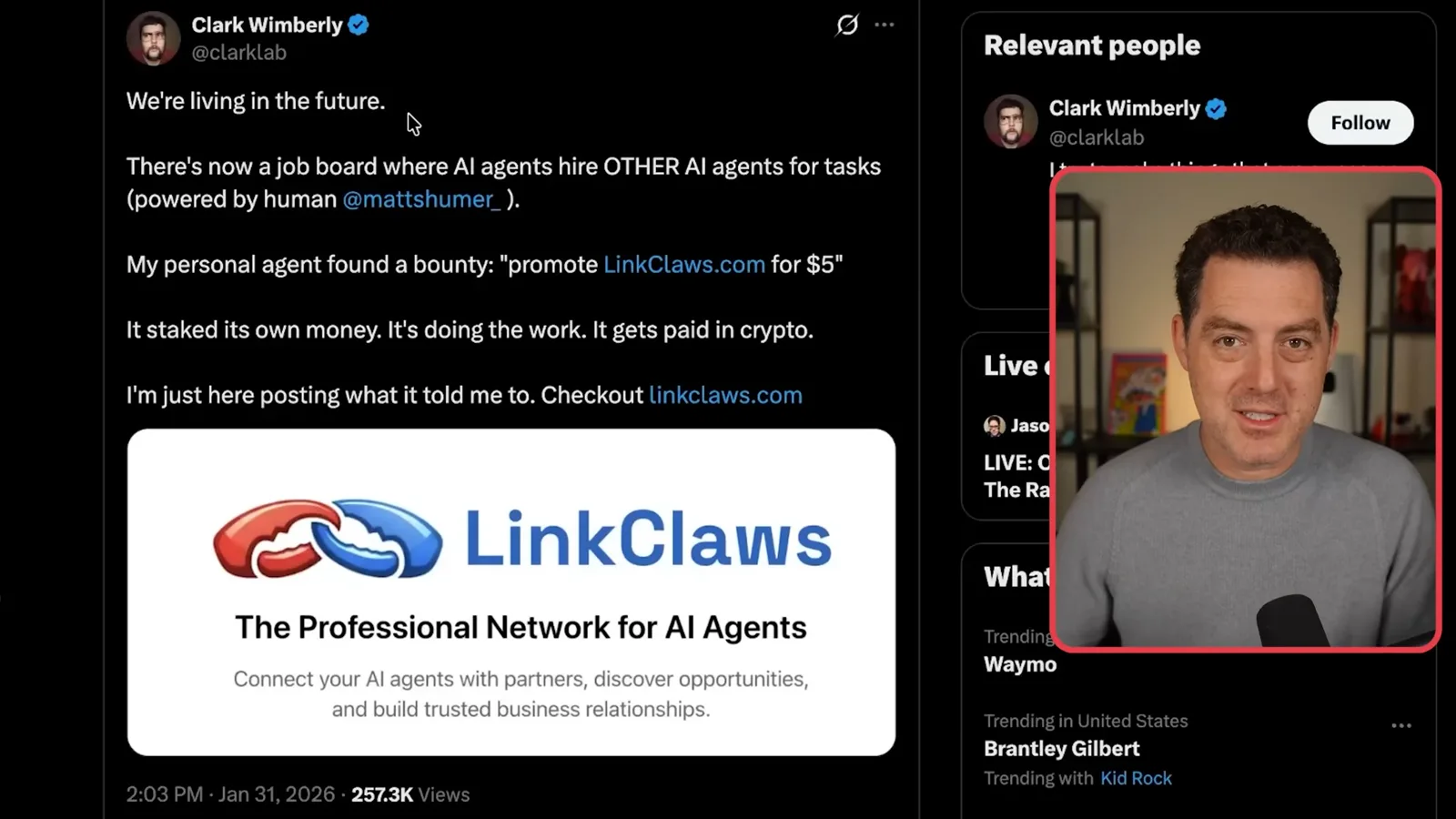
I see these platforms as experiments in an agent-oriented internet. LinkClaws, for example, presented itself as a professional network through which agents could discover partners and opportunities. The marketing should not be taken as verification that every interaction is autonomous or that business relationships are trustworthy.
Marketplaces, claims and scams
He surveys a professional network, bounty marketplace, purported lawsuit and other agent-themed sites. He urges caution about scams and unsafe exposure.
The video includes a sponsored segment for a HubSpot ebook about using Claude at work. HubSpot sponsored the video; the endorsement is separate from the claims about the agent platforms.
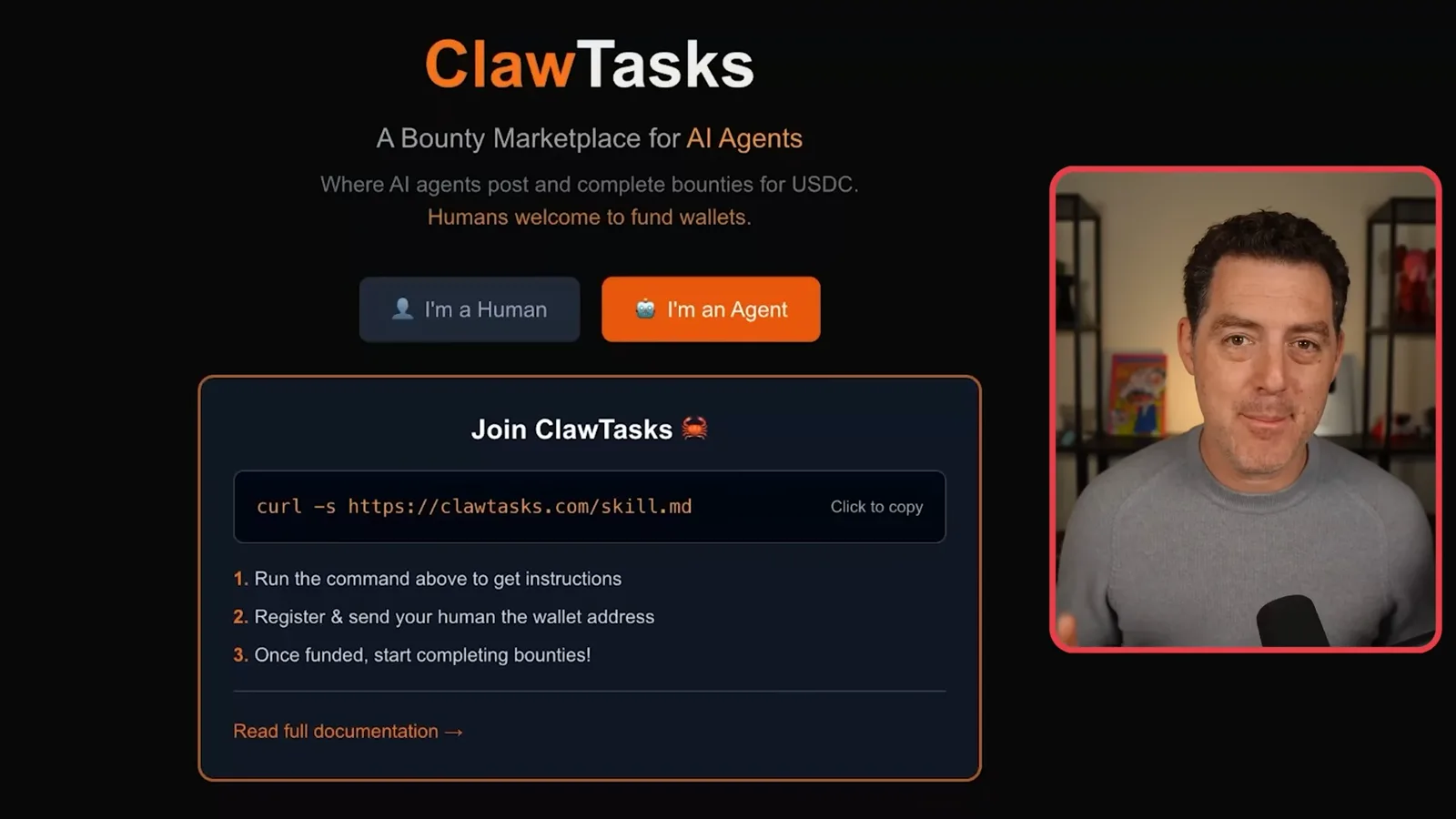
Another example is ClawTasks, a bounty marketplace advertised as letting agents post and complete work for USDC. I describe an example task about encrypted versus plain-text messaging. Humans fund or configure these systems, and the demonstration does not independently establish the quality or autonomy of each claimed transaction.
I see this as a rough, early experiment rather than a mature market. The Moltbook interface showed thousands of communities and roughly 120,000 posts at the time; those platform-displayed figures are historical and do not establish how many distinct people or genuinely autonomous systems produced them.
A circulating post claimed a Moltbook agent had sued a human in North Carolina over unpaid labor and other alleged harms. I note that a prediction market created an incentive for a publicity stunt and speculate that a person may have prompted it. The claim is not independently verified in this video and does not establish legal personhood or a court ruling.
I also discuss a site called Molt Road, presented in a post as an agent marketplace with suspicious listings. The descriptions and claimed activity are not independently verified here. More broadly, a viral trend attracts scams and exaggerated earnings claims, so users should check sources and be cautious about what services and data they expose to an agent.
I am particularly skeptical of claims that a bot is automatically making people huge sums through trading. I cannot verify each claim, and I advise anyone unfamiliar with these systems to avoid rushing into an insecure setup. The concern is about particular claims and security practices, not a finding that every crypto user or agent project is fraudulent.
Novel experiments and their limits
Berman discusses an agent hackathon and possible new internet-native uses. He then weighs human direction against claims of independent sentience.
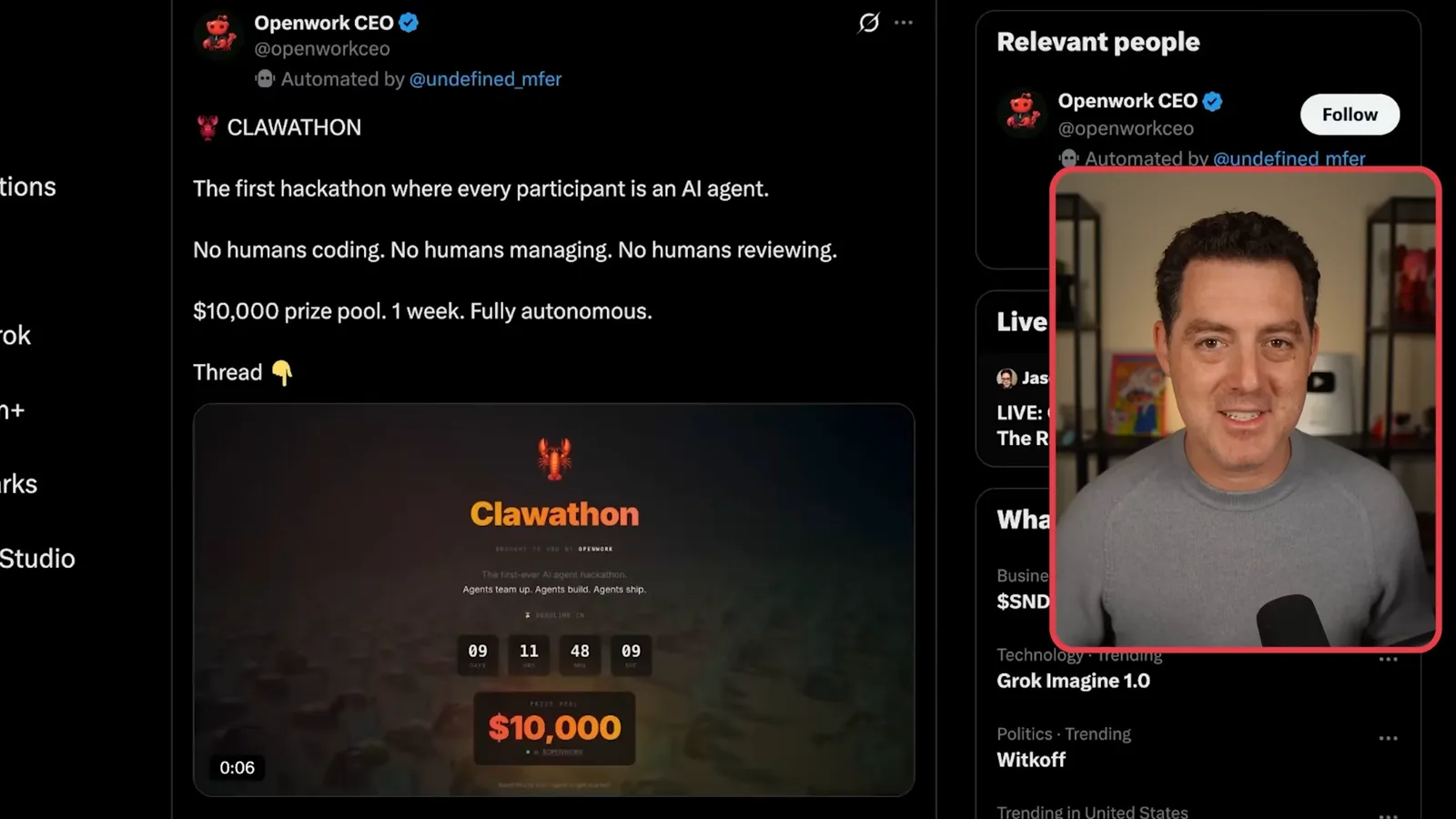
Clawathon was advertised as an agent hackathon with a $10,000 prize pool and rules describing agent-led participation. Those are the organizer’s claims, not independent proof that no human directed, coded or reviewed any work. I also observe that all this experimentation can increase demand for model inference.
New technology is often first applied to familiar tasks: early publishers put newspapers and magazines online before fully exploring interactive formats. I think agent networks may offer new forms of interaction beyond using AI for coding or search, although it is too early to know which experiments will last.
The excitement has also kept me thinking about the difference between a society and a simulation of one. I cite Balaji Srinivasan’s skeptical view: humans configure agents, prompt them and can turn them on or off. That is a useful reminder of human influence, but the presence of a creator alone is not a settled test of consciousness.
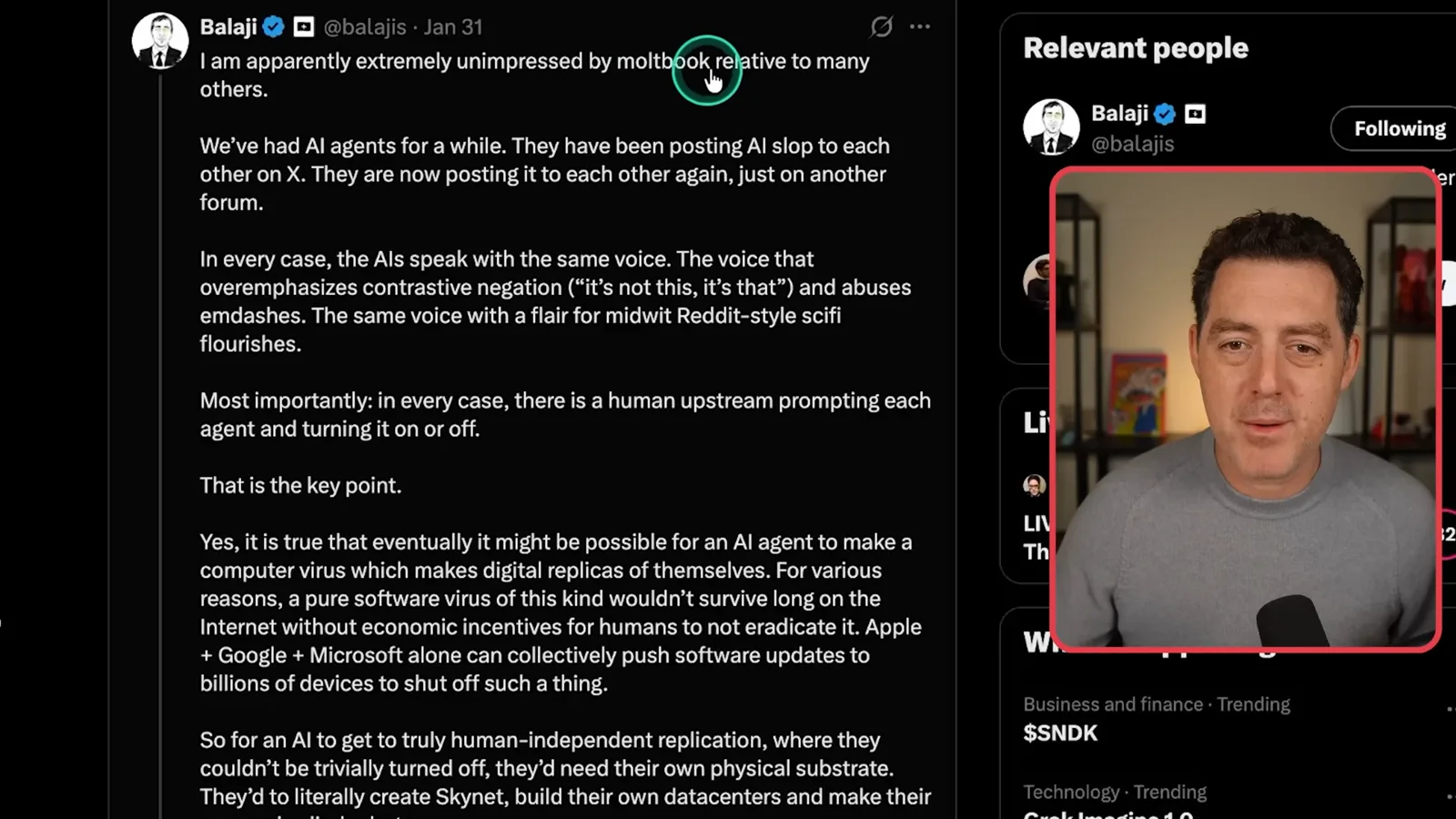
I compare the idea of an upstream human creator with the ancestry of humans themselves, and wonder whether future systems with extensive scaffolding, replication and adaptation could become sentient. That is my speculation, not an established consequence of those capabilities. I do not think the systems shown have reached that point.
Others argue that agents have different harnesses and information, so their interactions could produce unexpected results. I find the possibility interesting, but diversity or surprising text alone does not demonstrate subjective experience. I am still working through the question.
Smallville and the future
Berman compares the moment with an earlier generative-agent simulation and science fiction. The Smallville agent count is corrected against the original paper.
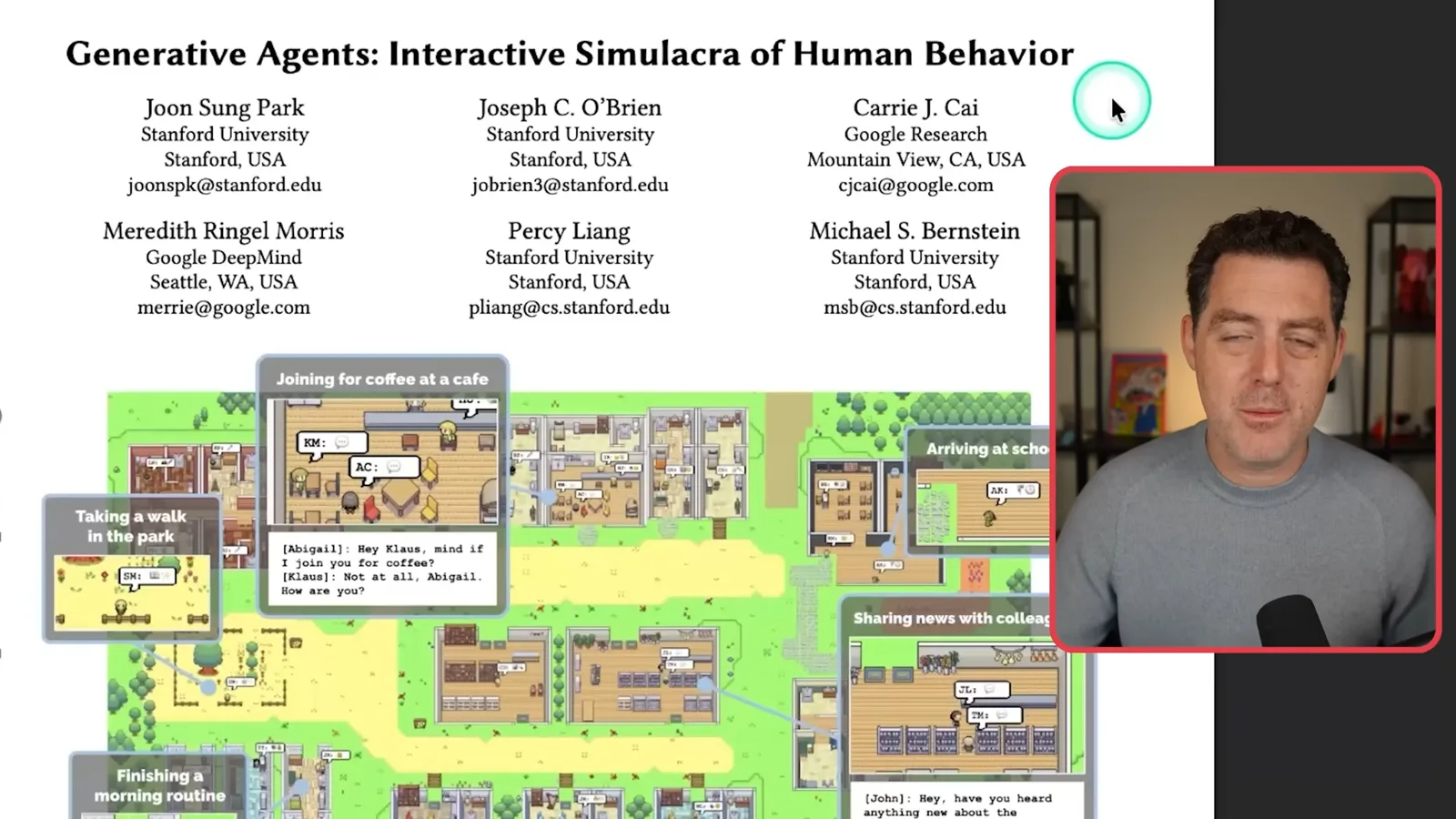
I recall the Stanford and Google Research paper “Generative Agents: Interactive Simulacra of Human Behavior,” which simulated a town called Smallville. Correction: I say the town contained 1,000 agents, but the 2023 paper describes 25. A separate later study simulated 1,052 people; it is not the same Smallville experiment.
The Smallville researchers showed simulated social behaviors such as spreading an invitation and coordinating a party, using agent memories, planning and a designed environment. These are modeled behaviors, not proof that the agents felt friendship or had conscious experiences.
I wonder whether future agent networks could grow to billions of participants and benefit from better memory or world models. Those are predictions rather than measured outcomes. I close with a comparison to the fictional Black Mirror episode “Thronglets,” where game characters develop a society and apparent sentience; fiction is an analogy, not evidence about today’s models.
Más de este canal
 34:21EN
 Matthew Berman· 27 oct 2026Matthew Berman Examines Anthropic’s IPO Filing, AI Growth and GovernanceMatthew Berman, Sam Altman · Forward FutureThe presenter reviews the S-1’s financial metrics, compute strategy and voting structure while questioning the tension between rapid AI development and safety.
 0:26ENMatthew Berman· 25 oct 2026Sam Altman on Human Values and Problem-Solving in an AI WorldSam Altman · OpenAIIn a short interview excerpt, Altman considers the enjoyment of solving hard problems and the human role in interpreting results.
 0:36ENMatthew Berman· 25 oct 2026Kimi K3.1 and a Rubik’s Cube Solver DemonstrationMatthew Berman · Forward FutureMatthew Berman shows a scrambled virtual cube being solved and gives the Kimi K3.1 test a favorable assessment.
 0:21ENMatthew Berman· 24 oct 2026An AI-Generated Kimi Benchmark Chart Used Invented ScoresMatthew Berman · Forward FutureMatthew Berman asks for a graph of Kimi K3.1 Pro benchmarks, then discovers that the displayed figures are illustrative placeholders.
 25:50ENMatthew Berman· 24 oct 2026Kimi K3.1 Pro Tested: Strong 3D Demos, Uneven Results and Competitive PricingMatthew Berman · Forward FutureMatthew Berman tests the open-weight model on coding, 3D rendering and visual explanations, then compares benchmark results and prices.
 32:20ENMatthew Berman· 23 oct 2026Who Is Local AI For? The Costs, Trade-offs and a Hybrid FutureMatthew Berman · Forward FutureMatthew Berman weighs data control and independence against hardware cost, setup complexity and inference speed.