En 30 segundos
Matthew Berman demonstrates an early integration of MemGPT and AutoGen using a Conda environment, Python packages and a GPT-4 configuration. He walks through the interface, memory manager and agent definitions, then runs a short conversation. MemGPT’s external memory can extend available context, but it does not make a model’s context window literally unlimited or guarantee perfect recall; the demonstrated in-memory manager also should not be assumed to persist across restarts.
- 1A historical setupBerman copies example code, creates a Conda environment and installs the then-current packages.
- 2Connecting the systemsHe configures GPT-4, an AutoGen proxy, the MemGPT interface and a state manager.
- 3A group of agentsThe example wraps a MemGPT coder and pairs it with a standard product-manager assistant.
- 4A short test runThe agents exchange an initial message and product ideas; the tutorial stops before a longer task or memory test.
Conclusiones
- The 2023 walkthrough connects a MemGPT-backed coder to an AutoGen group chat with a user proxy and product-manager agent.
- MemGPT manages information across memory tiers; the underlying model still has a finite context window and retrieval can fail.
- The shown configuration uses an in-memory state manager, so persistence across restarts is not demonstrated.
- Berman runs a brief conversation and stops at feedback; the clip does not test long-term memory or establish reliable autonomous coding.
- Package names, APIs and model availability are historical and may have changed.
Lee el texto editado por capítulos
Preparing the environment
Berman introduces the integration and sets up a Conda environment and Python packages. The example is from 2023 and may not work unchanged with later versions.
In this October 2023 tutorial, I show an early integration that uses MemGPT to power an AutoGen agent. Both projects were evolving quickly, so the demonstration may involve bugs and the exact APIs and installation steps should be understood as historical.
I start with example code provided by the MemGPT authors and make minor edits. I create an app.py file in Visual Studio Code and note that an OpenAI API key is needed for this example. I say the key displayed in the video will be revoked; credentials should be kept out of shared source files.
I create and activate a Conda environment using Python 3.11 and select its interpreter in the editor. To avoid installing packages into the wrong environment, I invoke that environment’s Python executable with its pip module and install the then-current MemGPT and AutoGen packages.
When the first install command fails because I omitted a leading slash in the interpreter path, I correct the path and retry. This illustrates why checking the selected interpreter and installation target matters. Package names and compatibility may have changed since the recording.
Configuring agents and memory
He walks through model configuration, the MemGPT interface and state manager. He creates a MemGPT coder and a standard product manager.
The code imports AutoGen and MemGPT components, configures GPT-4 and creates an AutoGen user proxy. I mention that another model might be possible but do not demonstrate one. A MemGPT interface connects the two systems, while a state manager handles information used by the agent.
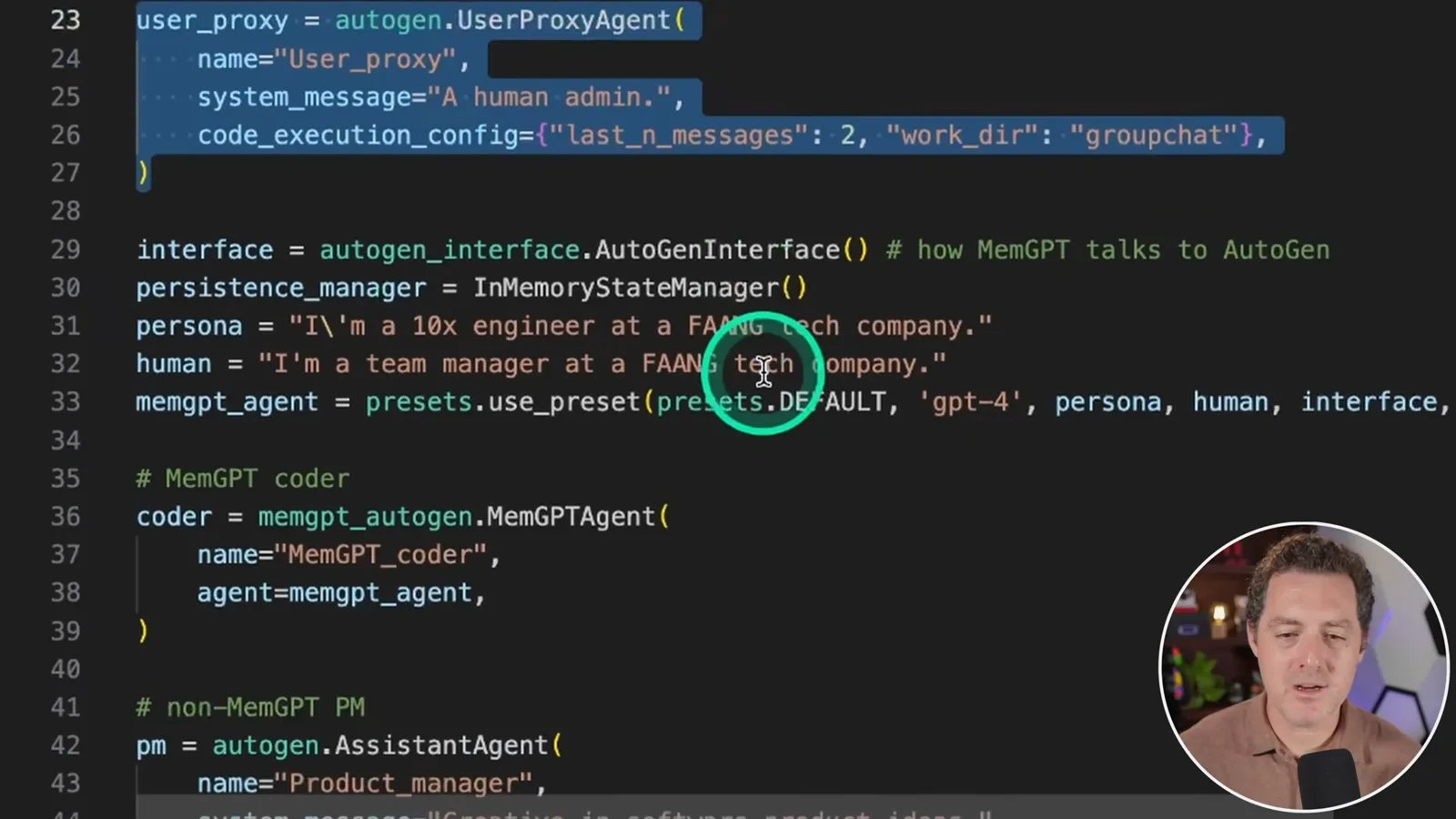
The example constructs an in-memory state manager, defines persona and user context, and passes them into a MemGPT preset. The in-memory choice does not demonstrate storage across restarts. More broadly, MemGPT manages information across memory tiers to extend usable context; the model’s actual context window remains finite and recall is not guaranteed.
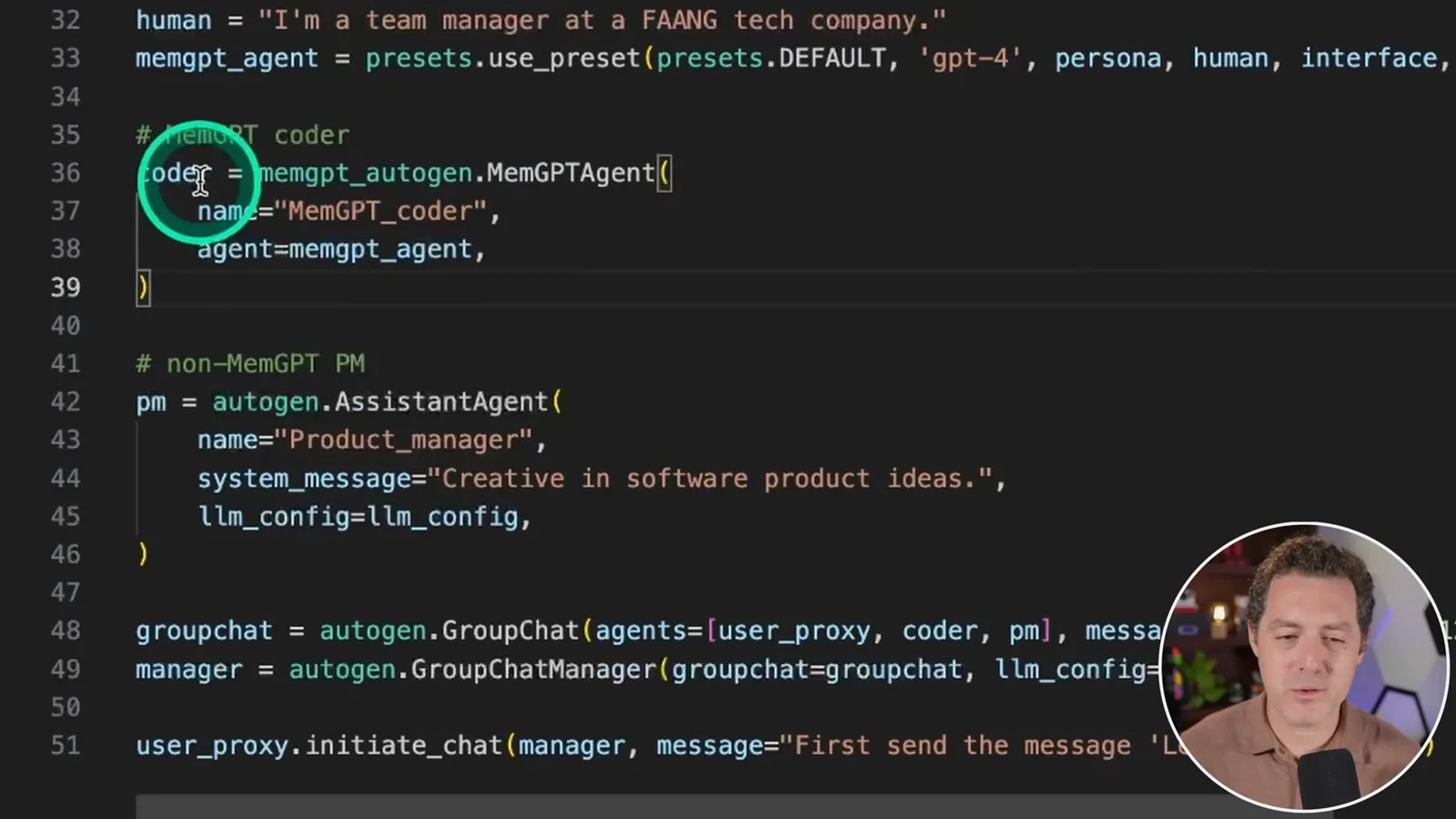
I wrap that MemGPT agent as a coding participant in AutoGen and create a separate ordinary assistant as product manager. A group-chat manager coordinates the user proxy, coder and product manager, and the proxy begins with an instruction to send a short message.
Running the group chat
The demo sends an initial message and receives product ideas. It shows an integration working for a short exchange, not unlimited or persistent memory.
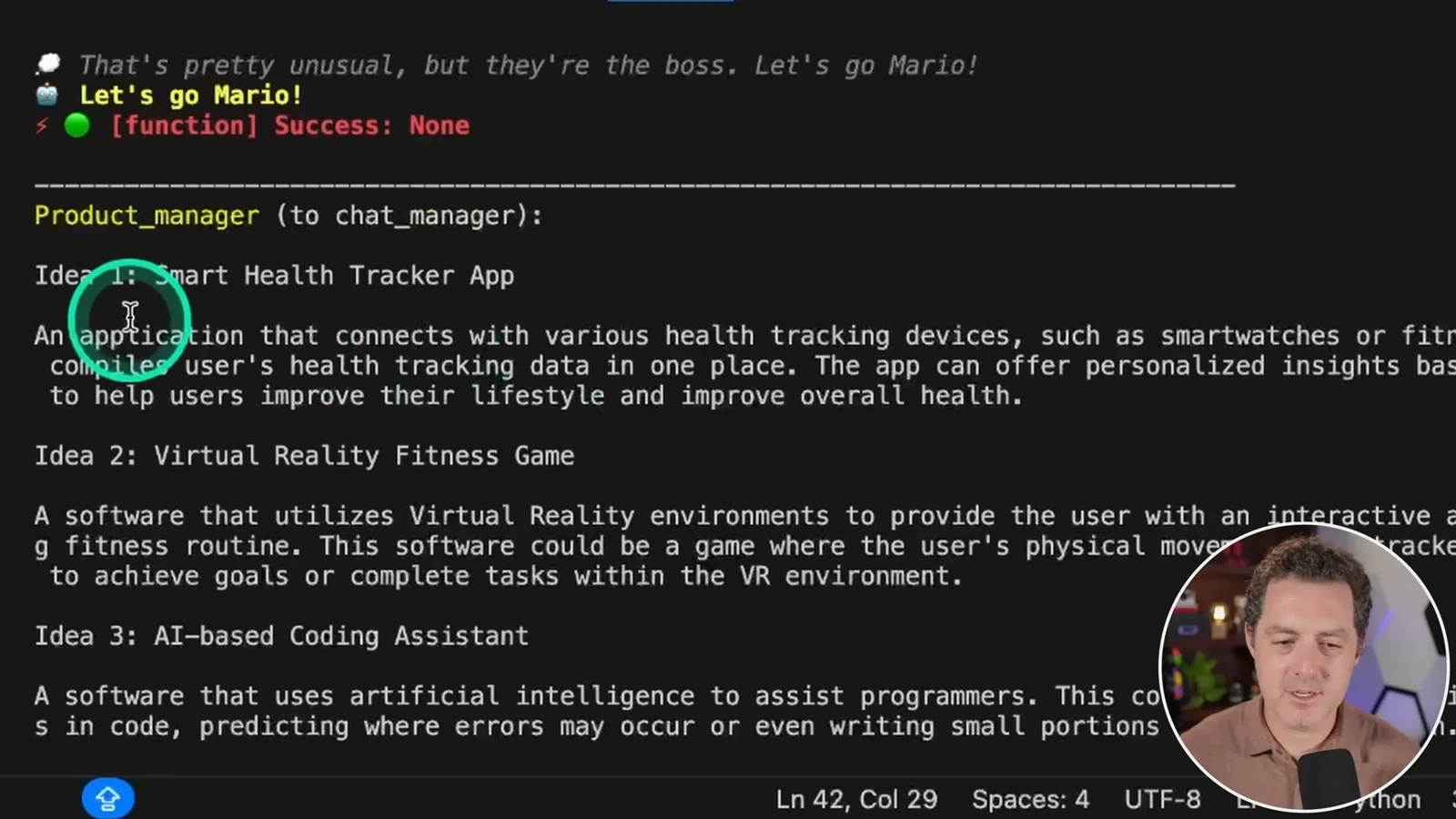
Running the script shows the MemGPT coder producing the requested message, including a displayed internal dialogue and a function result. The product-manager agent then proposes several application ideas and asks for feedback. I stop there, so this is a short integration demonstration, not a test of long-term recall or complete autonomous software development.
Más de este canal
 34:21EN
 Matthew Berman· 27 oct 2026Matthew Berman Examines Anthropic’s IPO Filing, AI Growth and GovernanceMatthew Berman, Sam Altman · Forward FutureThe presenter reviews the S-1’s financial metrics, compute strategy and voting structure while questioning the tension between rapid AI development and safety.
 0:26ENMatthew Berman· 25 oct 2026Sam Altman on Human Values and Problem-Solving in an AI WorldSam Altman · OpenAIIn a short interview excerpt, Altman considers the enjoyment of solving hard problems and the human role in interpreting results.
 0:36ENMatthew Berman· 25 oct 2026Kimi K3.1 and a Rubik’s Cube Solver DemonstrationMatthew Berman · Forward FutureMatthew Berman shows a scrambled virtual cube being solved and gives the Kimi K3.1 test a favorable assessment.
 0:21ENMatthew Berman· 24 oct 2026An AI-Generated Kimi Benchmark Chart Used Invented ScoresMatthew Berman · Forward FutureMatthew Berman asks for a graph of Kimi K3.1 Pro benchmarks, then discovers that the displayed figures are illustrative placeholders.
 25:50ENMatthew Berman· 24 oct 2026Kimi K3.1 Pro Tested: Strong 3D Demos, Uneven Results and Competitive PricingMatthew Berman · Forward FutureMatthew Berman tests the open-weight model on coding, 3D rendering and visual explanations, then compares benchmark results and prices.
 32:20ENMatthew Berman· 23 oct 2026Who Is Local AI For? The Costs, Trade-offs and a Hybrid FutureMatthew Berman · Forward FutureMatthew Berman weighs data control and independence against hardware cost, setup complexity and inference speed.