En 30 segundos
Matthew Berman speaks with Ramp chief economist Ara Kharazian about business AI spending, subscriptions, APIs and the changing competition among OpenAI, Anthropic and Google. They also debate model pricing, switching costs, open-weight models and the future of AI software. The discussion uses a 2026 snapshot of Ramp's business customers; paid adoption is not the same as vendor revenue, total usage or a representative measure of the whole economy.
- 1A window into business purchasesRamp's data comes from its own corporate customers and should be read as a selected sample of business transactions, not a census of AI usage.
- 2APIs dominate observed spendingKharazian says roughly four-fifths of the AI spending he discusses is via APIs; that is a dollar split, not a count of users or tasks.
- 3Adoption is not revenueThe chart compares the share of Ramp customers paying providers. It does not show the firms' total revenue, and customers can pay more than one provider.
- 4Bundled use can be invisibleFree, bundled or indirectly purchased services may not appear as separate payments, complicating comparisons across providers.
- 5Switching has practical costsBusinesses must consider evaluation, integration, security and contracts in addition to model prices.
- 6The local-model debateKharazian and Berman disagree about future open-weight and local model performance; their predictions are not established by the payment data.
Conclusiones
- Ramp's corporate transactions offer a timely view of purchases but do not capture all AI use or represent every business.
- API spending and subscription adoption answer different questions, and dollars spent do not reveal the number of model calls.
- Anthropic gained paid adoption in Ramp's customer base, but the chart shown does not establish total revenue rankings.
- Free, bundled and indirect access can make a provider's usage difficult to observe in direct payments.
- Model choice depends on quality, error costs, integration and switching expenses as well as price.
- Forecasts about adoption and local model performance are the speakers' opinions, not conclusions established by the transaction data.
Lee el texto editado por capítulos
Voice AI and verifying model output
Berman and Kharazian discuss voice experiences and why AI-generated analysis requires checks.
Berman opens with a question about voice models: are increasingly natural conversations necessarily good conversations? He finds some voice assistants overly agreeable. The issue is not just how human a voice sounds, but whether the system will challenge an assumption when that is useful.
Kharazian says the application determines the architecture. A real-time speech model may be attractive when conversational latency matters, while a pipeline that converts speech to text, uses a language model, and converts the answer back to speech can be more practical for other tasks. Customer service is one example where a short delay and a reliable answer may be preferable to an impressive demo.
The two also discuss using AI to write analysis code. Kharazian warns that statistical work needs checks: a plausible-looking script or result can contain a mistake that changes the conclusion. Domain knowledge and verification remain necessary even when the model makes it much easier to produce a first draft.
What Ramp's transaction data can show
Kharazian explains the business spending index, its sample and its limits. The speakers distinguish adoption from evidence of productivity.
Ramp's economist introduces the evidence behind its AI index. Ramp handles corporate spending and sees transactions from tens of thousands of businesses. Those payments, receipts and invoices provide a window into which vendors companies pay and, in some cases, the models they buy through APIs.
That window has boundaries. Ramp's customers are businesses, not a representative sample of all consumers or all firms, and they may be more comfortable adopting technology than the average company. A payment to a vendor shows purchasing activity; it does not reveal every employee's use, the quality of the resulting work, or all use obtained without a direct payment.
Kharazian describes an index built from observable transactions as a useful complement to surveys. A survey asks what companies say they plan to do; expenditures show a commitment of money. The index can move quickly enough to capture changes in adoption before they appear in slower economic statistics.
The conversation turns to whether AI is already producing an economic boom. Kharazian treats the pace of company adoption as an early signal worth watching, not proof that a measured increase in productivity or GDP has already resulted. Spending can precede any gains, and the relationship needs to be tested over time.
Berman asks whether the companies paying for AI are experimenting or making it central to operations. Kharazian distinguishes businesses paying for a subscription from those spending through an API. The latter can embed model calls in products and internal systems, so the payment can reflect repeated production use rather than a single individual's seat.
Even rapid growth starts from a small base. Kharazian says AI accounts for less than 1% of non-payroll spending in the businesses he discusses. That figure describes his measured cohort and definition of spending; it should not be taken as the share of every firm's budget or of the wider economy.
API spending, subscriptions and model choice
The conversation examines the split between API and subscription purchases, premium models and the possibility of routing work to cheaper systems.
The distinction matters for the room available to grow. Companies may dramatically increase model use while the direct bill remains small beside salaries and other operating costs. That makes aggregate growth rates impressive without necessarily making AI a company's largest expense.
Kharazian says roughly four-fifths of AI spending in the data he describes flows through APIs, with the remainder through subscriptions. This is a split of observed spending, not a count of users or an estimate for all AI activity. API purchases can support many kinds of services, including features built into another company's product.
Berman asks how much of that API activity is coding. Kharazian cautions against equating an API transaction with a coding assistant: businesses use models behind products and workflows as well as for software development. The payment data shows what is purchased more readily than the exact task behind each call.
Their discussion of subscriptions is different. Coding products and premium plans can be conspicuous in the direct subscription data, while other AI features may be bundled into a software bill. An analyst looking only at one payment category can miss activity purchased through another.
Within model APIs, Kharazian says more capable, higher-priced models have attracted a large share of spending. A dollar-weighted chart will naturally give more weight to expensive calls; it is not the same as a chart of requests, tokens, or distinct users.
Berman raises the possibility of routing work to cheaper models. A company could reserve an expensive model for the hardest tasks and use a smaller one where it performs well enough. Kharazian agrees that the economics may change as companies learn to match model quality and price to the job.
The question is not simply whether a cheaper model exists. Teams must evaluate whether it produces acceptable answers in their particular workflow, including the cost of mistakes, delays and additional review. A low per-call price is only one input into the total value of a deployment.
The speakers discuss whether enterprises are actually optimizing in this way yet. Kharazian's reading of the spending is that businesses have been willing to pay for the strongest available systems. The evidence describes purchases during this period; it does not establish that every application needs the most expensive model.
Berman asks about the gap between AI enthusiasm online and adoption in ordinary businesses. Kharazian says the data captures a distribution: some firms spend heavily, while others are only beginning or have no observed direct AI purchase. The behavior of early adopters should not be mistaken for a universal experience.
The index is useful precisely because it lets the reader track changes across that distribution. But, Kharazian notes, firms can use several vendors at once, and different measures answer different questions: the proportion buying a service, the amount spent, and the activity inside a product are not interchangeable.
Anthropic and OpenAI in the adoption data
The speakers interpret a chart of paying Ramp customers and discuss Anthropic's rise. The chart measures customer penetration rather than total revenue.
The conversation moves to the competition between OpenAI and Anthropic. Berman brings up a Wall Street Journal chart based on Ramp's data, and Kharazian describes how the pattern of business payments changed as Claude products gained traction.
The chart shown in the video compares the proportion of Ramp's customers paying for AI services and individual providers. It is an adoption measure for that customer base, not a ranking of the companies' total revenue. A business can pay more than one provider, so the vendor lines need not sum to the overall share.
OpenAI had a substantial early lead in the observed customer base. Anthropic's paid adoption then rose sharply, narrowing that gap. Kharazian points to product improvements and business demand as possible reasons, while emphasizing that the data itself records payments rather than the motives of every buyer.
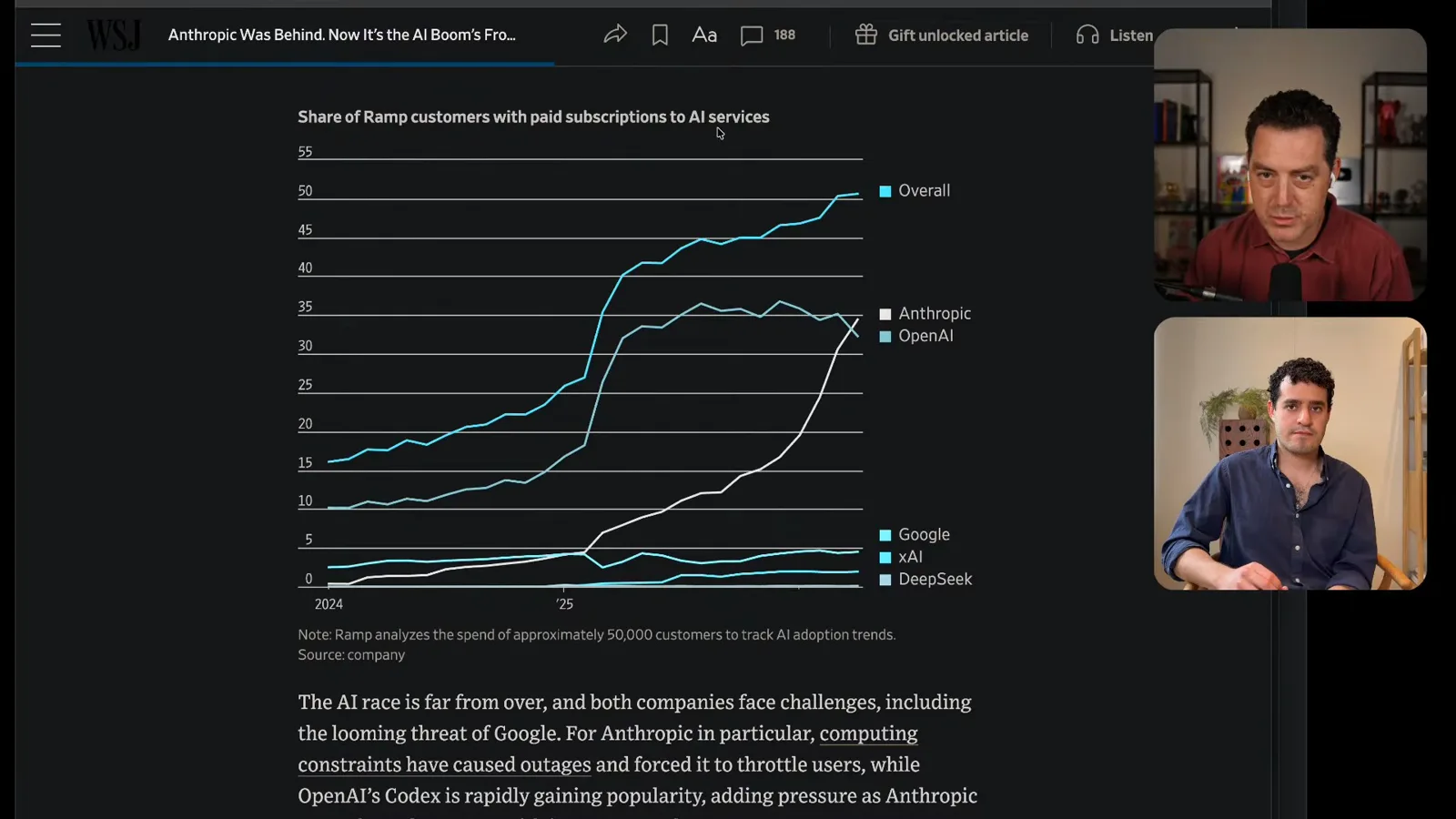
The speakers look at new adopters as well as all existing customers. A shift in the provider selected by businesses making a first observed purchase can change the overall picture over time, but it is not identical to an existing customer cancelling one service and switching to another.
Claude Code is part of their explanation for Anthropic's momentum among technical users. Kharazian also discusses Cowork as an attempt to reach people outside the terminal. Anthropic introduced Cowork in January 2026; the products serve related but distinct ways of putting Claude to work.
Berman asks how controversies around Anthropic and the US government might affect enterprise demand. Kharazian says the purchasing pattern he sees does not show a broad abandonment of Anthropic. That observation alone cannot establish why individual firms stayed or left, or predict how a government dispute will resolve.
For a company making a purchase, a public controversy is only one consideration. Product performance, employee habits, security requirements and existing contracts may also matter. The guest's interpretation is about business decisions observed in a particular period, rather than a finding about every public or private customer.
The pair then compare OpenAI's and Anthropic's advantages. Both compete to make their models useful in products and professional workflows, but each release can change users' perceptions. Kharazian cautions against turning a snapshot into a permanent verdict on a fast-moving market.
Google, distribution and specialized providers
Bundled and free AI complicate transaction-based comparisons. The speakers consider multiple vendors, niche products and switching costs.
Berman asks where Google appears in the data. Kharazian notes that a direct payment measure has difficulty capturing a model delivered for free, bundled with an existing software agreement, or purchased through another intermediary. Google's true use may therefore be larger than its separately identifiable payments suggest.
The distribution channel matters as much as the model. A company already using a large software suite might receive an AI feature without making a new, easily classified subscription purchase. Conversely, an independent product may show up clearly as its own line on a card statement.
The speakers compare Google's product experience with dedicated coding tools. Kharazian argues that an effective agent experience can be an adoption advantage. His characterization should be read as a product judgment: Google had already introduced its Gemini CLI as an open-source AI agent in June 2025.
Berman notes that enthusiasm on X can give a distorted impression of what most people use. Kharazian agrees that a highly engaged online audience is different from the wider business population. Transaction data provides a second view, though its own customer selection and visibility limitations still apply.
Large organizations may pay for multiple model providers simultaneously. Different teams have different tasks and preferences, and enterprises may test alternatives before standardizing. An increase in one vendor's customer count therefore does not automatically mean an equivalent decrease for another.
The discussion extends to specialized providers. A company focused on legal work or on voice may offer domain-specific products that are more useful to a customer than a general model alone. Kharazian describes a market in which applications and foundation-model providers can coexist.
Berman asks whether model providers can take over these applications as they add features. Kharazian says specialized products can still compete through workflow integration, customer relationships and the details of execution. Whether a particular company will retain that advantage is a commercial question, not something the aggregate payment chart can settle.
The guests also discuss switching costs. Model access can seem interchangeable at the level of an API, but an actual migration can involve prompts, evaluations, integrations, data handling, security reviews and contracts. The cost differs by deployment, so a simple per-token price comparison can miss important work.
For an individual, trying another chatbot can be nearly frictionless. For a business with systems and employees built around a service, moving may require more time and evidence. At the same time, access to several vendors can reduce dependence on any single provider.
Local models and the future of AI software
Berman and Kharazian debate open-weight models, costs and software competition. Kharazian closes with a forecast for business adoption.
Berman raises open-weight and locally run models. Kharazian is skeptical that locally available models will consistently match the leading hosted systems; Berman pushes back that models and hardware continue to improve. Their disagreement concerns future capabilities and cost, not a result established by Ramp's transaction data.
Kharazian suggests that some competing models benefit from outputs produced by leading systems. Berman questions broad claims of this kind. Allegations about training practices require separate evidence, and the conversation does not establish that any particular developer improperly used another model's outputs.
The trade-off includes privacy, control and operating costs as well as raw model quality. A model can be run on a user's own hardware or hosted by another company, and smaller models may be sufficient for constrained tasks even if they lag a leading system on harder work.
On pricing, Kharazian returns to the value of a result. If a stronger model produces meaningfully better work, a business may rationally pay more; if the task is routine and error costs are low, a cheaper model may be the better choice. The relevant comparison is the outcome for a specific workflow.
Berman expects competition and improving models to keep changing that calculation. Kharazian says current spending suggests that many companies still prioritize frontier performance. That is an observation about the customers and period under discussion, not proof that optimized routing will never become common.
The pair consider what happens to software companies as the largest AI labs release more application features. Kharazian argues that companies can still succeed by designing useful products around a model. Distribution, trust, specialized workflows and an existing customer base can matter even when the underlying model is widely available.
Berman and Kharazian discuss examples of software businesses adapting to AI instead of assuming that every incumbent will disappear. A model can make new interfaces possible while a product still needs to solve a customer's whole problem, integrate with existing work and deliver a dependable experience.
The conversation returns to the pace of adoption. Kharazian believes the addressable market remains large because many companies are only starting to buy AI products. The figures he has presented measure observable purchasing; they do not establish how effectively those companies use what they buy.
Asked to look ahead, Kharazian predicts that business adoption will become much more widespread over the next one to three years. That is his forecast, not a result guaranteed by the index. Berman closes the interview by thanking him for explaining what transaction data can and cannot reveal.
After the interview, Berman briefly tells viewers about an upcoming conversation with Google's Sundar Pichai. The livestream ends with that announcement and closing remarks.
Más de este canal
 34:21EN
 Matthew Berman· 27 oct 2026Matthew Berman Examines Anthropic’s IPO Filing, AI Growth and GovernanceMatthew Berman, Sam Altman · Forward FutureThe presenter reviews the S-1’s financial metrics, compute strategy and voting structure while questioning the tension between rapid AI development and safety.
 0:26ENMatthew Berman· 25 oct 2026Sam Altman on Human Values and Problem-Solving in an AI WorldSam Altman · OpenAIIn a short interview excerpt, Altman considers the enjoyment of solving hard problems and the human role in interpreting results.
 0:36ENMatthew Berman· 25 oct 2026Kimi K3.1 and a Rubik’s Cube Solver DemonstrationMatthew Berman · Forward FutureMatthew Berman shows a scrambled virtual cube being solved and gives the Kimi K3.1 test a favorable assessment.
 0:21ENMatthew Berman· 24 oct 2026An AI-Generated Kimi Benchmark Chart Used Invented ScoresMatthew Berman · Forward FutureMatthew Berman asks for a graph of Kimi K3.1 Pro benchmarks, then discovers that the displayed figures are illustrative placeholders.
 25:50ENMatthew Berman· 24 oct 2026Kimi K3.1 Pro Tested: Strong 3D Demos, Uneven Results and Competitive PricingMatthew Berman · Forward FutureMatthew Berman tests the open-weight model on coding, 3D rendering and visual explanations, then compares benchmark results and prices.
 32:20ENMatthew Berman· 23 oct 2026Who Is Local AI For? The Costs, Trade-offs and a Hybrid FutureMatthew Berman · Forward FutureMatthew Berman weighs data control and independence against hardware cost, setup complexity and inference speed.