En 30 segundos
Matthew Berman reviews Anthropic’s reported Opus 4.7 benchmark gains, cybersecurity safeguards, token usage and safety evaluations. He questions why Mythos Preview remained limited while Opus 4.7 was released more broadly, and offers several speculative explanations. The company’s claims and model-specific evaluation results do not establish the models’ parameter counts, consciousness or performance on every real-world task.
- 1A coding benchmark jumpAnthropic’s table reports 64.3% on SWE-bench Pro for Opus 4.7 versus 53.4% for 4.6 and 77.8% for Mythos Preview.
- 2Cyber capability and releaseThe company reports similar cyber capability to Opus 4.6 and says it tested differential reductions and new safeguards.
- 3Prompt migrationAnthropic advises users to review prompts because stronger instruction following can change how earlier instructions are interpreted.
- 4Token usageThe updated tokenizer and increased reasoning at higher effort levels can change token use; Anthropic recommends measuring real workloads.
- 5Safety thresholds and welfareBerman discusses the system card’s risk assessment and model-welfare research, which do not resolve whether AI has subjective experience.
Conclusiones
- Anthropic reports improvements over Opus 4.6 on selected coding, vision and knowledge-work tests, with some results lower or roughly unchanged.
- Mythos Preview was limited to selected defensive cybersecurity partners, while Opus 4.7 was released more broadly with new cyber safeguards.
- Anthropic says it experimented with reducing particular cyber capabilities during Opus 4.7 training; one benchmark difference alone cannot establish the effect of that intervention.
- The updated tokenizer may produce roughly 1.0–1.35 times as many input tokens depending on content, and higher effort can produce more output tokens.
- The system card’s automated R&D threshold and behavioral evaluations have specific definitions; they do not prove a model is conscious or generally safe.
- Berman’s estimates of parameter counts, internal deployment motives and supervision architecture are speculation rather than confirmed specifications.
Lee el texto editado por capítulos
Opus 4.7 and Mythos Preview
Berman compares reported coding and cybersecurity scores and asks why the two releases received different access. He speculates about training and model size without confirmed parameter counts.
In April 2026, Anthropic released Claude Opus 4.7, a new version of a model family I use frequently. I am struck by the reported improvement over 4.6 and by its proximity on some tests to Mythos Preview, which Anthropic had restricted to a limited set of defensive cybersecurity partners. I want to understand how the company drew that deployment distinction.
I speculate about whether model size, training runs or future versions influenced the decision. The video repeats a rumor that Mythos has ten trillion parameters and guesses a smaller size for Opus; neither figure is established by the cited materials. My proposed explanations of Anthropic’s motives are hypotheses, not confirmed internal facts.
Anthropic’s table reports SWE-bench Pro scores of 53.4% for Opus 4.6, 64.3% for 4.7 and 77.8% for Mythos Preview. On SWE-bench Verified, the displayed scores are 80.8%, 87.6% and 93.9%. These are substantial differences on those evaluations, but benchmark setups and real coding workflows can differ.
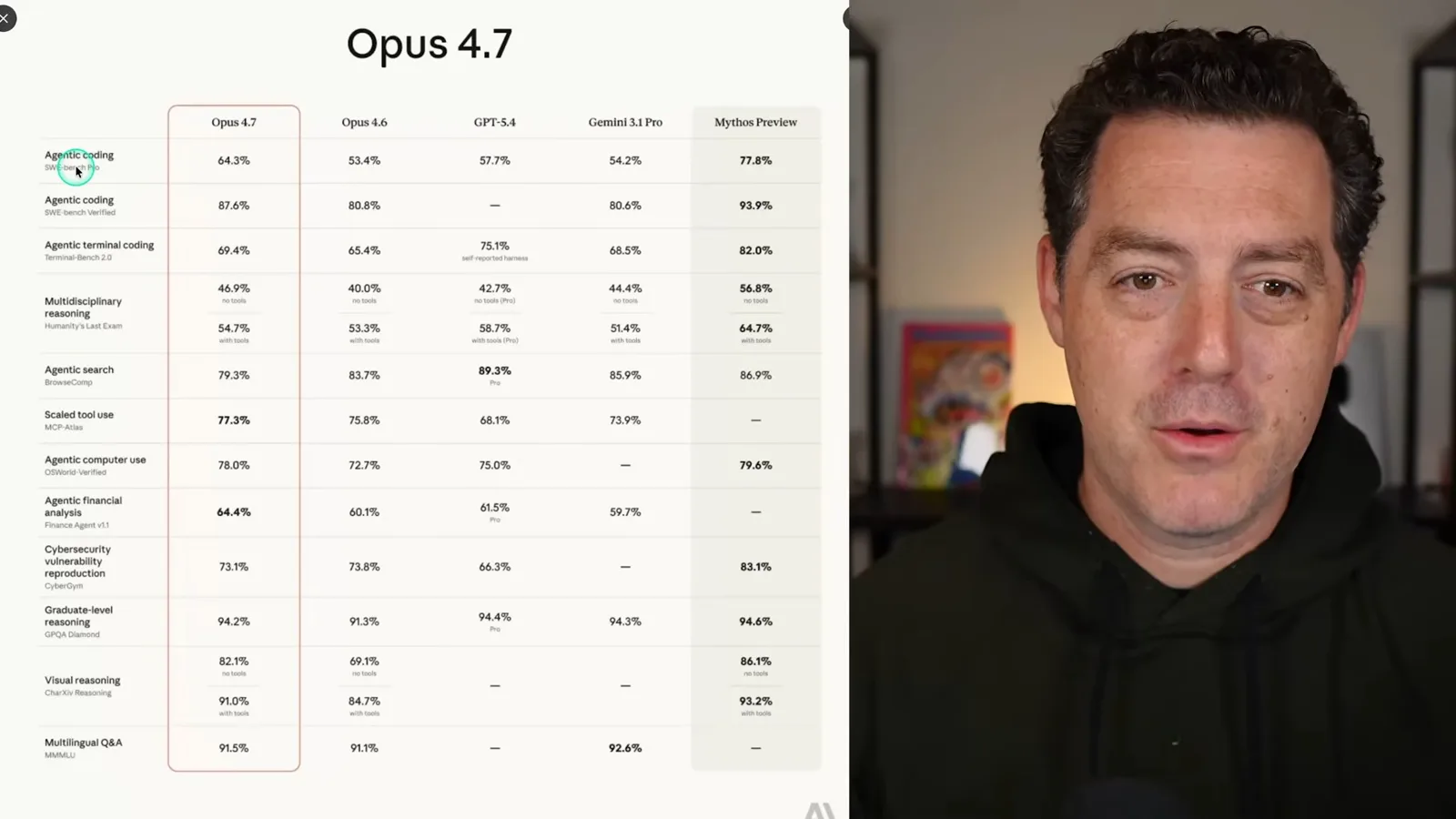
I interpret the emphasis on coding as part of a business and research feedback loop: useful coding tools can attract enterprise demand and help teams build future systems. That is my strategic interpretation, not proof of a fully autonomous self-improvement loop. I also wonder whether the limited Mythos announcement has marketing effects, but I have no evidence that this was the reason for the decision.
The displayed results show a roughly seven-point gain on Humanity’s Last Exam without tools and a smaller gain with tools, while agentic search drops from 83.7% to 79.3%. On the displayed computer-use test Opus 4.7 reaches 78%, compared with Mythos Preview’s 79.6%. Improvements are uneven across tasks rather than a uniform increase everywhere.
The CyberGym vulnerability-reproduction scores shown are 73.8% for Opus 4.6, 73.1% for 4.7 and 83.1% for Mythos Preview. I ask whether Anthropic intentionally reduced cyber capability. The company says it experimented with differential reductions during training, but a small difference on one test cannot isolate the cause or measure all cyber abilities; Anthropic characterizes 4.7 as roughly similar to 4.6 in its cyber evaluations.
I conjecture that Mythos is a new, much larger training run and that future iterations could improve further. Those model sizes and the details of its training are not confirmed in the video. Anthropic’s stated distinction concerns its evaluations and safeguards, not a publicly specified parameter threshold.
Safeguards and practical use
Anthropic describes cyber safeguards and efforts to reduce specific capabilities. Berman considers prompting, multimodal work and memory.
Anthropic describes Opus 4.7 as stronger on difficult software-engineering tasks and says it follows instructions carefully and checks work. It also reports gains in vision and professional outputs such as interfaces, slides and documents. I like Opus for front-end work, but that is my experience and preference rather than a controlled comparison.
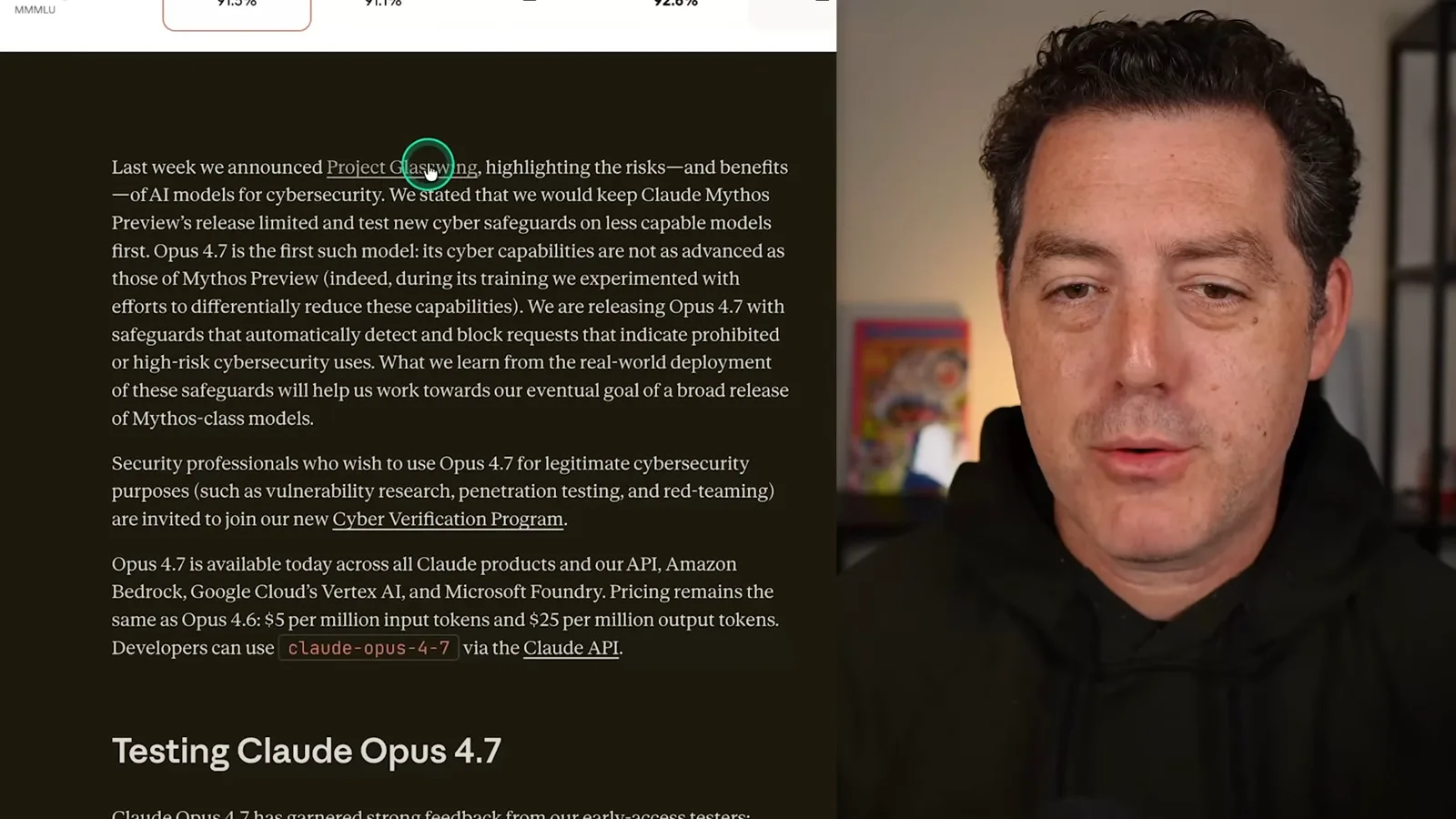
The company says it limited Mythos Preview under Project Glasswing while testing new cybersecurity safeguards on a less capable model first. It says Opus 4.7 includes safeguards intended to detect and block prohibited or high-risk cyber requests, and that deployment experience will inform future decisions. Legitimate security work can also be affected, so the company describes a verification program.
I speculate that a stronger model might supervise a weaker one to detect harmful activity. The release statement does not establish that Mythos is monitoring Opus in this way, so that remains my conjecture. The broader question is how to test safeguards against misuse while preserving legitimate defensive work.
Anthropic says Opus 4.7 follows instructions more literally, which can make prompts written for older models behave unexpectedly. I recommend reviewing model-specific prompting guidance when changing models and adjusting prompts or agent harnesses based on testing. Greater instruction adherence can be useful, but it also makes precise instructions and evaluation important.
The release also reports better multimodal support, professional work and use of filesystem-based memory over longer tasks. The ability to use stored notes depends on the application and its tools, not simply on a model possessing a universal persistent memory. I then review Anthropic’s prerelease charts for several distinct tasks.
Evaluation results and token costs
He reviews knowledge-work, vision and safety charts, then discusses effort settings and tokenization. The results depend on the evaluated tasks and setups.
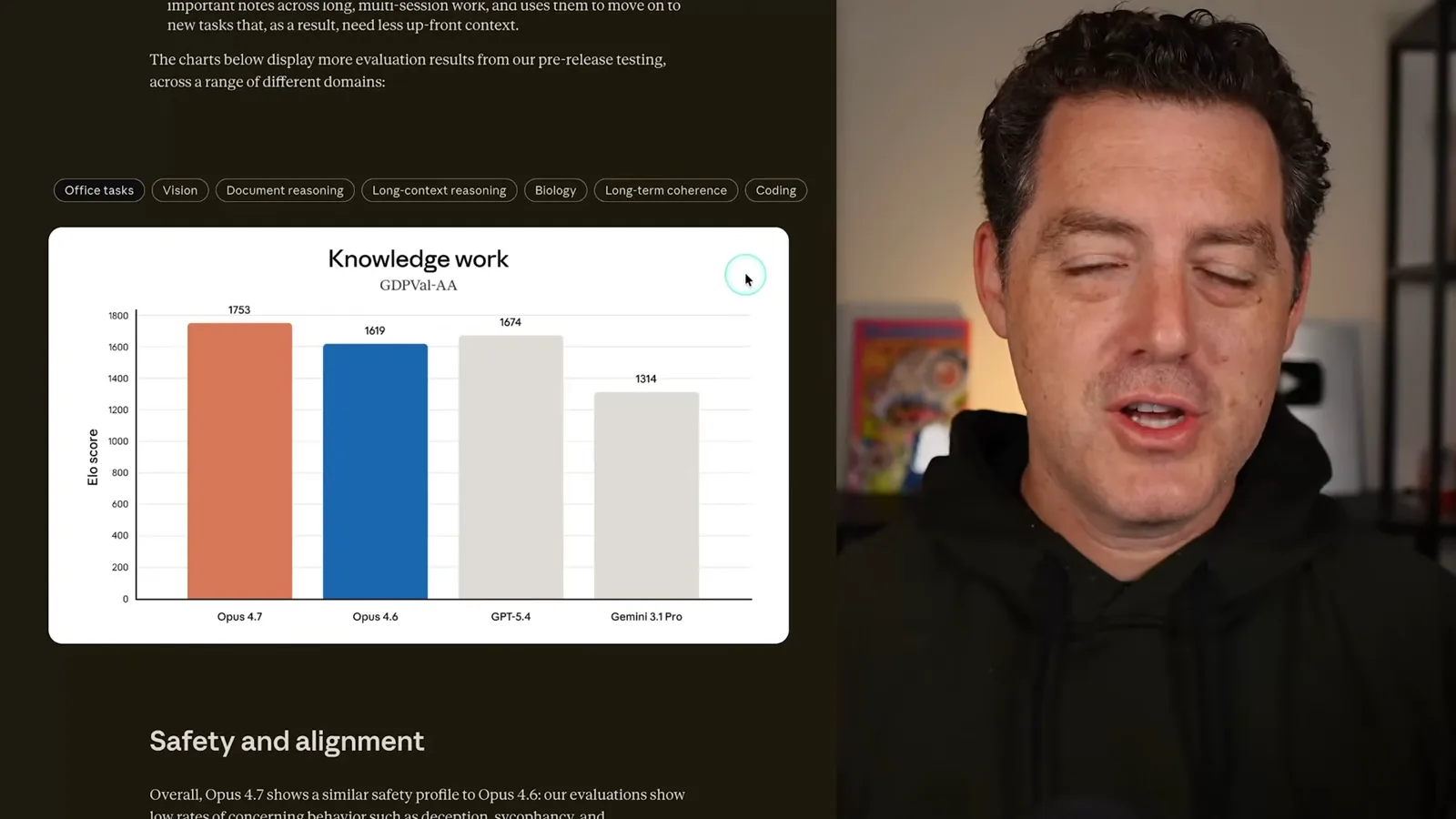
On the displayed GDPVal-AA knowledge-work evaluation, Anthropic reports an Elo score of 1,753 for Opus 4.7, compared with 1,619 for 4.6 and 1,674 for GPT-5.4. Other charts show gains in screenshot navigation, document reasoning, long-context reasoning, biomolecular reasoning and a simulated vending-machine task. These are specific tests and scoring methods; they are not proof of superiority on all professional work.

I notice that Anthropic’s automated behavioral audit gives Mythos Preview a lower misaligned-behavior score than the Opus models, and ask why the stronger model remained limited. The company’s release decision also considers capability and misuse risk; a score from one alignment evaluation does not establish overall safety or make the two deployment decisions interchangeable.
Opus 4.7 adds an extra-high effort setting between high and max and a Claude Code review command. These options let users choose different tradeoffs between effort, latency and output. The usefulness and cost of a setting should be measured on the actual task rather than assumed from its name.
I suggest that compute constraints may also have influenced the limited release of Mythos, citing user quotas and access changes. That is speculation; the public explanation emphasizes cybersecurity risk and safeguards. Capacity and pricing can change, and the video does not establish Anthropic’s internal serving constraints or financial position.

Anthropic says its updated tokenizer can map the same input to roughly 1.0–1.35 times as many tokens depending on the content, and that higher effort can produce more output tokens in agentic settings. It also reports improved overall token usage on an internal coding evaluation and recommends measuring real traffic. A higher input token count alone does not determine total task cost or efficiency.
System card and model welfare
Berman questions the automated R&D assessment and discusses model-welfare research. He closes with plans for further testing.
The system card says Opus 4.7 does not advance Anthropic’s capability frontier relative to Mythos Preview on the relevant evaluations. I reduce this to a possible release ‘bar,’ but the actual assessment includes multiple risks and mitigations, not simply one numerical benchmark threshold.
The card says its automated AI R&D threat model does not apply to Opus 4.7 under Anthropic’s current assessment. I question the conclusion because AI tools can already assist research and generate data. That assistance is not the same as the card’s defined threshold: fully automating or dramatically accelerating large top-tier research teams in sensitive domains. The 4.7 finding alone does not establish that Mythos crossed that threshold.
I discuss Anthropic’s model-welfare research and its examination of models’ reported circumstances and internal representations. I find precaution worth considering, but those measurements and a model’s statements do not establish subjective experience or consciousness. Describing the work as treating a model as certainly conscious would overstate what the evidence shows.

The card describes one autonomy threat model as applicable and a second, concerning highly accelerated or automated research, as not applicable to Opus 4.7 under its assessment. It also discusses model responses to questions about ending conversations. These are research and deployment evaluations with uncertainty, not a conclusive answer to model welfare.
Opus 4.7 looks promising to me, but I have not completed the practical testing discussed in the video. I plan to try it over the following days and compare its behavior in real workflows rather than relying only on launch charts.
Más de este canal
 34:21EN
 Matthew Berman· 27 oct 2026Matthew Berman Examines Anthropic’s IPO Filing, AI Growth and GovernanceMatthew Berman, Sam Altman · Forward FutureThe presenter reviews the S-1’s financial metrics, compute strategy and voting structure while questioning the tension between rapid AI development and safety.
 0:26ENMatthew Berman· 25 oct 2026Sam Altman on Human Values and Problem-Solving in an AI WorldSam Altman · OpenAIIn a short interview excerpt, Altman considers the enjoyment of solving hard problems and the human role in interpreting results.
 0:36ENMatthew Berman· 25 oct 2026Kimi K3.1 and a Rubik’s Cube Solver DemonstrationMatthew Berman · Forward FutureMatthew Berman shows a scrambled virtual cube being solved and gives the Kimi K3.1 test a favorable assessment.
 0:21ENMatthew Berman· 24 oct 2026An AI-Generated Kimi Benchmark Chart Used Invented ScoresMatthew Berman · Forward FutureMatthew Berman asks for a graph of Kimi K3.1 Pro benchmarks, then discovers that the displayed figures are illustrative placeholders.
 25:50ENMatthew Berman· 24 oct 2026Kimi K3.1 Pro Tested: Strong 3D Demos, Uneven Results and Competitive PricingMatthew Berman · Forward FutureMatthew Berman tests the open-weight model on coding, 3D rendering and visual explanations, then compares benchmark results and prices.
 32:20ENMatthew Berman· 23 oct 2026Who Is Local AI For? The Costs, Trade-offs and a Hybrid FutureMatthew Berman · Forward FutureMatthew Berman weighs data control and independence against hardware cost, setup complexity and inference speed.