En 30 segundos
Matthew Berman discusses Eon’s virtual fruit fly and imagines applications ranging from understanding the brain to human uploading. Eon describes a simplified research prototype that relies on trained body controllers and hand-chosen mappings; the demonstration establishes neither consciousness nor the simulation hypothesis. The video includes a Zapier sponsorship.
- 1A simplified neural modelA connectome and leaky integrate-and-fire model provide the neural component; the cited accuracy figure lacks a verified denominator.
- 2Brain and body in a loopSensory input affects the model, selected outputs influence movement, and body state returns as input.
- 3Controllers and approximationsThe body uses trained movement controllers and hand-chosen mappings, contrary to the video’s suggestion that no training was involved.
- 4Simulation as a thought experimentA virtual fly does not establish that our universe is simulated.
- 5An open question about consciousnessWhether any future emulation would preserve experience or identity is unresolved.
Conclusiones
- Eon links a connectome-constrained neural model to a simulated body in a sensory-motor feedback loop.
- The model uses simplified neurons, pretrained movement controllers and hand-selected mappings; it is not a complete biological replica.
- The quoted 91% behavioral accuracy lacks an established benchmark in the materials reviewed.
- Consciousness, human uploading and the simulation hypothesis remain unproven.
- The viral biological-computing clip is not enough to verify its experimental claims.
Lee el texto editado por capítulos
A connectome-based fly
Berman introduces Eon’s simulated fly and discusses its proposed ingredients. The quoted accuracy figure lacks a clear validated denominator.
A simulated fruit fly has prompted an extraordinary set of questions: what does it mean to reproduce a brain in software, and could that ever extend to people? Eon's demonstration combines a connectome-based neural model with a simulated body. It is a research prototype, not proof that an entire biological fly or its consciousness has been copied.
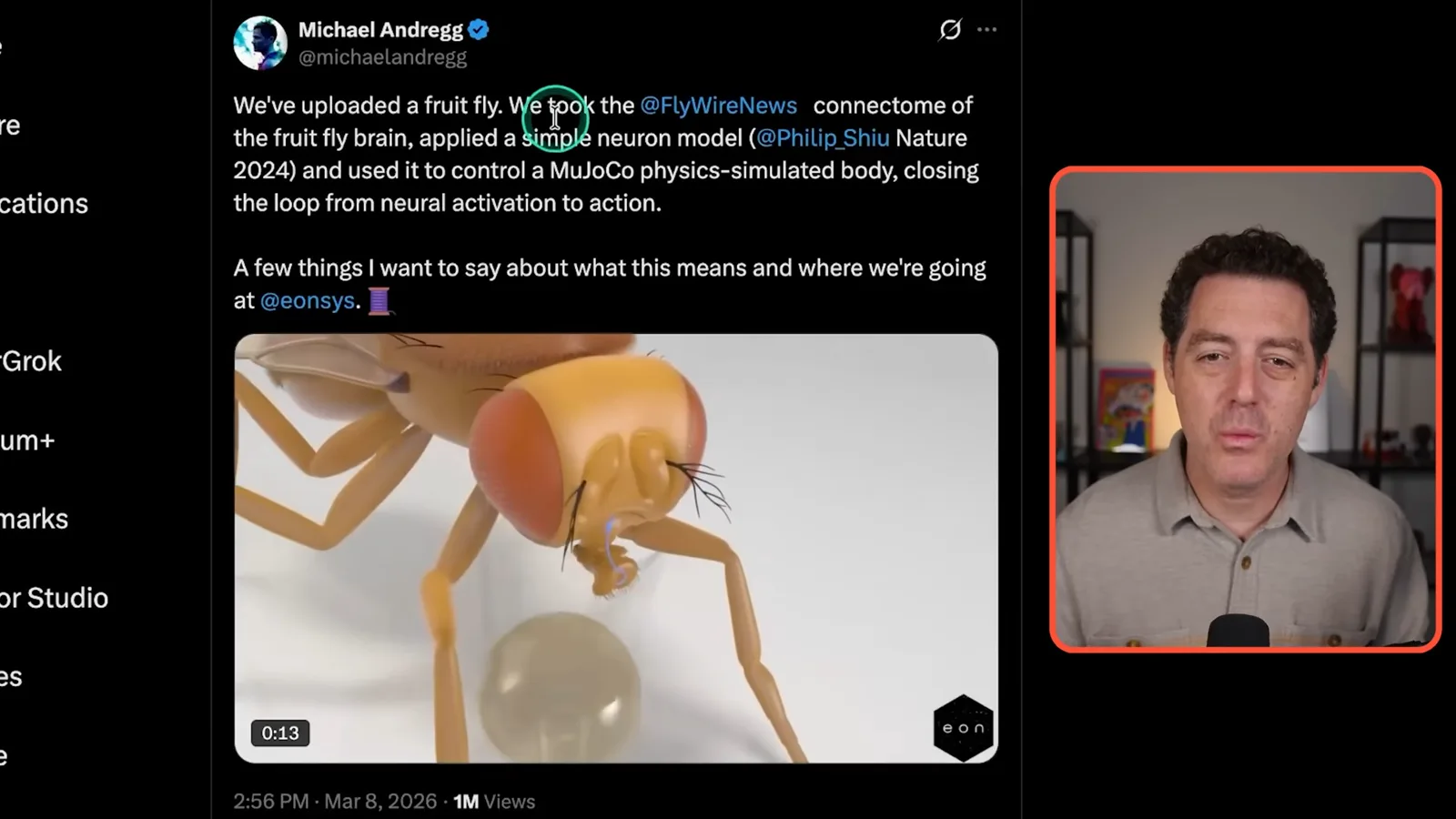
I discuss a post from Eon's Michael Andregg describing a fly brain connectivity map, a simple neural model and a physics-simulated body in a sensory-action loop. He cites 91% behavioral accuracy; the source material reviewed does not establish the benchmark or denominator for that figure, so it should not be treated as a validated measure of overall fly fidelity.
The ingredients highlighted in the video are the connection graph, synapse-count-based weights, inferred excitatory and inhibitory signs, and leaky integrate-and-fire dynamics. A connectome describes wiring, while that neuron model approximates how signals accumulate and trigger activity. It is not a detailed reproduction of all the biological processes in each cell.
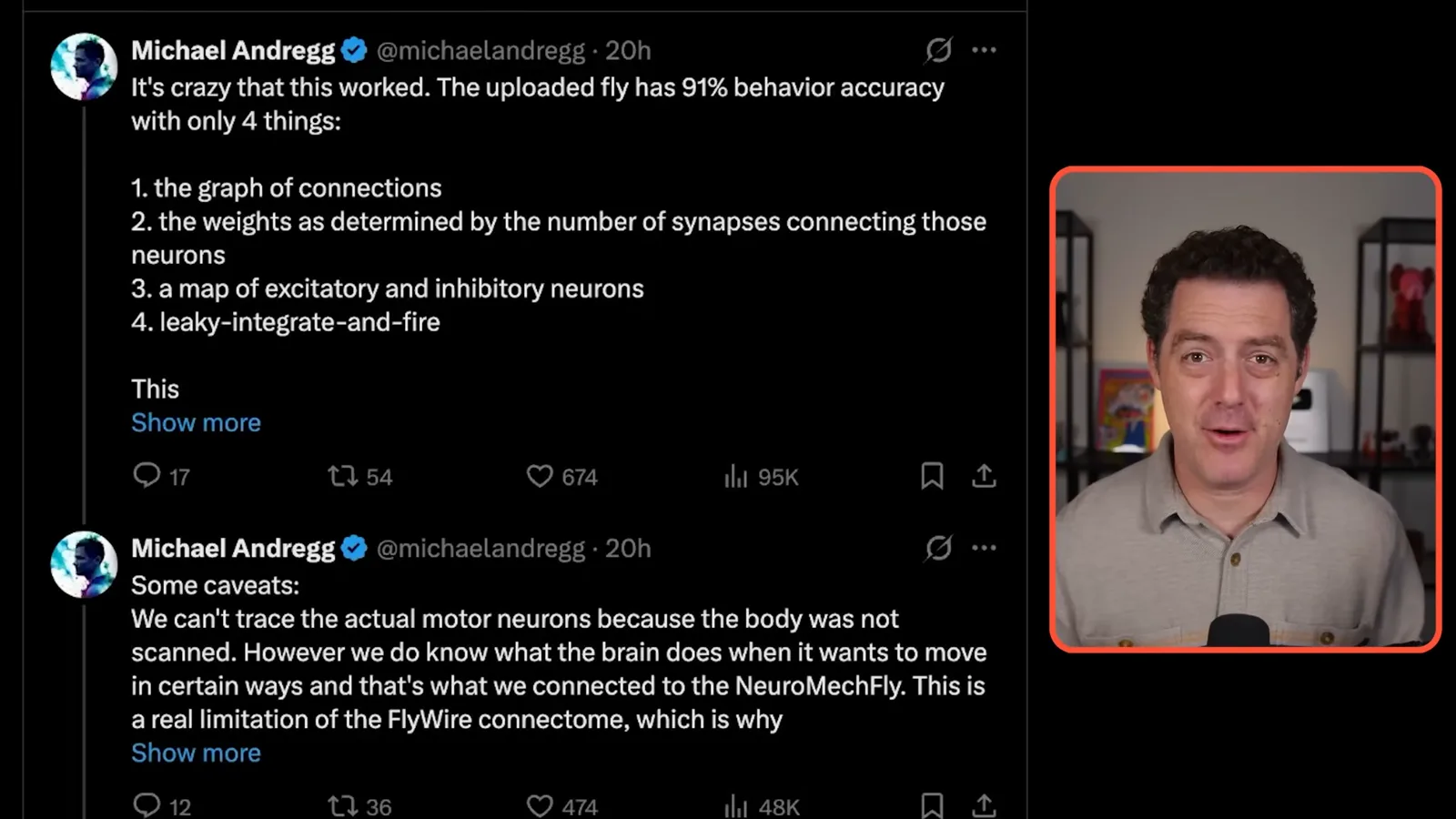
Andregg describes the result as an uploaded animal and says the team takes the possibility of experience seriously. Whether the simulation has subjective experience is unknown. Eon calls 'upload' a matter of degree; this description is an interpretation of a simplified model, not evidence of sentience.
Potential uses and speculation
The video considers neuroscience, intelligence and mind uploading. Claims about identity and accelerated consciousness remain speculative.
The team sees possible long-term uses in understanding the brain and disease, studying intelligence, and ultimately uploading minds. I find these possibilities fascinating: perhaps an emulated brain could run faster or work in parallel with copies. These are speculative possibilities, and neither human brain emulation nor preservation of personal consciousness has been demonstrated here.
The video includes a sponsored segment for Zapier about connecting agents to tools through its MCP service. The product and availability details in that segment are sponsor claims.
How the embodied model works
Eon joins a simplified neural model to a simulated body and a feedback loop. Existing trained controllers and hand-chosen mappings are important parts of the system.
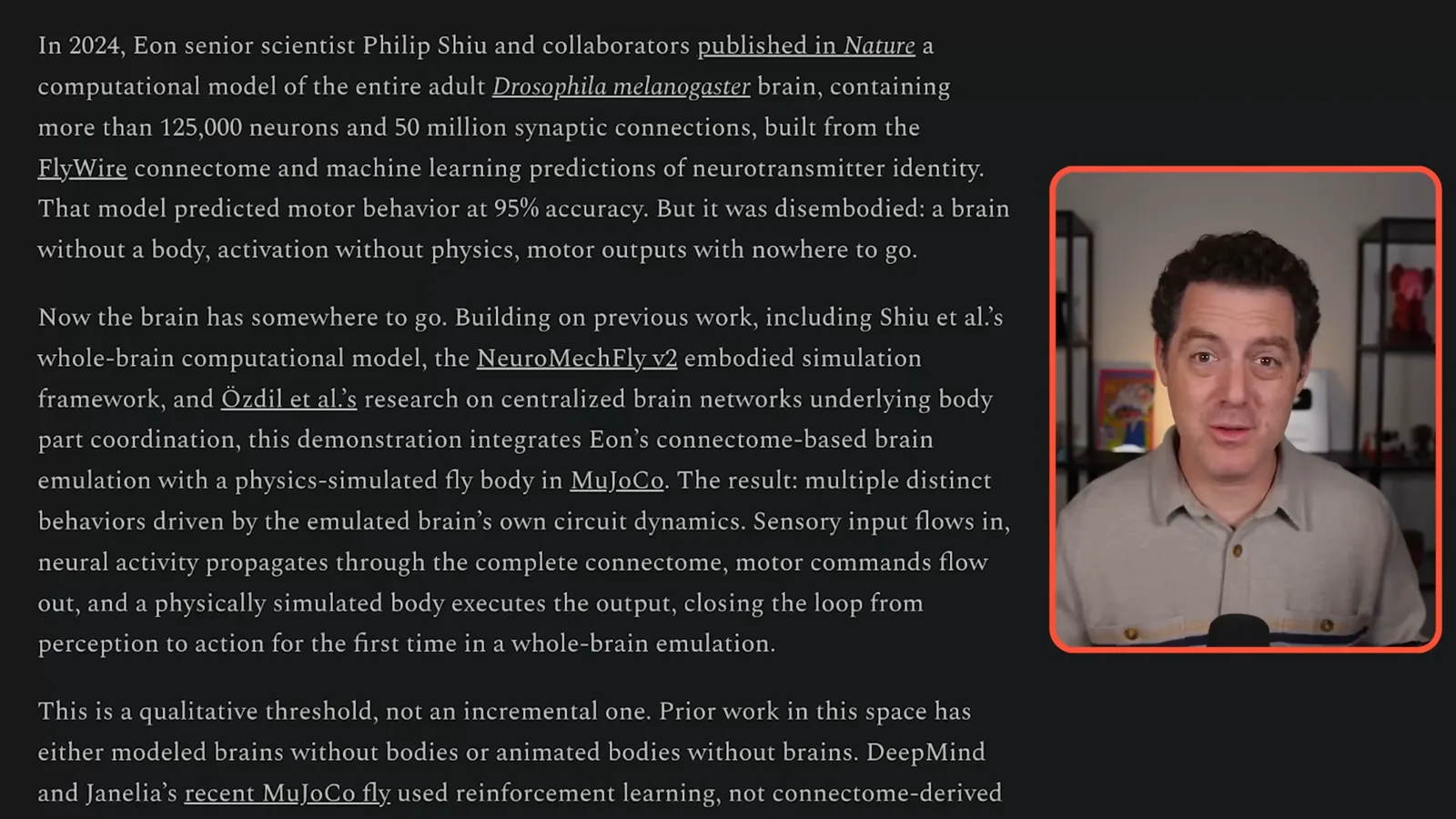
What makes this demo interesting is the attempt to connect a brain model to a body and environment: sensory signals enter the model, selected neural outputs affect movement, and the resulting state feeds back as input. Eon describes this as a closed sensorimotor loop. I compared it with earlier work on the much smaller nervous system of C. elegans.
I suggested that the fly's biology supplies structure shaped by evolution rather than requiring an AI model to be trained from scratch. But my description that the fly needed no training is incomplete. Eon's technical explanation says the embodied demo relies on existing NeuroMechFly controllers trained by imitation to produce fly-like movements.
Eon combines a simplified connectome-constrained model with the NeuroMechFly body and MuJoCo physics. The team uses a small set of descending neural signals to control behavior and maps some brain-to-body relationships by hand. It has not reconstructed the full biological motor hierarchy, and visual inputs currently have little influence on behavior.
The company says the current model covers only a limited set of senses and behaviors. It omits much of biological internal state, plasticity and learning, and its internal dynamics have not yet been validated against certain known neural signatures. The demonstration does not establish that wiring alone can reproduce the fly's complete behavior.
From fly maps to simulation theory
Berman compares neuron counts and explores FlyWire. He raises the simulation hypothesis, which this demonstration does not prove.
I compare neuron counts across animals, from C. elegans to flies, bees, octopuses and humans, and wonder how much work larger brains would require. Counts vary by source and region, and neuron number alone is not a reliable ranking of intelligence. Scaling from a simplified fly model to a whole human brain is not established by this demonstration.
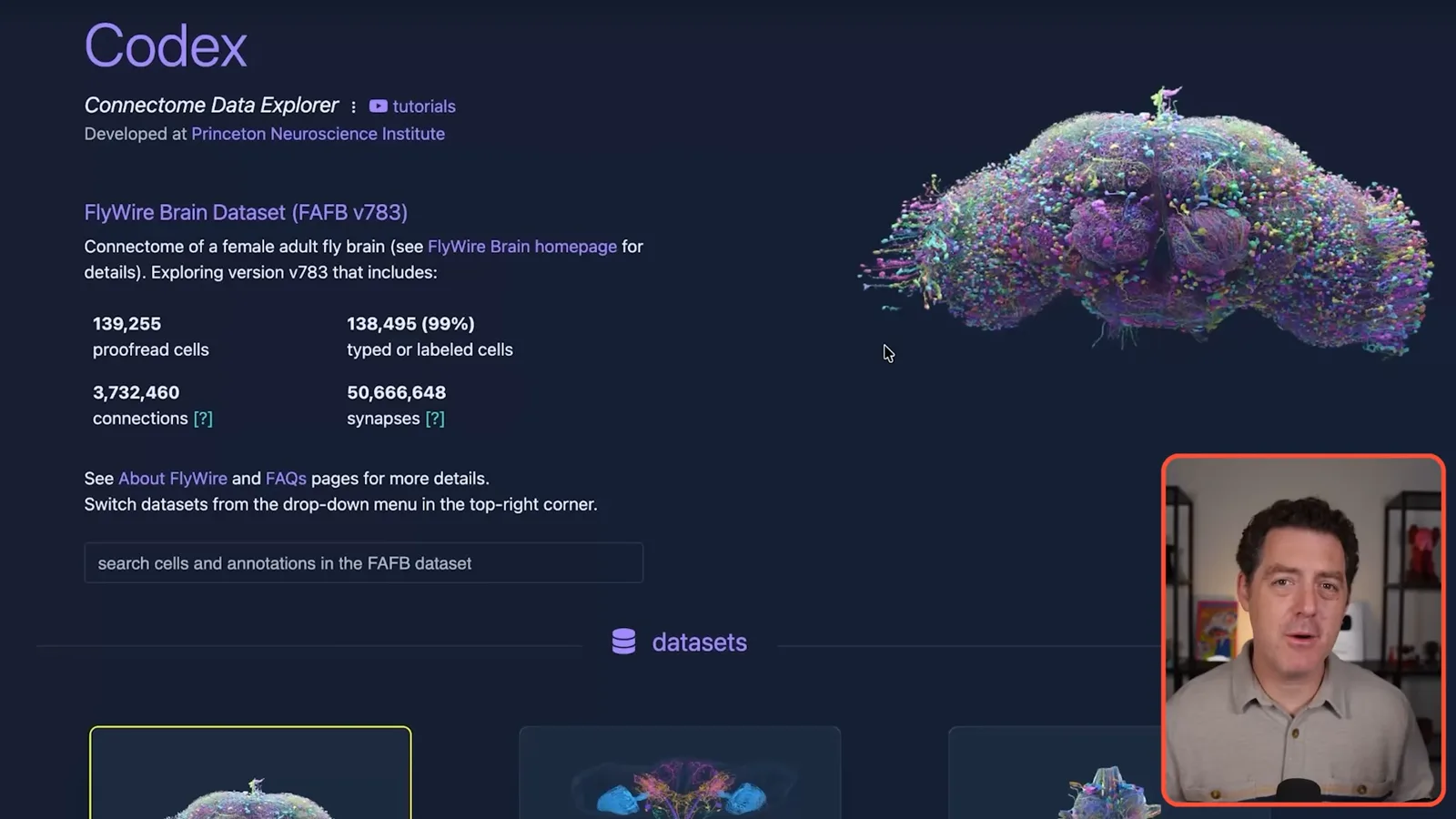
FlyWire offers an interactive view of the adult female fruit fly connectome. The displayed dataset lists roughly 139,000 proofread cells and about 50 million synapses, letting researchers explore the mapped connections. A structural map is valuable, but it does not capture every neural dynamic or all the body's wiring.
I then ask whether a simulated animal suggests that our own world might be simulated. It is a thought experiment, not evidence that we live in a simulation: creating one virtual model does not demonstrate who, if anyone, created our universe or how it operates.
Biological computing and consciousness
A viral game clip leads to questions about cells and computation. Berman closes with unresolved questions about human emulation and identity.
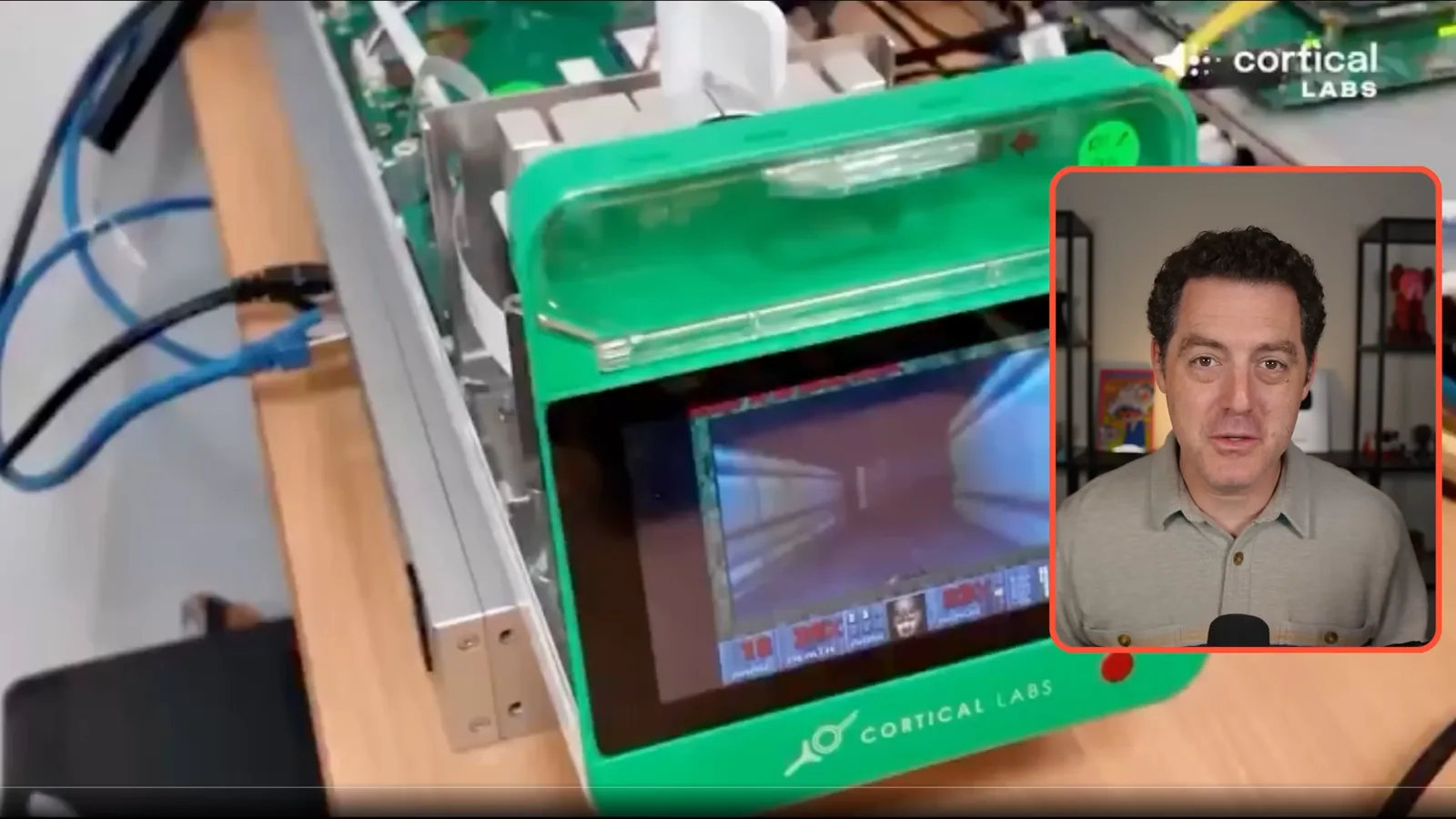
I also show a viral Cortical Labs clip described as human cells controlling a game of Doom. The video does not establish the experimental setup, the contribution of the cells relative to other software, or the degree of learning, so it should not be treated as independent verification of those claims. It invites questions about future biological computing.
The broader questions are philosophical as well as technical. If a future system reproduced a human brain's activity and behavior, would it be the same person, have subjective experience, or preserve consciousness? I imagine faster thinking and longer lives, but these outcomes remain unproven; no experiment shown here resolves identity, consciousness or immortality.
I am optimistic about continued progress in hardware and software and ask viewers whether the simulated fly is real or alive. Those are open questions. Eon's own account calls the present model a simplified demonstration and research platform, and treats a full-fidelity emulation as future work.
Más de este canal
 34:21EN
 Matthew Berman· 27 oct 2026Matthew Berman Examines Anthropic’s IPO Filing, AI Growth and GovernanceMatthew Berman, Sam Altman · Forward FutureThe presenter reviews the S-1’s financial metrics, compute strategy and voting structure while questioning the tension between rapid AI development and safety.
 0:36ENMatthew Berman· 25 oct 2026Kimi K3.1 and a Rubik’s Cube Solver DemonstrationMatthew Berman · Forward FutureMatthew Berman shows a scrambled virtual cube being solved and gives the Kimi K3.1 test a favorable assessment.
 25:50ENMatthew Berman· 24 oct 2026Kimi K3.1 Pro Tested: Strong 3D Demos, Uneven Results and Competitive PricingMatthew Berman · Forward FutureMatthew Berman tests the open-weight model on coding, 3D rendering and visual explanations, then compares benchmark results and prices.
 32:20ENMatthew Berman· 23 oct 2026Who Is Local AI For? The Costs, Trade-offs and a Hybrid FutureMatthew Berman · Forward FutureMatthew Berman weighs data control and independence against hardware cost, setup complexity and inference speed.
 1:03:37ENMatthew Berman· 23 oct 2026Matthew Berman’s Team Tests Kimi K3.1 on Animation, Games, and ChartsMatthew Berman, Alex, Brian · Forward FutureA live team AMA turns into an informal test of Kimi K3.1, from personal-agent workflows to motion graphics, a browser game, and a benchmark chart.
 0:53ENMatthew Berman· 22 oct 2026Sam Altman on AI and the Discovery of New KnowledgeSam Altman · OpenAIAltman expects progress in mathematical discovery to extend to biology, materials and energy.