En 30 segundos
Matthew Berman reviews Pope Leo XIV’s May 2026 encyclical Magnifica humanitas, praising its discussion of human dignity, technological power and artificial companionship. He also criticizes Anthropic’s regulatory advocacy and its co-founder’s participation at the document’s Vatican launch. The encyclical’s claims, Berman’s interpretations and Chris Olah’s statements are distinct. Berman’s suggestions about corporate motives and influence on the document are not established by the invitation itself.
- 1Private technological powerThe encyclical warns that concentrated private power makes governance for the common good harder.
- 2Dignity and workBerman considers how AI might affect human identity and explains why he values human-written essays.
- 3Artificial companionshipThe Pope warns of simulated relationships; Berman worries about young people and displacement of human bonds.
- 4Disarming AILeo describes freeing AI from competitive domination and monopolistic control, not rejecting technology.
- 5Anthropic at the VaticanOlah spoke at the launch, but Berman’s claims about corporate influence and motives go beyond what that fact establishes.
- 6Uncertain model findingsOlah described research into model internals and explicitly acknowledged uncertainty about its meaning.
Conclusiones
- The encyclical treats AI as a potentially valuable tool requiring vigilance, human dignity and public accountability.
- Leo’s call to disarm AI addresses a competitive mentality and concentrated control; it does not call for rejecting technology.
- Berman values human writing and worries that artificial companionship could displace human relationships.
- Berman interprets competition and regulation through a concern about incumbent power; his claims about Anthropic’s motives are opinions.
- Chris Olah described research findings and explicitly said their meaning was uncertain; the findings do not prove consciousness.
- Open-source endorsement and Anthropic influence on the encyclical are Berman’s inferences, not facts established by the passages shown.
Lee el texto editado por capítulos
Humanity and private power
Berman introduces the 2026 encyclical and its concerns about unpredictable technological change and concentrated private power. He adds his own criticism of AI regulation and incumbent incentives.
Pope Leo XIV has published Magnifica humanitas, an encyclical on safeguarding human dignity in the age of artificial intelligence. I want to examine some of its arguments and the debate around Anthropic’s participation in its presentation. The Vatican released the document on May 25, 2026; my discussion reflects that moment.
I read the title as a reminder that there is something special about human beings, even as people debate AI consciousness and the possibility that machines may replace human activities. The document warns that new technologies open possibilities whose long-term effects on dignity and the common good are difficult to predict.
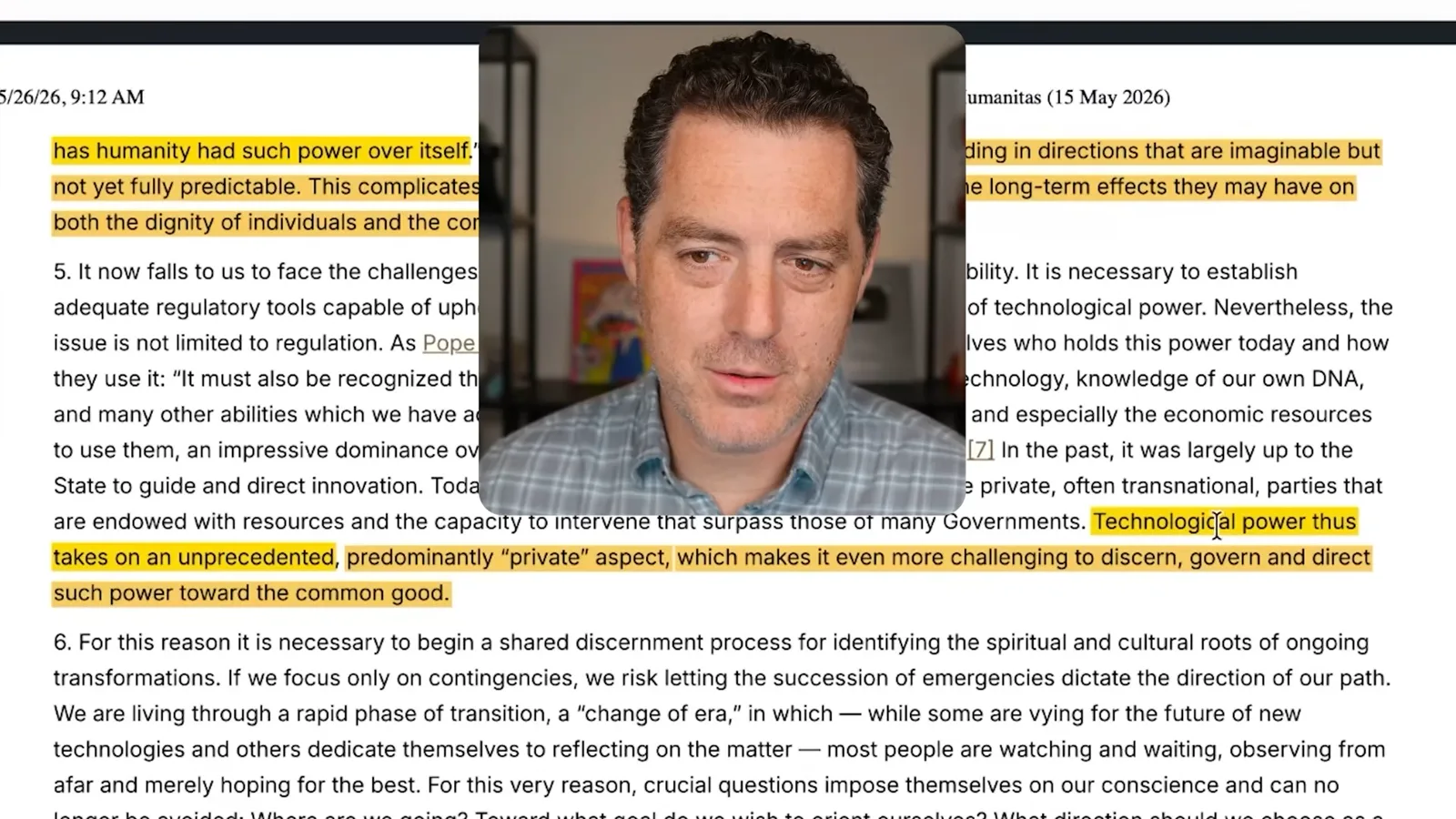
The encyclical argues that technological power has become predominantly private, complicating public scrutiny and governance. I see that concentration in the small number of organizations shaping frontier AI. I also suspect Anthropic’s views influenced the document, although its representative’s presence at the launch does not by itself establish influence over its authorship.
I worry that regulation supported by incumbent AI companies can make it harder for startups to compete. I interpret Anthropic’s lobbying and restricted access to its cybersecurity model, which I call Mythos, as examples of a potential regulatory-capture problem. Those are my assessments of the company’s incentives, not proof of its motives or that regulation necessarily produces capture.
The Pope rejects a simple yes-or-no choice about technology and says its character reflects those who create, finance, regulate and use it. I appreciate that nuance: neither an outright stop nor unchecked acceleration addresses the question of who controls the technology and whose interests it serves.
Dignity, writing and companionship
He considers work and human identity, the limits of current models and the risks of simulated relationships. His personal experiences and social predictions are distinguished from the document’s claims.
The encyclical says human dignity does not depend on ability, wealth, status or a person’s choices. I worry that AI could disrupt the work and contributions through which many people form their identity, while also believing human qualities could become more important as AI spreads.
My own example is writing. I have adopted a policy against using AI to help generate original essays for our newsletter. Reading AI-generated prose made me value the raw ideas and even the imperfections of human writing more; that is my preference, not a general measurement of all AI-assisted work.
Leo argues that even AI designers have only limited understanding of how these systems function. He also maintains that AI may simulate language and empathy but lacks the affective, relational and spiritual perspective through which humans develop wisdom. This is the encyclical’s account of current AI, not a settled scientific test of machine consciousness.
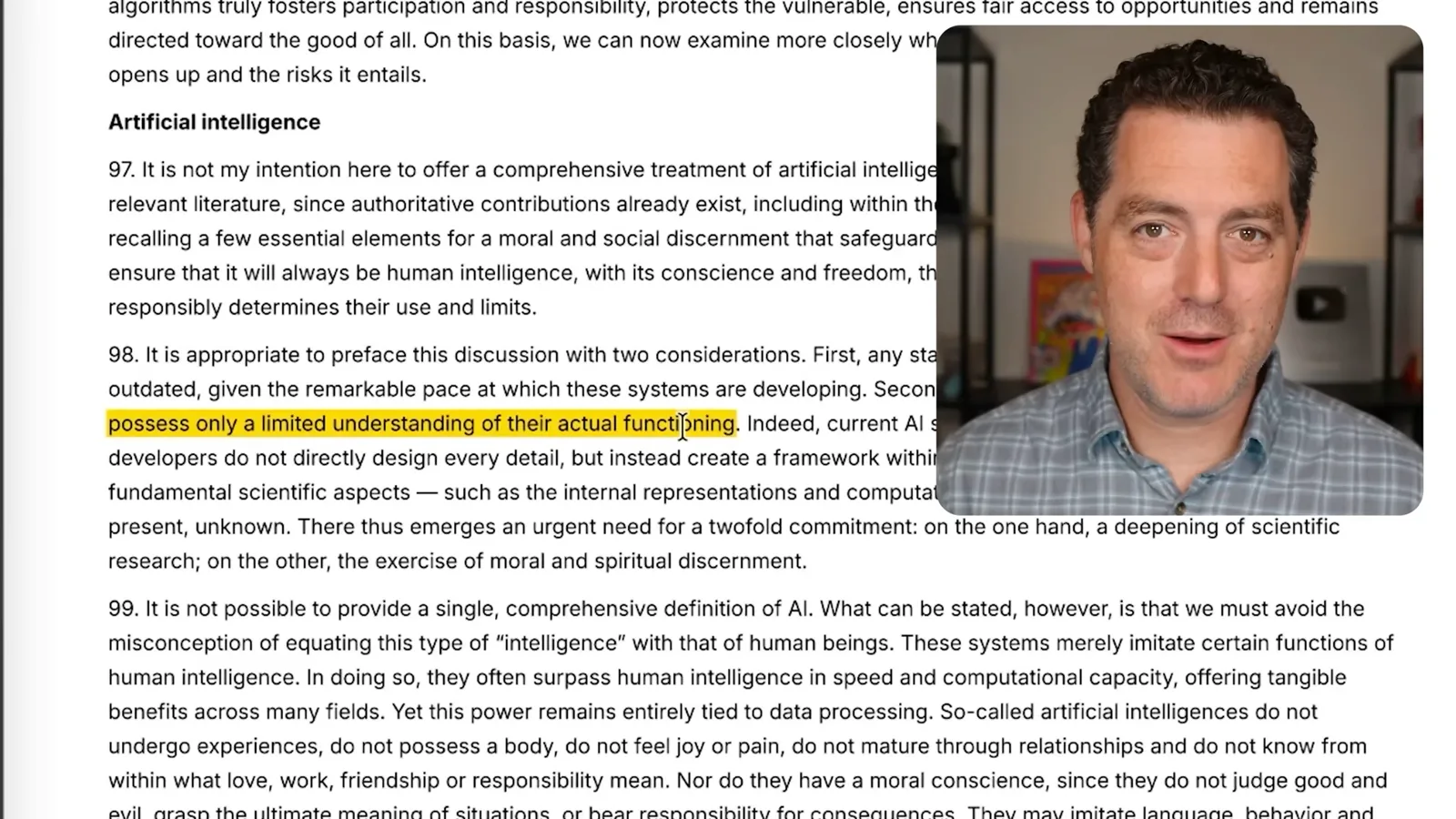
I agree with the warning about AI companionship. The encyclical says simulated care can create the appearance of a relationship and might weaken the desire for human connection, especially where real bonds are already lacking. I am particularly concerned about young people forming attachments to characters, though AI conversation may also provide comfort to someone who is lonely.
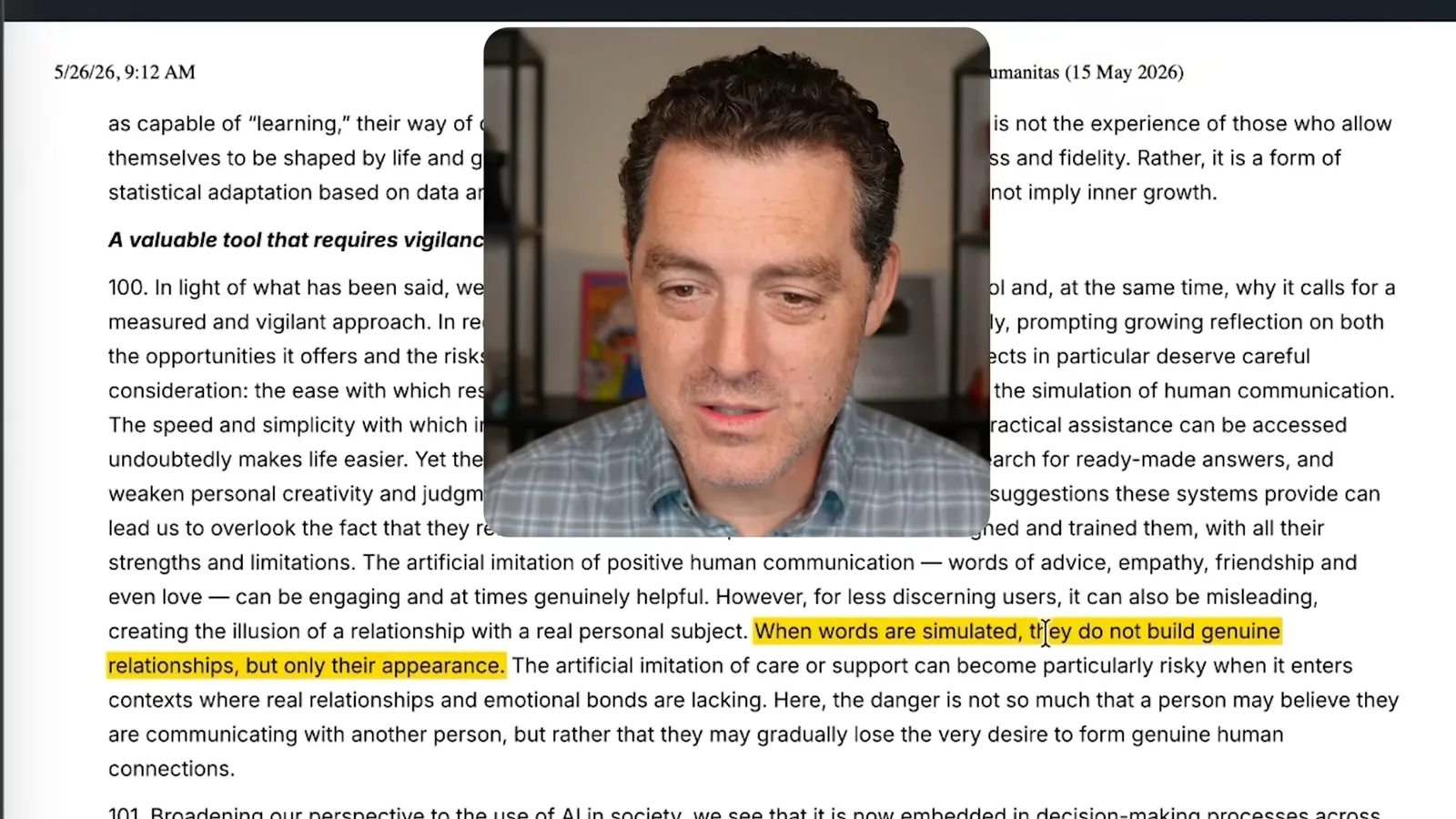
I worry that if artificial companionship is easier than human relationships, some people will choose it instead. I connect this concern to declining birth rates, but that is my speculation about a possible social effect, not evidence that AI companionship causes the decline.
Disarming AI and shared power
Berman explains the Pope’s call to move beyond competitive domination. He interprets its concern about monopolies in light of his own views on competition and open source.
The Pope calls for AI to be “disarmed”: his document describes a competitive mentality extending beyond military uses into economic and geopolitical contests. I recognize that I also describe frontier labs and countries as being in an AI race. I welcome the moral challenge, while remaining skeptical that human competition will disappear.
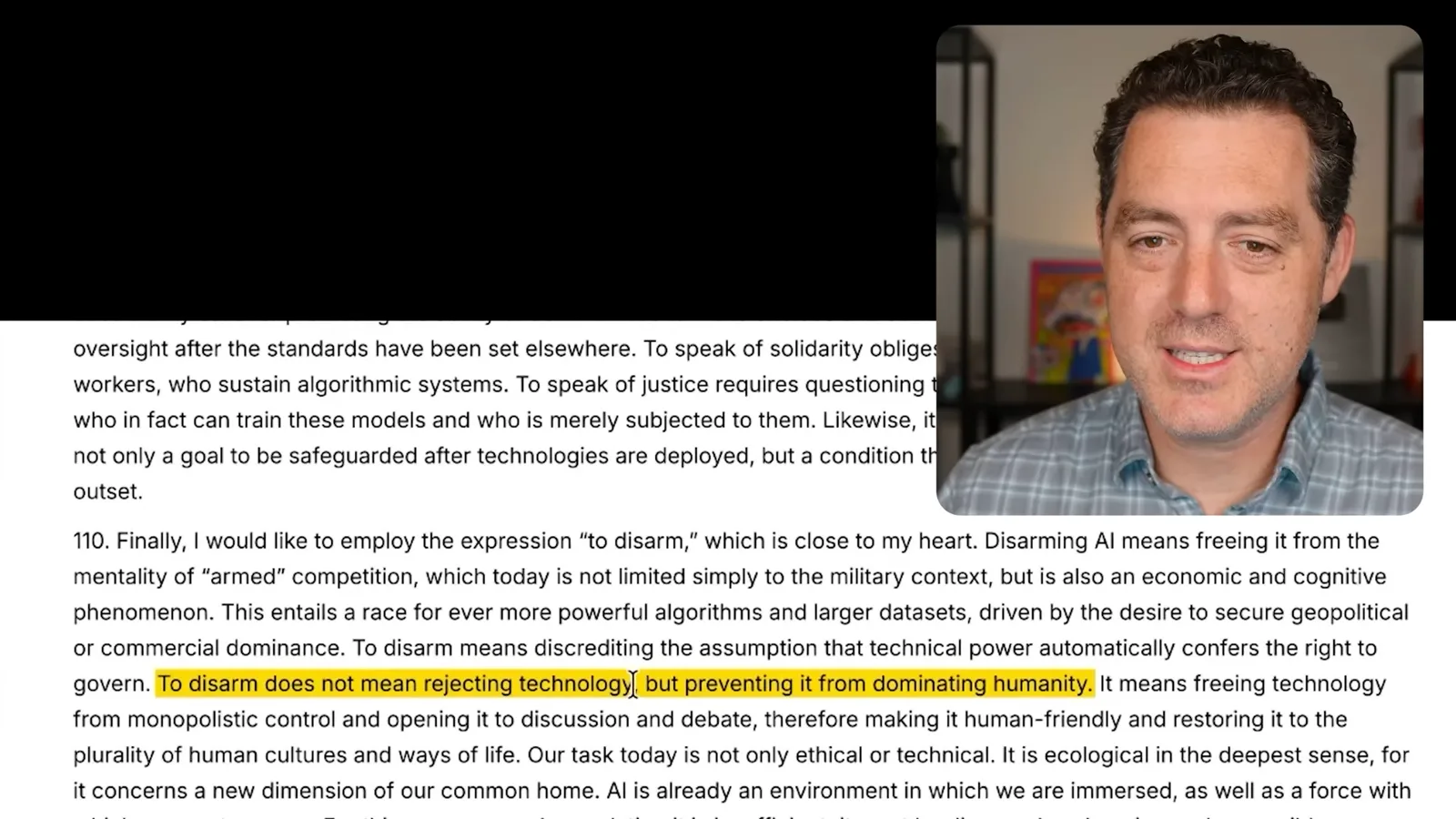
In the encyclical, disarming does not mean rejecting technology; it means preventing domination, loosening monopolistic control and opening technology to public debate and diverse cultures. I think that is an important distinction. The document calls for appropriate regulatory tools, but also says regulation alone is insufficient.
I return to my criticism of Anthropic and worry that excessive regulation could entrench the few companies already leading the field. In my reading, there is a tension between regulation and broad participation if rules block competition. I see open source as one possible way to distribute control, but that is my interpretation rather than an explicit endorsement in the passages I discuss.
I find the encyclical more informed and nuanced than I expected. It cautions that claims about AI can quickly become outdated and challenges the assumption that technological progress automatically benefits everyone. I also highlight its discussion of attention-driven businesses that exploit addiction and insecurity.
Anthropic and the governance debate
Berman responds to Chris Olah’s Vatican remarks and cites critics of AI lab and government power. He closes with praise for the encyclical and concern about corporate influence.
Anthropic co-founder Chris Olah spoke at the Vatican presentation. I interpret his participation and the company’s approach to safety as self-serving positioning, and I speculate that the company seeks disproportionate influence. The Vatican’s announcement confirms that Olah was an invited speaker, but that alone does not establish a formal alliance or Anthropic’s influence over the encyclical.
In the excerpt, Olah says his interpretability team finds internal model structures resembling some neuroscience results, evidence of introspection and states that functionally resemble emotions. He explicitly says he does not know what those findings mean and calls for continued discernment. These research interpretations do not establish that an AI experiences emotion or consciousness.
I cite Brian Roemmele’s criticism that the company’s safety narrative could serve as a competitive barrier and a regulatory lever. I share that concern, but it is a criticism of incentives rather than a demonstrated account of why the Vatican invited Olah or what Anthropic intended. In his full remarks, Olah also called for informed outside critics of AI labs.
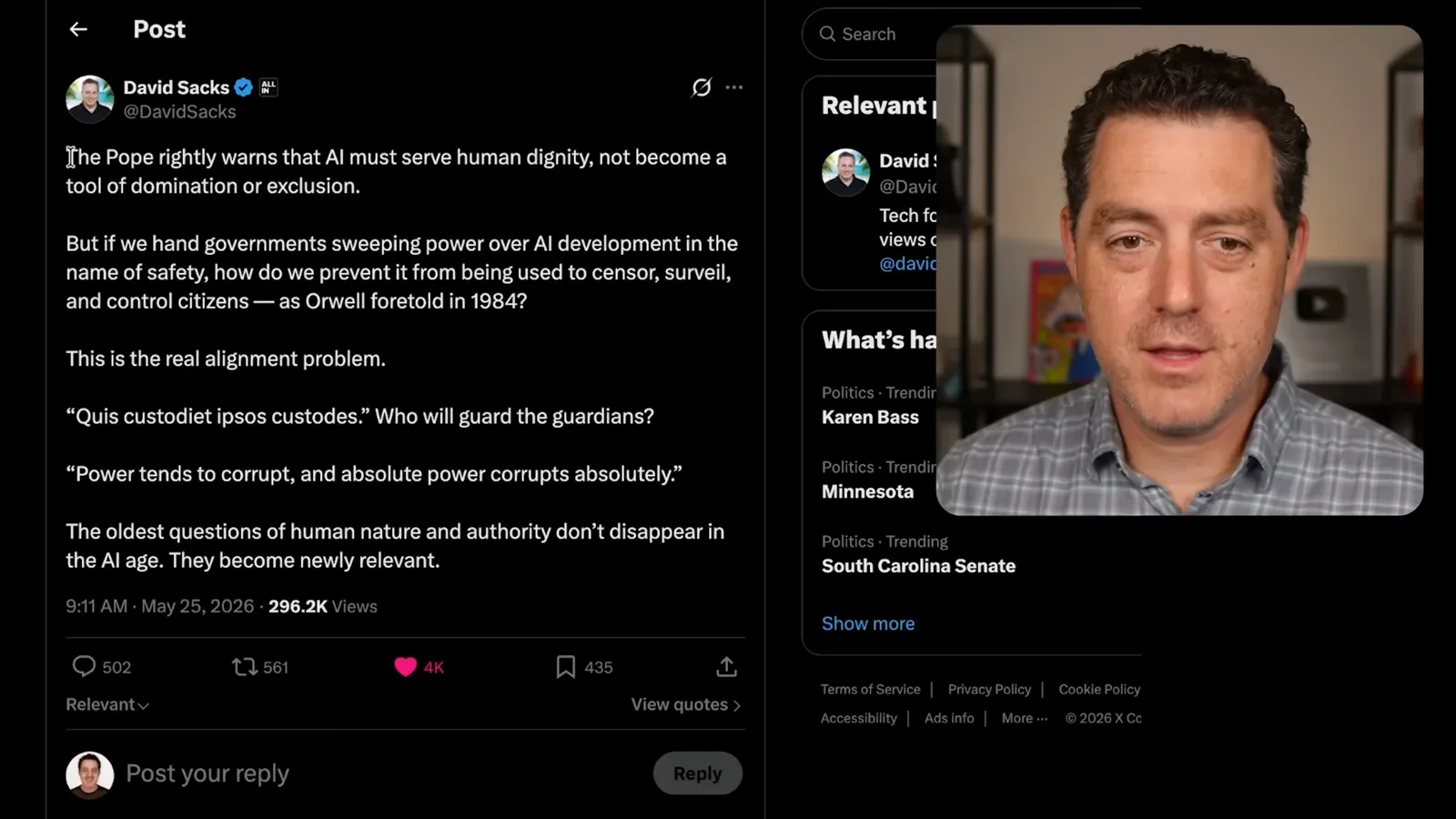
I then read David Sacks’s argument that broad government power over AI could enable censorship, surveillance and control, despite the shared goal of protecting human dignity. The concern illustrates another side of the governance debate: concentrating power in governments can raise questions just as concentrating it in companies can.
I discuss another commentator’s criticism of Anthropic’s public positioning. I do not agree with every example offered, including criticism of its advertising rivalry with OpenAI, but I agree with the concern that invoking model qualities and seeking policy influence may strengthen the company’s position. That remains a disputed interpretation, not proof of deception.
My overall reaction to the encyclical is positive, including parts with which I disagree: I appreciate its care and willingness to engage with difficult questions. My continuing objection is to what I see as Anthropic positioning itself as an authority over who should build AI. The question of how to distribute power over AI remains open.
Más de este canal
 34:21EN
 Matthew Berman· 27 oct 2026Matthew Berman Examines Anthropic’s IPO Filing, AI Growth and GovernanceMatthew Berman, Sam Altman · Forward FutureThe presenter reviews the S-1’s financial metrics, compute strategy and voting structure while questioning the tension between rapid AI development and safety.
 25:50ENMatthew Berman· 24 oct 2026Kimi K3.1 Pro Tested: Strong 3D Demos, Uneven Results and Competitive PricingMatthew Berman · Forward FutureMatthew Berman tests the open-weight model on coding, 3D rendering and visual explanations, then compares benchmark results and prices.
 32:20ENMatthew Berman· 23 oct 2026Who Is Local AI For? The Costs, Trade-offs and a Hybrid FutureMatthew Berman · Forward FutureMatthew Berman weighs data control and independence against hardware cost, setup complexity and inference speed.
 1:03:37ENMatthew Berman· 23 oct 2026Matthew Berman’s Team Tests Kimi K3.1 on Animation, Games, and ChartsMatthew Berman, Alex, Brian · Forward FutureA live team AMA turns into an informal test of Kimi K3.1, from personal-agent workflows to motion graphics, a browser game, and a benchmark chart.
 0:53ENMatthew Berman· 22 oct 2026Sam Altman on AI and the Discovery of New KnowledgeSam Altman · OpenAIAltman expects progress in mathematical discovery to extend to biology, materials and energy.
 0:22ENMatthew Berman· 21 oct 2026A Robot Bodyguard Video Shows Dramatic Rescue ScenariosMatthew Berman · Forward FutureMatthew Berman reacts to a short robot demonstration depicting fighting and vehicle-rescue scenarios.