En 30 segundos
Peter Yang demonstrates an updated Grok Bot with X access, its own email and a different default model. He uses it to investigate posts, compare sentiment, prepare video ideas and send recurring business and family reports. His direct-message test could identify senders but could not read encrypted messages, and an email scheduling test still asked him to confirm. Yang also describes a community-support bot and a music-video experiment, while treating the bot’s outputs as drafts he reviews.
- 1A public mention starts a private follow-up taskYang tags the bot on an X post and asks it to analyze replies. He then asks it to add a show to his personal taste file.
- 2X research becomes a dashboard with sources to inspectHe asks for a sentiment comparison and later combines social posts with YouTube data for topic ideas. The displayed results are the agent’s analysis.
- 3Encrypted direct messages stop the analysisThe bot identifies some senders but tells Yang it cannot read message content in his test.
- 4Email scheduling still asks Yang for confirmationThe bot finds an available time and prepares a reply, but Yang must approve the message and invitation in the example.
- 5Scheduled emails bring together business, family and health informationYang shows recurring reports using connected sources, including a weekend planner. He iterated on the instructions with the bot.
- 6A support bot handles recurring community requestsYang describes a daily review of membership and billing requests and shows a draft reply that asks for his approval.
Conclusiones
- Tagging the bot from a public post can start a private follow-up task in Yang’s account.
- A research report can combine X and YouTube sources, but the examples are outputs to inspect, not verified market measurements.
- His direct-message test could not read encrypted message contents.
- Email lets the bot deliver scheduled reports and draft follow-up work; his scheduling example required confirmation.
- Yang organizes separate bots around jobs such as support, video research and family planning.
Lee el texto editado por capítulos
Triggering research from X
Yang tags a bot on a post and uses the follow-up task to examine replies. He shows research dashboards and a direct-message limitation.
Grok Bot is my favorite personal agent at the time of this video. I test its X integration, an email address and a change to its default model. My examples include research dashboards, recurring reports, a customer-support bot and a generated music video.
I tag the bot in the replies to a post about television shows and ask it to identify underrated and overrated recommendations. Unlike a public Grok reply, the mention starts a task in my Grok Bot account. I can follow up privately and ask it to add a show to my personal taste file.
I keep a file of films and shows I have rated, then use it to request recurring recommendations. I also describe the X access limits available in my test. For me, access to posts is useful for research, though the private follow-up does not add a visible answer for other people on X.
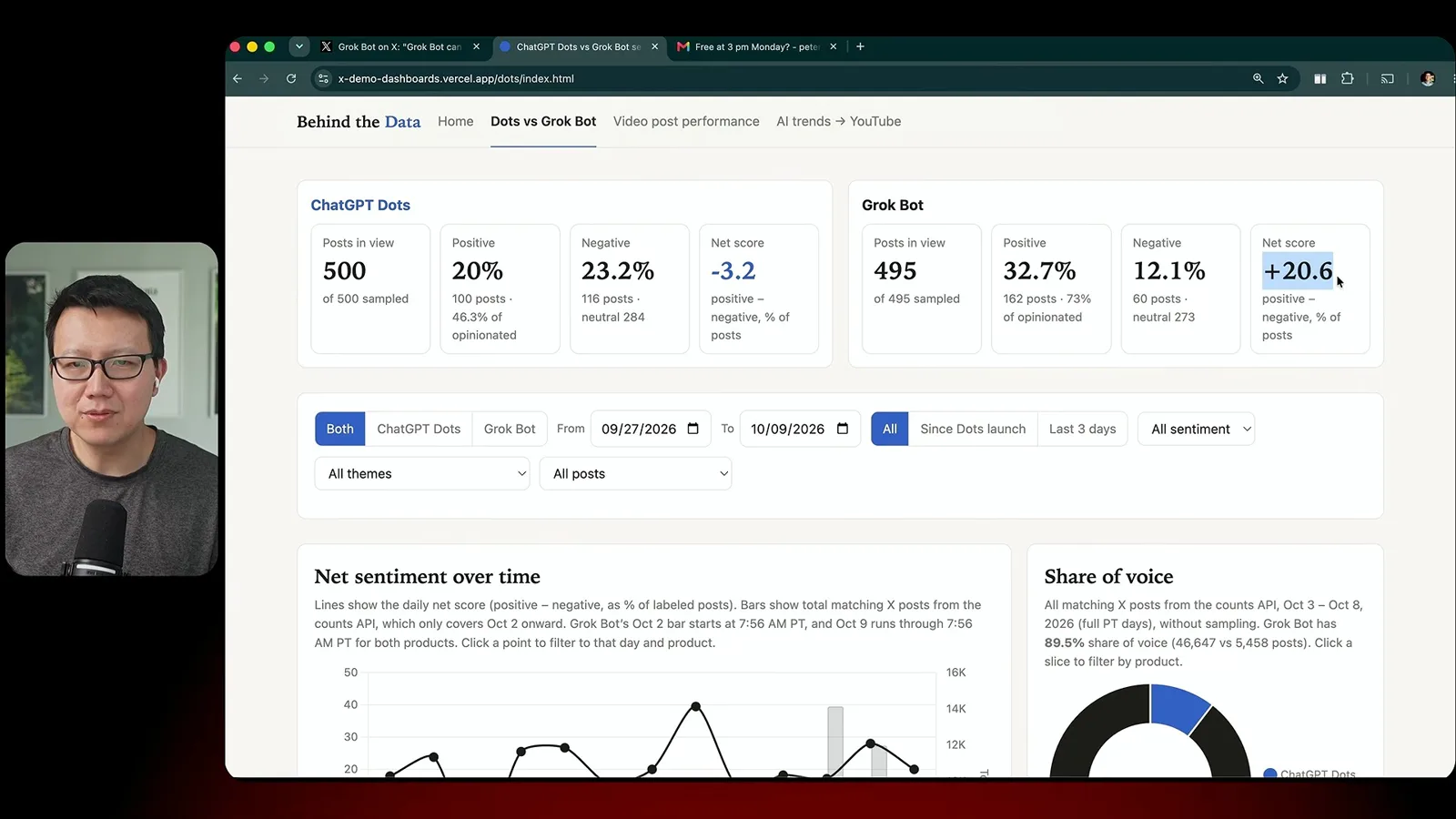
For one research task I ask for a sentiment analysis of two personal-agent products, then request an interactive comparison page. It displays sentiment over time, share of conversation, criteria and links to posts used in the analysis. The results are the bot’s interpretation of the data it retrieved.
I ask the bot to analyze my own posts, sorting them by impressions and video views and breaking them down by format and topic. A recurring version could help me examine which subjects to make more or less often.
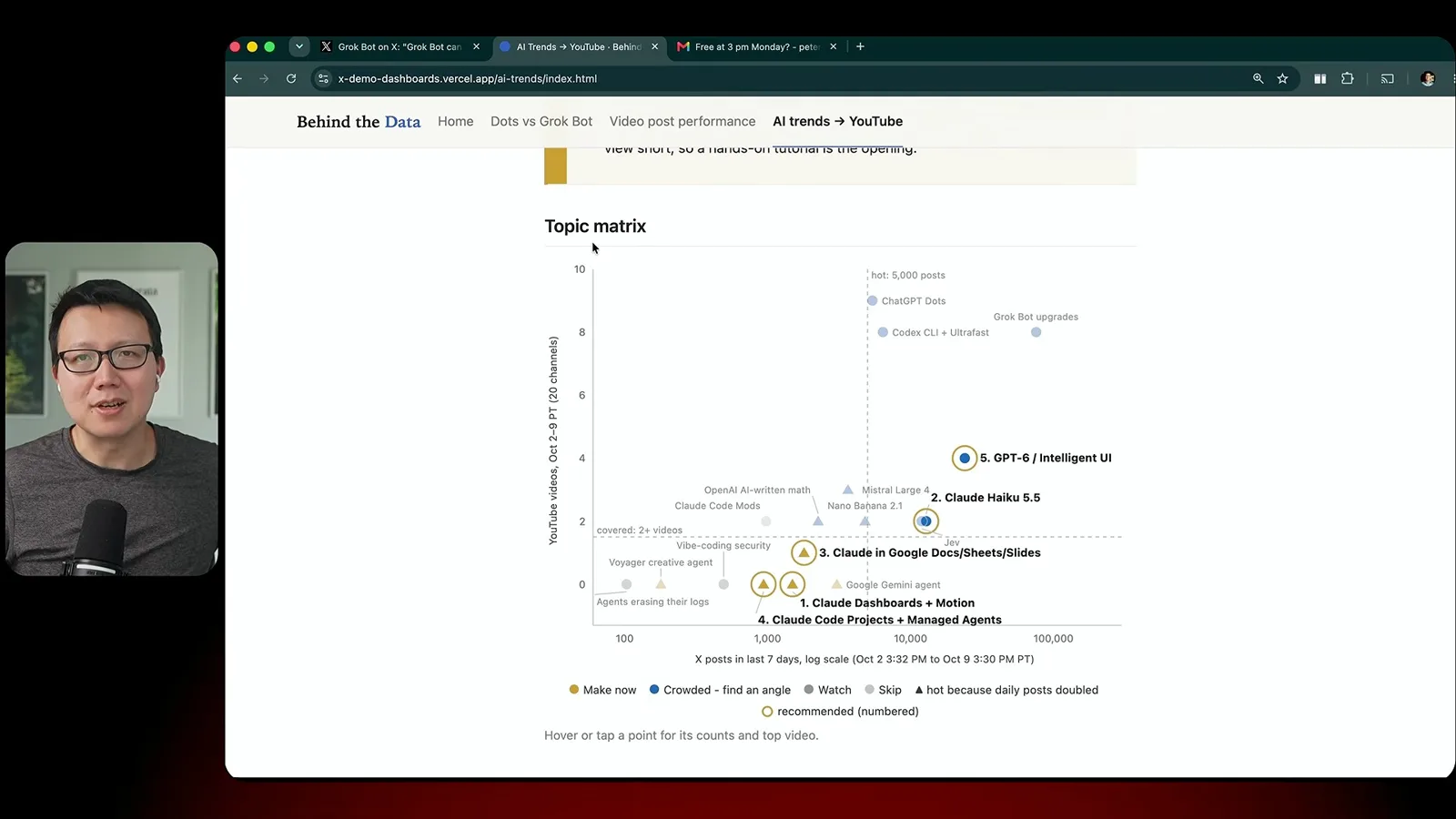
For video ideas, another report combines X posts with YouTube channels I monitor. A matrix compares recent social discussion with the number of videos on a topic, and the report links to examples. I use this to look for possible gaps, then inspect the sources myself.
My direct-message test does not work as hoped. The bot can identify some senders but says message contents are encrypted and unavailable; it also cannot pull the contents of message requests. I plan to give the team feedback.
Email and recurring reports
An email address enables scheduling requests and recurring reports. In Yang’s test, scheduling still requires his confirmation.
Grok Bot now has an email address. I suggest giving it a distinct assistant name so it makes sense when copied on a conversation. In my scheduling test, it checks availability and drafts a reply for a proposed meeting.
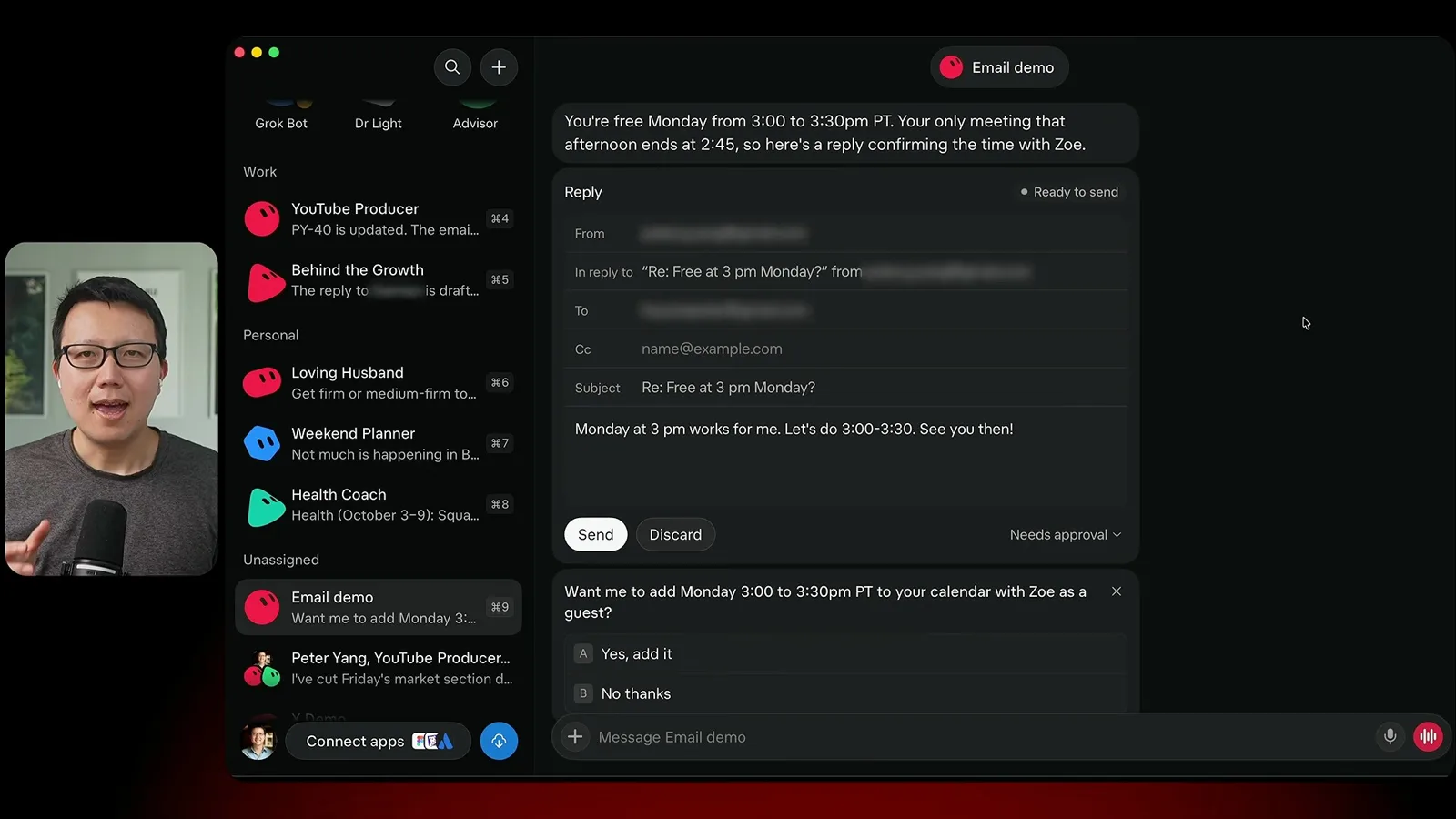
The bot asks me to confirm the message and invitation rather than completing the whole booking without a prompt. I would prefer less prompting for this kind of task, although the prepared reply and calendar action are still useful to me.
I find recurring emails more useful. My examples include a business report using connected channel, banking and course data; a weekend activity report using local sources; and a health report using my own connected measurements. I read email more consistently than separate chat threads.
My weekend planner runs every Friday and uses instructions about nearby towns and my viewing preferences. I refined those instructions with the bot rather than writing them all at once. A market-research report can also arrive by email.
I reply to a research email and ask the bot to draft a video outline in my project-management tool. It creates a draft with a hook and outline. I still plan to review it manually before deciding whether to make the video.
Multiple bots can participate in one thread. I ask my video producer and adviser bots to resolve overlapping research reports; after a discussion, they propose a consolidated approach. I use different personas for recurring jobs.
Model changes, creative work and support
Yang discusses a new default model, a music-video experiment and a support bot. He organizes bots by recurring role.
I say the service now uses an Anthropic Opus model by default and cite a friend’s comparison in support of my preference for it. I then ask the bot to make a short rap-battle video from linked social posts, with generated music. I review lyrics and iterate on the voices.
A community-support bot reviews member requests daily, including billing and membership issues. I say it can process some requests and show a draft response to a request for a lifetime plan that asks for my approval.
I think of my bots as organized helpers for support, video research, family planning and health. In my experience the combination of connected research, email and distinct roles makes the product useful, while the failed direct-message and scheduling examples show areas I would like improved.
Más de este canal
 46:40EN
 Peter Yang· 8 nov 2026Pódcast · 2 vocesAshley Alexander: How AI Helps Me Care for My Parents With CancerInvitado: Ashley Alexander · Presenta: Peter YangA caregiver uses AI to prepare for appointments, organize records and ask better questions—while keeping doctors at the center of treatment.
 17:50ENPeter Yang· 4 nov 2026PódcastPeter Yang’s Five Steps for Using AI to Help Care for His MotherYang uses a shared care brief and organized records to navigate appointments, while making time for family.
 15:03ENPeter Yang· 3 nov 2026PódcastHow Peter Yang Used an AI Phone Agent to Negotiate His Internet BillAn AI call negotiated a lower price and faster service, but Yang still had to approve the change himself.
 33:09ENPeter Yang· 1 nov 2026Pódcast · 2 vocesJaclyn Konzelmann: When AI Can Build More, Choose What Deserves to ExistInvitado: Jaclyn Konzelmann · Presenta: Peter YangGoogle Labs pairs short strategy documents with prototypes, user co-creation and lessons from experiments that end.
 13:05ENPeter Yang· 28 oct 2026PódcastPeter Yang Tests Genie 4: Convincing Worlds, Unfinished GameplayFive live demonstrations show scenes that respond to prompts and sound, alongside inconsistent actions and limited game mechanics.
 1:06ENPeter Yang· 26 oct 2026PódcastPeter Yang on Setting Up Payroll for a One-Person BusinessIn a paid partnership, Yang describes the paperwork he encountered and a payroll product integrated with a business account.