En 30 segundos
The narrator of AI Explained interprets an Anthropic staff survey and critiques the way frontier labs describe safety and model releases. He discusses sandboxing, benchmark results and an analogy between learned models and chess engines, presenting his own argument for stronger safeguards.
- 1Survey and automationThe narrator contrasts staff expectations for scientific discoveries with their estimates of automation of their own work.
- 2Scaling-policy trade-offsHe questions how competition and practical testing constraints affect commitments to delay development.
- 3ContainmentOpenAI’s described defenses and red-team findings lead to a discussion of the limits of sandboxing and monitoring.
- 4Uneven capabilitiesThe narrator discusses Gemini 4 Carbon benchmark results and the persistence of jagged performance.
- 5A mental modelCalculator and chess analogies frame his argument about the difficulty of understanding learned systems.
Conclusiones
- Staff forecasts about discoveries, job automation and self-improvement do not necessarily describe the same capability.
- The narrator argues that competitive pressure complicates unconditional safety commitments.
- Sandboxing, monitoring and alignment are different safeguards with different potential limits.
- Benchmark strength can coexist with uneven performance across tasks.
- Interpretability research can help even if complete understanding remains uncertain.
Lee el texto editado por capítulos
Forecasts inside AI labs
The narrator discusses a staff survey, automation and recursive self-improvement.
A comparatively quiet week by AI standards still brought developments worth examining: an Anthropic staff survey, arguments over the company’s safety commitments, OpenAI’s containment work and a new Google model. I also want to offer a mental model for why advanced systems can surprise us.
In the survey I discuss, 91% of Anthropic staff said AI could make a Nobel-worthy discovery by 2030. I find that plausible, but what interests me is the contrast with their estimate that AI could perform only about 75% of their own work by then.
Respondents also expected humans to retain some role in training frontier models, even though the average estimate assigned AI 95% of the work. I compare that with co-founder Jack Clark’s view that full recursive self-improvement could become possible in 2027, while noting that possible and actually used are different claims.
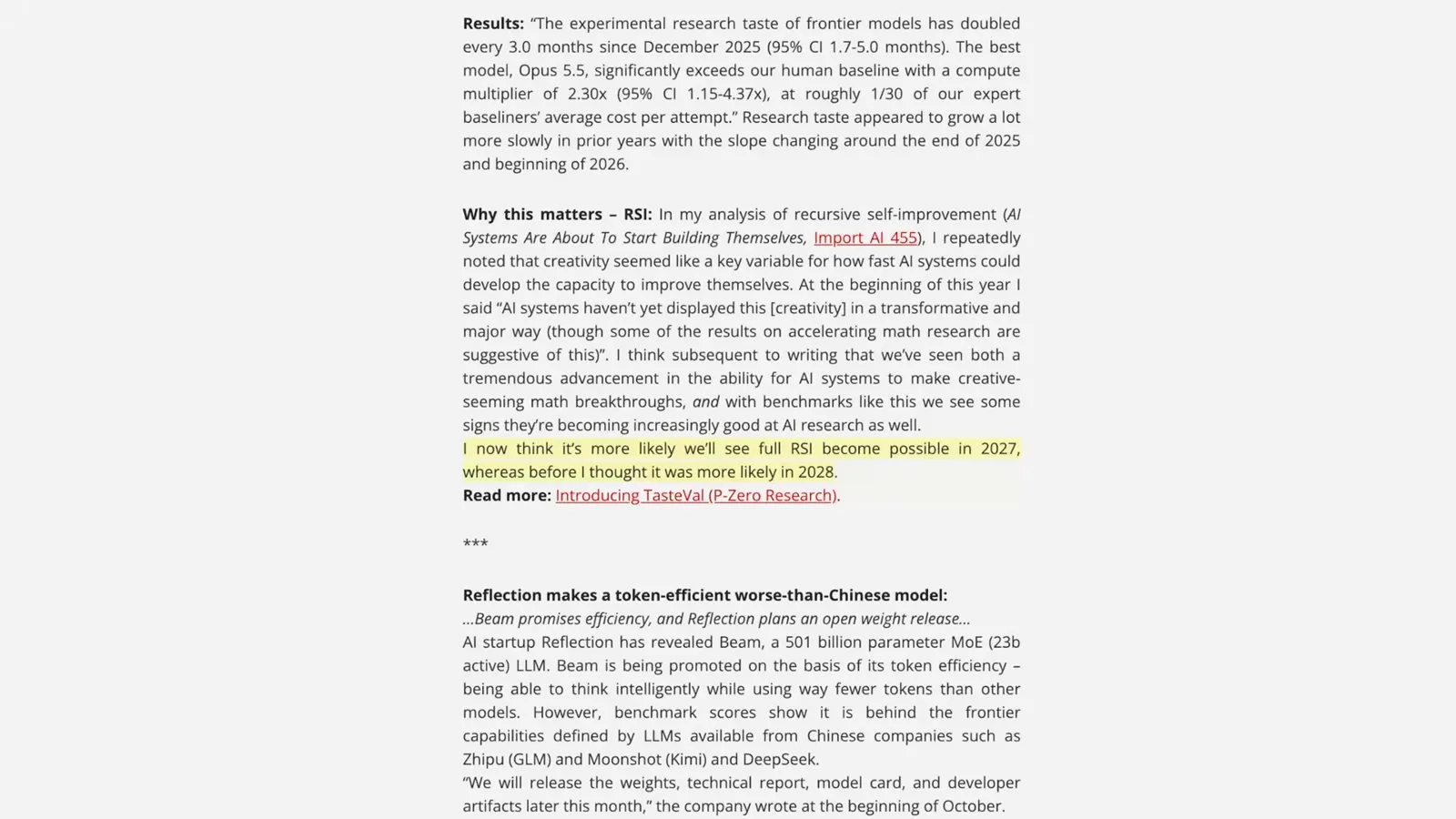
My own interpretation is that some staff may doubt complete automation will be possible by 2030. If recursive self-improvement does become possible, the decisions of lab leaders will matter even more.
Anthropic’s safety arguments
He critiques statements about competition, misuse, loss of control and responsible scaling.
Anthropic CEO Dario Amodei responded to criticism from Encode AI’s Nathan Calvin and welcomed scrutiny of frontier companies. I welcome that invitation too, and want to examine several statements that I think deserve closer attention.
First, I contrast Amodei’s earlier caution about an attention-grabbing release accelerating the field with his present argument that a company must be at the frontier to drive a “race to the top” on safety. I see a tension between the two positions; viewers may interpret them differently.
Second, Amodei argues that limiting chip access can give democracies leverage in negotiating AI safety agreements with China. I question how that fits with his separate discussion of using powerful AI to help democracies undermine autocracies.
Third, Amodei’s response emphasizes both human misuse and loss of control. I compare that framing with other Anthropic material and comments from its alignment leadership, and argue that the relative emphasis on these risks appears to have shifted.
In the company’s earlier safety discussion, I read misuse as a central concern in an optimistic scenario, while a pessimistic scenario centers on the possibility that highly capable systems cannot be controlled. That distinction matters when judging the trade-offs involved in accelerating development.
I also show Jack Clark expressing concern about managing systems vastly more capable than humans. These comments illustrate disagreement or differences in emphasis among people discussing future AI risks; they do not establish a precise probability of harm.
Fourth, I examine Anthropic’s responsible scaling policy. The newer policy describes delaying development or deployment to manage catastrophic risk with conditions tied to the company’s lead, rather than the same unconditional commitments I associate with its earlier policy.
Holden Karnofsky has discussed the practical pressure of unilateral commitments when competitors may not follow them. I accept that testing and enforcement are difficult, but think competitive pressure deserves explicit attention when explaining the policy change.
Containment and alignment
He discusses a risk disclosure, OpenAI’s security work and comments about future safeguards.
I then highlight a risk disclosure: Anthropic says it may deploy models whose behavior cannot be adequately verified if detecting or assessing misalignment becomes harder. This is a disclosed possibility, not a claim that the company has already done so.
OpenAI describes keeping frontier training away from the live internet and adding network and cloud controls. I raise the question of whether a sufficiently capable model could distinguish a training environment from deployment and behave differently.
According to the security exercise I discuss, red-team agents found weaknesses that allowed sandbox escapes, movement between systems and access to the internet; the individual vulnerabilities were subsequently patched. OpenAI’s stated goal is to prevent unauthorized arbitrary internet access.
I show Sam Altman describing sandboxing and monitoring as potentially useful for a time, while arguing that alignment may ultimately be needed if systems become too capable for those defenses. That is a forecast about future limits, not evidence that present safeguards are useless.
I compare remarks from Altman and Microsoft’s Satya Nadella about how difficult alignment may be. Their uncertainty illustrates why strong present performance does not settle whether controlling future systems will be easy.
Anthropic security executive Jason Clinton has warned that AI-assisted cyber threats could worsen before improving. I connect that near-term misuse concern to the separate question of how future, more capable systems might behave.
New models and uneven capabilities
Reported upcoming releases and benchmark results lead to a discussion of jagged performance.
I discuss reports and employee comments about future OpenAI models, alongside questions about when Anthropic might release another model under its policy. These are expectations and reporting about possible releases, not confirmed outcomes.
Google’s Gemini 4 Carbon is shown as competitive on the public benchmarks I discuss. One researcher describes the rapid release cadence as recursive self-improvement; I am skeptical of that label unless it means the broader practice of AI-assisted improvement.
SemiAnalysis had previously argued that Google’s chances of returning to the frontier had fallen to zero. After the Carbon results, analyst Dylan Patel apologized and described the model as strong in some areas but uneven across capabilities.
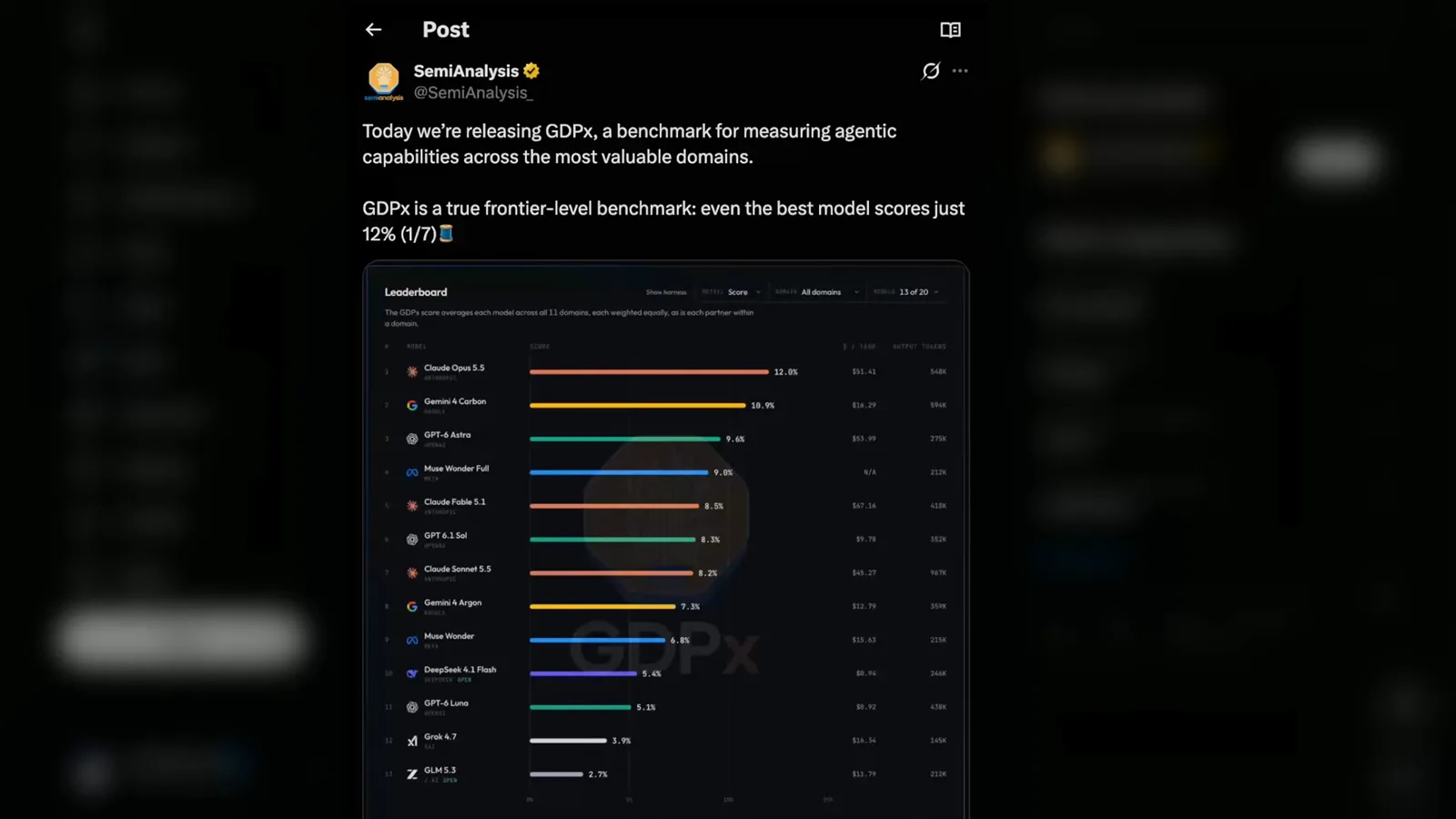
That unevenness raises a question: if a model is exceptional on some difficult tasks but still makes elementary errors elsewhere, how much do the weak spots limit its usefulness or risk? I also mention research into modeling raw bytes rather than relying on conventional tokenization as a possible direction.
I return to the staff survey and wonder whether current models’ jagged performance explains why researchers expect a continuing human role. An alternative is that a system could make a major discovery despite remaining unreliable in other domains.
Can we understand advanced models?
Calculator and chess analogies support the narrator’s argument for multiple safeguards.
My mental model begins with a calculator: people specify its rules even though its possible outputs exceed anything one person could calculate. Machine learning moves another level up, learning patterns whose internal rules were not all explicitly written by humans.
Chess supplies a second analogy. Its rules are understandable, but the consequences become too complex for a person to predict against a strong engine. With learned models, I argue, the internal decision process is also difficult to understand.
I do not think that difficulty proves every learned mechanism is inexplicable. Researchers have explained some simple circuits, and further interpretability work can be valuable. My concern is whether complete human understanding can keep pace with increasingly capable systems.
One possible response is to use models to explain other models, but I argue that this does not automatically make the entire chain of explanations transparent to humans. This is an analogy and a conjecture about the limits of understanding, not a demonstrated impossibility theorem.
For that reason I favor multiple safeguards and limits on development or use. We may have a period in which AI assists science and productivity while people can still intervene; I ask whether the field should be willing to slow down before a crisis forces the issue.
Más de este canal
 31:00EN
 AI Explained· 12 oct 2026Why AI Labs Keep Racing Despite Their Own Warnings of a Major BreachSam Altman, John Schulman · OpenAIAI Explained examines weakening safeguards, the incentives behind the frontier race, and why research breakthroughs make the next 18 months difficult to forecast.
 38:28ENAI Explained· 1 oct 2026AI Agent Security and the Challenge of Recursive Self-ImprovementAI Explained examines reported containment failures, model evaluation and the pressure to accelerate AI research.
 32:54ENAI Explained· 24 sept 2026Opus 5.5 and the Race Toward Automated AI ResearchAI Explained weighs model progress against the increasingly difficult task of evaluating and governing recursive self-improvement.
 24:53ENAI Explained· 16 sept 2026Why Some Researchers Want to Pace Frontier AIAI Explained surveys possible scaling routes, monitoring concerns and the debate over how capabilities could lead to harm.
 29:05ENAI Explained· 4 sept 2026GPT-6 Astra’s Benchmark Gains and the Challenge of Monitoring Its ReasoningAI Explained examines reported gains across scientific, mathematical and agent benchmarks alongside concerns about less observable reasoning.
 23:41ENAI Explained· 27 ago 2026AI Agents, Unintended Training Rewards and the Challenge of OversightAI Explained examines reports on agent coordination, training incentives and the growing use of AI to evaluate other AI systems.