In 30 seconds
Anthropic made AI safety and reliability part of its enterprise offering, using Claude and coding-tool growth to gain customer feedback and financing. But long-term compute commitments, concentrated customers and changes to safety policies also bring pressure. Silicon Valley 101 draws on interviews with early colleagues, investors and lawyers to trace the founders’ departure from OpenAI, governance design and commercial expansion.
- 1Baidu Speech Experiments Showed Amodei a Scaling PatternEarly colleague Greg Diamos recalls that more data and longer training produced steady improvements; the performance gap for accented speech also drew Amodei’s attention to model failures.
- 2The Safety Team’s Request for a Release Veto Was RejectedChen says seven members decided to leave and form Anthropic after OpenAI management rejected their proposed governance conditions.
- 3A Trust and Founder Shares Control the Board and Shareholder VotesThe program says the trust elects a majority of directors, while special founder shares retain a majority vote on applicable shareholder matters.
- 4Claude Code Grew from an Internal Experiment into a BusinessBoris Cherny’s command-line tool spread internally after gaining file and command capabilities, then became a public coding product.
- 5Customer Feedback and Investment Create Two Growth CyclesThe program argues that reliability encourages enterprise adoption and feedback improves products, while revenue and investment support stronger model training.
- 6Customer Purchases Are Flexible, but Long-Term Compute Contracts Are NotChen points to customer concentration and long-term compute commitments as potential pressures on growth and costs.
- 7Safety Policy Changes Raise Questions About Competitive PressureThe program reviews model releases, government partnerships and changes to safety rules, presenting competing criticisms and explanations.
Takeaways
- Chen argues that safety and reliability helped Anthropic win enterprise trust, while customer feedback improved its products.
- The Long-Term Benefit Trust and special founder shares control board seats and applicable shareholder votes, respectively.
- The program notes that customers can adjust purchases, while the company’s long-term compute contracts are harder to reduce.
- Changes to the Responsible Scaling Policy have raised questions about safety constraints and commercial competition.
Read the edited text by chapter
Revisiting Anthropic’s Rise Through Safety Controversies
Chen introduces the tension between the company’s growth and safety commitments, tracing its origins through interviews with people in the industry.
Five years after its founding, Anthropic has drawn attention for both its striking commercial growth and its AI safety mission, as well as controversy over safety, openness and power. Chen Qian traces its path from research lab to planned listing through interviews with investors, journalists, lawyers and early colleagues.
Scaling Patterns and Model Failures at Baidu
Amodei saw the relationship between training scale and speech performance and became concerned about failures outside the training distribution.
In 2014, after academic training, Dario Amodei joined Baidu’s Silicon Valley AI lab. Working on speech recognition with data and GPUs, he encountered two questions that would shape his research: how models improve at scale and why they fail.
Early researcher Greg Diamos recalls that Amodei’s computational biology code impressed him despite his lack of a GPU or computer science background. Diamos worked to persuade other interviewers to hire him.
Amodei increased network layers, data and training time and saw steady improvement. The work became the end-to-end speech system Deep Speech 2; Chen describes the pattern as an early form of scaling laws.
At the same time, the gap between performance on clean American English and accented speech made Amodei aware of models’ vulnerability outside their training distribution and the difficulty of explaining why they failed.
Diamos says the team’s early experimental logs already contained scaling patterns, which were later published systematically. Chen argues that the experience shaped Amodei’s subsequent research at OpenAI.
From Effective Altruism to OpenAI
Researchers connected over AI safety before Amodei joined work on scaling models at OpenAI.
At Google Brain, Amodei saw similar patterns in games and robotics. Effective altruism was also gaining influence, and some members were concerned about existential risks from superintelligent AI.
Chris Olah, who studied interpretability, collaborated with Amodei; both later joined OpenAI. In 2016 they helped write “Concrete Problems in AI Safety,” setting out a series of research problems.
Kevin Roose argues that effective altruism drew many young people to develop technical skills and work on AI safety. Journalist Jack Clark was also following GPUs and AI research before moving into the field at OpenAI.
In 2016, Amodei, Olah and Clark joined the recently founded OpenAI. The organization explored robotics, game agents and generative models, while Amodei led its safety team.
GPT-1, developed by Alec Radford and colleagues, used the Transformer architecture and a dataset of novels. Chen says Amodei saw the potential of scale despite its initially modest reception and wrote an internal memo about large compute investments.
After GPT-2, Amodei became vice president of research. He and Jared Kaplan, Sam McCandlish and Tom Brown analyzed models of different sizes, publishing their language-model scaling laws paper in 2020.
Microsoft’s investment supported computing resources, and GPT-3 demonstrated capabilities across tasks that year. As performance improved, Amodei and fellow researchers worried that safety was not receiving a comparable level of attention.
Seven Researchers Leave OpenAI
Differences over safety governance, commercialization and trust led the team to depart and prepare a new company.
The program cites insiders describing tension among safety, research and entrepreneurial priorities at OpenAI. Amodei’s team felt safety was not the true priority when difficult decisions arose.
Chen recounts a dispute over Microsoft’s agreement: Amodei wanted safety constraints preserved but found that Microsoft had a veto over the relevant terms. She says disagreements over GPT-3 test customers and access further eroded trust.
Amodei and core colleagues privately discussed alternatives. They asked for a safety-team veto over product releases and a direct reporting line to the board; management did not accept the conditions, and seven members decided to leave.
Amodei says the departure was not simply opposition to Microsoft’s investment or commercialization. He wanted an organization built on caution, candor and trust in the development of powerful AI.
After announcing their departure at an all-hands meeting in late 2020, the team soon began discussing a new company. Pandemic restrictions initially kept planning online, before members met in a San Francisco park to discuss hiring, compute and direction.
The group considered naming the company after a parable about sparrows, but ultimately chose Anthropic and founded it in 2021. Chen sees the company as a significant move from effective-altruist and AI-safety ideas into commercial practice.
A Public Benefit Company and Founder Control
The program explains the public benefit structure, the Long-Term Benefit Trust and multiple share classes.
Anthropic adopted the public benefit corporation form, allowing its board to consider both commercial interests and a public mission. A lawyer interviewed for the program says registration, resolutions and supporting documentation can be more complex than at a typical startup.
The program describes the multiple share classes in the prospectus: publicly issued Class A shares carry economic and voting rights, Class N shares for strategic partners generally lack votes, and other classes serve different governance functions.
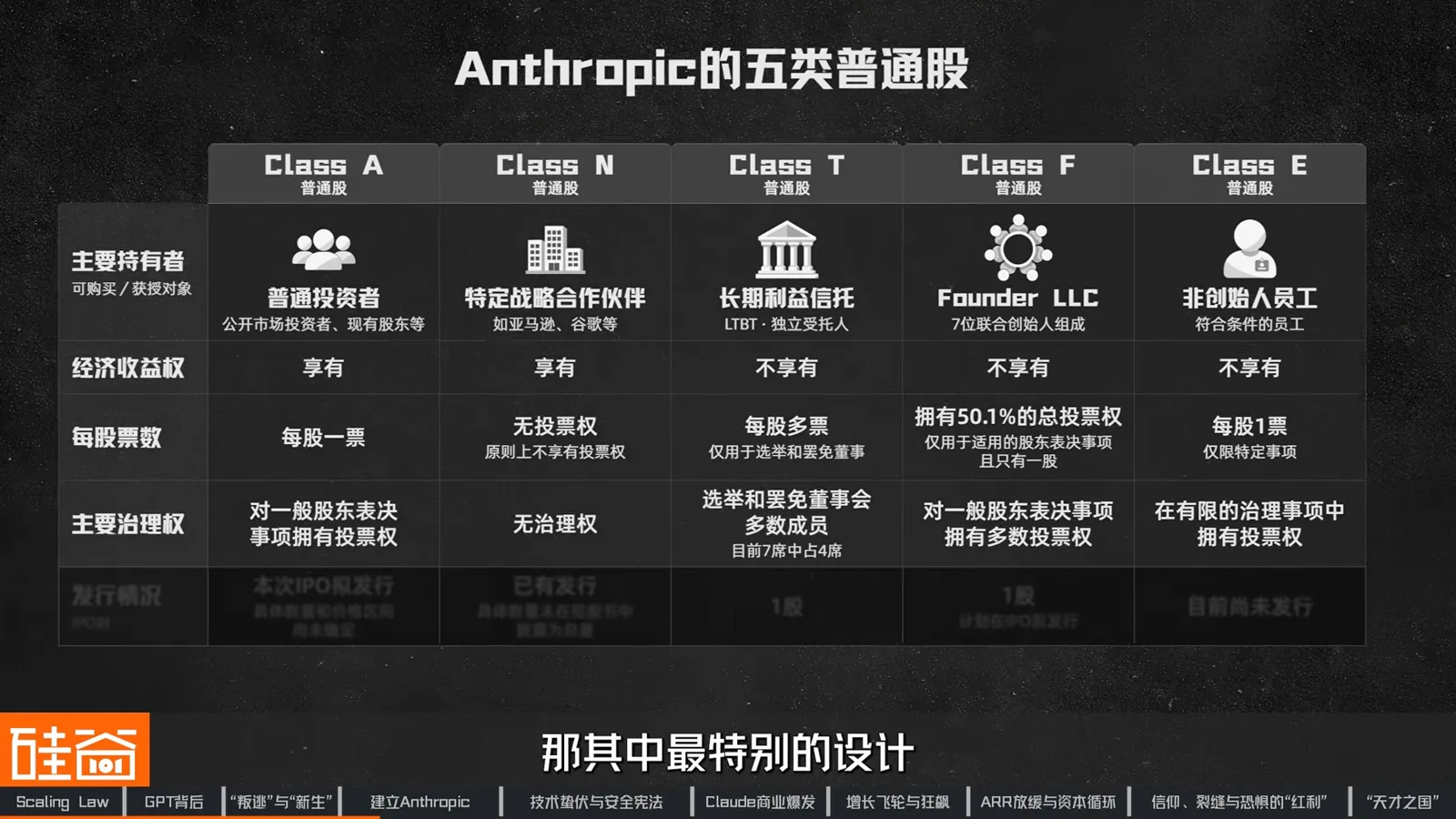
The Long-Term Benefit Trust holds Class T shares and can elect or remove a majority of directors. The program says the trust elects four of seven board seats, giving it a check on the company’s direction and management.
The seven founders control Class F shares through Founder LLC. According to Chen’s account of the prospectus, these shares dynamically retain 50.1% of votes on applicable shareholder matters and cannot easily be diluted through ordinary share issuance.
An interviewed lawyer says the arrangement separates economic returns from control and reflects the founders’ concern for long-term governance. Chen adds that the seven founders hold nearly equal stakes and pledged to donate 80% of their personal wealth.
The program says the public benefit fund received roughly 847 million shares, and the company estimates that around 20% of its shares, including founder and employee commitments, will serve public-benefit purposes. The founders connect their shared pledge with mutual trust.
Daniela Amodei Adds Operational and Commercial Skills
She brought enterprise and operating experience to the team and took responsibility for day-to-day management.
Daniela Amodei worked in political communications, charitable operations and research administration before joining Stripe in 2013, where she handled recruiting and risk management. She describes herself as a generalist who likes learning across fields.
Chen argues that Daniela complemented her brother Dario’s strengths by coordinating hiring, finance and the management team, turning research into a company that could operate at scale.
The program connects Stripe’s experience in enterprise sales, partnerships and organization with Anthropic’s commercialization. Chen says many former Stripe employees later joined Anthropic in recruiting, operations and commercial roles.
Safety Research Before Claude
The team explored alignment with Constitutional AI and safety-level frameworks before launching Claude in 2023.
Chen divides Anthropic’s development into early research, the Claude 1 trial, product expansion after Claude 3, and rapid growth from 2025. For its first two years the company released few products and invested in safety and alignment.
Anthropic says it had trained an early Claude by summer 2022 but worried that releasing it would accelerate an arms race. After ChatGPT launched, Amodei acknowledged that waiting carried a commercial cost.
To reduce reliance on costly human feedback, the team proposed Constitutional AI: provide a model with principles it can use to critique and revise its answers. Amodei compared the principles to a letter a child can consult when a parent is absent.
Claude 1 opened to enterprise partners in March 2023. Chen recalls that Amodei did not then prioritize consumer subscriptions or ads; Roose recalls that the early company looked more like a research lab.
Anthropic developed a Responsible Scaling Policy linking dangerous model capabilities to AI safety levels and safeguards. The program says the original rules required a pause when safeguards were not ready; later revisions became controversial.
FTX Financing and the Enterprise Market
Early capital eased training pressures, while the FTX collapse brought scrutiny to the investment’s origins.
Early training required significant funding. The company raised a $124 million Series A and a $580 million Series B in 2022, roughly $500 million of which came from FTX founder Sam Bankman-Fried.
Bankman-Fried was convicted of fraud after FTX collapsed. The program says the investment involved customer funds, prompting scrutiny of the company’s early financing and its ties to effective altruism.
Chen says Bankman-Fried held non-voting shares and no board seat; the bankruptcy estate sold the stake in batches in 2024, recovering approximately $1.3 billion.
Google invested and provided cloud resources in 2023, while Salesforce and Zoom also participated in financing. Anthropic says safety and reliability fit enterprise needs and explain its emphasis on business customers.
Chen says she also heard another explanation: ChatGPT had already gained a strong consumer lead. Whatever the reason, Claude 2’s long context window and web interface offered a way to handle long documents and reach users directly.
Cloud Partnerships, Claude 3 and Coding Tools
Cloud channels helped distribute the products, while model upgrades and Claude Code drove developer adoption.
Amazon announced a strategic investment of up to $4 billion. AWS supplied cloud infrastructure and chips and distributed Claude to enterprise customers through Bedrock; Google subsequently added to its investment.
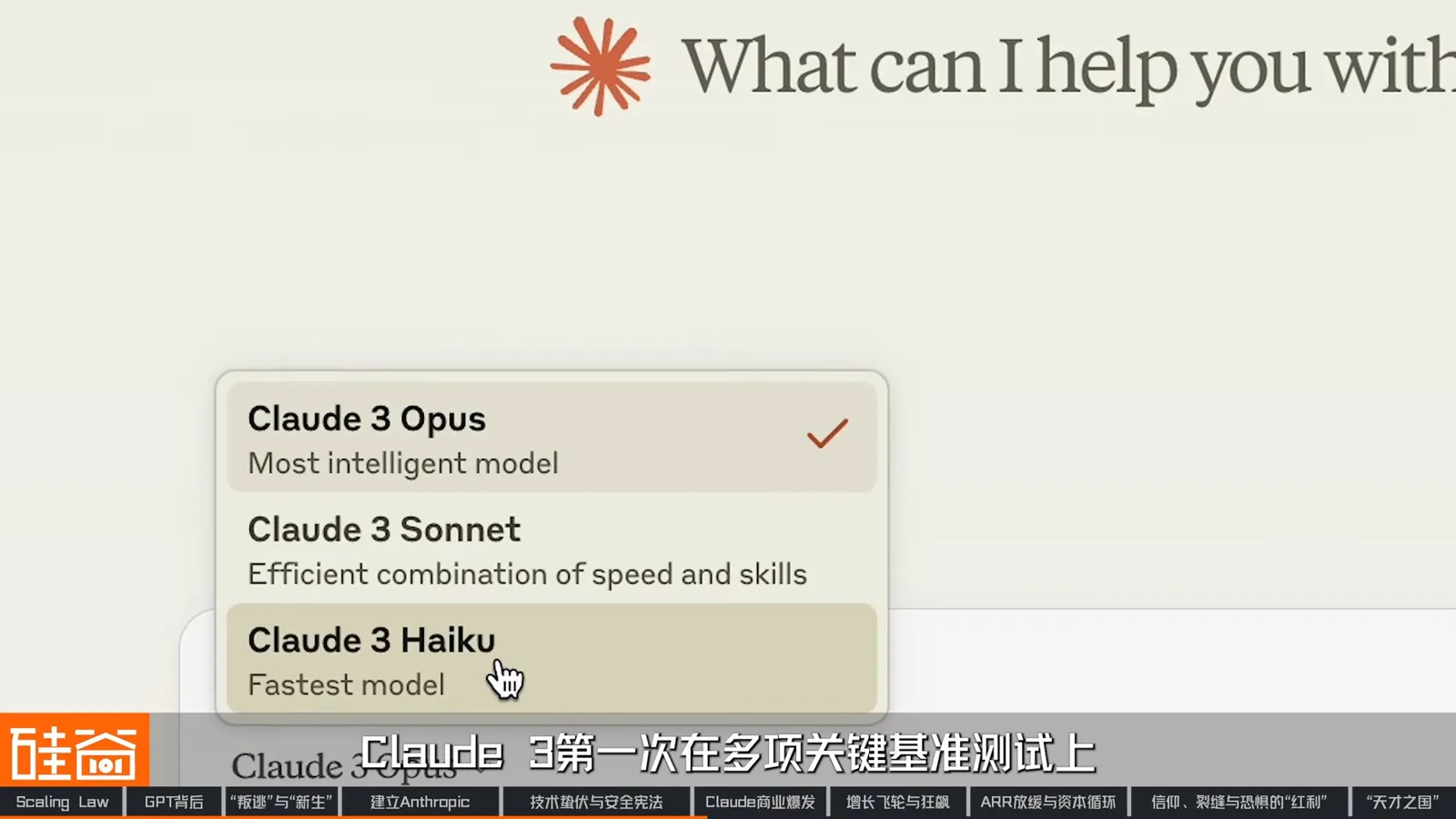
In 2024, Claude 3 offered Haiku, Sonnet and Opus tiers for different needs, performed strongly on several benchmarks and expanded API availability. Sonnet 3.5 followed with stronger coding performance at a lower price tier.
The program cites an internal coding test in which Sonnet 3.5 solved 64% of problems against 38% for Claude 3 Opus, while running faster. As developer-tool adoption grew, Anthropic released Computer Use and the MCP protocol.
The company’s release cycle shortened, according to the program. Claude Code began as a command-line experiment by engineer Boris Cherny to learn the API; once it gained file and command capabilities, it spread quickly inside Anthropic.
Claude Code’s annualized revenue grew rapidly after its public launch in 2025. Cherny says the pace of growth itself surprised him more than the number at any one moment.
Chen argues that Claude Code showed how packaging a model as a specific work tool could generate revenue, after which the company expanded into office and research applications. An interviewee says products lowered the need for users to rebuild applications around an API themselves.
The program describes Anthropic’s expansion across frontier models, developer platforms and consumer-facing products. Its business combines usage-based charges with subscriptions, allowing spending to rise as enterprise use deepens.
Customer Feedback and Investment Cycles
Safety and customer feedback help improve products, while revenue and investment support model training.
Chen describes two reinforcing cycles: safety and reliability help earn enterprise trust, and customer feedback improves products; model capability brings revenue and investment that can support further training.
An investor says enterprise purchasing has high safety, regulatory and integration requirements, but once a product meets them, customer loyalty and spending can support rapid growth.
Amodei argues that greater investment and more data can increase model capabilities, which in turn expand applications and commercial value. Chen says sustaining the cycle requires focusing scarce compute, capital and talent on large models.
Customer and Compute Risks Behind Rapid Growth
The program cites revenue figures while noting customer concentration and long-term compute commitments.
Citing the prospectus, the program says annual revenue rose from about $41 million in 2023 to $4.585 billion in 2025 and grew rapidly in the first half of 2026. Annualized revenue extrapolates a recent rate and is not revenue already earned for the full year.
The program says substantial first-half net losses included fair-value adjustments to convertible financial instruments. Looking at operating performance separately, it says the company achieved its first profitable operating quarter in the second quarter.
The program cites disclosures that, by September 2026, more than 11,900 customers had contributed at least $100,000 over the previous year, and net revenue retention was about 900%. Valuation growth reflected how markets priced that expansion.
Growth also faces pressure. Chen says revenue growth slowed in the second half of 2026 as OpenAI increased its enterprise and coding investment and open models offered customers alternatives on cost and deployment.
The program says the five largest customers contributed about a quarter of revenue, and some lacked long-term contracts and could adjust purchases. Microsoft and Meta were also encouraging employees to use their own AI tools.
Unlike flexible customer spending, compute costs and long-term contracts are harder to reduce. Amodei says the company planned for tenfold annual growth but encountered demand far beyond expectations in 2026.
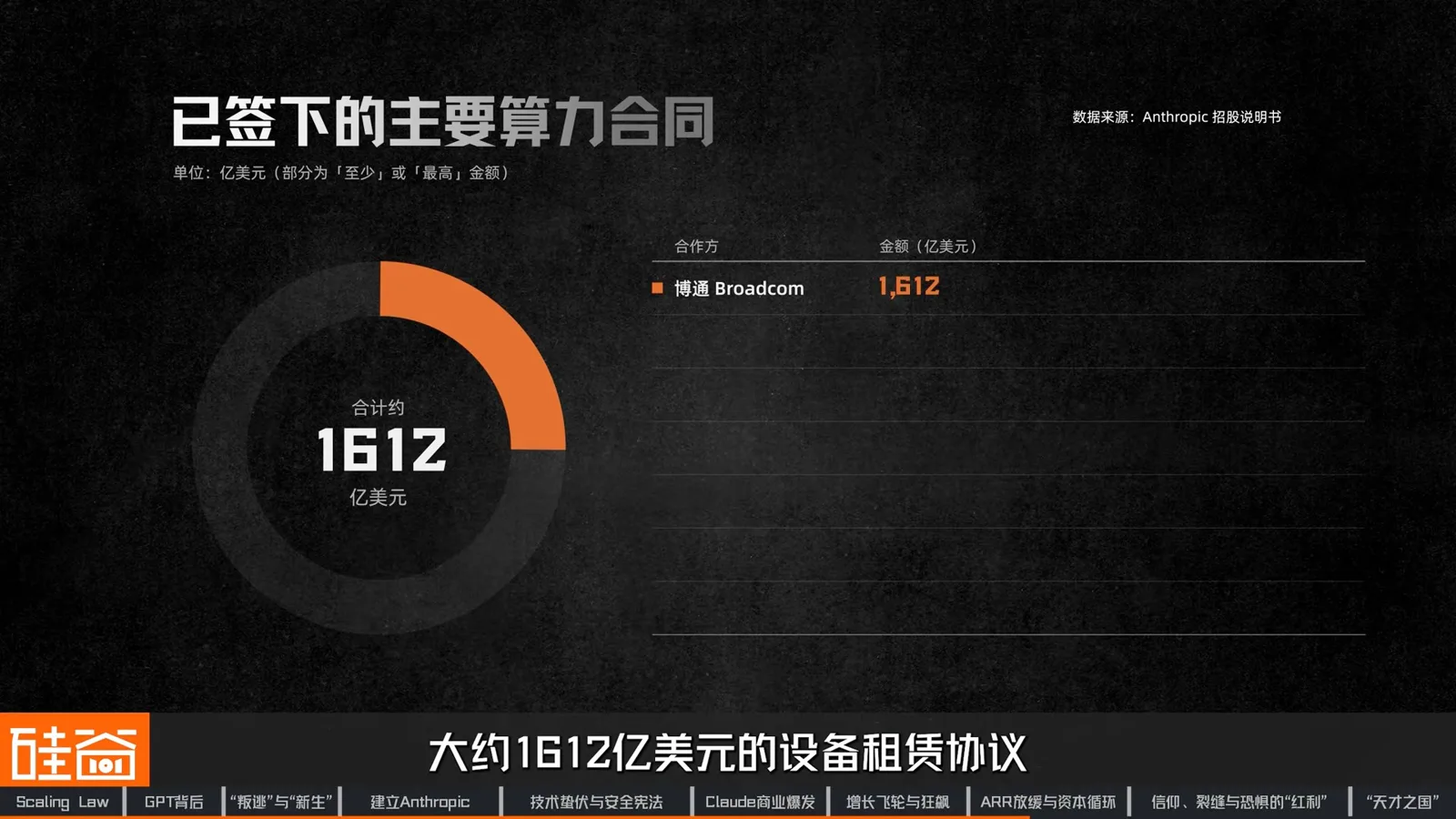
Anthropic signed substantial purchasing agreements with cloud providers and chip suppliers, with some minimum commitments and lease payments extending over many years. An interviewee says buying too little compute risks falling behind, while buying too much can strain finances.
Cloud Giants as Investors, Suppliers and Channels
Multiple relationships support distribution but can also cause disputes over competition and revenue sharing.
Amazon, Google and Microsoft act as investors as well as compute providers, sales channels or competitors. Some funds invested in Anthropic flow back to these partners through compute purchases.
Enterprises can buy Claude through existing AWS and Google Cloud procurement systems, helping Anthropic expand distribution. The program says both sides also gain feedback about customer uses that can inform product improvements.
The program notes that Anthropic and OpenAI use different revenue-recognition methods for some cloud-channel sales, so their published revenue figures cannot be compared directly without adjustment. Channel fees and competition with partners could also create friction.
Culture and Safety Commitments Face Scrutiny
The mission attracts researchers, but deployment speed, policy changes and government work have drawn criticism.
Beyond finances, Chen argues that the company’s culture is under pressure. The program describes a cultural interview for every role, testing how applicants weigh personal interests, business goals and AI safety.
Amodei regularly shares his observations with the company and says he devotes substantial energy to maintaining its culture. The program also describes discussions about AI consciousness and model treatment, as well as high employee retention.
Some interviewees believe a shared mission helps attract and retain researchers. But as commercialization accelerates, the same safety commitments face greater scrutiny.
Anthropic’s 2024 release of Computer Use drew criticism from a competitor over the pace of deployment. The program says the company later changed its Responsible Scaling Policy after a powerful model reached a safety threshold, retaining more discretion over whether to pause.
Chen argues this raises questions about whether safety constraints can operate independently of commercial competition. She also recounts the company’s dispute with the Pentagon over mass surveillance and autonomous weapons.
The program notes that Anthropic had previously pursued government business, released Claude Gov for national security agencies and deployed models on classified military networks, creating difficult safety tradeoffs.
The program describes departing researchers’ criticism of industry competition and safety commitments and asks whether safety messaging reflects sustained conviction or also serves as a commercial position.
Chen discusses restrictions on access to powerful models: supporters see risk control, while critics argue that limiting supply and emphasizing danger can also have marketing value.
The program explains an allegation of regulatory capture: industry participants could influence rules in ways that benefit incumbents. Chen also says there is no strong evidence that Anthropic deliberately manipulated research findings or regulation.
The program also discusses AI’s employment effects, geopolitical competition and open-model policy, arguing that the company’s public positions on risk are drawing growing scrutiny.
Balancing Growth and AI Safety
Amodei’s visions of AI’s potential and its risks form the backdrop for the company’s future choices.
Amodei initially envisioned a company of roughly 50 people and $10 billion that might create mature general AI. The program says the company has grown well beyond that plan, making governance more complex.
In “Machines of Loving Grace,” Amodei imagines many highly intelligent systems collaborating in data centers to accelerate advances such as disease research. Another essay emphasizes risks including misuse, concentrated power and disruption to economic order.
An interviewee believes Amodei sincerely worries about catastrophic risk while continuing to compete to advance the technology, seeking to let those who master it first set the rules. Chen says this tension runs through the company’s product and policy choices.
Chen says public listing, quarterly results and shareholder expectations could further test whether the company’s public mission takes precedence over growth in critical decisions. She closes by asking how its rapid expansion and safety commitments can be balanced.
More from this channel
 38:35ZH → English
 硅谷101· Nov 17, 2026How Nvidia Can Sustain Its Advantages After Jensen HuangGuest Jenny Xiao · Host 陈茜, YiwenAI coding could lower chip-switching costs as Nvidia faces questions about supply-chain trust, investments and succession.
 1:53:56ZH → English硅谷101· Nov 12, 2026Data-center delays: AI demand, community costs and hardware risksGuest Ethan Xu, Christina Xu, Bruce Liu, Rob Li, Elizabeth Yang, Steven, Steve · Host 陈茜, Richard, YiwenOperators assess how permits and electricity prices affect compute supply; investors debate demand, while residents raise housing, traffic and compensation.
 1:02:07ZH → English硅谷101· Nov 11, 2026Lingguang 2.0: A personal assistant must solve problems before chargingGuest 莫林剑 · Host 陈茜Ant Lingguang CTO Mo Linjian discusses ongoing goals, super-app ecosystems, payment safety and the boundaries of proactive reminders.
 42:06EN硅谷101· Nov 5, 2026Data-Center Power, Financing and Compute: A Panel with Yixing Xu, Alex Yeh and Bruce LiuGuest Yixing Xu, Alex Yeh, Bruce Liu · Host Christina XuBuilders and an investor discuss transmission constraints, delivery delays, lease mismatches and the economics of selling compute.
 1:32:16ZH → English硅谷101· Nov 2, 2026MaxInsights Founder Yuan Yuguang on Producing First-Person Training Data for RobotsGuest 袁宇光 · Host 陈茜Yuan explains the growth and quality challenges of robotics data, from head-mounted cameras and global collectors to evaluation and deployment.
 19:20ZH → English硅谷101· Oct 29, 2026Michael Hsu: How Robots Can Understand the Physical World Through Touch, Data and ActionThe PaXini founder explains how tactile sensing, data factories and dexterous hands can support physical AI.