In 30 seconds
After Jensen Huang resigned as Nvidia CEO, chip-industry guests argue that AI coding could gradually lower the cost of moving software to other hardware, though one experiment does not represent a full system migration. The program says Nvidia’s advantage also rests on rack-scale integration, long-standing supply partnerships and its developer ecosystem. Meanwhile, investments in customers raise questions about demand and financing risk, while decisions and customer relationships that depended heavily on the founder create challenges for his successor.
- 1The three-day port had a narrow scopeThe program cites an alleged Anthropic experiment on an AMD GPU while cautioning that one prompt-processing task is not a cross-platform migration of an entire AI system.
- 2Competition may shift from a single chip to the whole systemA guest expects chips, networking, scheduling, cooling and supply-chain integration to matter increasingly to data-center capabilities.
- 3The developer ecosystem is a path to future computing demandYiwen argues that open-model tools make familiar platforms easier for small teams to use; Nvidia’s proposed acquisition of Hugging Face remains under regulatory review.
- 4Investing in customers makes independent demand harder to assessAn investor worries that flows among strategic investments, cloud purchases and chip sales may inflate valuations or obscure underlying demand.
- 5A decision system built around a founder faces a succession testThe program says more than 60 executives reported directly to Huang. A flat structure can move quickly but requires a successor to take on decisions across fields.
- 6Talent competition outside core businesses involves more than payChen Qian says research autonomy, product ownership and expectations for stock returns can all affect whether employees stay.
Takeaways
- A single AI-assisted chip-porting experiment cannot be equated with migrating an entire AI system.
- Guests believe Nvidia’s system integration and supply-chain coordination may matter more than any one software barrier.
- The program says a chip supplier investing in customers complicates assessment of independent computing demand and deal risk.
- Flat decision-making and founder-led customer relationships can bring speed but make succession harder.
Read the edited text by chapter
What Nvidia faces after its founder’s departure
The program examines AI tools, the supply chain and organizational succession after Huang’s resignation.
After Jensen Huang resigned as Nvidia CEO and left its board, Chen Qian asks more than who should succeed him: how can a company that tightly combines chips, software, supply chains and customer relationships operate after its founder leaves?
Chen says some in technology fear Huang left when Nvidia needed him most. A guest argues that AI coding tools are reducing the cost of adapting software for other chips and could gradually change CUDA’s competitive advantage.
Can AI coding weaken CUDA’s switching costs?
A guest expects porting to other chips to become faster, but the program cautions that one inference experiment is not a whole-system migration.
CUDA is Nvidia’s parallel computing platform, which lets developers use GPUs for general-purpose computing. Even if a rival chip has a performance or price advantage, migrating existing software and engineering expertise still takes time and investment.
The program cites presentation material reportedly from Anthropic: connecting to a new chip platform once could take dozens of engineers and months, while Claude Mythos helped a team adapt a particular inference task to an AMD GPU in about three days. The program stresses that the experiment covered one prompt-processing task for one model, not an entire system migration, and needs further verification.
One guest expects coding agents to reduce reliance on scarce low-level engineers over time. CUDA will not lose relevance overnight, he says, but its role as a switching barrier may weaken. He believes AI could generate or adapt computing kernels, operator libraries and system scheduling more quickly for different hardware.
The guest also envisages customized software stacks running end to end, from an application through assembly code, inference serving and runtime scheduling. If each model or application can more easily get its own software, the advantage of a general-purpose ecosystem could be challenged; this remains his assessment of the direction of the technology.
Competition expands from chips to systems and supply chains
A guest expects coordination across chips, networks, cooling and long-term capacity to become more important.
If CUDA’s advantage weakens, the guest believes system integration will matter more. Nvidia makes more than GPUs: it is developing CPUs, networking and software, using tools such as Dynamo to coordinate inference. Competition could shift from single-card performance to entire racks or data centers.
The guest says inference can be split into prefill and decoding, and some cache moved to storage; combining CPUs and GPUs is another heterogeneous system. Nvidia did not invent liquid cooling, power delivery or optical interconnects, but its product demands and iteration speed have pushed suppliers to adopt such technologies faster.
The guest points to multiple chips in Vera Rubin systems, Mellanox’s networking capabilities and optical circuit switching. He believes Huang could bring suppliers together around ambitious technical directions and worries that investment and expansion decisions could slow after the leadership change.
Chen cites Huang’s description of his long partnership with TSMC to emphasize decades of technical collaboration and trust. The program says Nvidia became TSMC’s largest customer in 2025 and used a substantial share of its advanced-packaging capacity.
For a foundry that invests heavily and waits years for returns, the program argues, confidence in long-term demand matters as much as current order size. A guest worries that Huang’s departure could change how partners assess future demand.
The same guest speculates that TSMC could give other promising customers more opportunities when allocating advanced process and packaging capacity, including AMD as its software ecosystem and performance improve. This is a judgment about future allocations, not an announced capacity plan.
The program turns to open-source models, autonomous driving, robotics and quantum computing. Chen says these contribute relatively little revenue today, but Huang hoped to establish a computing ecosystem and standards before the next surge in accelerated-computing demand.
Why an open ecosystem matters to a chipmaker
Yiwen explains Nvidia’s open-model strategy and the proposed Hugging Face acquisition, which remains under review.
Yiwen describes the AI industry as five layers: energy, chips, infrastructure, models and applications. She says Nvidia participates in several through investment, acquisitions and partnerships, and its proposed Hugging Face acquisition illustrates its developer strategy.
Hugging Face hosts models, weights, datasets and applications, making it an important place for developers to find and deploy open models. Leonis Capital partner Jenny Xiao believes the proposed acquisition signals that Nvidia wants to be a central participant in open AI, not just a chip supplier.
Yiwen says the proposed transaction remains under regulatory review and is not a done deal. Nvidia had previously supported open-weight models and released Nemotron and tools and models for robotics and the physical world; one commercial benefit is expanding the community of developers using computing resources.
Yiwen says large model labs and cloud providers have the resources to explore multiple clouds and chips from other vendors, while small companies and individual developers need new models to run quickly on familiar hardware. Mature adaptation tools help Nvidia reach those potential future customers.
One guest believes Hugging Face’s common interfaces and community could strengthen Nvidia’s developer relationships, though the outcome depends on how quickly competitors catch up. He says AMD and TPU suppliers focus relatively more on large customers and lag in support for the developer community.
Yiwen explains that Hugging Face’s Hub brings weights together, while libraries such as Transformers provide a more uniform way to call models, reducing repeated coding work when developers switch. The platform gives Nvidia a chance to participate earlier in the process from model discovery to computing choice.
Yiwen says some open-model researchers worry about the US open ecosystem after Huang’s departure. But openness also fits Nvidia’s commercial logic of expanding hardware demand, so a leadership change does not necessarily mean that strategy will disappear.
Investment across the industry raises financing questions
The program examines links between investments, computing purchases and chip supply, as well as the risks of investments and guarantees.
The program surveys Nvidia’s investments and partnerships across models, applications, computing, chips and energy. Yiwen cites Jenny Xiao’s analysis that Hugging Face would add distribution to this map; acquired companies, equity investments and supply partners have different relationships with Nvidia.
The program cites investment figures through July 2026 and mentions Nvidia’s investment and deployment partnership with Thinking Machines Lab. Yiwen’s assessment is that Nvidia is becoming involved earlier in AI projects and in the infrastructure they need.
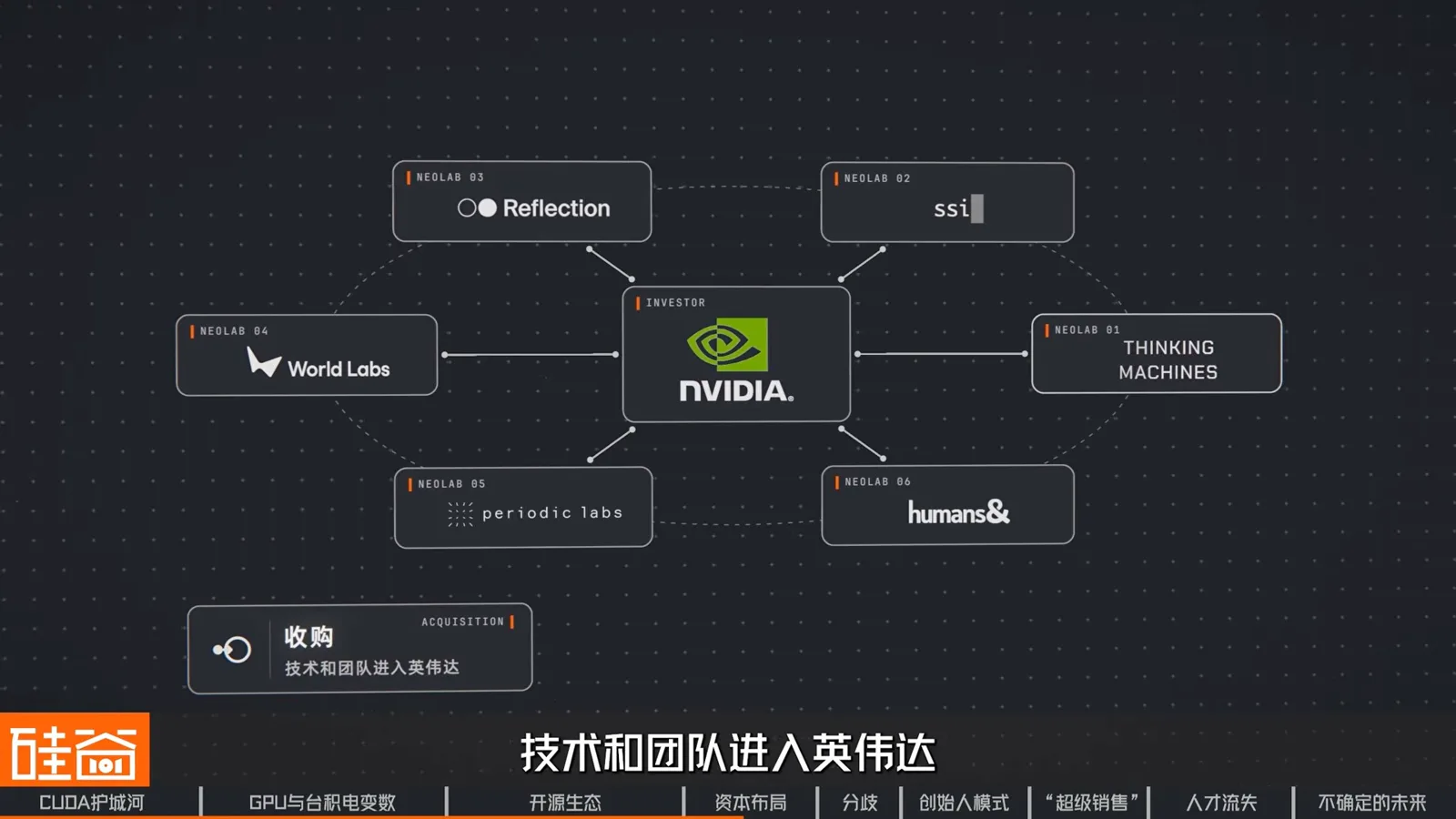
The arrangement raises a question about whether demand is being amplified more than once: a chip supplier invests in a model company, the model company buys cloud services and the cloud provider buys chips. A financial investor worries that strategic investments can raise valuations and make independent end demand harder to judge.
Yiwen cites media reports that Huang and CFO and interim CEO Colette Kress disagreed about the risks of financing guarantees for data-center projects. She asks whether the new leadership will continue Nvidia’s aggressive approach to investment and ecosystem building.
The program mentions a reportedly proposed guarantee tied to OpenAI data-center financing and Kress’s concerns about risk and return. A guest thinks that if Nvidia reduces financial support for ecosystem partners, some companies’ financing and expansion could suffer; the successor’s strategy remains to be seen.
Handing a flat organization to a successor
Direct reporting by many executives can speed decisions, while making succession dependent on skills across disciplines.
Chen then examines management. She says more than 60 executives previously reported directly to Huang, concentrating technical, product and commercial decisions. Employees also sent regular ‘top five things’ emails to keep management directly informed of project progress.
In the program’s view, this flat structure reduces layers and speeds decisions but depends on someone who understands multiple fields. Chen worries that if the organization has not naturally developed a person who can take on those cross-disciplinary decisions, the former efficiency advantage becomes a succession risk.
One guest believes Huang’s departure from both the CEO role and board will affect market expectations for the company’s valuation, even if near-term business figures do not immediately change. His proposed valuation discount is a personal judgment, not a certain outcome.
How to preserve the most important customer relationships
The program describes a sales system combining technical support, an ecosystem and leadership involvement.
Chen says Nvidia’s sales system does more than sell chips: salespeople, engineers and management work together to understand and solve customer problems and cultivate developers. A guest considers Huang one of the company’s most important salespeople because he knows its products and can help customers understand their value.
The program reviews the development of Nvidia’s early sales team and its shift from graphics-card supplier to enterprise computing platform. Chen cites the delivery of an early DGX system to OpenAI and later discussions with large customers and governments about AI infrastructure.
She argues Nvidia moved from selling chips to selling computing platforms and helping cultivate industry demand. The challenge for a successor is to take over Huang’s relationships with customers, suppliers and governments, which do not automatically transfer with a job title.
Changes in talent competition and stock incentives
Researchers’ career choices, stock returns and the founder’s departure may all affect retention.
On talent, Chen distinguishes core businesses such as GPUs, networking and computing systems from newer fields including robotics, world models and health care. The latter relate to the platform but may not be major revenue sources; researchers may gain more direct product control by founding a company or joining a focused lab.
Chen says Nvidia has acquired external teams through acquisitions and technology-licensing deals, but buying a team does not guarantee long-term retention. Beyond pay and computing power, leading researchers may value research autonomy and whether their work directly shapes the product.
Stock incentives cut both ways: past appreciation gave some employees enough wealth to retire or start companies, while newer employees face uncertain future returns. Chen believes the company may need more competitive pay, technical autonomy and career opportunities.
She says some people stayed at Nvidia partly because they wanted to work with Huang; his departure could change talent flows. A guest speculates that some employees may start companies or join competitors but does not give a definite number.
Board control and a founder’s personal influence
The program discusses governance and Huang’s role in the company’s history.
The program also discusses governance. Chen says Huang held a limited ownership stake and Nvidia did not establish a dual-class structure giving its founder super-voting rights when it went public. A guest believes this prevented him from controlling board decisions through his shareholding alone.
Chen recalls attending Nvidia’s GTC conferences, interviewing Huang and making a program about the company’s history. She says she respects his persistence, technical judgment and ability to unite engineers; she does not reach a conclusion about allegations in the controversy that remain to be clarified.
The program closes with the competition Nvidia has long faced: customers and partnerships change, and the company must keep moving. Chen says she hopes Huang will continue his career in the future.
More from this channel
 1:53:56ZH → English
 硅谷101· Nov 12, 2026Data-center delays: AI demand, community costs and hardware risksGuest Ethan Xu, Christina Xu, Bruce Liu, Rob Li, Elizabeth Yang, Steven, Steve · Host 陈茜, Richard, YiwenOperators assess how permits and electricity prices affect compute supply; investors debate demand, while residents raise housing, traffic and compensation.
 1:02:07ZH → English硅谷101· Nov 11, 2026Lingguang 2.0: A personal assistant must solve problems before chargingGuest 莫林剑 · Host 陈茜Ant Lingguang CTO Mo Linjian discusses ongoing goals, super-app ecosystems, payment safety and the boundaries of proactive reminders.
 42:06EN硅谷101· Nov 5, 2026Data-Center Power, Financing and Compute: A Panel with Yixing Xu, Alex Yeh and Bruce LiuGuest Yixing Xu, Alex Yeh, Bruce Liu · Host Christina XuBuilders and an investor discuss transmission constraints, delivery delays, lease mismatches and the economics of selling compute.
 1:32:16ZH → English硅谷101· Nov 2, 2026MaxInsights Founder Yuan Yuguang on Producing First-Person Training Data for RobotsGuest 袁宇光 · Host 陈茜Yuan explains the growth and quality challenges of robotics data, from head-mounted cameras and global collectors to evaluation and deployment.
 19:20ZH → English硅谷101· Oct 29, 2026Michael Hsu: How Robots Can Understand the Physical World Through Touch, Data and ActionThe PaXini founder explains how tactile sensing, data factories and dexterous hands can support physical AI.
 29:44EN硅谷101· Oct 27, 2026Harry Wang: AI, Two-Dimensional Semiconductors, and the Future of Chip ManufacturingA semiconductor researcher explains materials, yield, AI-controlled experiments, and a proposed feedback loop between models and chips.