In 30 seconds
At Silicon Valley 101’s Alignment 2026 conference, PaXini founder and CEO Michael Hsu argues that robots need perception, intelligence and execution to move from observation to reliable physical interaction. He presents the company’s tactile sensors, data and models, and its vision for an open robotics ecosystem. The video description identifies PaXini as a conference sponsor.
- 1From human touch to robot sensingHsu uses a glass of water and an egg to show how touch helps people adjust grip.
- 2Building robot experienceData factories and gloves collect interactions with objects for robot training.
- 3The three parts of PIEPerception, intelligence and execution together underpin interaction with the physical world.
- 4Touch and generalizationFeelix World aims to encode tactile information and explore few-shot and zero-shot generalization.
Takeaways
- Tactile information helps robots sense contact and force; vision and text alone are insufficient for manipulation.
- Data from human and robot interaction with objects can support training and continual learning.
- Handling unfamiliar objects is one way to evaluate robotic generalization.
- Physical AI needs a closed loop of perception, intelligence and execution.
- PaXini proposes a platform, integration and ecosystem to support more robot developers.
Read the edited text by chapter
Understanding the physical world through touch
Hsu uses the example of holding objects to explain tactile sensing and introduces PaXini’s business.
I’m Michael Hsu of PaXini AI. Today I want to talk about the PIE of physical AI. Our company takes its name from the Pacinian corpuscle, a receptor in human skin that senses texture and high-frequency vibration. We want to make a sensing skin with a similar function.
Imagine holding a full glass of water in one hand and an egg in the other. We know how to hold them without dropping or crushing the egg because our hands receive a great deal of tactile information and our brains can process it. Touch is central to how people interact with the physical world.
PaXini aims to advance general intelligence through embodied perception. The company has raised more than $600 million and its latest valuation exceeds $3 billion; its products are used in automobiles and other fields as well as robotics. Samsung, LG and BYD are among its investors and partners in robots or automation equipment.
From observation to interaction
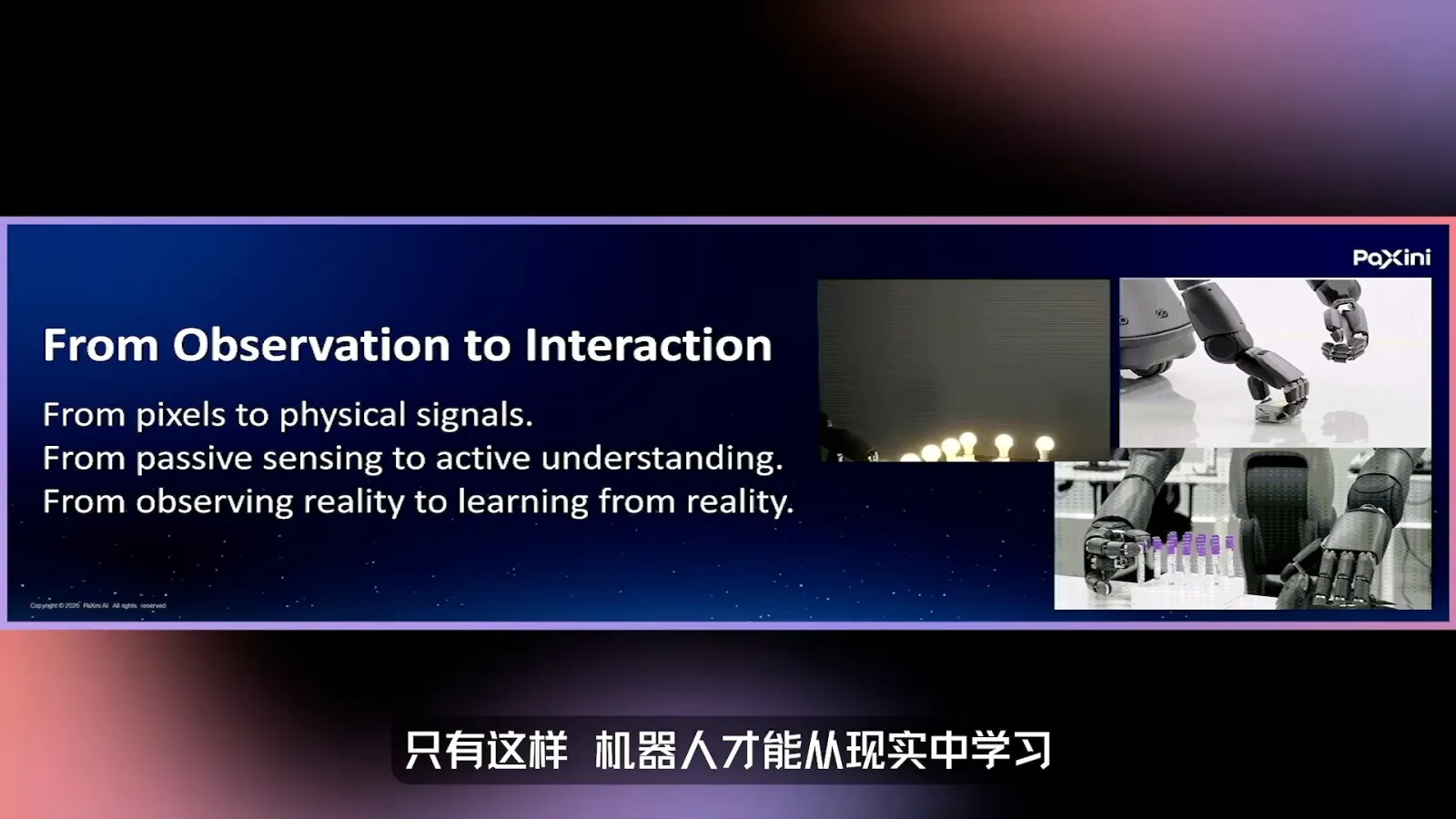
Robots must move beyond vision and textual knowledge to gain experience through contact.
When we consider intelligence in the physical world, we must ask whether AI can really understand it, even if it can think. When a person cleans a floor, touch helps them judge whether a vacuum nozzle is pressed against the surface. A robot making the same movement may not understand what happens during contact.
Intelligence without physical understanding is incomplete. There is still a large gap between knowing how to do something, doing it, and doing it reliably. The next generation of AI must do more than understand instructions or respond to prompts: it must interact with the world and bring about real change.
The world is more than the pixels a camera sees. It is also what we touch, feel and change. AI needs to move from observation to interaction, and from passive sensing to active understanding. Only then can robots learn from reality.
In our experiments, tactile sensors help a robot feel contact as it grasps a nozzle, an object or a light bulb. Textual knowledge alone is not enough: a robot may know that a cup is cylindrical without knowing how to grasp and manipulate it. Experience teaches it how to act.
Data and real-world evaluation
Data factories and gloves collect interaction experience, while unfamiliar objects offer a test of generalization.
To provide that experience, we need a data layer. In a data factory, a person observes and interacts with objects, for example by picking up a bottle. The resulting data can help a robot learn from the physical world. Every interaction can become an opportunity to learn.
Data collection need not be confined to a fixed factory. We also provide equipment so people can teach robots at home, turning interactions in many places into data and creating a flywheel for physical intelligence.
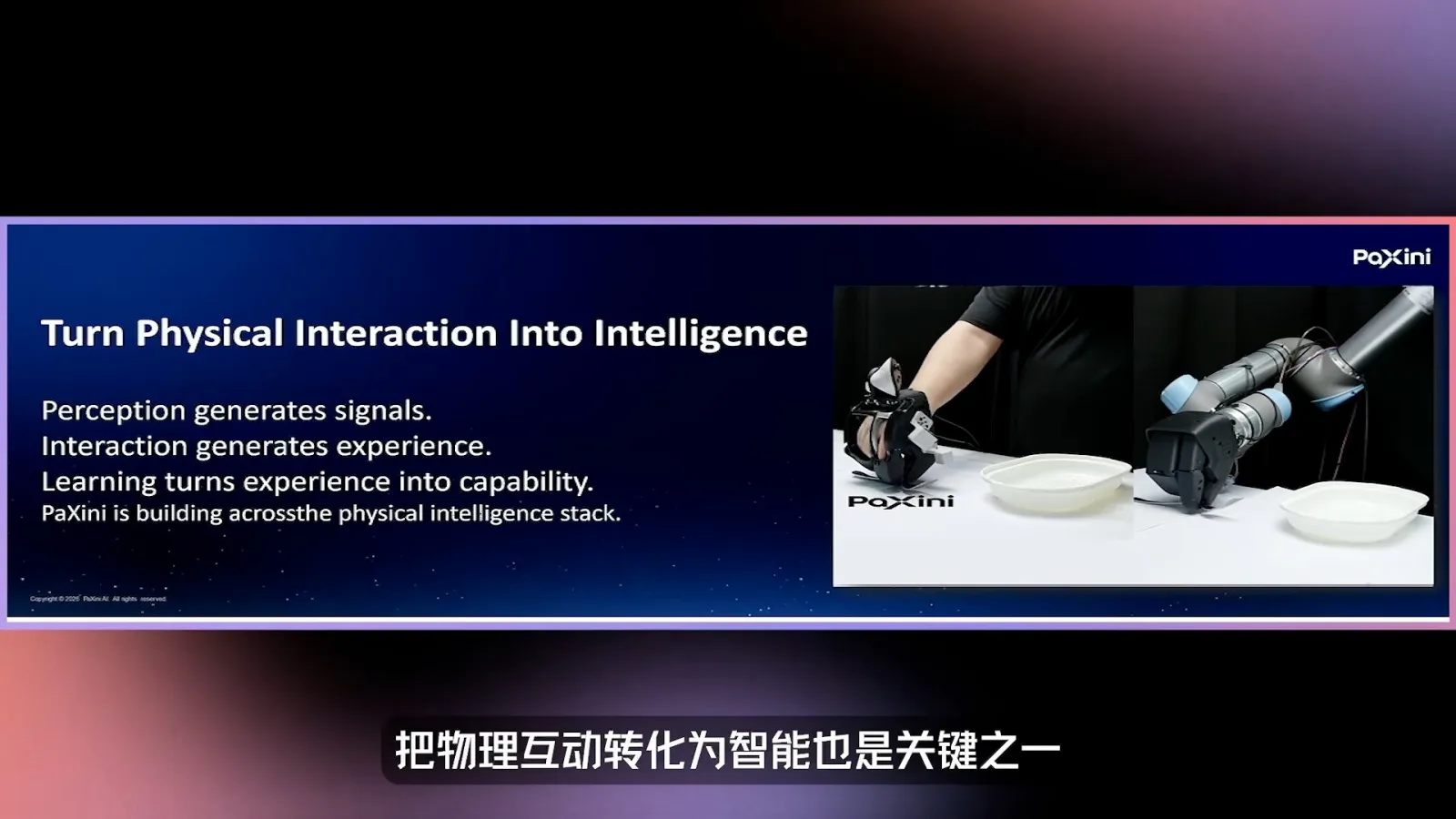
For example, we collect motion data with a glove. This is not simply remote control: we use the data to train a small model that can perform the action precisely. Both tactile signals and interactions with different objects matter to learning.
After learning, we also need to assess whether a task meets human needs. One simple benchmark is whether a robot can handle an object it has never seen or manipulated before. The real world is the ultimate test, and interaction must be measured in real environments.
PIE: perception, intelligence and execution
The talk covers sensors, data factories and models, and the execution capabilities of robot hands.
That brings us to PIE: perception, intelligence and execution. Every robot needs all three. We hope their combination can connect intelligence with reality and create more possibilities for robots.
The perception layer is built on our own sensor chips. In a demonstration, a sharp needle touches a robot fingertip; with tactile perception, the hand can respond to that contact. The same chip architecture can support sensors for robot fingertips, automobiles and other applications.
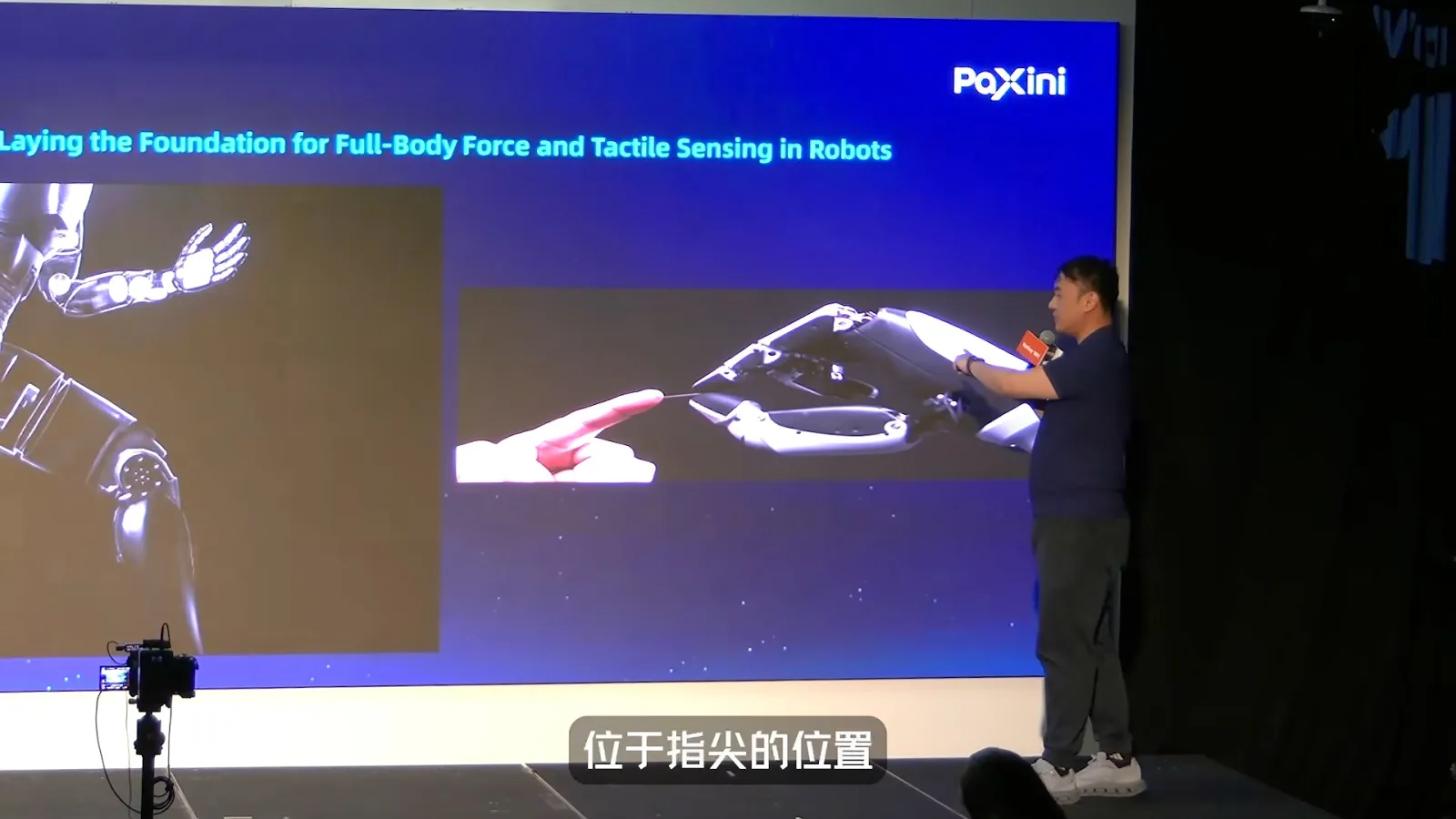
Current products include joint torque sensors, six-axis force and torque sensors for end effectors, and tactile sensors for fingertips, palms, skin and even the soles of feet. The goal is full-body physical perception, while new customer requests are prompting exploration of other uses.
The intelligence layer depends on data factories. We have obtained more than one million hours of high-precision human data containing tactile information, in a database called OmniSharing DB. It can support warehouse, household and factory applications.
We have planned five data factories: one each in Suqian and Tianjin, with three more nearing completion. Robots also need algorithms to learn from the data, which can be used for pretraining, post-training and even lifelong learning.
We developed Omni VTLA 2.0 to test how useful the data is. The model can use data from the factories as well as data generated by robots themselves, enabling further learning through continuing interaction.
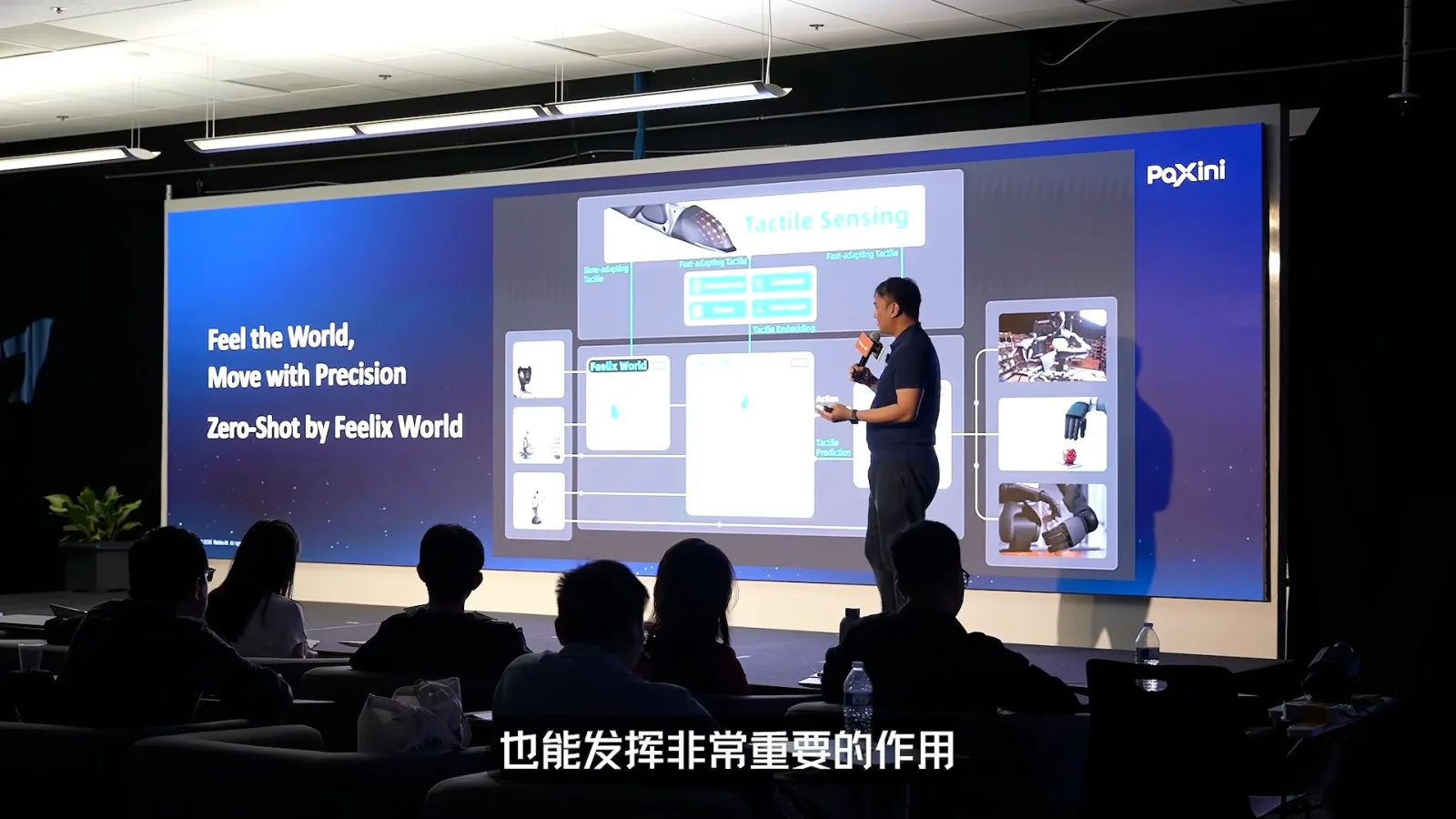
Another model, Feelix World, aims to encode tactile information and explore few-shot or even zero-shot generalization. We have not abandoned language or vision; we also combine robot interaction data with slow-adapting and fast-adapting tactile information.
The final part of PIE is execution. Even excellent perception and a good brain cannot close the loop and complete real-world tasks without a robot body and end effectors, such as hands. Robot-hand design is therefore essential.
We want to open our dexterous-hand designs to robot companies that need them, while improving reliability. Hsu says the DexH13 hand has undergone more than 20,000 hours of usage testing; the company has also developed applications with customers including LG, Samsung, JD.com, BYD and Honor.
Platform, integration and ecosystem
A second PIE points to an open platform and robotics ecosystem.
Finally, PIE has a second meaning: platform, integration and ecosystem. The first PIE gives robots the ability to interact with the physical world; the second seeks an open ecosystem that helps more people develop their own robots. We hope robots will take on demanding tasks and benefit people.
More from this channel
 1:32:16ZH → English
 硅谷101· Nov 2, 2026MaxInsights Founder Yuan Yuguang on Producing First-Person Training Data for RobotsGuest 袁宇光 · Host 陈茜Yuan explains the growth and quality challenges of robotics data, from head-mounted cameras and global collectors to evaluation and deployment.
 29:44EN硅谷101· Oct 27, 2026Harry Wang: AI, Two-Dimensional Semiconductors, and the Future of Chip ManufacturingA semiconductor researcher explains materials, yield, AI-controlled experiments, and a proposed feedback loop between models and chips.
 30:11ZH → English硅谷101· Oct 25, 2026How AI Is Reshaping Cross-Border Payments: From Transaction Routing and Risk Control to Agentic CommerceGuest Leo Li, Apple Gao · Host 陈茜硅谷101 starts from a cross-border airfare payment to unpack how complex payment networks really are, and how Antom is bringing AI into operations, risk decisions, and agent-driven commerce.