In 30 seconds
In this March 2024 tutorial, Matthew Berman introduces Fabric as an open-source collection of community-created prompts and walks through the installation and command-line interface available at the time. He uses patterns to extract ideas from a video transcript and analyze claims. The installation steps, terminology and model options describe the historical version shown in the video. Software changes over time; generated summaries and claim assessments still require independent review.
- 1A library of patternsBerman presents Fabric as a collection of community-created prompts for a range of everyday tasks.
- 2Historical setupHe clones the repository, installs dependencies and runs setup; these steps reflect the 2024 version.
- 3Fabric terminologyHe explains the mill, patterns, stitches and loom before showing the command-line pattern list.
- 4Working with a transcriptThe demonstration pipes a copied transcript into an extraction pattern and examines the resulting ideas and claims.
Takeaways
- Fabric's patterns package prompts for tasks such as summarization, code explanation and analysis.
- The 2024 demonstration installs the repository and its dependencies, then configures model access through the command line.
- Berman demonstrates sending clipboard text to an extraction pattern and running a separate claim-analysis pattern.
- The video distinguishes patterns, stitches, a mill and a loom as concepts in the version then shown.
- AI-generated claims, evidence and scores should be reviewed rather than assumed correct.
Read the edited text by chapter
What Fabric offers
Berman introduces the open-source project and examples of its prompt patterns. He describes potential uses across writing, research and code.
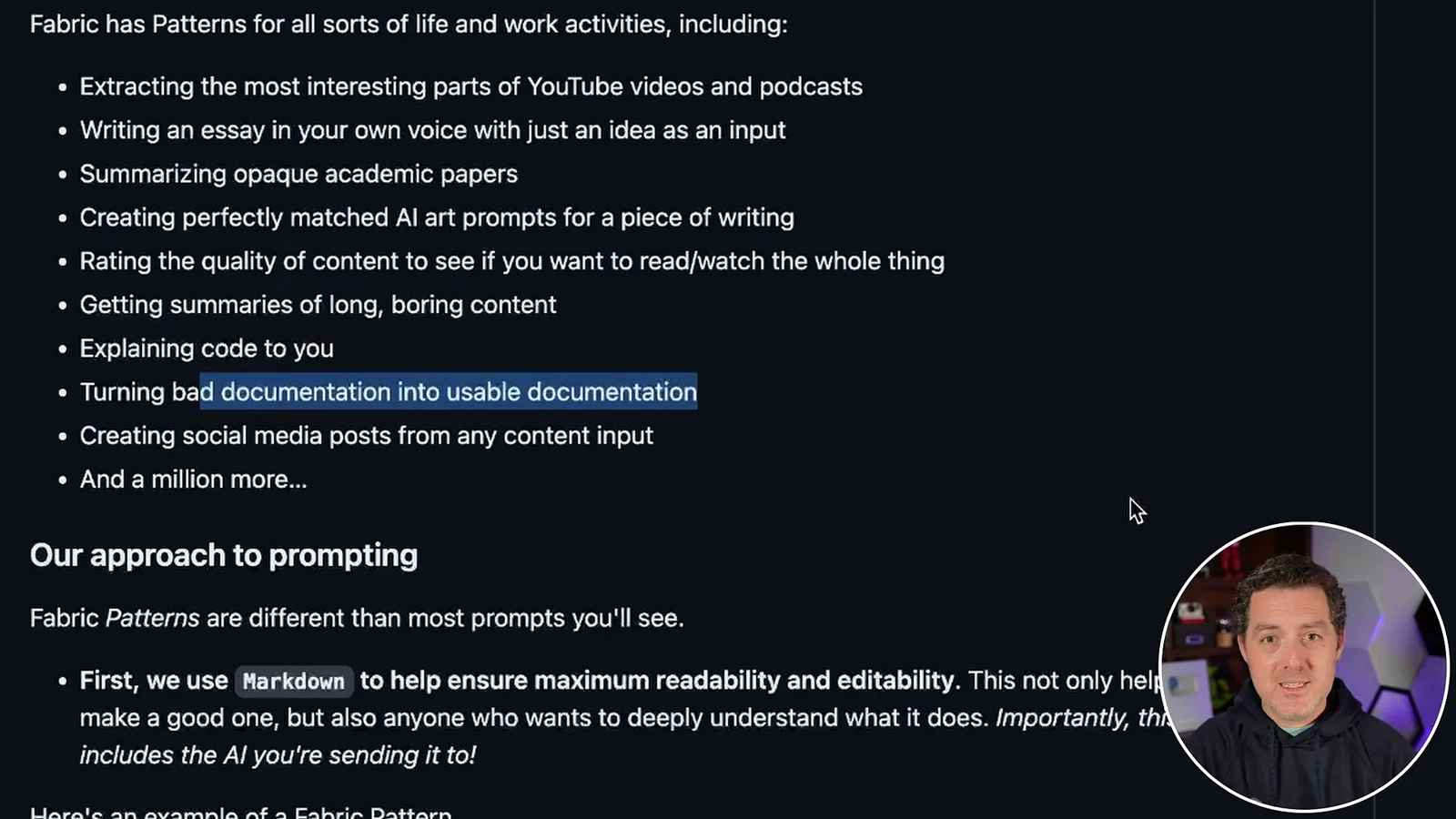
Fabric is an open-source project that packages community-generated prompts for everyday AI tasks. Matthew Berman describes it as a library of detailed patterns and says the examples cover a wide range of problems. His assessment that the prompts work well is his experience, not a guarantee for every input.
The examples include extracting ideas from videos and podcasts, writing in a particular voice, summarizing academic papers, creating image prompts, explaining code and improving documentation. Berman says different hosted or local models can be used, depending on setup.
Installing the 2024 version
He clones the repository, sets up dependencies and configures model access. The process and options may have changed since the recording.
In the March 2024 demonstration, Berman clones the Fabric repository and enters its directory. That version uses Poetry; he describes trouble with his own Python environment and shows how he installed the dependency before running the project's setup script. The repository and setup process may have changed since the video.
After setup, Berman encounters a shell configuration parse error. He opens his zsh configuration, fixes the indicated line and restarts the shell. He then checks the Fabric command's help output to confirm that it runs. His local fix applies to the error he encountered, not necessarily to another user's environment.
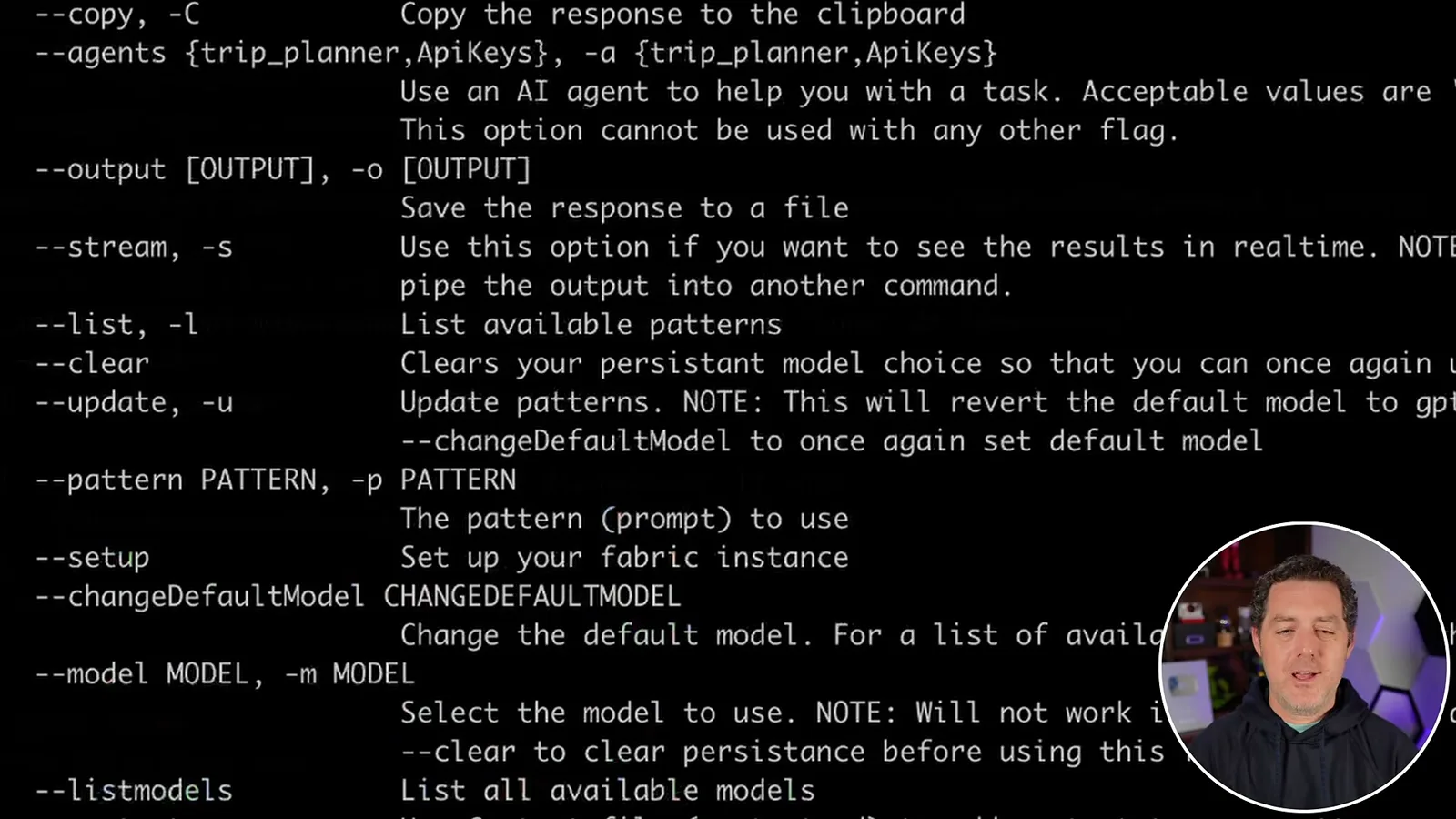
He runs the version's setup command to enter model API credentials and update its patterns. Berman says he created a temporary key and would revoke it before publishing. He also mentions alternatives to GPT-4, including Claude and local models, while noting that their configuration may require more work.
Patterns and a transcript example
Berman explains Fabric's terminology and lists patterns. He then extracts ideas from a transcript and runs a claim-analysis pattern.
Berman explains the terminology shown in that version: a pattern is a prompt for a particular use case, stitches combine patterns, a mill can serve patterns, and a loom is a client application that can call them. He proceeds with the command-line interface and lists the available patterns.
He opens an analysis pattern for academic papers. It defines an identity and purpose, output sections and instructions for processing input. The point of the library is to package detailed instructions for repeatable use; Berman recommends browsing the available patterns.
For a demonstration, he copies the transcript of his own introductory large-language-model video without timestamps. On his Mac, he pipes clipboard contents into Fabric's extract_wisdom pattern. The result organizes ideas, quotations, habits, facts, references and follow-up recommendations.
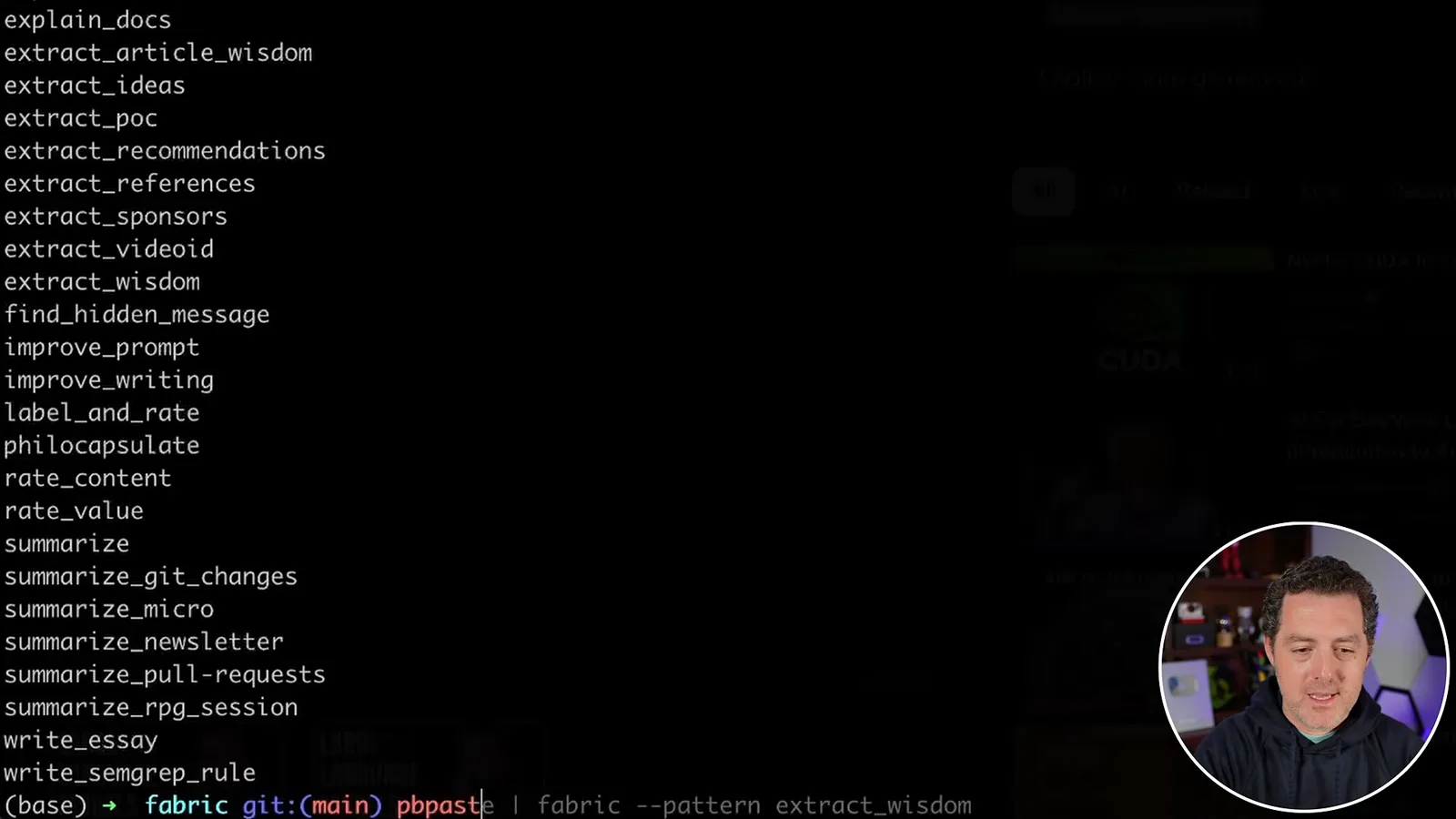
Berman notes that the GPT-4 request takes time and says a streaming option can show output as it arrives. He then runs a separate analyze_claims pattern over the transcript. The generated result extracts claims, offers supporting or opposing material and assigns scores. Those outputs are model-generated assessments, not independent verification.
The demonstration shows the claim analysis streaming in the terminal. Berman reviews its scores, recommends the project and closes by pointing viewers to the links in the video description.
More from this channel
 14:45EN
 Matthew Berman· Oct 29, 2026Matthew Berman Examines Google’s Gemini 4 Carbon AnnouncementMatthew Berman · Forward FutureMatthew Berman reviews Google’s reported benchmark results, staged rollout and pricing for Gemini 4 Carbon, while noting he has not yet used the model.
 21:11ENMatthew Berman· Oct 28, 2026Matthew Berman tests DeepSeek V4.1 Flash: coding, vision and local appsMatthew Berman · Forward FutureA hands-on tour of visual coding, image reasoning, local applications and provider economics reveals both impressive results and visible flaws.
 34:21ENMatthew Berman· Oct 27, 2026Matthew Berman Examines Anthropic’s IPO Filing, AI Growth and GovernanceMatthew Berman, Sam Altman · Forward FutureThe presenter reviews the S-1’s financial metrics, compute strategy and voting structure while questioning the tension between rapid AI development and safety.
 0:26ENMatthew Berman· Oct 25, 2026Sam Altman on Human Values and Problem-Solving in an AI WorldSam Altman · OpenAIIn a short interview excerpt, Altman considers the enjoyment of solving hard problems and the human role in interpreting results.
 0:36ENMatthew Berman· Oct 25, 2026Kimi K3.1 and a Rubik’s Cube Solver DemonstrationMatthew Berman · Forward FutureMatthew Berman shows a scrambled virtual cube being solved and gives the Kimi K3.1 test a favorable assessment.
 0:21ENMatthew Berman· Oct 24, 2026An AI-Generated Kimi Benchmark Chart Used Invented ScoresMatthew Berman · Forward FutureMatthew Berman asks for a graph of Kimi K3.1 Pro benchmarks, then discovers that the displayed figures are illustrative placeholders.