In 30 seconds
On April 18, 2024, Matthew Berman reviews Meta’s initial Llama 3 release, its reported benchmarks and safety tools, and the Meta AI assistant. He tests a Python Snake game and explores image generation and integrations across Meta apps. He is enthusiastic about coding and competition but his single demo is not a benchmark. Meta released model weights under its Llama 3 Community License, which contains conditions and is not an unrestricted open-source license.
- 1Two model sizesMeta initially released 8B and 70B pretrained and instruction-tuned models. Berman speculates about an intermediate size, which was not part of that announcement.
- 2A quick coding demoMeta AI generates Python Snake code that Berman runs in a terminal. He does not know which model size powered that response.
- 3Training and contextMeta reports more than 15 trillion pretraining tokens, four times more code than Llama 2, and an 8,192-token context.
- 4Historical benchmarksBerman reviews Meta’s 8B and 70B comparisons and notes that the 70B chart compares against Claude 3 Sonnet rather than Opus. The scores are tied to those models and evaluation settings.
- 5Safety toolsThe release included Llama Guard 2, Code Shield and CyberSec Eval 2; their presence does not guarantee secure output.
- 6Weights and licenseBerman is uncertain whether weights were released. Meta’s repository directs users to download trained weights under the Llama 3 Community License, which imposes terms and restrictions.
Takeaways
- The initial Llama 3 release included pretrained and instruction-tuned 8B and 70B models with an 8,192-token context.
- Meta said it pretrained on over 15 trillion tokens and reported improvements on selected benchmarks; those scores are historical, vendor-reported results.
- Meta AI produced a Snake game in Berman’s quick test, though he did not establish which model size served it.
- Meta made trained weights available under a community license with conditions, including an additional license requirement for qualifying services above 700 million monthly active users.
- Safety tools and Meta AI product demonstrations are useful context, not guarantees of safety or accuracy.
Read the edited text by chapter
Introducing Llama 3 and Meta AI
Berman reviews the 8B and 70B launch and tests a Snake game in the Meta AI interface. He plans a more complete evaluation separately.
Llama 3 day is here. Meta has just announced the third generation of its Llama family, and I want to look at the announcement, what is new and how the models perform. I plan to follow up with separate coding, testing and fine-tuning videos. This review reflects the April 18, 2024 launch.
I see the earlier Llama models as important to the growth of locally run language models. Meta initially offers Llama 3 in 8-billion- and 70-billion-parameter sizes, both pretrained and instruction-tuned. I notice the absence of a middle-sized model and guess one may arrive, but that is speculation, not part of the initial release.
Meta also offers a Meta AI chat interface. The announcement discusses applications such as agents, and I find that encouraging: an agent can involve more than a single prompt. I will try a quick example here and leave the full testing rubric for another video.
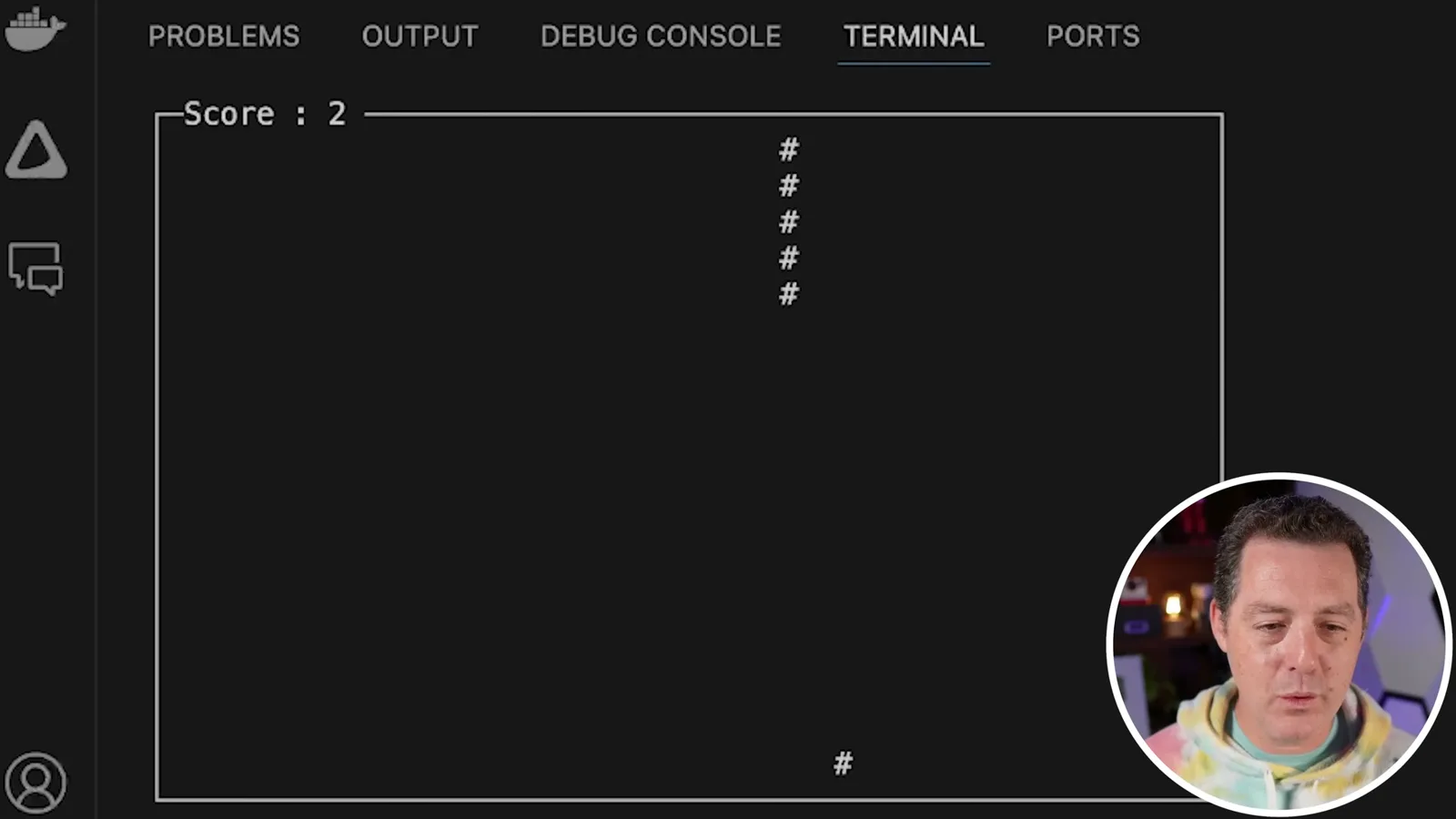
I ask Meta AI to write the game Snake in Python. It responds quickly with code using the curses library, which appears to target a terminal. I copy and run it; a window and score appear, and when the snake runs into itself, the game ends. I regard this as a pass, though I do not know whether the interface used the 8B or 70B model.
Training and benchmark claims
He discusses Meta’s training data and 8K context and compares the release charts with other models of the time. The figures are vendor-reported and depend on evaluation conditions.
Meta says Llama 3 improves language understanding, instruction following, coding and multistep tasks, and that its post-training reduces false refusals. Those are the company’s claims. I am especially interested in whether multistep behavior can help with agents and expect to try it with CrewAI; the Snake demo alone does not establish those broader capabilities.
Meta says it pretrained the models on more than 15 trillion tokens using two custom-built 24,000-GPU clusters. The company says the data set was seven times larger than Llama 2’s and contained four times as much code. The initial models use an 8,192-token context; I compare this with larger advertised contexts from other 2024 models and hope future fine-tunes extend it.
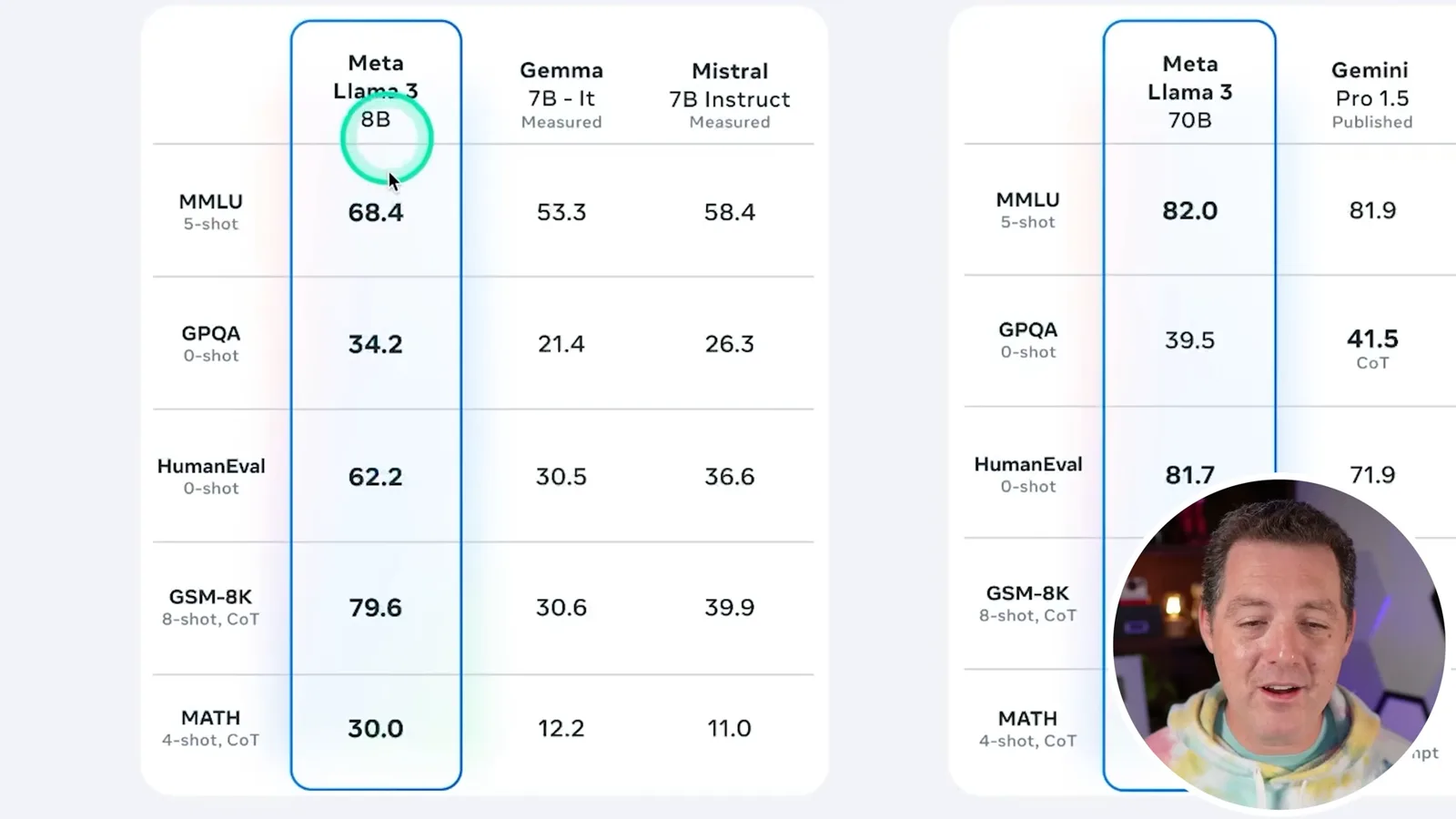
The release charts compare Llama 3 8B with Gemma 7B and Mistral 7B Instruct on tests including MMLU, GPQA, HumanEval, GSM8K and MATH. I am excited by the reported improvements, particularly in code and math. These are Meta’s reported scores for specific models and test settings, not proof that one model wins every task or remains the best later.
For the 70B model, Meta’s chart includes Gemini 1.5 Pro and Claude 3 Sonnet. I notice that Sonnet, rather than Claude 3 Opus, is the Claude comparison. The chart reports a strong HumanEval code-generation result for Llama 3 70B; I wonder whether the coding improvement will also help function calling and agents, but that connection needs its own tests.
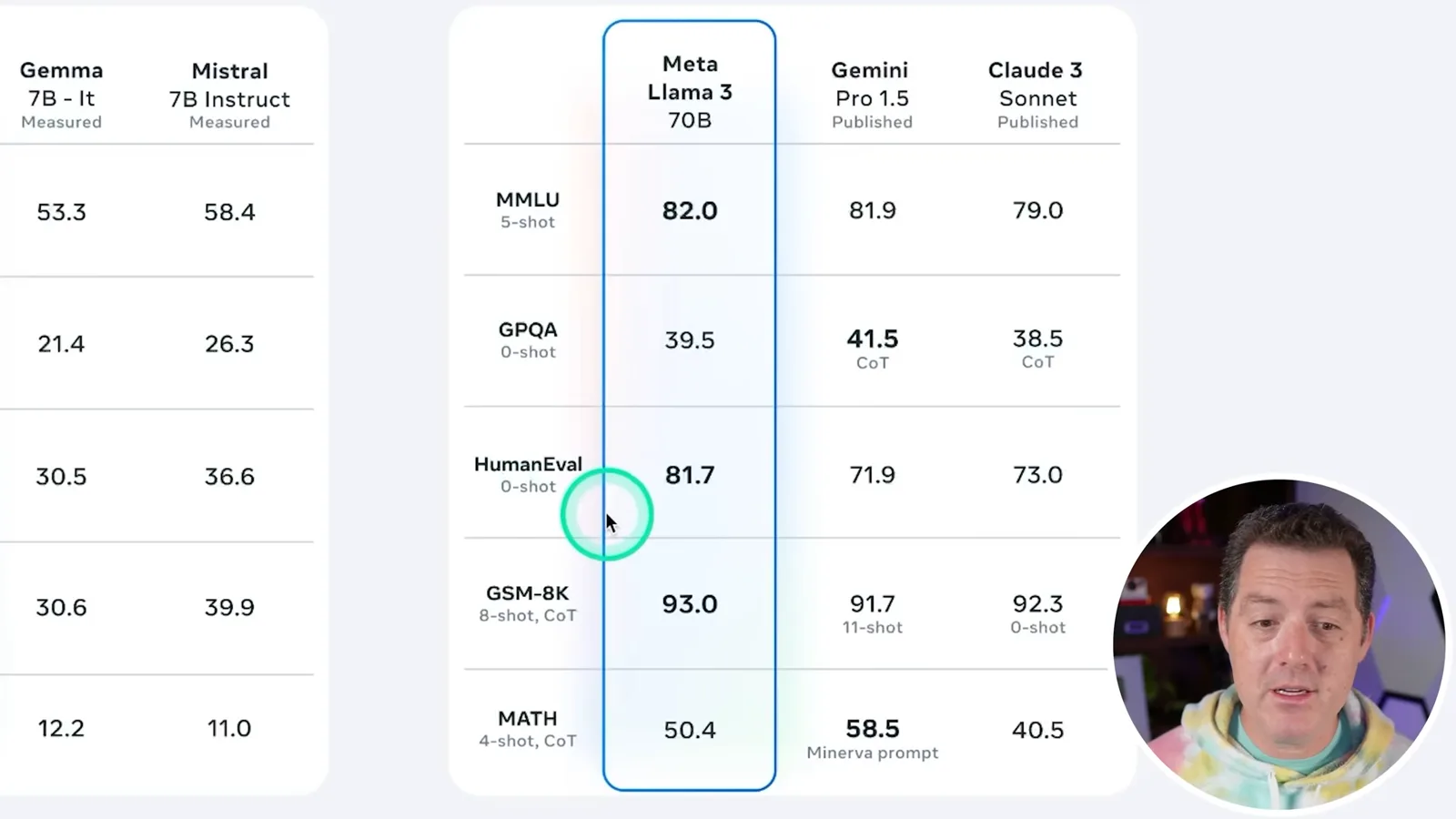
The reported 70B results vary by benchmark, including a math score below Gemini 1.5 Pro in the comparison. That is a useful reminder that a model can lead on one measurement and trail on another, and benchmark configurations and chosen competitors matter.
Safety and the AI market
Meta describes developer safety tools, and Berman considers the effect of accessible models on prices and where value may accrue. His market outlook is a prediction.
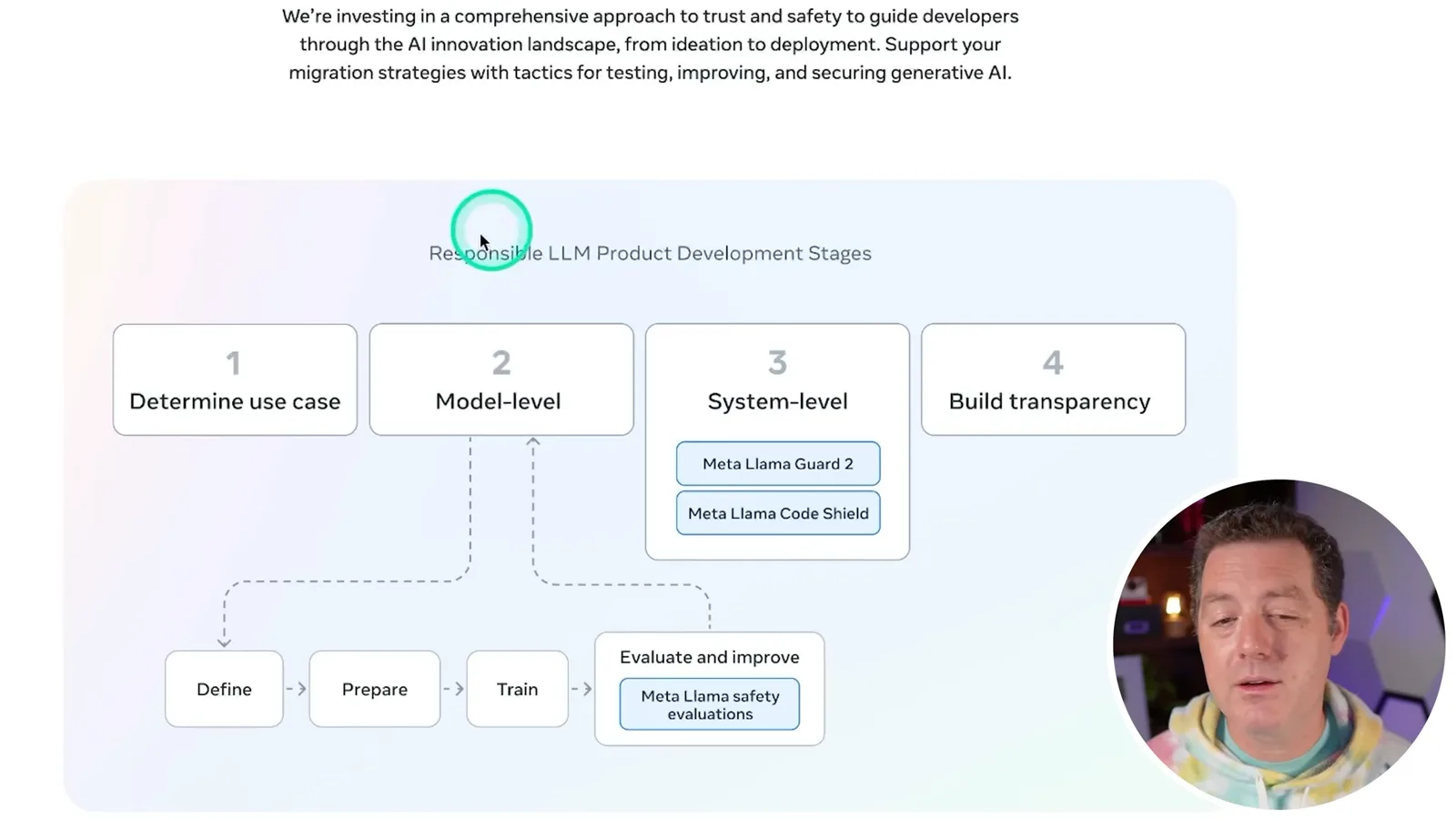
Meta also updates its responsible-use guidance and introduces Llama Guard 2, Code Shield and CyberSec Eval 2. I look at a diagram that places model and system-level safeguards alongside transparency and evaluation. These tools help developers assess and manage risks, but they do not make an application automatically safe.
The cyber evaluation covers areas including insecure coding practices, attacker helpfulness, code-interpreter abuse, offensive cybersecurity and susceptibility to prompt injection. I am particularly interested in the last category because jailbreaks have affected both proprietary and accessible models. I leave the associated paper for a possible later discussion.
Meta AI is Meta’s assistant interface, which at the time is offered free in the settings I discuss. Meta calls it a leading free assistant; that is a company claim, not an independently established ranking. I think Meta’s accessible model releases could increase competitive pressure and lower prices for developers and users, although that is my prediction.
I expect value to accrue at different parts of the AI stack: hardware, infrastructure such as orchestration and observability, and applications built on or enhanced with AI. I am more skeptical of durable value in the model layer as models become commoditized. This is a view of how the market may develop, not a settled outcome.
Meta AI across products
He tries image generation and discusses integration with Meta’s apps and search. He also reviews proposed features and the geographic rollout announced at the time.
Meta describes using its assistant in feeds, chats and search to obtain information without leaving its apps. I would like it to incorporate relevant context from a user’s activities and conversations rather than always acting as a stateless engine. That is a proposed direction, not a claim that the assistant already has unrestricted access to all such information.
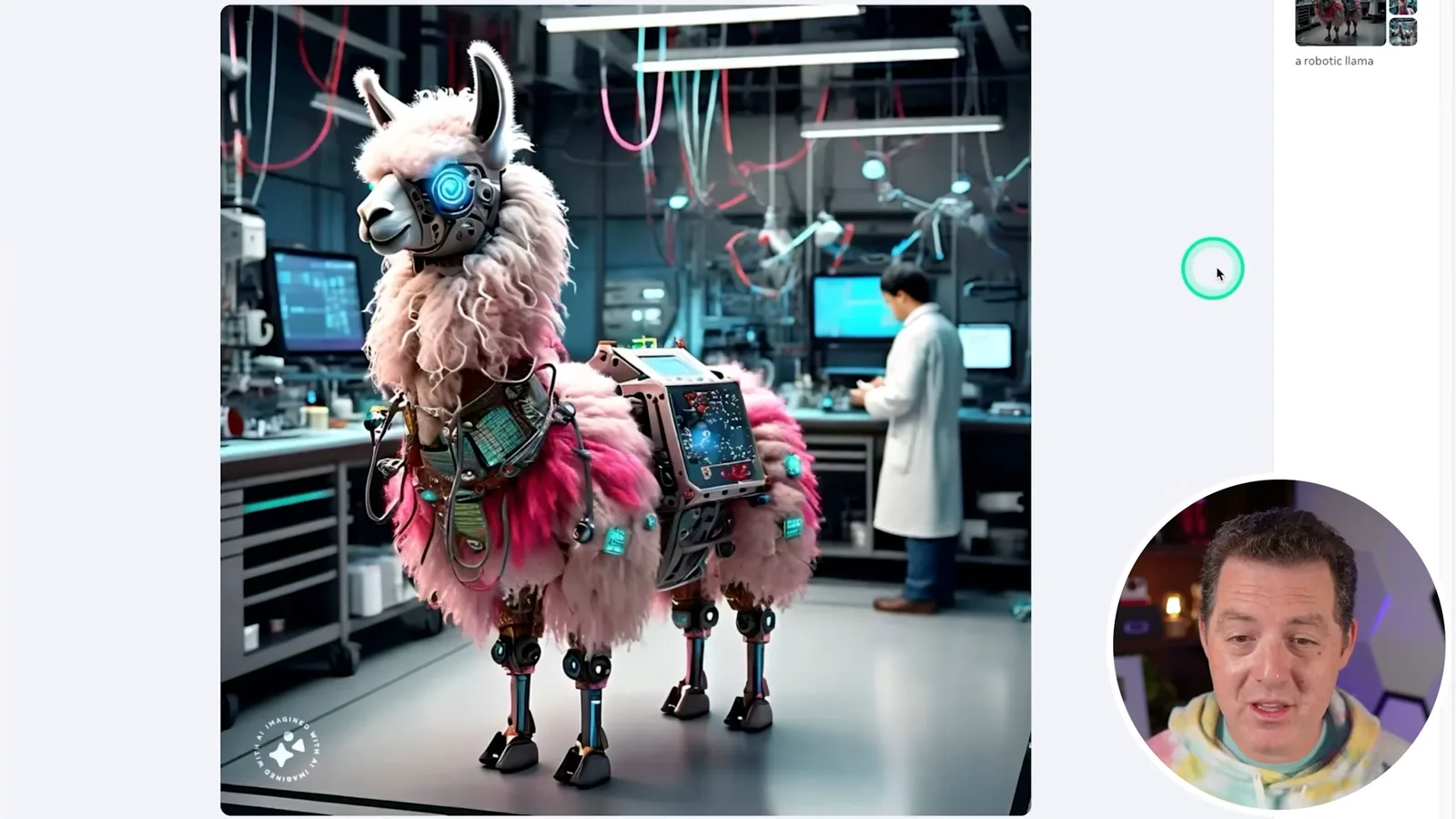
I try the image feature by asking for a robotic llama. I like the result, though I think it is not as high quality as the images I typically get from DALL-E. I notice an “Imagine” watermark on the displayed image. This is one subjective example, not a comprehensive image-quality or watermarking test.
Meta says it is rolling out Meta AI across Facebook, Instagram, WhatsApp and Messenger and expanding English-language availability to countries including Australia, Canada, Ghana, Jamaica, Malawi, New Zealand, Nigeria, Pakistan, Singapore, South Africa, Uganda, Zambia and Zimbabwe. Availability and features described here are those announced in April 2024.
The examples include asking for a restaurant with sunset views and vegan options, finding concerts for a weekend, using the assistant inside Messenger, and searching for a recipe video. Meta also shows it in the feed. I see this as evidence of the company’s investment in AI, though a demonstration alone does not establish that every answer will be correct.
Another example creates an image of a bird and then animates it into a shareable GIF. I still prefer the image quality of DALL-E or Midjourney in this quick impression, but the feature is free in the context I am discussing. Quality comparisons and product terms can change.
Model availability and conclusion
Berman reviews the repository and model card but expresses uncertainty about weights. Meta did make trained weights available subject to its community license.
I open the Llama 3 GitHub repository and model card and express uncertainty about whether the original weights are available. Meta’s repository says trained weights and a tokenizer can be downloaded after accepting the Llama 3 Community License. Its terms include an acceptable-use policy and an additional license requirement for qualifying services exceeding 700 million monthly active users; availability does not make use unrestricted.
I return to the training-token figure and the 8B and 70B model sizes, then review Meta’s comparisons with Llama 2. The charts show improvements on the listed benchmarks, within their specified settings. I am excited to test the models more thoroughly in a separate video rather than treating the launch charts or one Snake prompt as a complete evaluation.
More from this channel
 34:21EN
 Matthew Berman· Oct 27, 2026Matthew Berman Examines Anthropic’s IPO Filing, AI Growth and GovernanceMatthew Berman, Sam Altman · Forward FutureThe presenter reviews the S-1’s financial metrics, compute strategy and voting structure while questioning the tension between rapid AI development and safety.
 0:26ENMatthew Berman· Oct 25, 2026Sam Altman on Human Values and Problem-Solving in an AI WorldSam Altman · OpenAIIn a short interview excerpt, Altman considers the enjoyment of solving hard problems and the human role in interpreting results.
 0:36ENMatthew Berman· Oct 25, 2026Kimi K3.1 and a Rubik’s Cube Solver DemonstrationMatthew Berman · Forward FutureMatthew Berman shows a scrambled virtual cube being solved and gives the Kimi K3.1 test a favorable assessment.
 0:21ENMatthew Berman· Oct 24, 2026An AI-Generated Kimi Benchmark Chart Used Invented ScoresMatthew Berman · Forward FutureMatthew Berman asks for a graph of Kimi K3.1 Pro benchmarks, then discovers that the displayed figures are illustrative placeholders.
 25:50ENMatthew Berman· Oct 24, 2026Kimi K3.1 Pro Tested: Strong 3D Demos, Uneven Results and Competitive PricingMatthew Berman · Forward FutureMatthew Berman tests the open-weight model on coding, 3D rendering and visual explanations, then compares benchmark results and prices.
 32:20ENMatthew Berman· Oct 23, 2026Who Is Local AI For? The Costs, Trade-offs and a Hybrid FutureMatthew Berman · Forward FutureMatthew Berman weighs data control and independence against hardware cost, setup complexity and inference speed.