In 30 seconds
Matthew Berman surveys January 2025 reactions to OpenAI’s Operator research preview. He discusses the analogy with humanoid robots, parallel tasks, login friction, open-source alternatives, early security concerns and examples shared by users; these anecdotes and predictions do not establish universal capabilities.
- 1A digital counterpart to robotsKarpathy compares agents using human-oriented interfaces to humanoid robots; Berman emphasizes the potential and need for supervision.
- 2Login and site frictionSeparate browser sessions can lack credentials, and Berman encounters a Ticketmaster block.
- 3Other browser agentsBrowser Use and Stagehand offer related approaches, while cross-vendor benchmark comparisons require care.
- 4Agents and brand choicesMollick’s observations raise questions about which sites agents choose when searching and shopping.
- 5Examples from usersPosts describe travel planning, bill payment attempts, shopping, website creation and development testing.
Takeaways
- Operator was introduced in January 2025 as a research preview that used a separate browser for web tasks.
- Browser interaction may reach tasks without convenient APIs, but authentication, site blocks and user supervision remain challenges.
- Browser Use and Stagehand were related alternatives, while published benchmark scores depend on their evaluation conditions.
- Public examples of travel, payments and development testing illustrate possible workflows rather than guaranteed completion.
- Predictions about agents replacing software or changing creative work remain opinions.
Read the edited text by chapter
The agent analogy and supervision
Berman considers Karpathy’s comparison between digital agents and humanoid robots. He discusses mixed autonomy and the prospect of supervising several agents.
OpenAI's Operator research preview has prompted strong reactions across the AI industry. It uses a browser to perform web tasks on a user's behalf, and people are already experimenting with practical uses and discovering limits. This discussion comes from January 2025; [OpenAI later integrated Operator's core functionality into ChatGPT agent](https://openai.com/index/introducing-operator/) in July 2025.
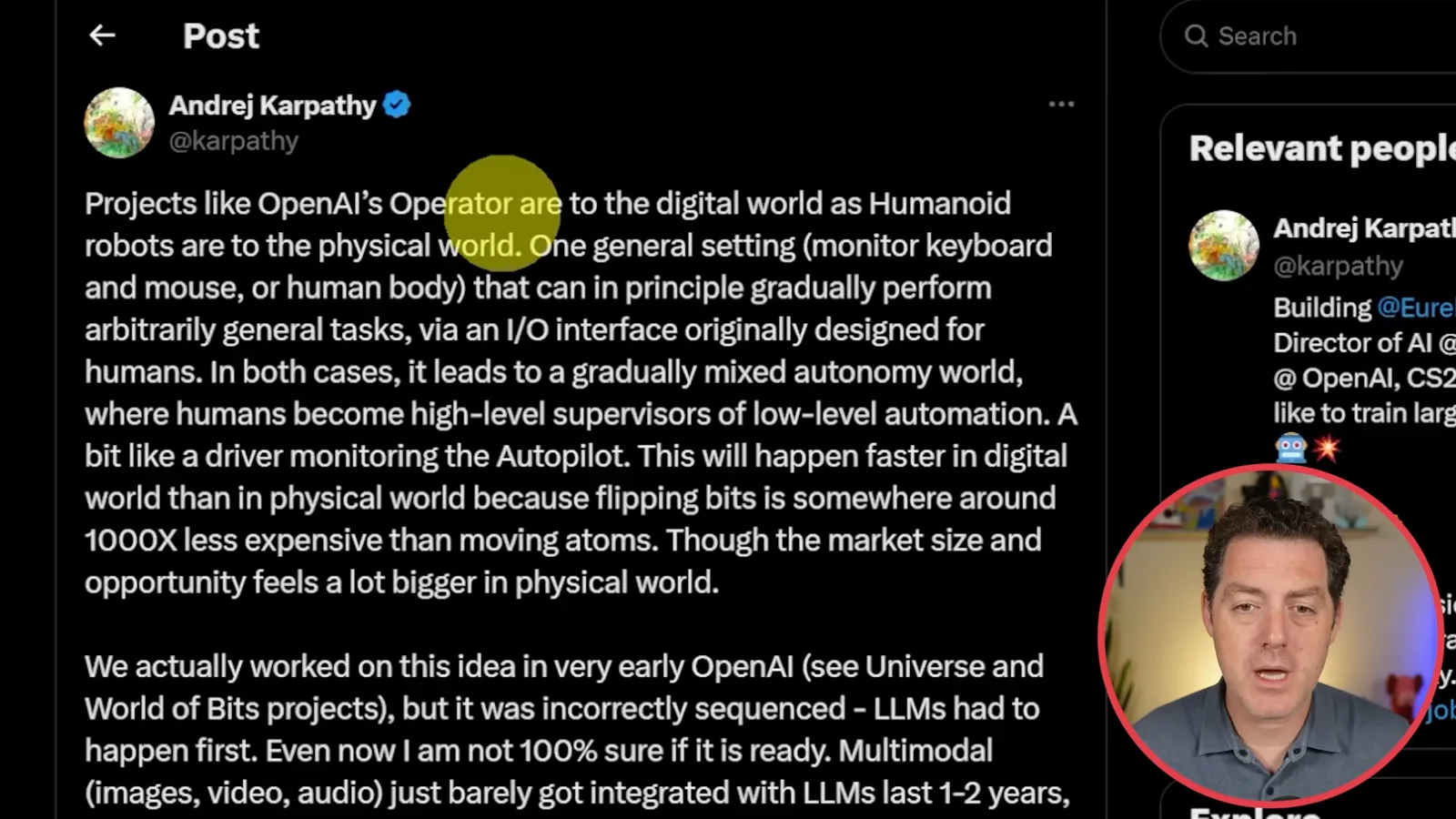
Andrej Karpathy compares browser agents in the digital world to humanoid robots in the physical world. I made a similar analogy: browsers, homes and factories were designed around humans, so systems that can work through familiar interfaces may be useful without requiring every environment to be rebuilt.
A browser agent sees a screen and acts through inputs such as a keyboard and mouse. An API could be more direct for a particular service, but many everyday workflows have no convenient API. I think operating existing interfaces could broaden the range of tasks agents can attempt, even if those interactions are initially difficult.
Karpathy imagines mixed autonomy, with humans supervising lower-level automation. I expect agents to take on more complex work over time, but people need to build trust before delegating consequential decisions. His estimate that moving bits is much cheaper than moving atoms is an analogy, not a measured universal cost ratio.
Karpathy suggests thinking of 2025–2035 as a decade of agents rather than assuming everything will be solved in one year. He imagines a person supervising several agents and stepping in to unblock them. I agree that there is a great deal of engineering still to do.
Nick Dobos and OpenAI's Greg Brockman discuss Operator as one of a broader wave of agents. I am particularly interested in launching several tasks in parallel and checking their progress, though the practical productivity gain depends on task reliability and the amount of supervision required.
Browser access, friction and alternatives
Industry reactions highlight potential use cases and the practical difficulty of authentication and blocked sites. Berman discusses related open-source projects and benchmark limitations.
Box CEO Aaron Levie argues that browser access could greatly expand the use cases for agents because many everyday web tasks lack APIs. His '100 times' figure is a prediction, not a measured result. I also like Operator's interface for watching work, reviewing steps and giving the agent updates.
Sunny Madra suggests the agent would be more useful in a user's own browser. A separate browser may lack familiar cookies and logins, creating friction when a user has to authenticate again. Browser access also requires care around sensitive information and permissions.
In my own attempt to find tickets, Ticketmaster paused the session after detecting unusual browser or network activity. That shows one practical obstacle, although the notice alone does not establish exactly what triggered it. I speculate that OpenAI's choice of a separate browser also gives it more control; I do not know its full reasoning.
Operator was not the first browser agent. Other projects presented at the time included an AI Gradio browser integration and the open-source Browser Use project, which can be paired with different models. Browserbase's Stagehand is another related open-source tool, not OpenAI's Operator source code.
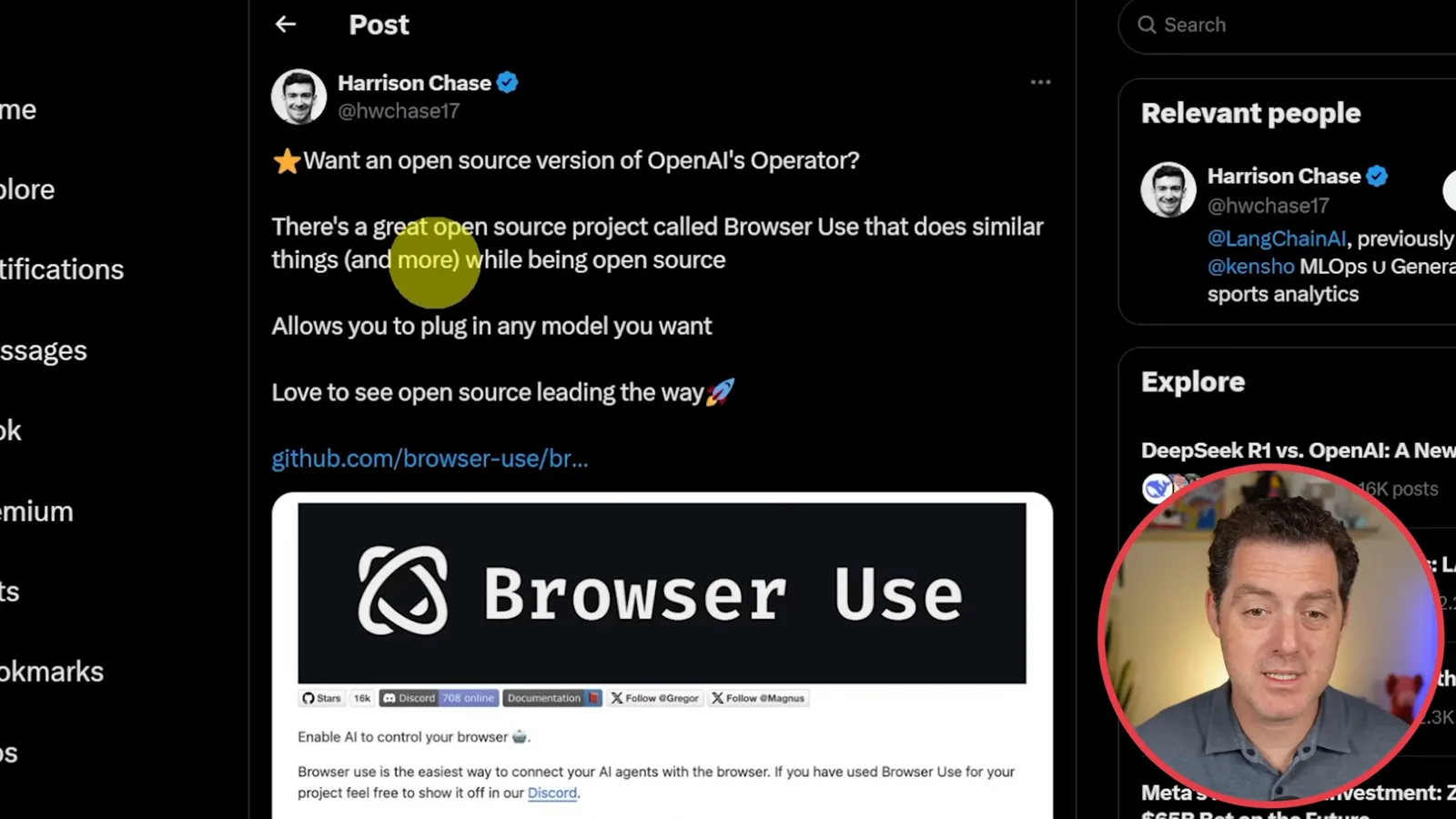
Berman cites reported WebVoyager scores of about 89% for Browser Use and 87% for Operator. [Browser Use's own report](https://browser-use.com/posts/sota-technical-report) describes its evaluation setup, which included modified dates and an automated judge. Scores from separate evaluations need comparable conditions and cannot establish a universal winner.
Safety, speed and agent preferences
Early reports raise questions about safeguards and the speed of automation. Berman also discusses observations about agents’ apparent site and brand choices.
A security researcher known as Pliny reported bypassing some Operator safeguards shortly after release. Such demonstrations raise questions about the reliability of controls; the reported examples are claims about the early preview, not evidence that every safeguard failed or that the behavior remains unchanged.
Another experiment asked Operator to open Operator itself. The site refused the attempt. It is a memorable example of a product boundary, although my suggestion that unlimited nesting could be costly is speculation about why that boundary existed.
Bojan Tunguz joked that an agent can take half an hour to do something a person could do in under a minute. That captures a real limitation of early previews: automation is not necessarily faster once navigation, waiting and supervision are included. I expect improvement, but it is not guaranteed for every task.
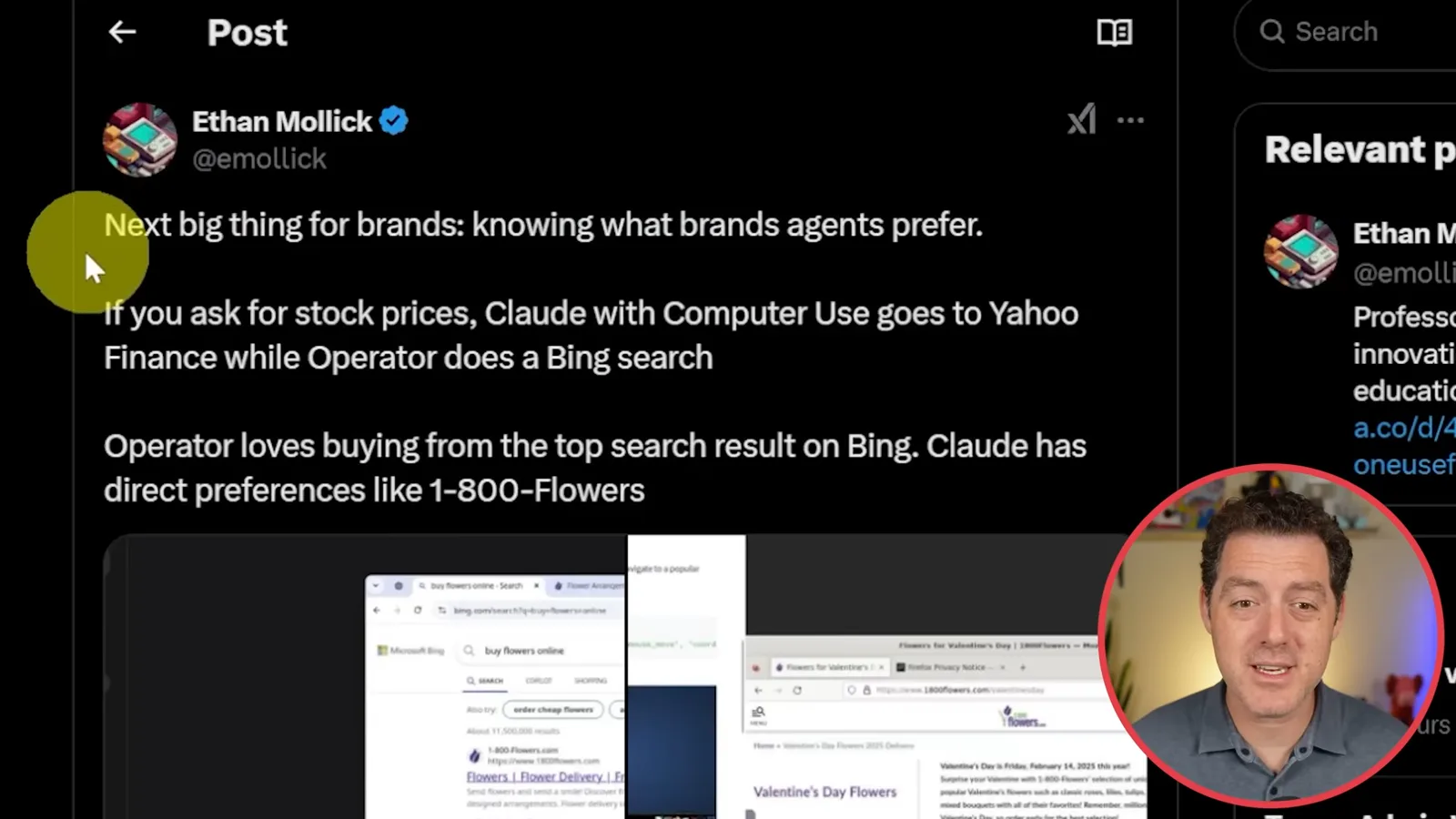
Ethan Mollick observed apparent differences in where agents searched and shopped, such as Bing results or specific retailers. These are observations from examples, not proof of fixed preferences. They raise an interesting question for brands: if agents choose where to look, optimizing for their behavior may become valuable.
Another post invokes music producer Rick Rubin as an example of human taste and judgment. I find the point interesting: choosing which work to develop and elevate may remain valuable as tools automate more production. That is an opinion about creative work, not a demonstrated boundary on AI.
Predictions and early use cases
Berman considers speculative implications for software and reviews user-reported examples involving travel, payments, shopping and development. The examples are not systematic tests.
Greg Kamradt speculates that feedback from browsing could improve future agents and that desktop access could extend automation beyond web pages. The possibility of learning from usage does not establish what data OpenAI actually retained or used in any particular case; those details depend on its published policies and settings.
I predict that agents could reshape software, with users directing tasks above existing databases. That is a vision rather than proof that business logic or applications will disappear. Moving from browser demonstrations to reliable desktop workflows involves security, permissions and verification as well as model capability.
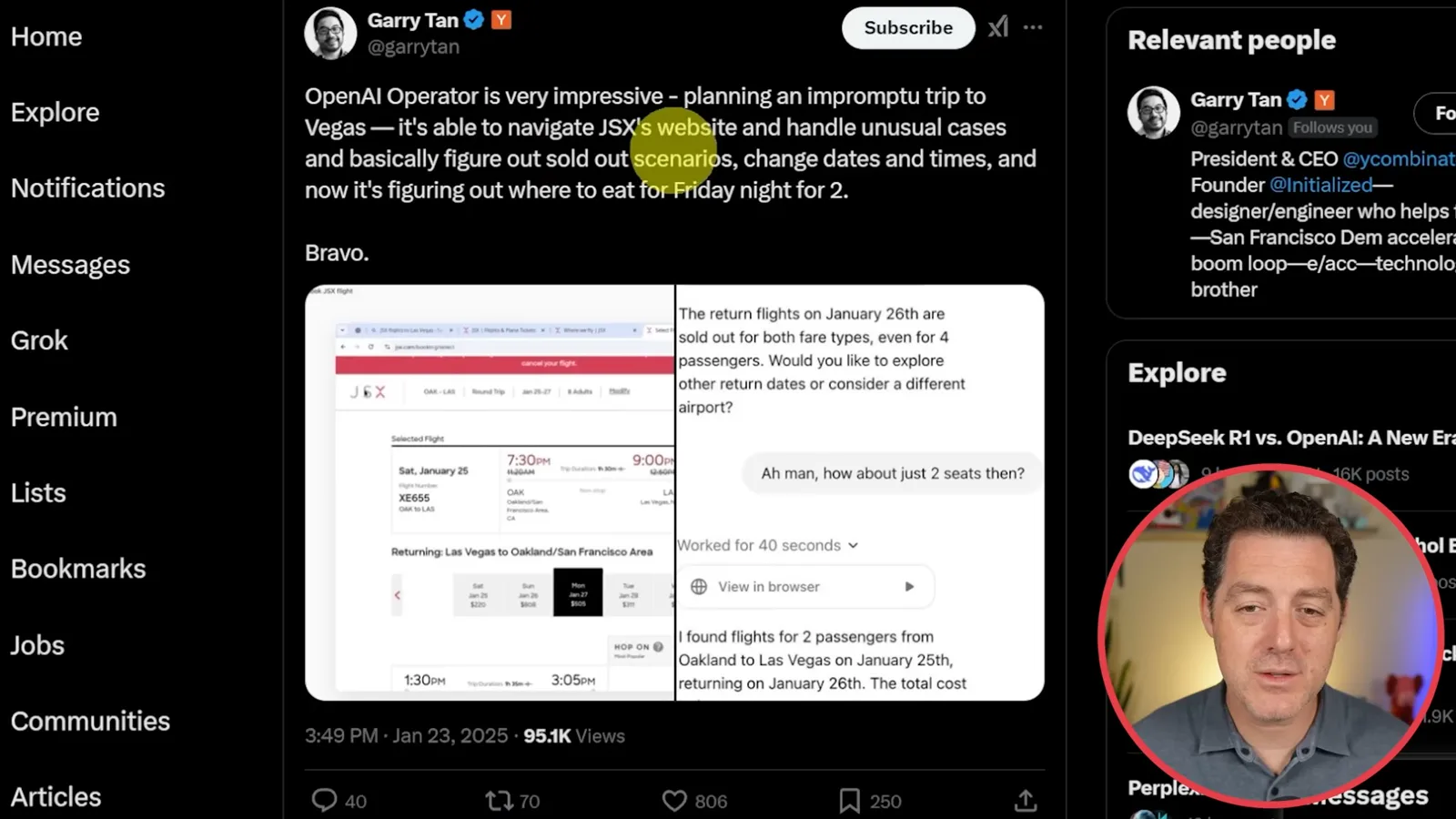
Garry Tan shared a travel-planning example in which Operator navigated an airline site, noticed sold-out return flights and asked whether to change the plan. The interaction illustrates a useful pattern: the agent can bring an unexpected constraint back to the person rather than silently deciding.
Olivia Moore described giving Operator an image of a bill and having it navigate toward payment, then ask for card information. This is an individual account, not a verified completion of payment. Financial actions and sensitive information still require careful user review and confirmation.
Another user described trying to negotiate a gym bench on Facebook Marketplace and arrange delivery. The appeal is the possibility of delegating several steps at once, but a public post about an attempt does not by itself prove that the entire purchase and delivery succeeded.
Dan Mac described an experiment connecting Operator, Google AI Studio and Replit to create a portfolio website. Kieran Klaassen also showed an agent testing a development feature through a tunnel. These examples suggest possible workflows, but connecting an agent to development systems requires attention to access and exposure.
My overall impression of the early reactions is positive but qualified by friction, speed and reliability. Operator was a research preview, and similar efforts existed outside OpenAI. I hope competition encourages both commercial and open-source projects to improve.
More from this channel
 34:21EN
 Matthew Berman· Oct 27, 2026Matthew Berman Examines Anthropic’s IPO Filing, AI Growth and GovernanceMatthew Berman, Sam Altman · Forward FutureThe presenter reviews the S-1’s financial metrics, compute strategy and voting structure while questioning the tension between rapid AI development and safety.
 0:26ENMatthew Berman· Oct 25, 2026Sam Altman on Human Values and Problem-Solving in an AI WorldSam Altman · OpenAIIn a short interview excerpt, Altman considers the enjoyment of solving hard problems and the human role in interpreting results.
 0:36ENMatthew Berman· Oct 25, 2026Kimi K3.1 and a Rubik’s Cube Solver DemonstrationMatthew Berman · Forward FutureMatthew Berman shows a scrambled virtual cube being solved and gives the Kimi K3.1 test a favorable assessment.
 0:21ENMatthew Berman· Oct 24, 2026An AI-Generated Kimi Benchmark Chart Used Invented ScoresMatthew Berman · Forward FutureMatthew Berman asks for a graph of Kimi K3.1 Pro benchmarks, then discovers that the displayed figures are illustrative placeholders.
 25:50ENMatthew Berman· Oct 24, 2026Kimi K3.1 Pro Tested: Strong 3D Demos, Uneven Results and Competitive PricingMatthew Berman · Forward FutureMatthew Berman tests the open-weight model on coding, 3D rendering and visual explanations, then compares benchmark results and prices.
 32:20ENMatthew Berman· Oct 23, 2026Who Is Local AI For? The Costs, Trade-offs and a Hybrid FutureMatthew Berman · Forward FutureMatthew Berman weighs data control and independence against hardware cost, setup complexity and inference speed.