In 30 seconds
In this January 2025 video, Matthew Berman discusses Dario Amodei’s essay on DeepSeek, model efficiency and U.S. chip export controls, alongside comments from Groq CEO Jonathan Ross and U.S. AI adviser David Sacks. The discussion mixes company claims, contested allegations and predictions about future AI and geopolitics. Recraft sponsored a segment, and Berman disclosed in the video description that he is a small investor in Groq. The allegation that DeepSeek trained on OpenAI outputs was not established by the public evidence presented in the video; DeepSeek’s reported V3 training-compute estimate is not an all-in R1 or company cost.
- 1Unproven distillation allegationsOpenAI, Ross and Sacks raised claims about model outputs, while the examples shown do not establish DeepSeek’s training provenance.
- 2Groq disclosureBerman’s description says he is a small investor in Groq, whose CEO appears in the video.
- 3Three dynamics of AI developmentAmodei describes scaling, efficiency improvements and shifts in the training or inference paradigm.
- 4What the V3 cost estimate coversThe approximately $5.576 million figure is a rental-equivalent estimate for reported V3 training stages, excluding prior R&D and ablations.
- 5A speculative capability timelineAmodei forecasts highly capable AI in 2026–2027 and argues that chip access could shape geopolitical outcomes.
Takeaways
- DeepSeek’s reported $5.576 million estimate concerns V3 training compute at an assumed rental rate and excludes earlier research and experiments.
- OpenAI-related distillation allegations remained unproven on the public evidence discussed, and model self-identification does not establish provenance.
- DeepSeek separately documented distilling its own R1 model into smaller Qwen- and Llama-based models.
- Amodei distinguishes increased training scale, efficiency improvements and new training or inference paradigms.
- Greater efficiency may encourage more compute use, but it does not by itself prove that total spending must rise.
- Amodei’s AGI timeline and export-control scenarios are predictions and policy arguments, not established outcomes.
Read the edited text by chapter
Distillation claims and evidence
Berman presents statements by OpenAI, Jonathan Ross and David Sacks. Their allegations about OpenAI outputs are distinct from DeepSeek’s documented use of its own model for distillation.
Anthropic CEO Dario Amodei has published an essay about DeepSeek, the economics of model development and U.S. export controls on advanced chips. I will unpack his argument and discuss contemporary allegations that DeepSeek may have used outputs from OpenAI models. This video was published on January 31, 2025; its market context and predictions are historical.
OpenAI told Axios that China-based groups may have used its model outputs inappropriately, while some users showed DeepSeek outputs claiming it was created by OpenAI. Such answers are not proof of training provenance: language models can hallucinate or reproduce text from several sources. The specific allegation about DeepSeek has not been established by the public evidence presented here.
Distillation broadly means training a model using outputs or other information from another model. In an interview excerpt, Groq CEO Jonathan Ross asserts that DeepSeek spent more on distilling or scraping an OpenAI model than on the headline training run. That is his allegation, not a verified finding; I described him as having no apparent incentive, but my video description discloses that I am a small investor in Groq.
I want to distinguish a limited training-cost number from the larger cost of research, hardware and development, while acknowledging DeepSeek's engineering innovations. The claim that the company used 50,000 GPUs is an estimate discussed by Amodei, not a verified inventory; it cannot independently establish what the company spent or how it obtained chips.
U.S. AI adviser David Sacks also asserted that there was substantial evidence of OpenAI-model distillation. His statement is an allegation, and neither the clip nor the examples shown establish the specific training data. DeepSeek's R1 paper does document distilling its own R1 outputs into smaller Qwen- and Llama-based models; that is distinct from the allegation involving OpenAI.
Amodei's essay argues that reactions to DeepSeek overstated its threat to U.S. AI leadership while making export controls more important. I agree that the sharp fall in NVIDIA's stock following the news looked like an overreaction, but that is our interpretation of market behavior, not a proven explanation for every investor's decision. Recraft sponsored a separate segment of this video.
The essay and export-control context
Amodei frames DeepSeek’s progress as compatible with existing trends and argues for chip controls. Berman discusses market and geopolitical implications.
Amodei's policy concern is whether access to large quantities of advanced chips could enable China to develop highly capable AI systems. U.S. export controls restrict certain advanced-chip transfers to China, subject to specific rules and thresholds. My speculation about eventual geopolitical dominance and claims about particular smuggling routes should not be treated as established outcomes or proof about DeepSeek's supply chain.
Scaling, efficiency and reasoning
The discussion examines training scale, shifting efficiency curves and reinforcement learning. AlphaGo is used as an illustration, with its original training context clarified.
The first dynamic Amodei describes is scaling: holding other factors broadly constant, increasing training compute has historically improved performance on some tasks. His hypothetical example moves from 20% to 40% to 60% task success as spending rises from $1 million to $10 million to $100 million. It illustrates a possible relationship, not a universal law that every capability improves linearly with each tenfold increase.
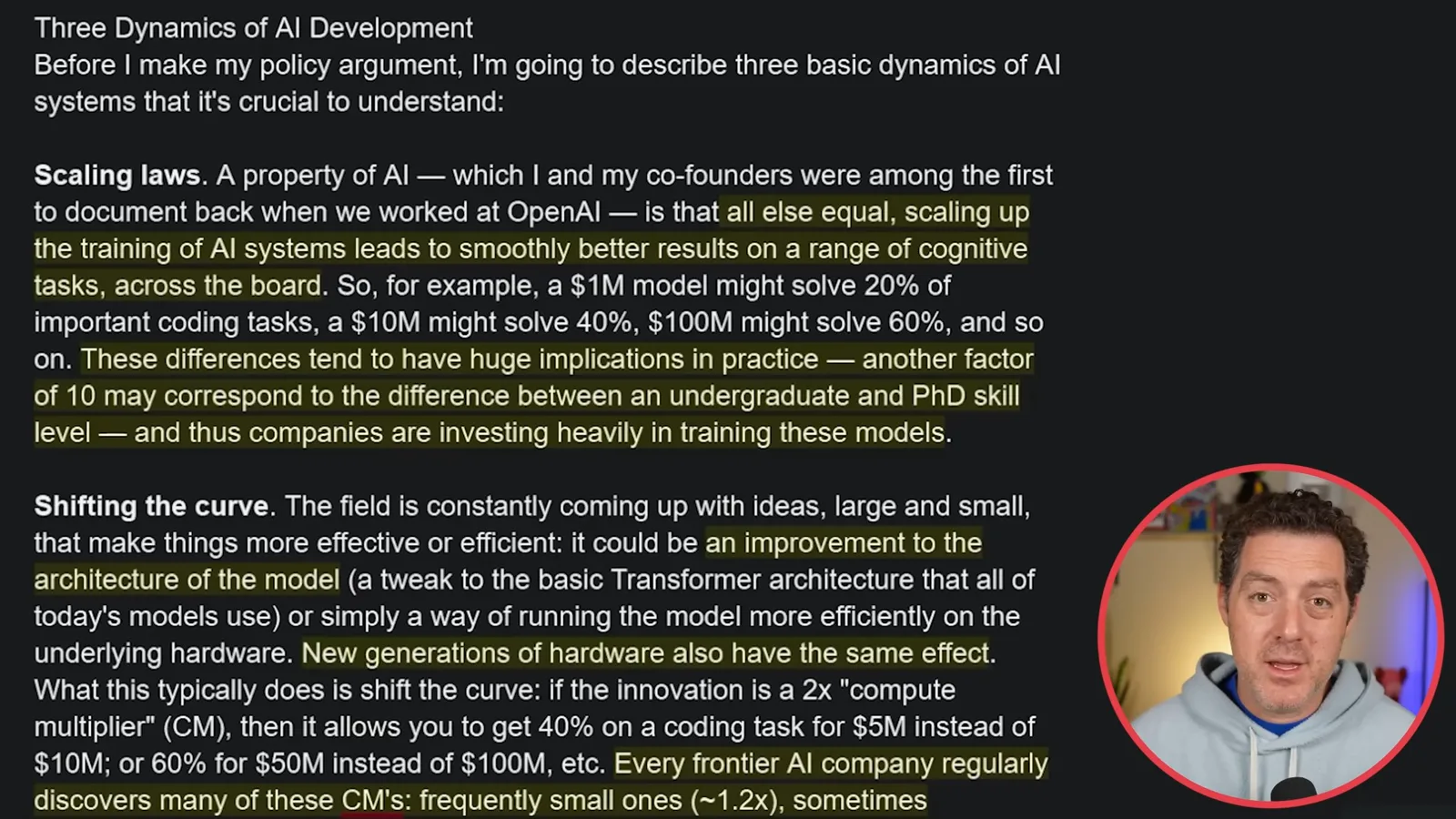
The practical significance of better scores may be large, Amodei argues, which can motivate companies to make increasingly expensive training runs. But the mapping from benchmark performance to real-world skills is task dependent; illustrative comparisons to undergraduate or doctoral ability do not establish general equivalence.
The second dynamic is a shifting efficiency curve. Better architectures, software and hardware can make a given level of performance achievable with less compute. Amodei describes frequent small compute multipliers, occasional larger ones and rare very large improvements; these are his characterization of industry progress, not guaranteed rates for each model.
Amodei argues that developers may use efficiency gains to train more capable systems rather than simply cut total spending. I connect that possibility to Jevons' paradox: lower cost per unit can stimulate demand. Whether total compute use rises depends on price, investment, demand and other constraints; an efficiency gain alone cannot guarantee the outcome.
I speculate that an artificial superintelligence could confer a lasting national advantage, and Amodei considers the geopolitical consequences of advanced AI. Neither a fixed winner-take-all outcome nor the ability to control such systems has been demonstrated. Amodei estimates that model cost efficiency had historically improved around fourfold per year, which he uses as a rough comparison, not a physical constant.
The third dynamic is a shift in what gets scaled. Amodei highlights reinforcement learning for reasoning and increased computation at inference time. These are related but distinct: reinforcement learning changes the model during training, whereas test-time compute is work performed while answering. Sampling and selecting outputs is one possible approach, not a universal description of every reasoning model.
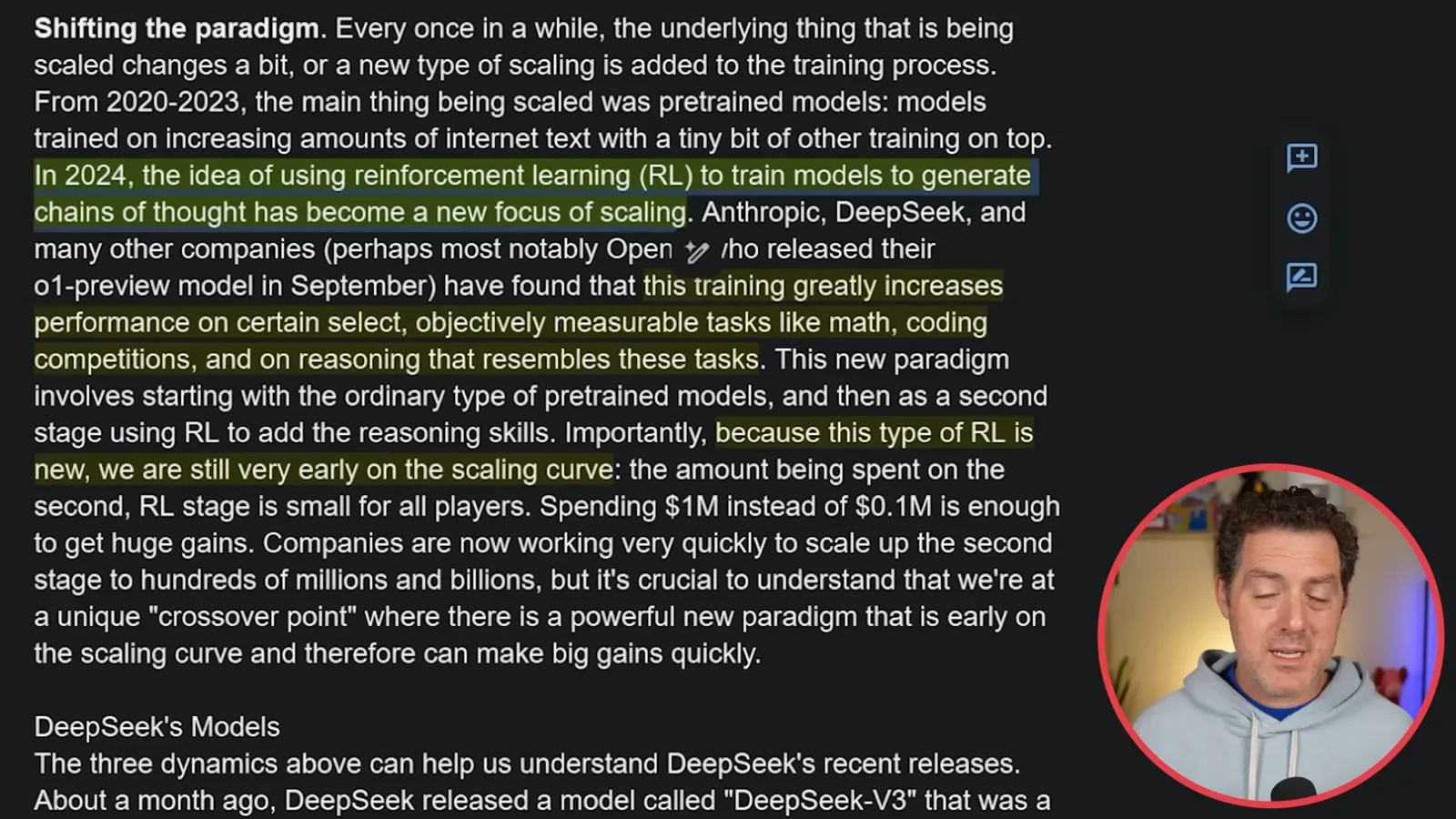
Amodei says this newer training approach can improve performance on tasks with comparatively verifiable answers, such as mathematics and coding competitions. A useful reward signal makes it possible to reinforce successful behavior, though the gains need not transfer equally to open-ended or subjective tasks.
I use AlphaGo's famous move 37 against Lee Sedol to illustrate reinforcement learning and self-play. AlphaGo's 2016 system combined learning from human expert games with reinforcement learning and search; the claim that it learned entirely without human examples applies to later work such as AlphaGo Zero, not that original match system. The surprising move is an example of a creative result, not proof that no human could have found it.
Amodei frames reasoning training as a later stage built on a pretrained model and says this approach was early in its scaling trajectory. He emphasizes DeepSeek-V3, released in December 2024, as an important underlying model whose engineering efficiencies deserved attention before the R1 release.
V3, R1 and the cost of development
Amodei emphasizes the V3 base model and compares costs and capabilities. The reported training-compute number excludes earlier research and is not an all-in company cost.
DeepSeek's R1 report describes building on DeepSeek-V3-Base and using reinforcement learning, along with additional training stages; R1 is more than a simple one-step recipe. Amodei argues that V3 approached earlier leading U.S. models on selected tasks at a lower reported training cost. Such comparisons depend on the specific models, tests, compute accounting and dates.
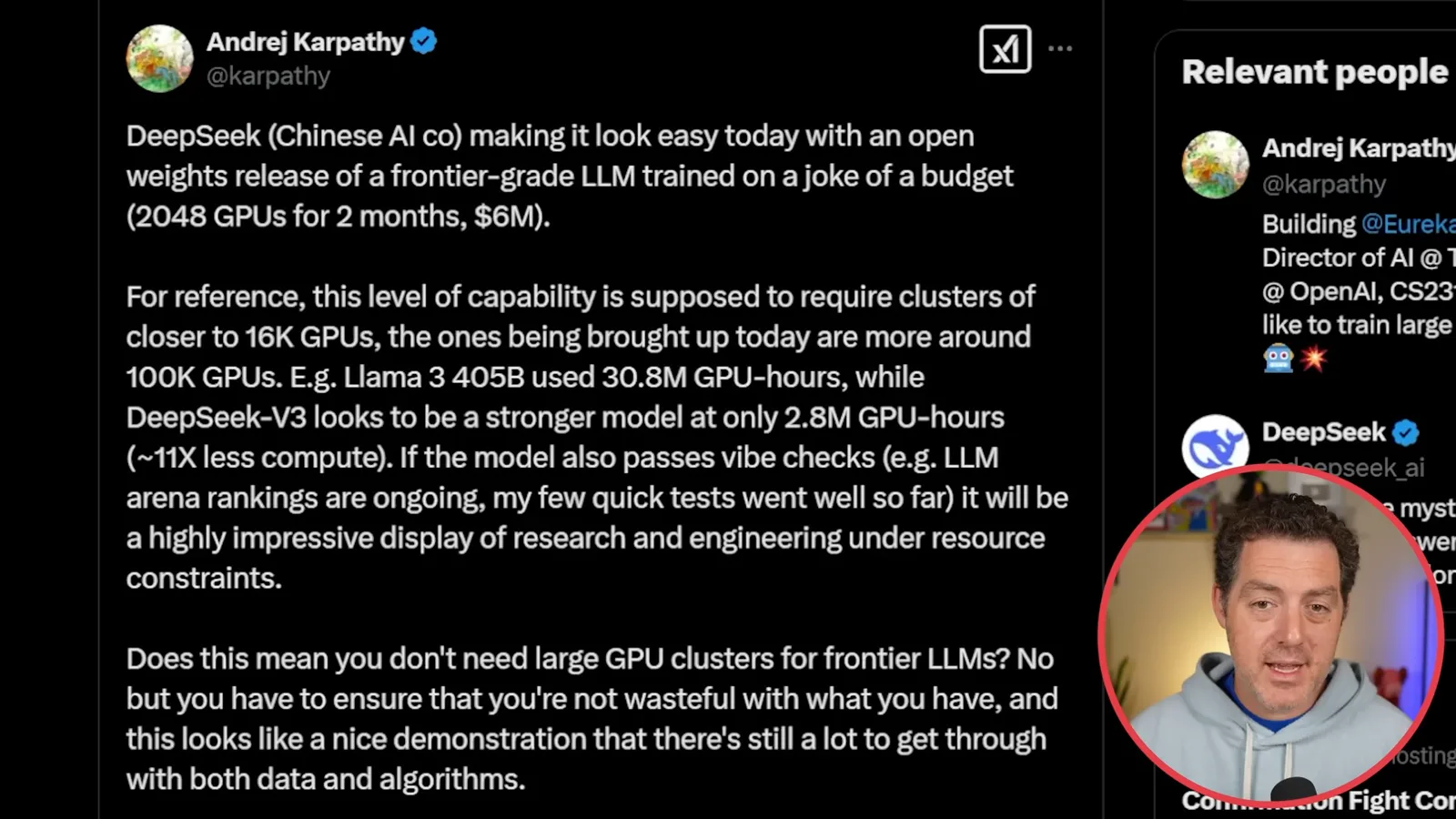
Andrej Karpathy had highlighted V3's reported efficiency, citing 2,048 GPUs over roughly two months and a training figure around $6 million. DeepSeek's V3 technical report estimates 2.788 million H800 GPU-hours at $2 per GPU-hour, or about $5.576 million for the reported training stages. It explicitly excludes earlier research and ablation experiments; the figure is neither R1's full cost nor DeepSeek's total expenditure.
I raise the possibility that OpenAI-generated data could help explain the cost, while acknowledging that the claim is unproven. I also discuss the tension between AI companies using public web material for training and objecting to others using their outputs. Those practices can involve different legal terms and facts; the analogy does not settle whether any particular use was lawful.
Amodei says Anthropic's Claude 3.5 Sonnet cost tens of millions of dollars to train and was not trained using a larger, more expensive model. His comparison is that V3 approached the performance of U.S. models roughly seven to ten months older for less money, but not by the extreme ratios suggested in some coverage. This is a competitor CEO's estimate, not a universally verified ranking or accounting audit.
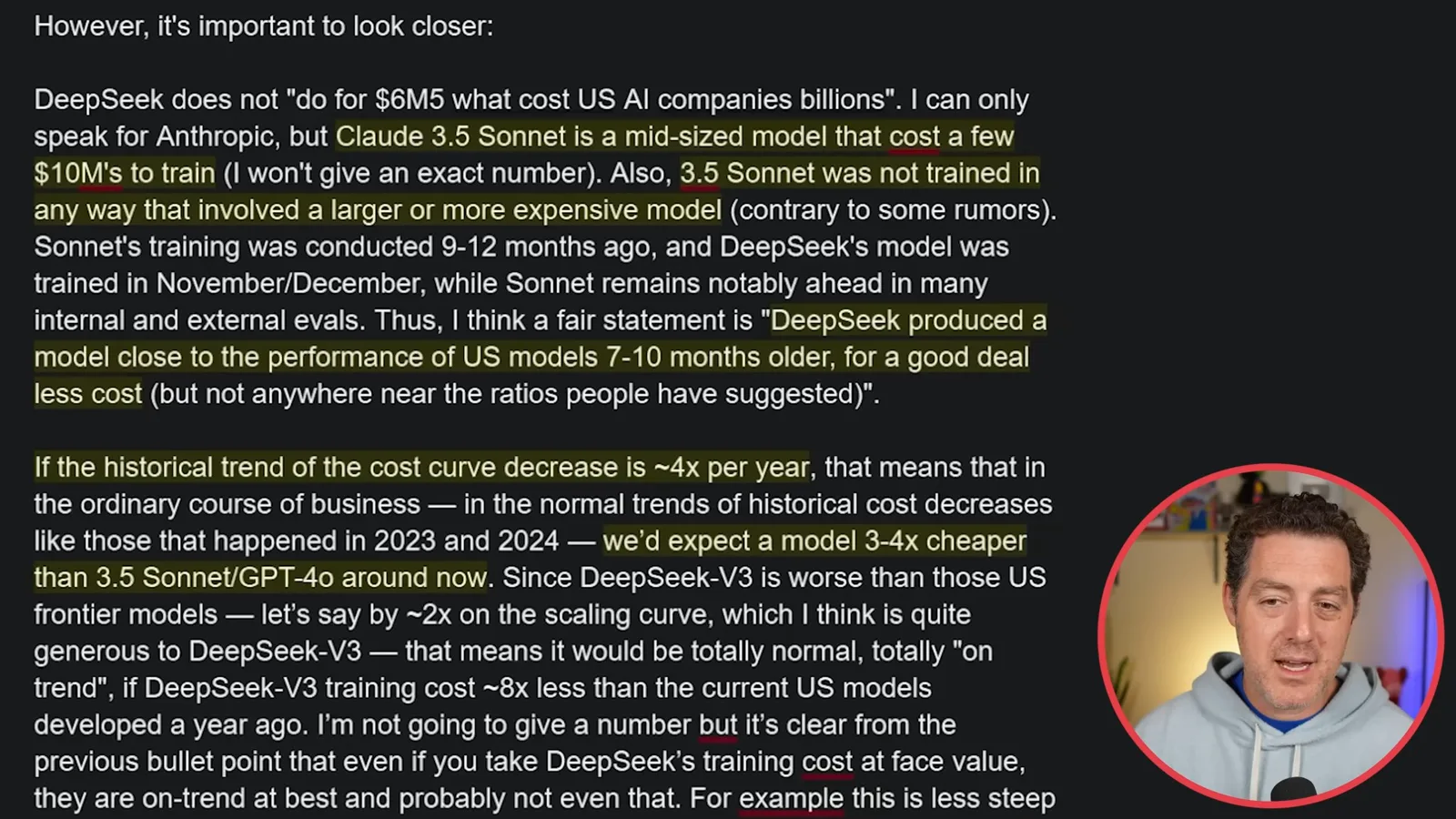
Amodei argues that a cost reduction of roughly three to four times would fit his estimate of the industry's annual efficiency trend. On that view, V3's timing was consistent with ongoing progress even though its release came from a Chinese company. I agree that the distinction matters, while the cost trajectory and comparison are estimates rather than guarantees of future performance.
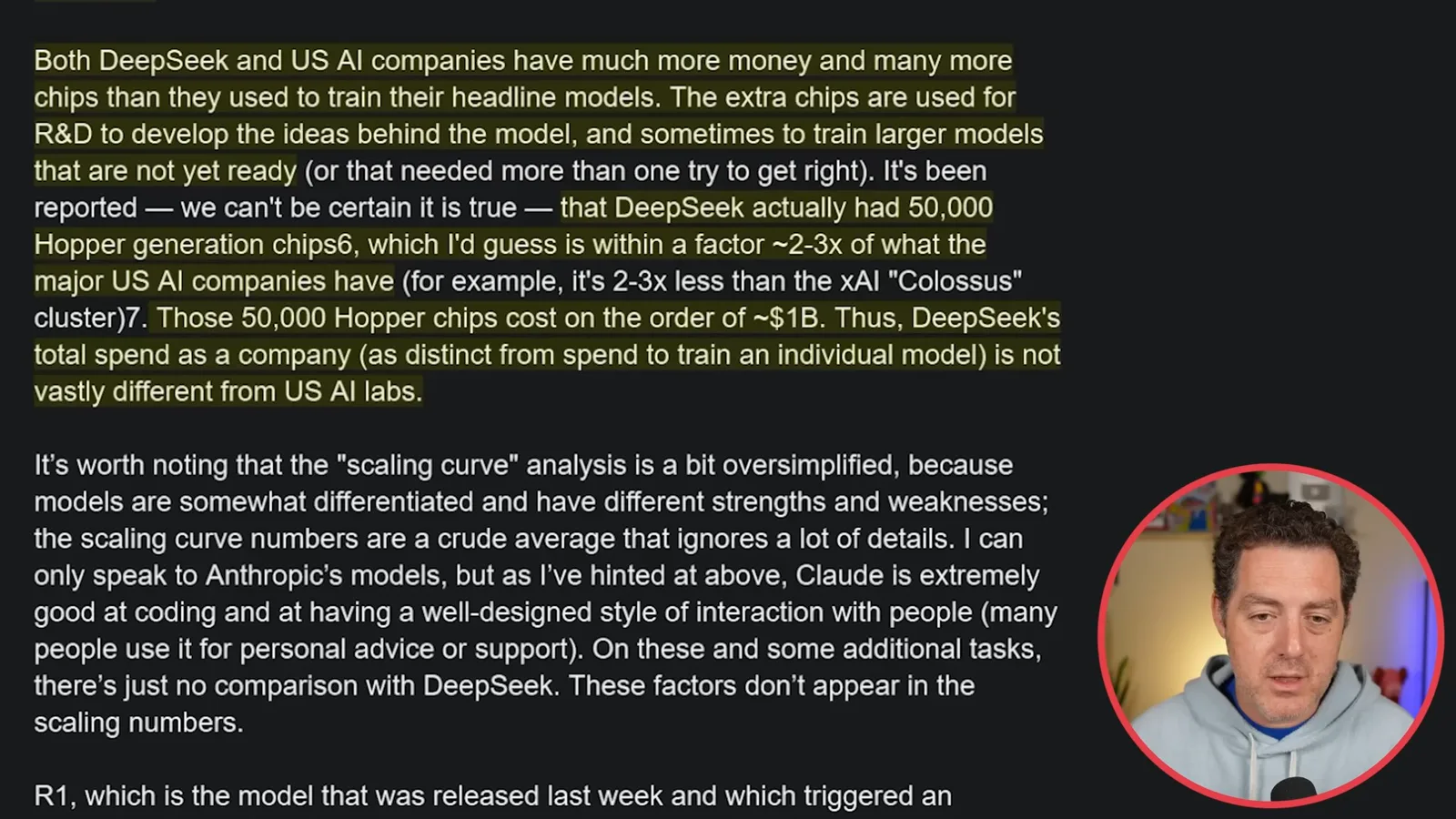
He cautions that companies use many more chips than those allocated to a single final training run: research, experimentation and other models also consume resources. His estimate of 50,000 Hopper-generation chips for DeepSeek and an associated capital cost is explicitly uncertain; public reporting does not establish that inventory as fact.
Predictions and export controls
The essay forecasts more capable AI and outlines contrasting geopolitical scenarios. Berman closes with his view of NVIDIA’s market reaction.
I emphasize that DeepSeek still deserves credit for its innovations and for making model weights available. Amodei predicts that researchers in the United States and China will apply efficiency improvements while continuing to spend heavily on training larger systems. That is a forecast, not a demonstrated necessity that all firms must spend more.
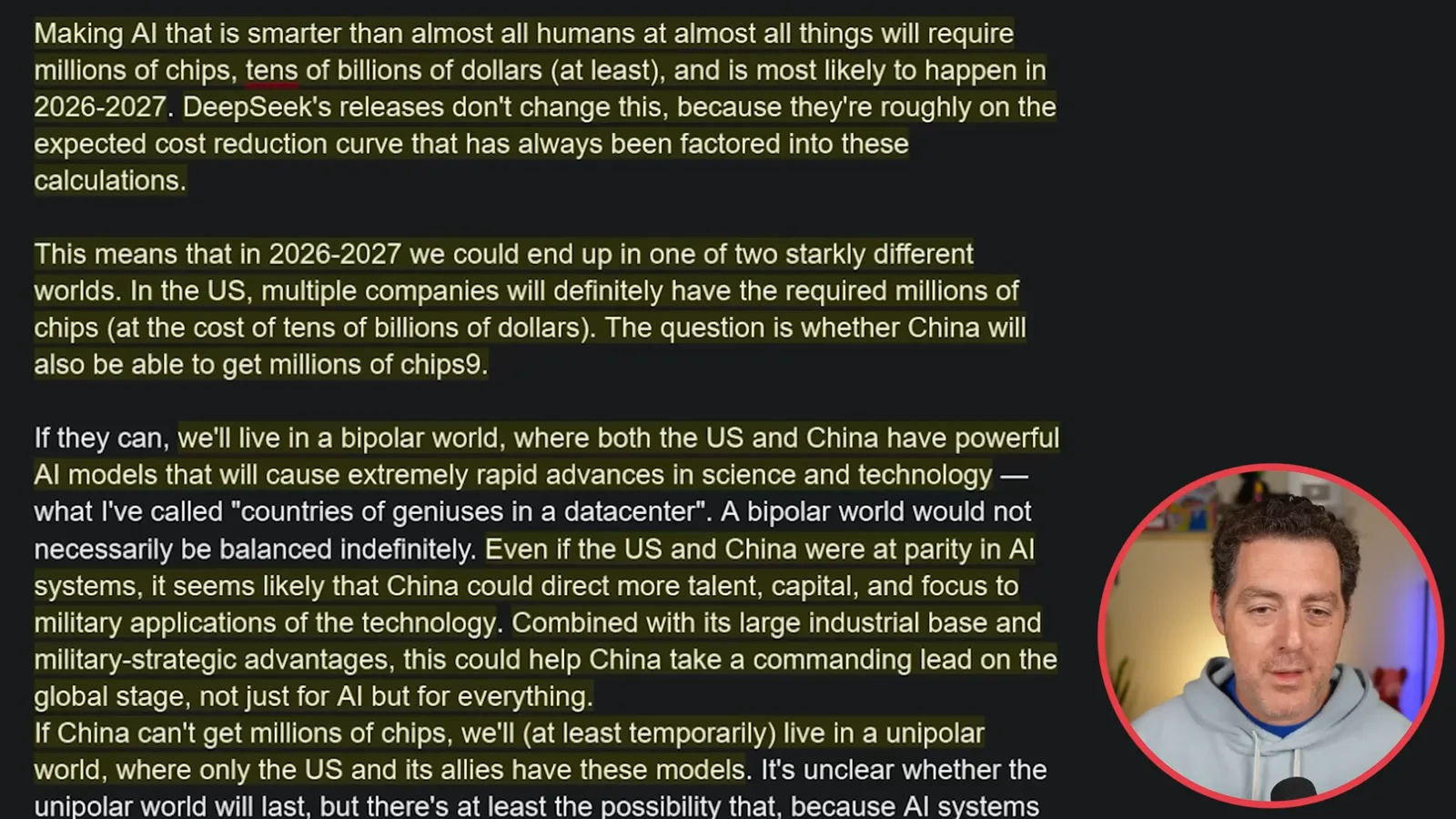
Amodei predicts that AI more capable than almost all humans at almost all tasks could arrive in 2026 or 2027 and require millions of chips and tens of billions of dollars or more. In the video I discuss this as his proposed timetable; it is a speculative prediction, and such capabilities, costs and dates cannot be inferred from the DeepSeek release alone.
His two scenarios turn on whether China can acquire comparable compute. He describes a possible bipolar world in which both the United States and China possess powerful systems, and argues that China could concentrate talent and capital on military applications. These are geopolitical scenarios and judgments, not established forecasts of capabilities or policy outcomes.
If controls substantially limit China's access, Amodei envisages a period of U.S. and allied advantage. He argues that DeepSeek's performance does not itself show export controls failed and that very large chip acquisitions would be harder to conceal than smaller ones. The effectiveness and costs of such restrictions are contested policy questions, and the video does not independently verify specific supply routes.
I close by agreeing with Amodei's view that DeepSeek's release need not be bad for NVIDIA and that the share-price decline was hard to explain. That is an opinion about a market reaction, not a guarantee about NVIDIA's future demand or stock performance.
More from this channel
 34:21EN
 Matthew Berman· Oct 27, 2026Matthew Berman Examines Anthropic’s IPO Filing, AI Growth and GovernanceMatthew Berman, Sam Altman · Forward FutureThe presenter reviews the S-1’s financial metrics, compute strategy and voting structure while questioning the tension between rapid AI development and safety.
 0:26ENMatthew Berman· Oct 25, 2026Sam Altman on Human Values and Problem-Solving in an AI WorldSam Altman · OpenAIIn a short interview excerpt, Altman considers the enjoyment of solving hard problems and the human role in interpreting results.
 0:36ENMatthew Berman· Oct 25, 2026Kimi K3.1 and a Rubik’s Cube Solver DemonstrationMatthew Berman · Forward FutureMatthew Berman shows a scrambled virtual cube being solved and gives the Kimi K3.1 test a favorable assessment.
 0:21ENMatthew Berman· Oct 24, 2026An AI-Generated Kimi Benchmark Chart Used Invented ScoresMatthew Berman · Forward FutureMatthew Berman asks for a graph of Kimi K3.1 Pro benchmarks, then discovers that the displayed figures are illustrative placeholders.
 25:50ENMatthew Berman· Oct 24, 2026Kimi K3.1 Pro Tested: Strong 3D Demos, Uneven Results and Competitive PricingMatthew Berman · Forward FutureMatthew Berman tests the open-weight model on coding, 3D rendering and visual explanations, then compares benchmark results and prices.
 32:20ENMatthew Berman· Oct 23, 2026Who Is Local AI For? The Costs, Trade-offs and a Hybrid FutureMatthew Berman · Forward FutureMatthew Berman weighs data control and independence against hardware cost, setup complexity and inference speed.