In 30 seconds
Matthew Berman examines Mark Zuckerberg’s essay on personal superintelligence, agreeing with its emphasis on individual empowerment and invention while questioning whether free access can counter concentrated computing power. He discusses jobs, data centers, safety, chip controls, distillation and the uncertain dynamics of self-improving AI.
- 1A free baseline and paid computeMeta proposes broad free access and a dynamic auction for additional capacity. Berman questions whether richer users will be able to buy a lasting advantage.
- 2The lawyer thought experimentEven if both parties use the same model, unequal compute could change how much research or reasoning they can afford.
- 3Benefits for host communitiesBerman cites teacher bonuses linked to Meta data-center construction in Louisiana and discusses water commitments.
- 4A debate over distillationZuckerberg argues for the ability to learn from other models; Berman discusses competitive incentives and applicable law.
- 5Self-improvement and powerBerman doubts that multiple self-improving systems necessarily remain balanced, while acknowledging uncertainty about the future.
Takeaways
- Berman supports widely distributed AI but worries wealth will determine how much compute each person can use.
- Meta proposes free access and a dynamic auction for additional compute; the effects on inequality remain uncertain.
- Legal and business examples show why equal access to a model need not imply equal resources.
- New occupations and smaller companies are possible outcomes, not guarantees of a smooth labor transition.
- Data-center benefits, water commitments and security claims require scrutiny at the local and system level.
- The effects of export controls, distillation and recursive self-improvement are contested or speculative.
Read the edited text by chapter
The promise and the concern
Berman welcomes broad access to AI but worries about concentrated power. He contrasts his reading of Meta and other labs, and favors invention over automation alone.
Mark Zuckerberg's essay asks who will control superintelligence and what people will use it for. I welcome its vision of individual empowerment, invention and a balance of power, but I think its central promise has a serious weakness: access to a model does not mean equal access to the computing power needed to use it.
I see Meta as advocating broad access and open models, in contrast to what I see as the more centralized safety approach of labs such as Anthropic. That's my characterization of their positions, not a statement that Zuckerberg named Anthropic in the essay. I worry about a small group deciding what is best for everyone.
Zuckerberg questions why someone expecting AI to eliminate most jobs would rush to build it. I share that question, including when I hear Dario Amodei warn about white-collar job losses. My concern is that extreme concentration of power is itself dangerous; history makes me optimistic that technology can ultimately increase prosperity, though transitions can be difficult.
The essay says invention, rather than automation alone, will be superintelligence's greatest contribution. That resonates with my own company: automating repetitive work has freed us to make new and better content, and we are busier, not idle. Zuckerberg argues that individuals should direct widely distributed intelligence rather than leave decisions to a few experts.
Personal agents and entrepreneurship
The essay imagines agents, privacy and new businesses. Berman considers how people may use freed time and why lower costs could open new markets.
His concrete vision includes an agent working around the clock on relationships, health, career, finances and household tasks. It could free time, but people may choose to spend that time differently: some might work less, while others might use it to accomplish more.
A reported remark by Meta CTO Andrew Bosworth illustrates the tension. Asked whether AI productivity gains should bring back additional days off, he argued for using extra time to do more for users. People may welcome either more leisure or more work, but an individual's preference and an employer's expectations may not coincide.
Zuckerberg also promises strong privacy and security for personal content. I find some irony in that given Meta's privacy record, and I am less enthusiastic than some people about glasses as the interface. These are proposed properties of a future product, not proof that every privacy problem has been solved.
The essay predicts powerful tools will make the economy more entrepreneurial. As an entrepreneur, I like the prospect of trying ideas without raising money or assembling a large team. Small teams can already reach very high valuations; a one-person billion-dollar company remains a prediction rather than an accomplished milestone in my account.
I think of the long tail of problems that were previously too expensive to solve. Lower costs could make more ideas commercially viable, potentially including research into rare diseases, and make room for more entrepreneurs. A personalized tutor or coach and wider participation in scientific progress fit that vision, although a hypothetical treatment is not a proven cure.
The compute problem
Meta proposes free access and an auction for more capacity. Berman argues that unequal spending can preserve unequal power.
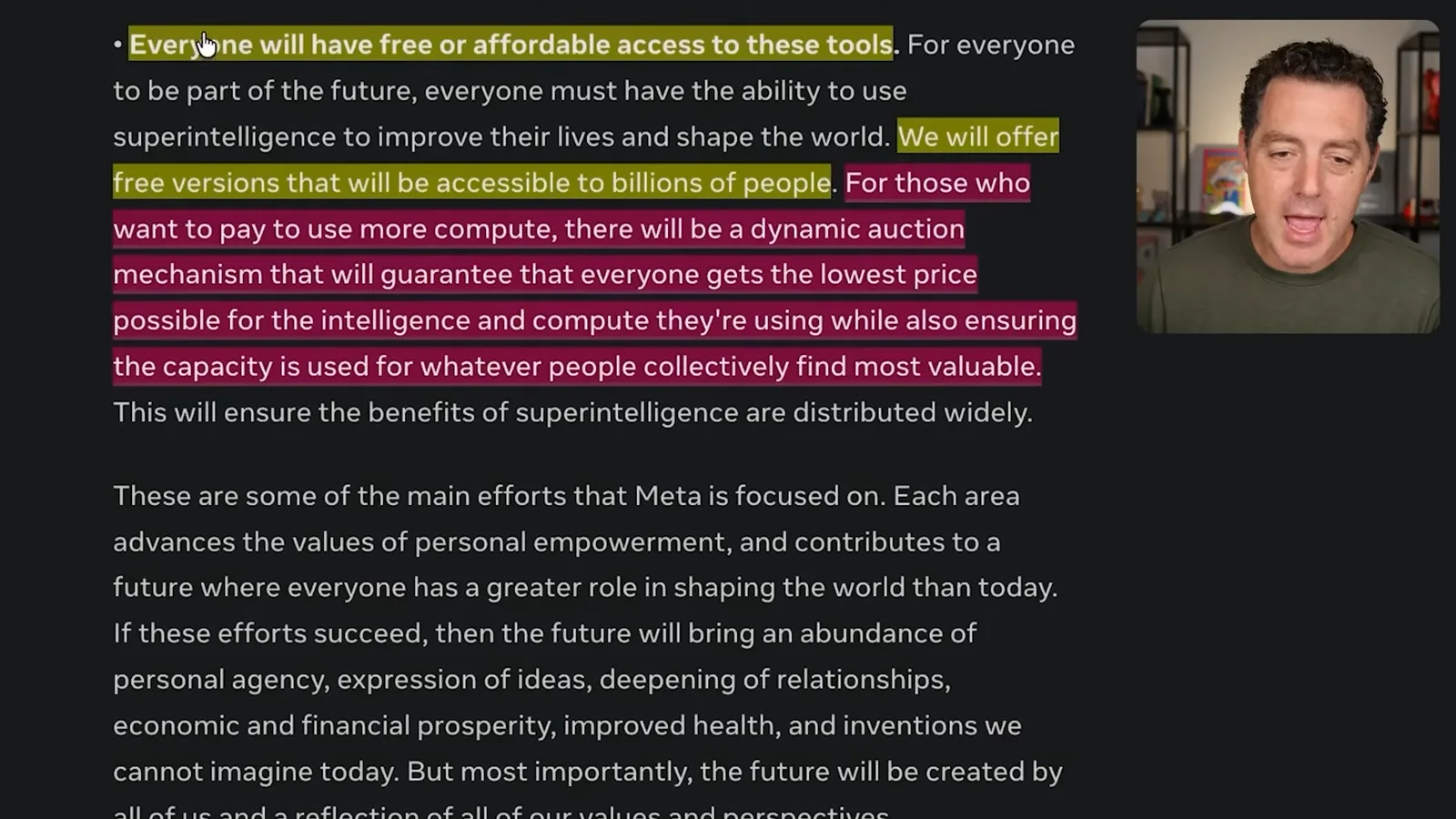
The key passage says Meta will offer free versions accessible to billions and proposes an auction for people who pay for more compute. Zuckerberg argues this will make intelligence affordable and allocate capacity to valuable uses. I read a tension here: a free baseline can be broadly available while those able to pay more can buy substantially more capacity.
If additional compute produces additional useful intelligence, wealthier people or companies may gain an advantage even with the same model. I worry this could entrench existing economic positions, creating what I call a permanent underclass. That is a concern about a possible future, not a demonstrated inevitability.
Zuckerberg lists job displacement, community impacts, cyber and biological misuse, surveillance, geopolitical competition, and keeping control of superintelligence as risks. He rejects the idea that one perfectly aligned system can serve every person's conflicting values at once, and instead proposes distributing power as a check against concentration.
I agree that no single institution should decide everyone's future. Yet if model capabilities become widely available or commoditized, the decisive resource may be the compute and energy people can afford. The essay's call for broad access does not by itself resolve unequal purchasing power.
Law, security and competition
Thought experiments about lawyers, cyber defenders and businesses expose different consequences of resource asymmetries. Berman argues model access alone is insufficient.
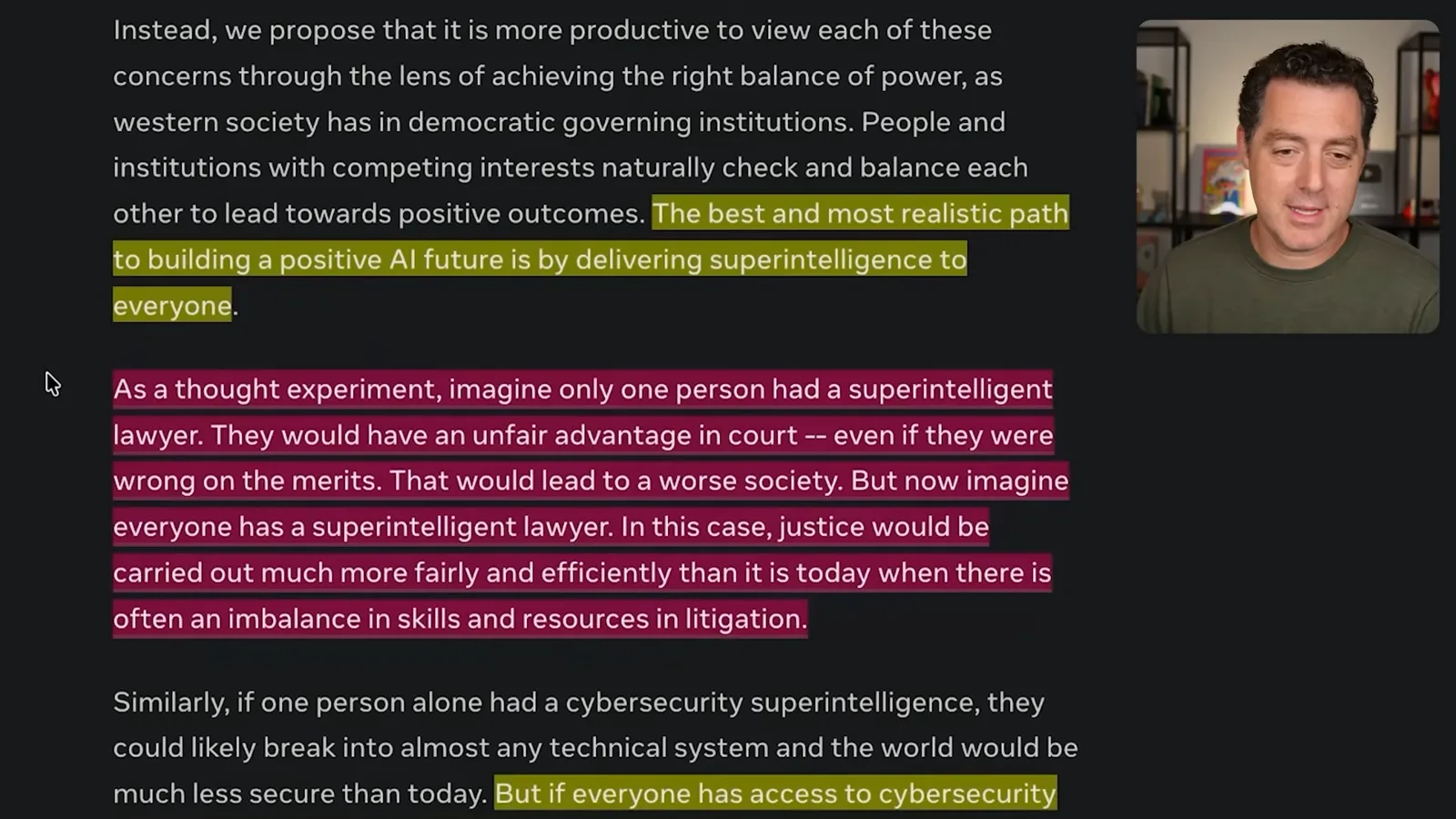
Consider Zuckerberg's thought experiment about a superintelligent lawyer. If only one side has one, it could overwhelm an opponent; if both do, he suggests justice could become fairer. My objection is that the party with more compute might still run more research, parallel work or deeper reasoning, recreating a resource imbalance.
In cybersecurity, Zuckerberg suggests widespread intelligent defenders could make systems safer. I suspect large defenders may have more resources than many attackers, so a compute advantage could help in that particular scenario. That is an assumption about the balance of attackers and defenders, not a guarantee that every system will be secure.
The business example raises the same issue as the lawyer. If every company has access to a capable model, a large incumbent with its own data centers and capital may still outspend a startup. Meta says its personal focus avoids putting power exclusively in institutions, but institutions can still purchase more compute.
Jobs and local communities
Berman discusses new work, smaller firms and Meta’s Louisiana data-center example. He also considers water use and company commitments.
On jobs, I return to agreement with the essay's optimism. There are many unmet needs, and AI may lower the cost of addressing problems that previously offered too little return, including rare conditions. That possibility is an economic argument, not evidence that any particular disease will become curable.
Zuckerberg acknowledges compute is finite and its use has an opportunity cost. He argues that inventing valuable new things could justify allocating resources to invention rather than replacing existing work. I worry a well-funded company could see a startup's valuable idea and deploy far greater resources to compete, though competitive outcomes depend on more than compute alone.
The essay expects new occupations, citing possible one-person product studios, worldbuilders and personalized biology alongside past examples such as app developers. I am optimistic that new work will emerge as old tasks change. The move away from farming illustrates how technology changed the mix of jobs, but past transitions do not guarantee an easy AI transition.
Zuckerberg also predicts smaller companies and more of them, rather than necessarily fewer jobs in total. I can imagine small teams serving long-tail markets that previously did not make economic sense. That future still depends on people being able and willing to become entrepreneurs and adapt to changing work.
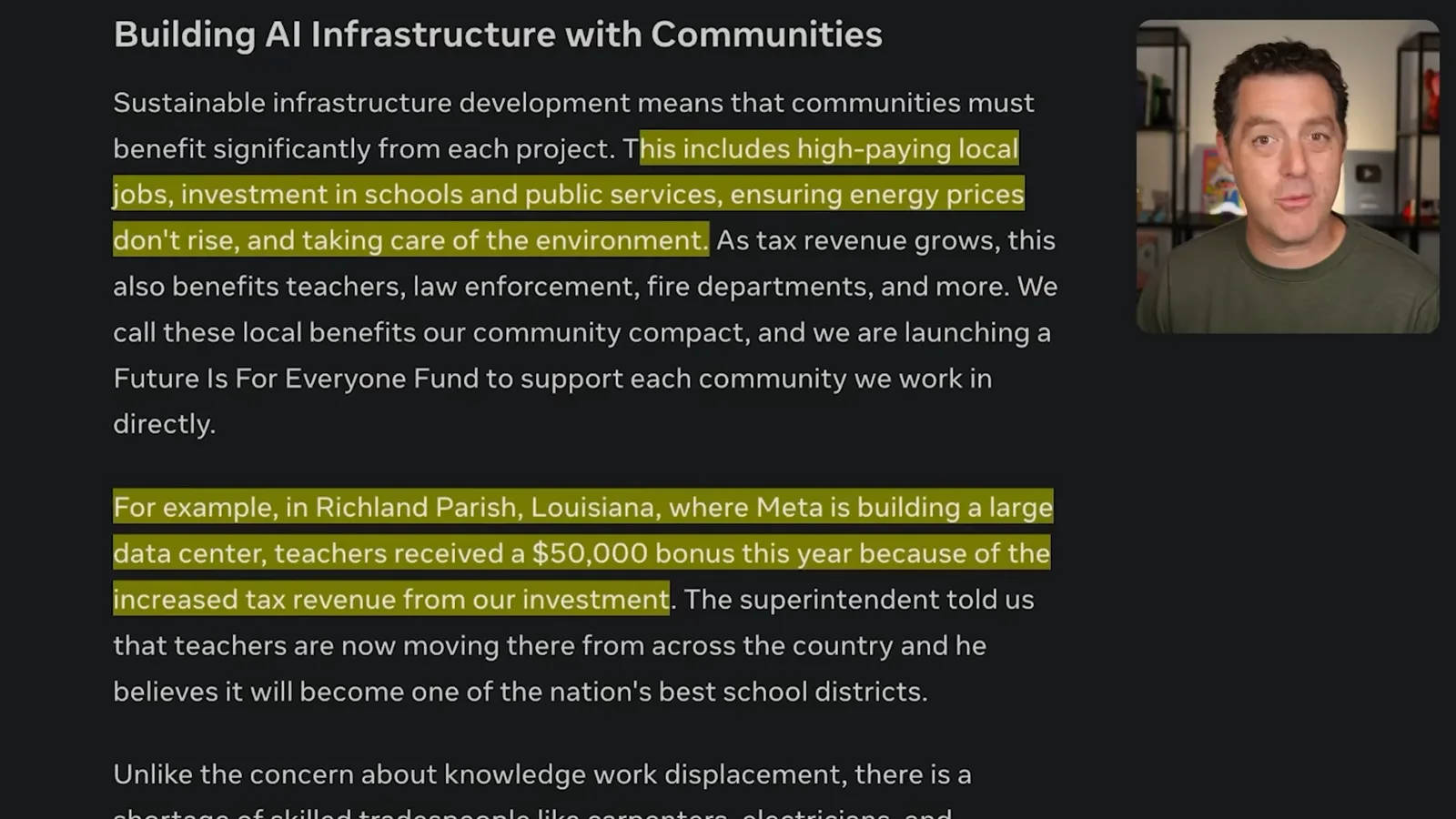
Data centers face public opposition, so the essay argues that host communities should share in their benefits. It cites Richland Parish, Louisiana, where increased tax revenue associated with Meta's construction supported large teacher bonuses. Meta describes bonuses of up to $50,000; the amount was not necessarily identical for every employee.
Zuckerberg says Meta aims to restore more water than it consumes in the watersheds where it operates by 2030, and 200% in water-stressed areas. I note that some newer facilities use closed-loop cooling, but a cooling loop alone does not establish a site's total water footprint. These are company goals and design claims, not independently verified outcomes for every facility.
Safety and geopolitical competition
The discussion moves from cyber and biological risks to compute concentration, chip controls and energy infrastructure. The proposed remedies are contested.
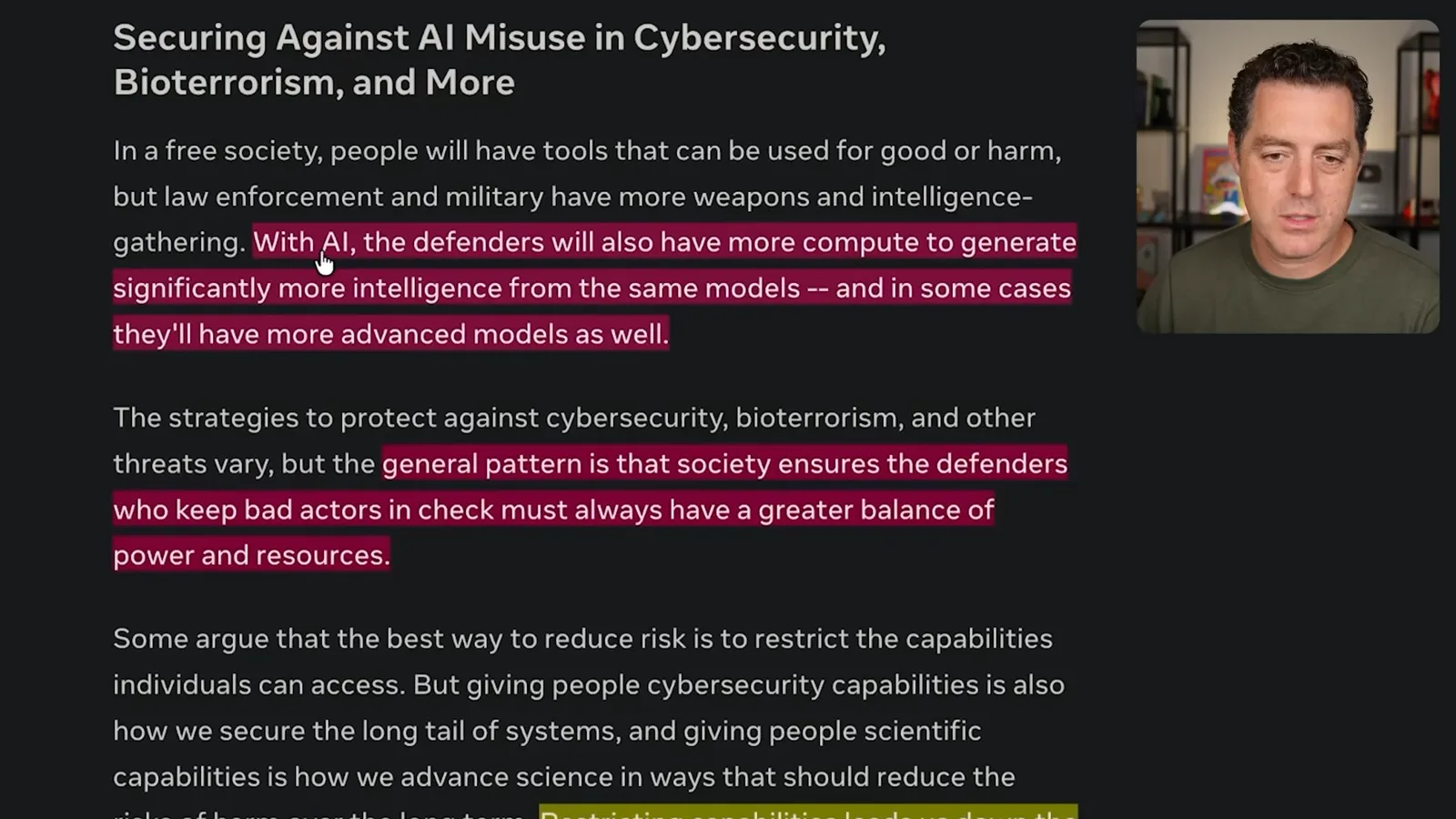
On safety, Zuckerberg argues defenders can have more compute and sometimes more advanced models than attackers. I see that as the same resource asymmetry I worry about elsewhere: more capital can translate into more influence. Broadly available model weights alone do not necessarily balance the power of organizations that control very different amounts of infrastructure.
We agree that centralizing capabilities creates its own risks. On biological and chemical misuse, I argue that knowledge alone is not the same as physical production and favor controls on dangerous materials, equipment and facilities. This is a contested safety judgment: access to capable tools may also change what actors can do, and physical controls are not guaranteed to eliminate misuse.
On US–China competition, Zuckerberg argues chip export controls have slowed foreign labs and should continue. I contrast that with Nvidia's Jensen Huang, who has argued restrictions can spur China to build alternatives and reduce US influence. I also note Nvidia's commercial interest in chip sales; the effectiveness and consequences of controls remain disputed.
Zuckerberg calls for the US to build more energy and data-center infrastructure, arguing China is expanding its capacity. I worry that local opposition can slow projects, though the video's broad claim that data centers are being banned nationwide should not be read as a description of a single nationwide ban.
Distillation and self-improvement
Berman assesses Zuckerberg’s support for distillation and the proposed checks on self-improving systems. He closes with his unresolved concern about compute and energy.
The essay also defends the principle that models should be able to learn from other models and calls for reconsidering policy on distillation and training data. I interpret this as a challenge to closed-model labs, although Zuckerberg does not name Anthropic in the passage. I favor following applicable intellectual-property law and debating changes where appropriate; the legal position depends on the circumstances.
Distillation could let a competitor build on an expensive frontier model for less money and time, potentially changing the value captured by its creator. I speculate that restrictions on Chinese access might still be treated differently from domestic use; that is my interpretation, not a rule established by the essay.
Finally, Zuckerberg discusses recursive self-improvement and suggests multiple labs reaching it around the same time could provide checks and balances if their systems are benevolent. I question that assumption: if improvement compounds rapidly, an early lead might widen before others catch up. Both the mechanism and the outcome are speculative.
Overall, I like the vision of open access and want everyone to benefit from powerful AI. My unresolved concern is who controls compute and energy. I hope the owners of infrastructure will have incentives to solve problems that many people need solved, because unused or unproductive compute will not generate a return; I am still thinking through how that hope fits with the concentration of resources.
More from this channel
 34:21EN
 Matthew Berman· Oct 27, 2026Matthew Berman Examines Anthropic’s IPO Filing, AI Growth and GovernanceMatthew Berman, Sam Altman · Forward FutureThe presenter reviews the S-1’s financial metrics, compute strategy and voting structure while questioning the tension between rapid AI development and safety.
 0:26ENMatthew Berman· Oct 25, 2026Sam Altman on Human Values and Problem-Solving in an AI WorldSam Altman · OpenAIIn a short interview excerpt, Altman considers the enjoyment of solving hard problems and the human role in interpreting results.
 0:36ENMatthew Berman· Oct 25, 2026Kimi K3.1 and a Rubik’s Cube Solver DemonstrationMatthew Berman · Forward FutureMatthew Berman shows a scrambled virtual cube being solved and gives the Kimi K3.1 test a favorable assessment.
 0:21ENMatthew Berman· Oct 24, 2026An AI-Generated Kimi Benchmark Chart Used Invented ScoresMatthew Berman · Forward FutureMatthew Berman asks for a graph of Kimi K3.1 Pro benchmarks, then discovers that the displayed figures are illustrative placeholders.
 25:50ENMatthew Berman· Oct 24, 2026Kimi K3.1 Pro Tested: Strong 3D Demos, Uneven Results and Competitive PricingMatthew Berman · Forward FutureMatthew Berman tests the open-weight model on coding, 3D rendering and visual explanations, then compares benchmark results and prices.
 32:20ENMatthew Berman· Oct 23, 2026Who Is Local AI For? The Costs, Trade-offs and a Hybrid FutureMatthew Berman · Forward FutureMatthew Berman weighs data control and independence against hardware cost, setup complexity and inference speed.