In 30 seconds
Matthew Berman examines Jiayi Pan and collaborators’ TinyZero project, which applied reinforcement learning to pretrained Qwen2.5 models on an arithmetic game. He discusses the reward signal, model-size and algorithm comparisons, the reported compute cost, and the authors’ warning that the finding does not establish general reasoning.
- 1A narrow reproductionTinyZero applied reinforcement learning to Qwen2.5 on Countdown, rather than cloning or distilling DeepSeek-R1.
- 2A verifiable rewardThe arithmetic game offers checkable answers that can reward successful attempts.
- 3Starting model mattersIn these trials, the 0.5B model behaved differently from the larger Qwen variants, which developed search and verification patterns.
- 4Generalization remains unprovenPan cautioned that the reported result was validated on Countdown rather than general reasoning.
- 5What $30 coversThe estimate refers to roughly ten H100 GPU-hours for a 3B PPO run, not the cost of pretraining the underlying model.
Takeaways
- TinyZero reproduced a reasoning-style behavior on a narrow task using a pretrained Qwen model, not the full DeepSeek-R1 model.
- The reported under-$30 figure concerns a specific reinforcement-learning run and excludes the cost of base-model pretraining.
- A verifiable arithmetic answer supplies a clear reward signal for training.
- The researchers observed different outcomes by model size and cautioned against ranking algorithms without tuning.
- Performance on Countdown alone does not demonstrate general reasoning ability.
Read the edited text by chapter
The DeepSeek aha moment and TinyZero
Berman introduces R1-Zero’s reported self-revision and a small-scale experiment inspired by it. The project uses an existing pretrained model.
A Berkeley research project called TinyZero demonstrates a DeepSeek-R1-Zero-style reinforcement-learning effect on a small arithmetic game. The reported cost is under $30 for a particular training run on an already pretrained model; it does not include building a frontier base model, and the project did not clone DeepSeek-R1 or establish equivalent general reasoning.
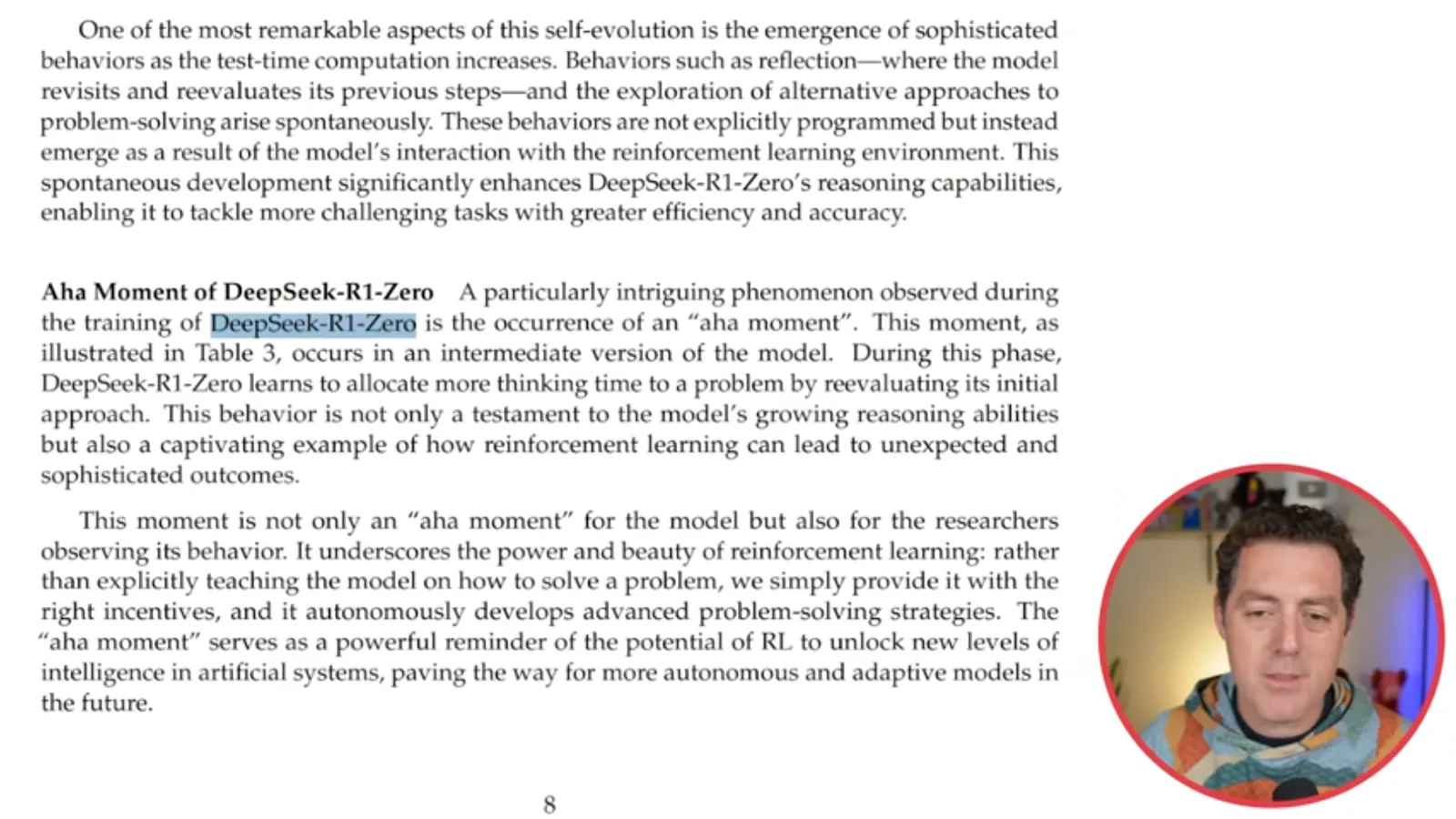
The DeepSeek paper describes an “aha moment” in an intermediate R1-Zero model: while working on a problem, it reevaluated its initial approach and allocated more output to reasoning. The authors present this as an example of strategies emerging during reinforcement learning rather than being explicitly supplied as a step-by-step demonstration.
My view is that reinforcement learning will become increasingly important after base-model pretraining. A clear reward is easier to define when an answer can be checked, as in many math or coding tasks. Open-ended questions such as which color is best do not have one objectively correct answer and are harder to reward in the same way.
Jiayi Pan, a UC Berkeley PhD student, and collaborators applied this idea to Countdown. They used already pretrained Qwen2.5 models, including a 3B base model, and rewarded the model for producing valid solutions. This is a small-scale reproduction of a behavior studied in R1-Zero, not distillation of the full DeepSeek model.
The project reports that the model developed written search and self-verification behaviors during reinforcement learning. That observation concerns its generated solutions on the tested tasks; it does not show that the model learned general reasoning from scratch. In the DeepSeek work, too, the starting model had already undergone substantial pretraining.
Rewards and the Countdown game
The game provides a verifiable arithmetic target for reinforcement learning. An example shows a model revising an attempted answer.
A reward function tells the system how well an attempt meets a goal. In Countdown, the player combines given numbers with basic arithmetic to reach a target, so an answer can be checked automatically. That makes it easier to try many candidate solutions and reward correct ones than in a subjective creative task.
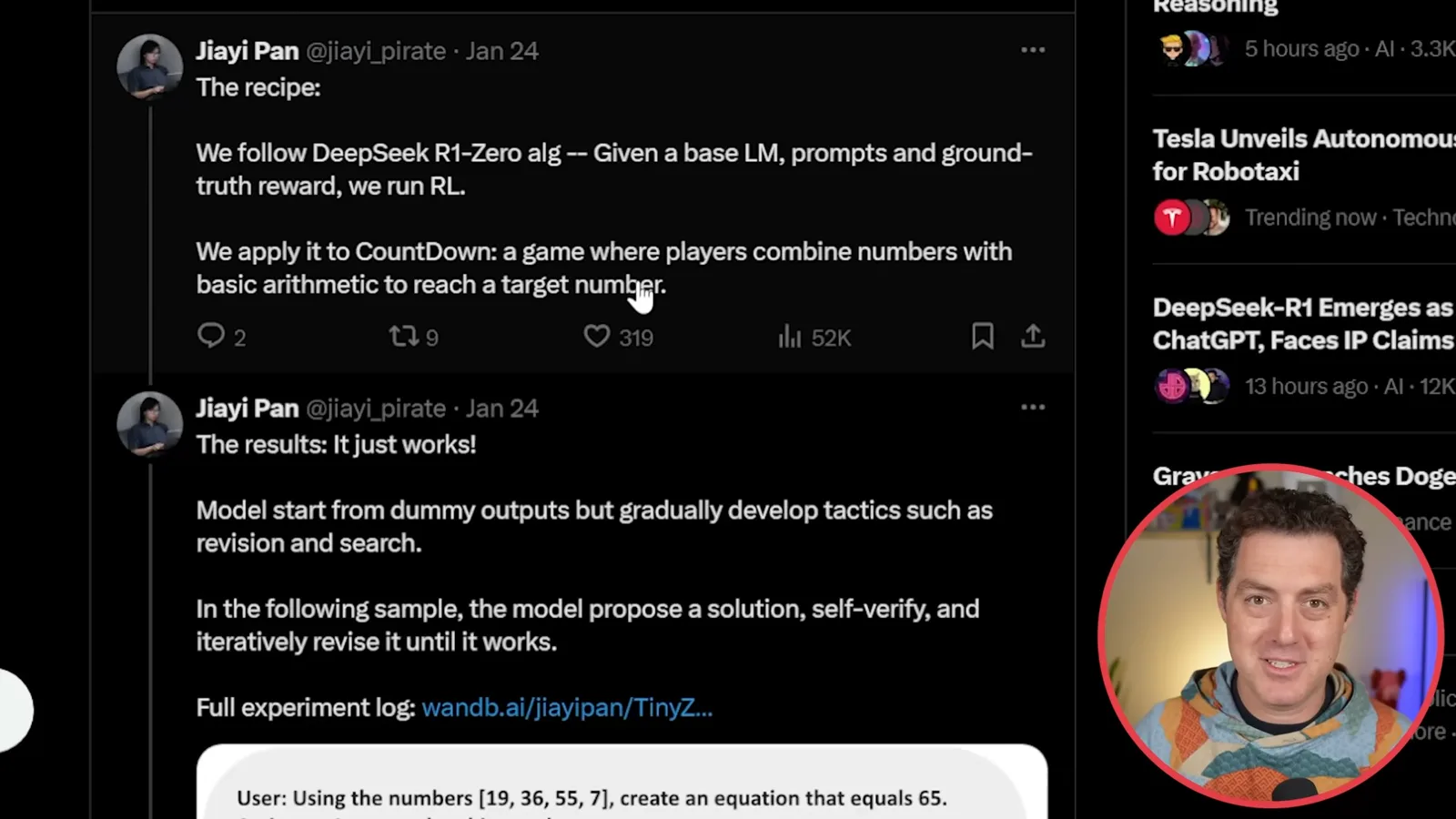
One example asks for an equation using 19, 36, 55 and 7 to reach 65. The displayed response tries and revises intermediate approaches before producing 55 + 36 - 7 - 19 = 65. It is an illustration of one output, not a measurement of reliability on all possible problems.
Model sizes and training variants
The researchers compare model sizes, base and instruction models, and several reinforcement-learning algorithms. Berman considers potential future applications.
The recipe starts with a base language model, prompts and a ground-truth reward, then applies reinforcement learning to the game. Pan reports that the initially unhelpful outputs gradually developed revision and search. The experiment logs are available for closer inspection. AWS sponsored the video; its Bedrock promotion is separate from the TinyZero research.
I speculate that small models adapted for narrow jobs might eventually combine task-specific reinforcement learning with additional computation or training at inference time. That is a possibility to explore, not a result shown by this experiment. Test-time compute and changing model weights at inference are distinct ideas, and the video does not demonstrate their combination.
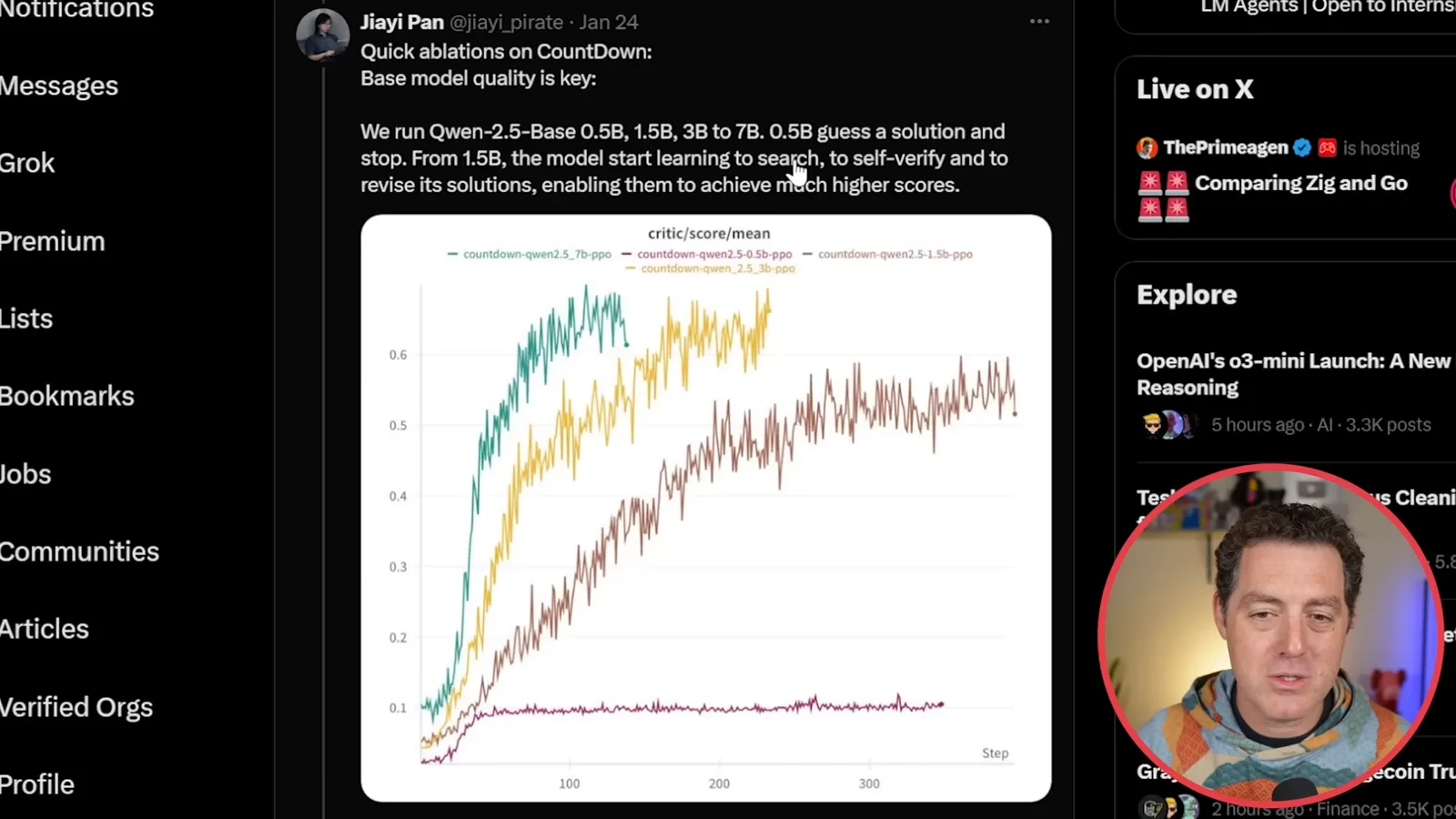
The team compared Qwen2.5 base models of 0.5B, 1.5B, 3B and 7B parameters. Pan reports that the smallest model tended to guess and stop, whereas models from 1.5B upward learned search, verification and revision in this setup. The displayed training curves suggest that the starting model’s capabilities matter for the task.
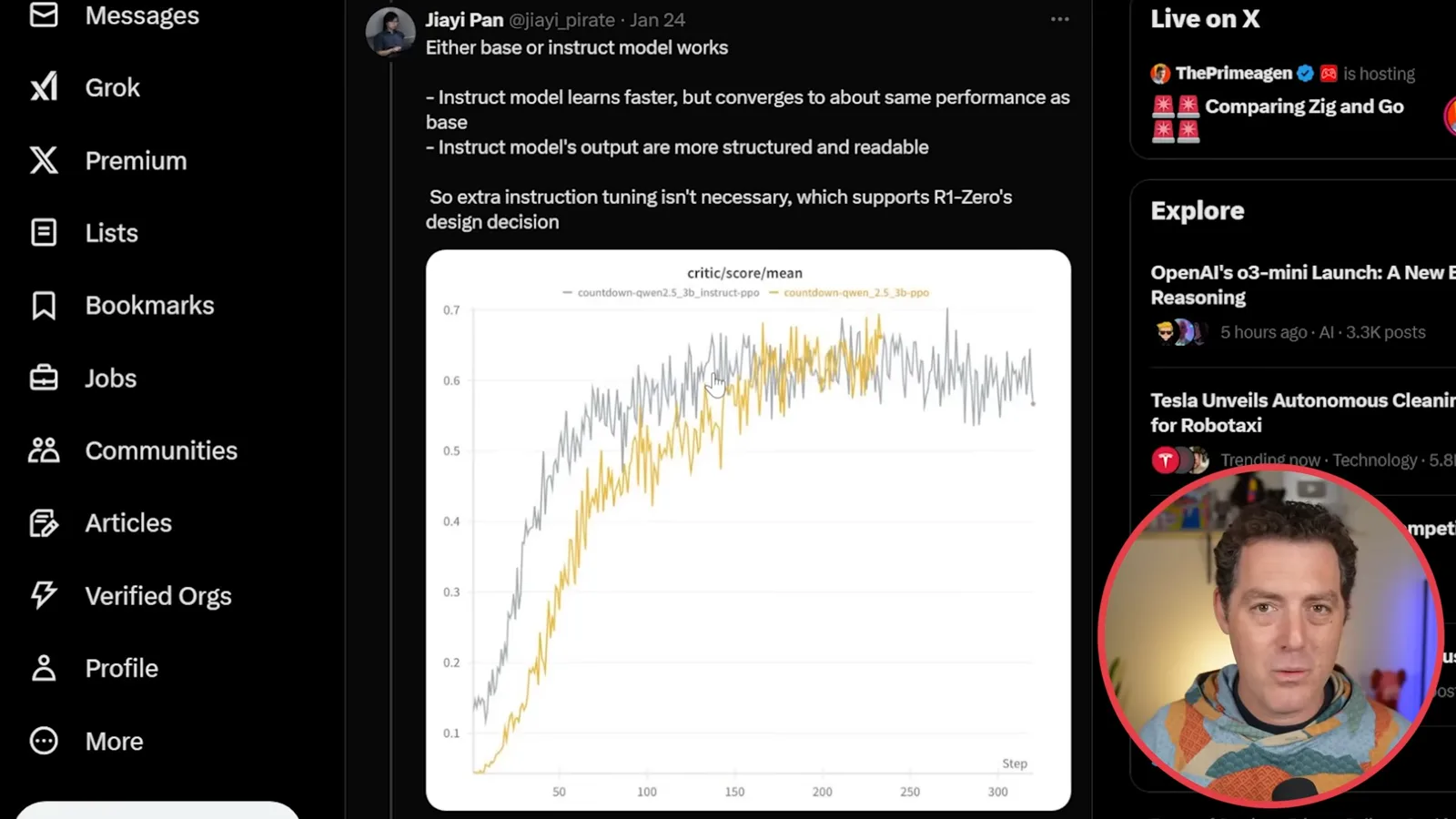
They also compared base and instruction-tuned variants. The instruction model learned faster and produced more structured, readable responses, while the reported final Countdown performance was roughly similar. That is evidence about these particular runs, not proof that instruction tuning is unnecessary for every application.
Pan says the team tried PPO, GRPO and PRIME, and observed long reasoning traces with each. The researchers had not tuned their hyperparameters and explicitly declined to rank the algorithms quantitatively. The experiment therefore does not establish that the algorithm choice never matters.
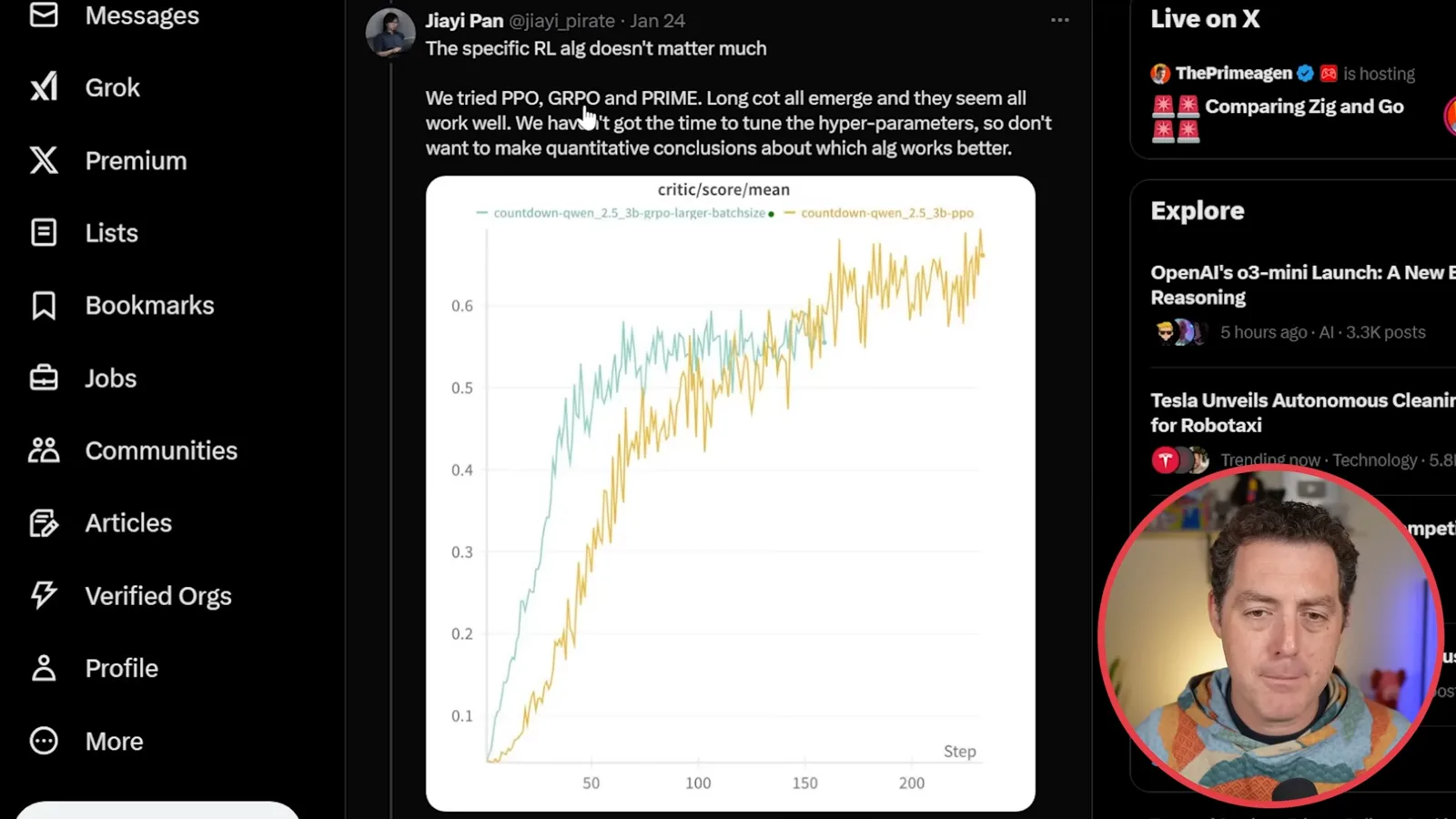
The observed strategy also depended on the task. For Countdown the model searched and checked proposed answers; for multiplication, Pan reported a step-by-step strategy based on the distributive rule. I find that variation interesting when considering small systems specialized for particular problems.
Limits, compute cost and open resources
The research is restricted to a narrow task and includes an unsuccessful Open LLaMA setup. The quoted price applies to a particular 3B training run.
The central caveat is scope: Pan said the main result had been validated on Countdown rather than general reasoning, with compute limiting further experiments. A separate Open LLaMA run had a termination problem: the model often continued generating because the implementation did not stop after the answer, so the team did not report those results in the thread.
Asked about the price, Pan identified the run as a 3B model trained with PPO and estimated about ten H100 GPU-hours, corresponding to roughly $30 at the assumed rate. This is an estimate for the additional experiment, not the cost of pretraining Qwen, conducting all research, or reproducing DeepSeek-R1. Actual costs depend on hardware prices and configuration.
In preliminary observations, the 3B model’s output length first fell as it learned the expected format, then its chain-of-thought length increased alongside improved performance. Pan cautioned that minor code mismatches could affect this early result, so it should be interpreted cautiously.
Pan also considered DeepSeek’s published training-cost figures plausible under the stated mixture-of-experts and FP8 assumptions; that is his assessment, not an independent audit. TinyZero’s code, dataset and experiment logs were made available for others to study and reproduce the narrow experiment.
More from this channel
 34:21EN
 Matthew Berman· Oct 27, 2026Matthew Berman Examines Anthropic’s IPO Filing, AI Growth and GovernanceMatthew Berman, Sam Altman · Forward FutureThe presenter reviews the S-1’s financial metrics, compute strategy and voting structure while questioning the tension between rapid AI development and safety.
 0:26ENMatthew Berman· Oct 25, 2026Sam Altman on Human Values and Problem-Solving in an AI WorldSam Altman · OpenAIIn a short interview excerpt, Altman considers the enjoyment of solving hard problems and the human role in interpreting results.
 0:36ENMatthew Berman· Oct 25, 2026Kimi K3.1 and a Rubik’s Cube Solver DemonstrationMatthew Berman · Forward FutureMatthew Berman shows a scrambled virtual cube being solved and gives the Kimi K3.1 test a favorable assessment.
 0:21ENMatthew Berman· Oct 24, 2026An AI-Generated Kimi Benchmark Chart Used Invented ScoresMatthew Berman · Forward FutureMatthew Berman asks for a graph of Kimi K3.1 Pro benchmarks, then discovers that the displayed figures are illustrative placeholders.
 25:50ENMatthew Berman· Oct 24, 2026Kimi K3.1 Pro Tested: Strong 3D Demos, Uneven Results and Competitive PricingMatthew Berman · Forward FutureMatthew Berman tests the open-weight model on coding, 3D rendering and visual explanations, then compares benchmark results and prices.
 32:20ENMatthew Berman· Oct 23, 2026Who Is Local AI For? The Costs, Trade-offs and a Hybrid FutureMatthew Berman · Forward FutureMatthew Berman weighs data control and independence against hardware cost, setup complexity and inference speed.