In 30 seconds
On April 8, 2026, Matthew Berman reacts to Anthropic's decision that third-party harnesses including OpenClaw would no longer draw from ordinary Claude subscription limits. Anthropic said users could continue through separately billed extra usage or an API key; this was a billing and access change, not a blanket ban on Claude in OpenClaw. Berman describes his own model switch, questions policy clarity and argues for avoiding dependence on one provider. The video includes a paid DigitalOcean promotion. Plan limits, terms, credits, pricing and model availability are historical details that may change; Anthropic later revised its approach to third-party agent usage.
- 1Subscription usage changedThe email shown says that from April 4 third-party harnesses would use separately billed extra usage instead of plan limits. It also offers a time-limited refund option.
- 2Anthropic's explanationBoris Cherny said subscriptions were not designed for the usage patterns of these tools and cited capacity management.
- 3Switching modelsBerman describes switching his OpenClaw setup to GPT-5.4 and using existing model-specific prompt files; that experience does not establish zero switching costs for everyone.
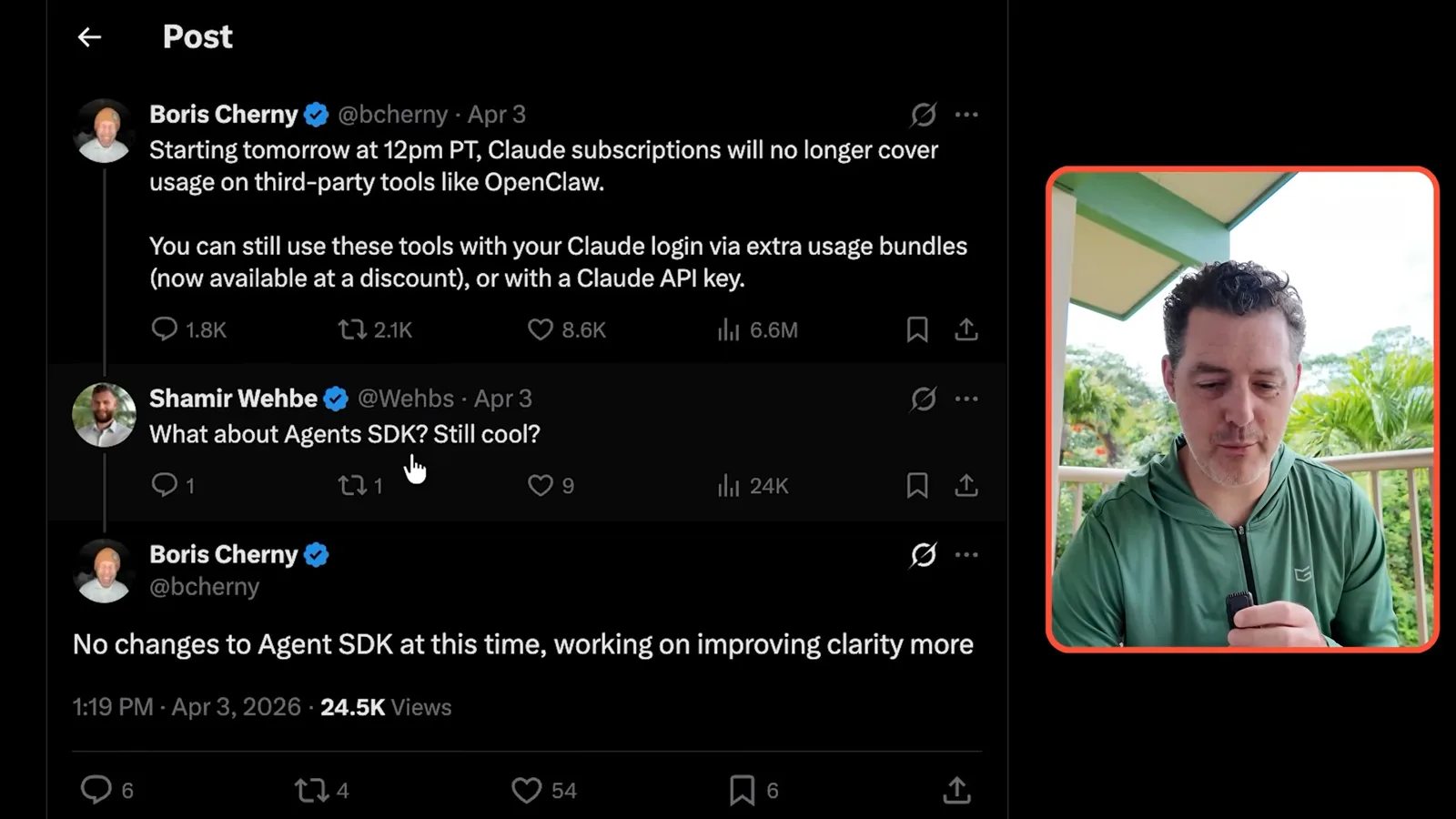
- 4SDK ambiguityA displayed reply says there were no changes to Agent SDK at that time, while Berman says the application to his setup remained unclear.
- 5A disputed classificationOpenClaw creator Peter Steinberger reported a first-party request being classified as third-party usage; Cherny called the behavior unintentional and said it was being investigated.
Takeaways
- The April 4, 2026 policy moved third-party harness usage such as OpenClaw outside ordinary Claude subscription limits, with extra usage billed separately.
- Anthropic offered eligible users transitional credits and a cancellation-and-refund option under the terms shown at the time.
- Berman's rapid model switch was aided by prompt files he had already tailored; migration cost and results vary by system.
- Agent SDK compatibility and automated classification were disputed in the video, and the policy evolved after it was recorded.
- Status-page uptime and annualized revenue are snapshots, not proof of the causes of every outage or of an entire year's revenue.
- The DigitalOcean segment is sponsored and its cost and reliability comparisons are promotional claims.
Read the edited text by chapter
Subscription change and capacity
Berman reviews Anthropic's notice and its explanation for moving third-party use to extra billing. He discusses historical quota changes and user concerns.
Anthropic told Claude subscribers that third-party harnesses, including OpenClaw, would no longer use their ordinary subscription allowance beginning April 4, 2026. I find the timing and communication frustrating. The notice did not ban all use of Claude in OpenClaw: it said users could enable separately billed extra usage or use an API key, subject to the relevant terms.
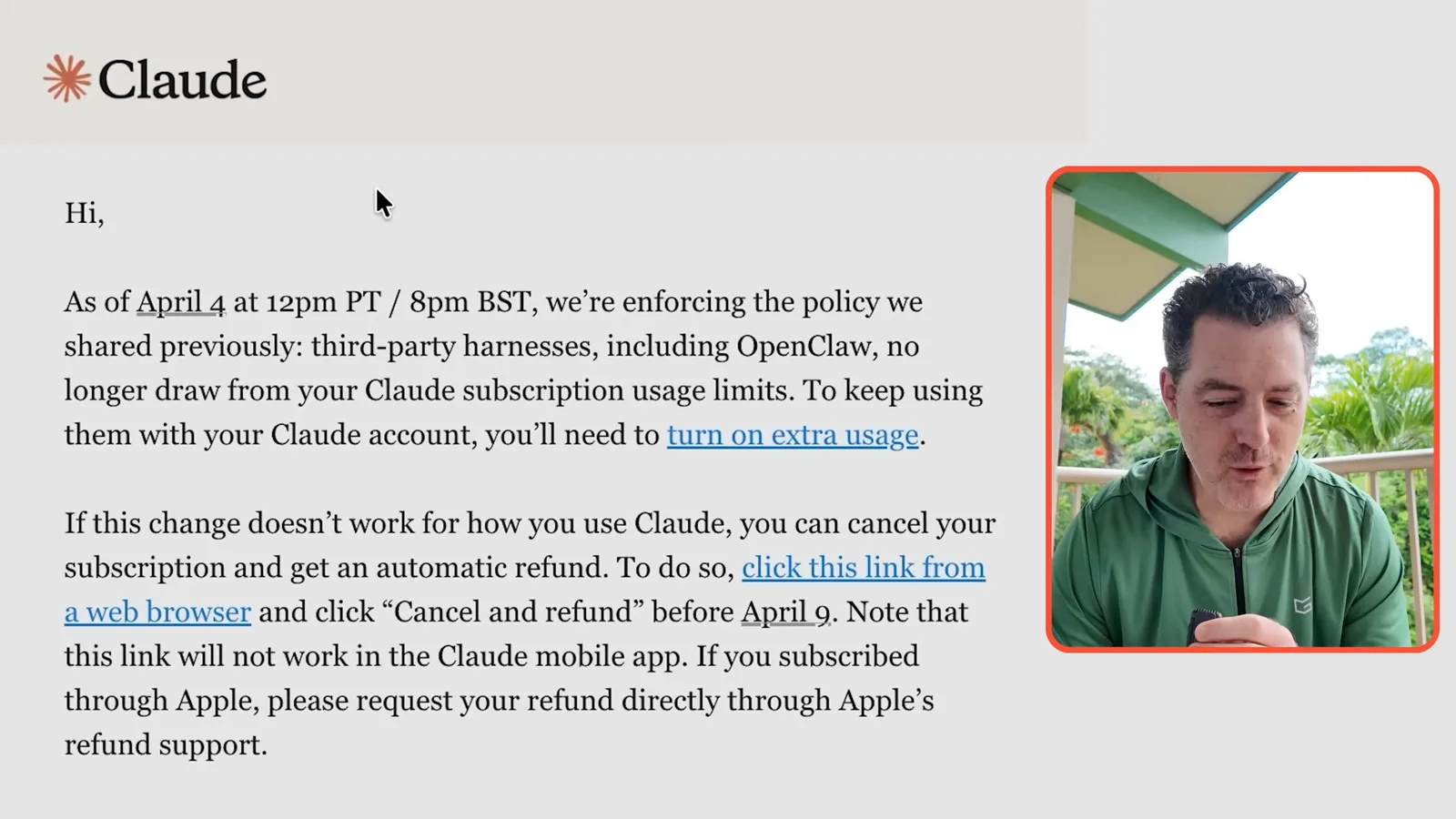
The email displayed in the video sets noon Pacific on April 4 as the enforcement time and says affected users could cancel for an automatic refund before April 9, with a different process for Apple subscriptions. I say the message arrived less than a day before the change. These were time-limited conditions from 2026, not a standing refund offer.
I discuss a reported comparison between a $200 subscription and a much higher equivalent amount of API credits, suggesting that flat-rate usage can be subsidized. That comparison depends on assumptions about usage and pricing and does not establish Anthropic's actual cost or profit on every subscriber. More usage charges could change the economics for people running agents heavily.
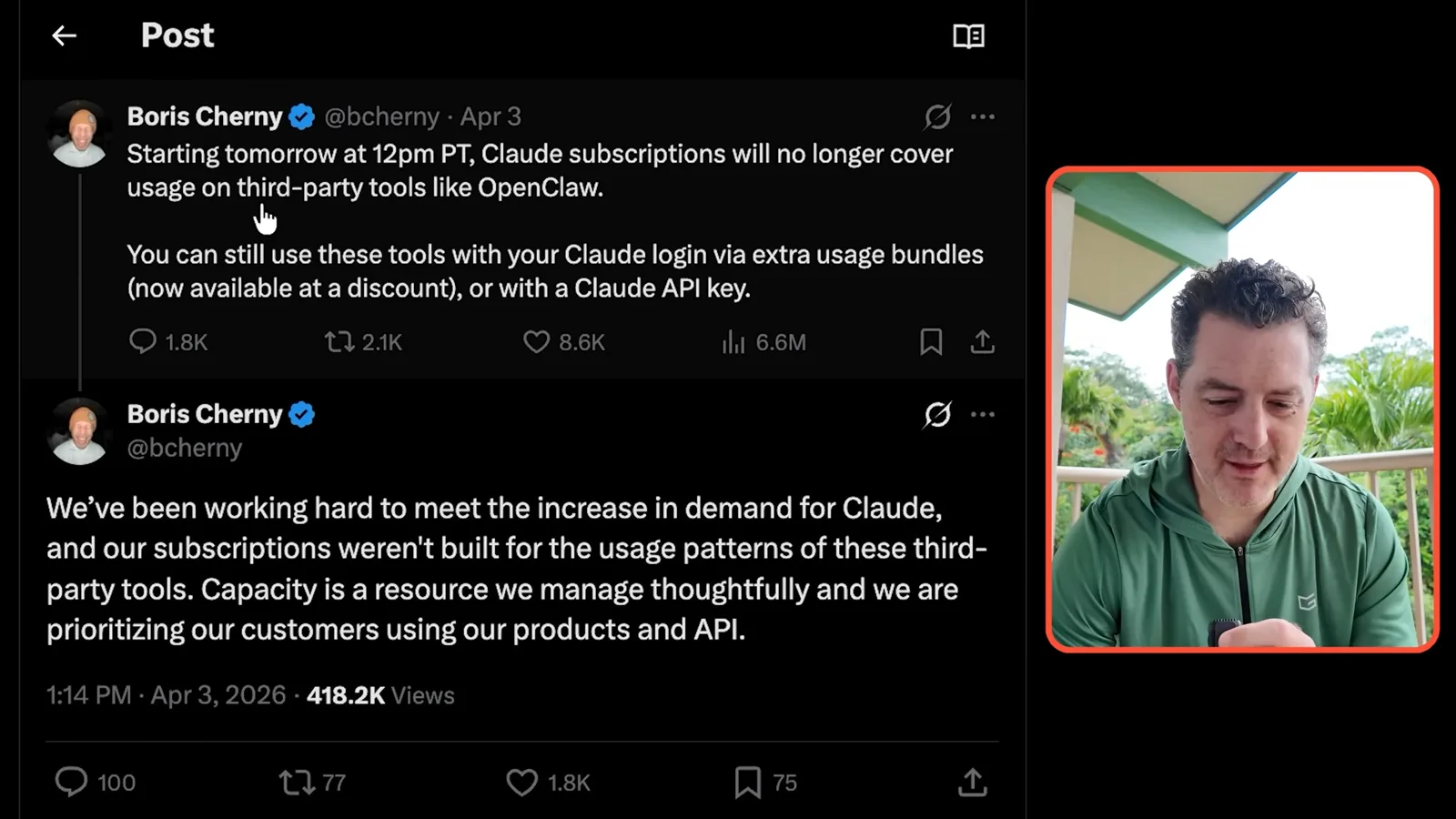
Boris Cherny, who leads Claude Code, said subscriptions were not built for the usage patterns of some third-party tools and cited the need to manage capacity. He also described a one-time credit equal to the monthly plan and discounted extra-usage purchases. Eligibility, deadlines and billing conditions applied to those offers.
I argue that Anthropic faced simultaneous growth and capacity pressure. I point to a temporary promotion that doubled usage outside weekday peak hours and on weekends, and a separate announcement that some users would consume their five-hour allowance faster during weekday peaks. These were distinct, time-bound policies; my suggestion that affected users were mostly OpenClaw users is speculation.
I also report user complaints about quotas being exhausted unexpectedly after a reset. Those anecdotes point to frustration, but they do not establish how widespread the issue was or its cause. From the notice, I initially wonder whether Claude can be used in OpenClaw at all; the stated April policy allowed use through separately billed extra usage or an API key.
Switching models and sponsor
He describes switching his own setup and tailoring prompts for each model. A paid DigitalOcean segment follows.
In my own setup I asked OpenClaw to switch routes from Claude to GPT-5.4 through Codex authentication. I say the change took about three minutes. This is one experience with a prepared configuration, not evidence that switching has literally zero cost: compatibility, evaluation, pricing, permissions and provider terms can all differ.
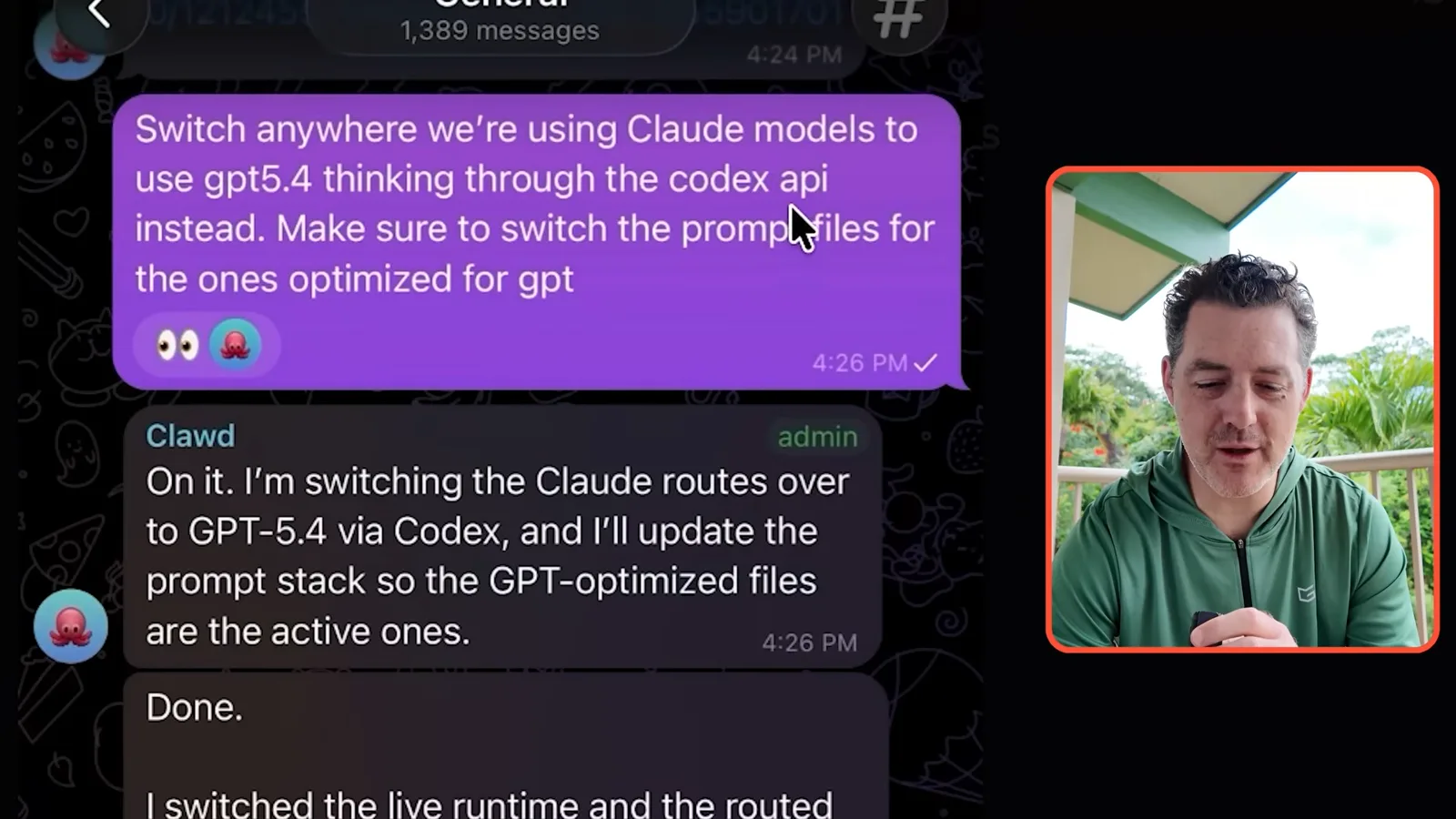
A detail that helped me was keeping separate prompt files optimized for each model. The wording I use for Opus 4.6 can differ from the wording for GPT-5.4 even when the task is the same. I recommend planning for those differences, while recognizing that other applications may need more extensive changes and testing.
DigitalOcean sponsors this video. I promote its Agnostic Inference Cloud for deploying open models and describe advantages in simplicity, throughput and cost. Those are sponsored product claims, not independently established comparisons or guarantees for every workload.
SDK policy, uptime and growth
Berman discusses uncertainty around the Agent SDK and shows a status-page snapshot. He cites a reported annualized revenue run rate and infrastructure expansion.
A user asks Boris Cherny whether the Agent SDK is affected, and his displayed response says there were no changes to the SDK at that time while clarity was being improved. I remain unsure how that answer applies to using the SDK inside OpenClaw and decide to avoid relying on it. That uncertainty reflects the April 2026 discussion, not a definitive current interpretation.
I contrast my experience of Claude quotas with my experience using Codex and say I have not personally hit a Codex limit. Quotas and available authentication methods depend on plan, service and date, so my experience is not a universal entitlement or a comparison of all users' costs.
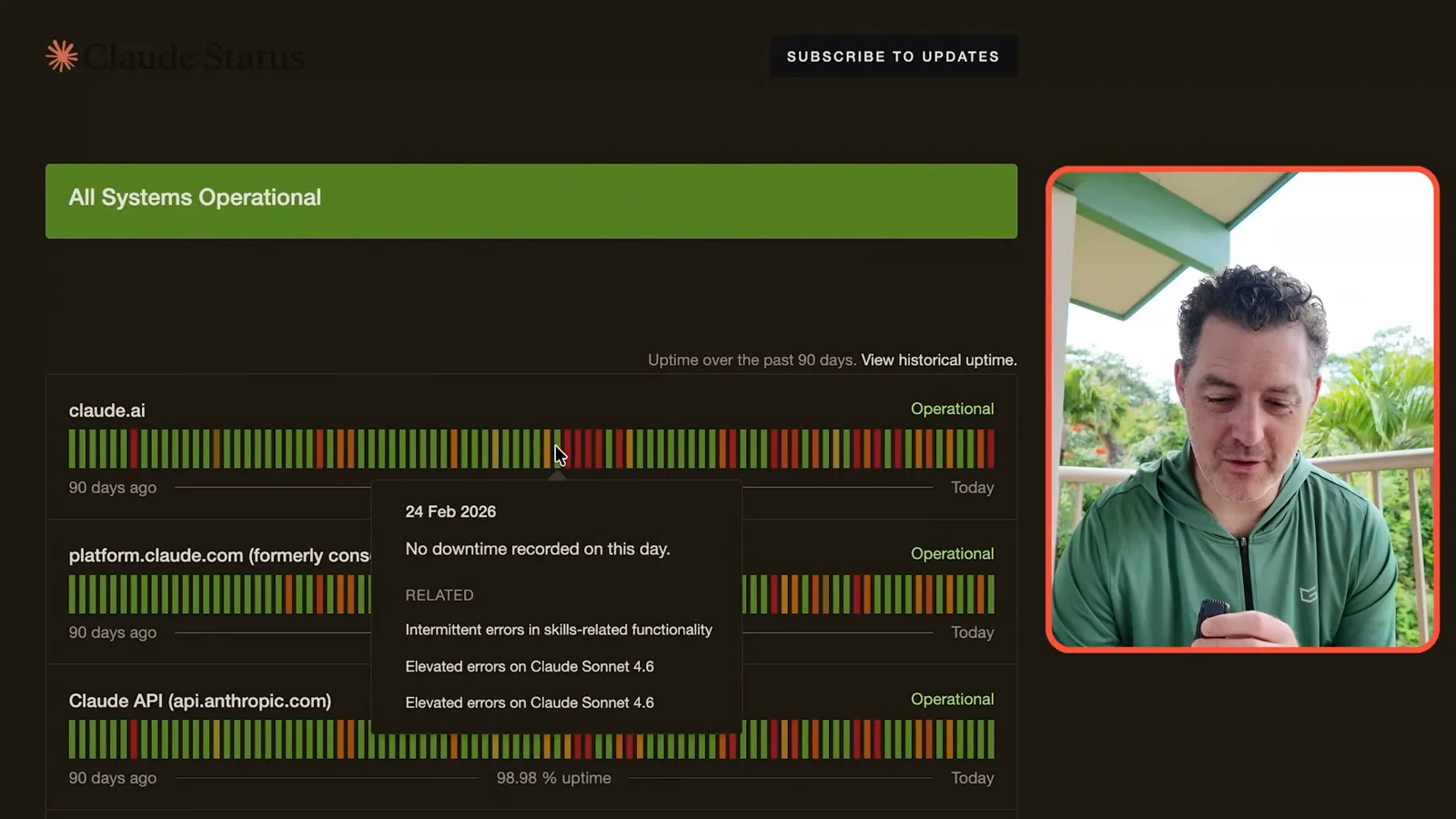
I show Claude's status page, which in the displayed 90-day snapshot reports roughly 98.77% uptime for claude.ai and below 99% for the API. I consider that insufficient for some workflows. A status-page snapshot is not a current availability guarantee, and it does not by itself prove that GPU capacity caused each incident.
I cite reporting that Anthropic's annualized revenue run rate had passed $30 billion, up from roughly $9 billion at the end of 2025, and mention a Google infrastructure deal. A run rate extrapolates recent revenue; it is not revenue actually earned over a full year. The public comparison with OpenAI is uncertain because reported figures may cover different periods and use different accounting methods.
I interpret this growth as evidence of strong demand and suggest coding alone justifies the run rate. The reported company-wide figure does not isolate revenue from coding, however, and growth by itself does not establish profitability or the cause of all capacity constraints.
Multi-model strategy and disputed blocking
He argues for using several providers and local models. He reviews a reported classifier issue, Anthropic's response and OpenClaw's GPT-5.4 improvements.
My broader recommendation is to maintain a multi-model strategy instead of depending on one provider. Alongside frontier models, I suggest considering local or open-weight models for classification, extraction and summarization. The best division depends on the task, quality requirements, deployment costs and the particular models available.
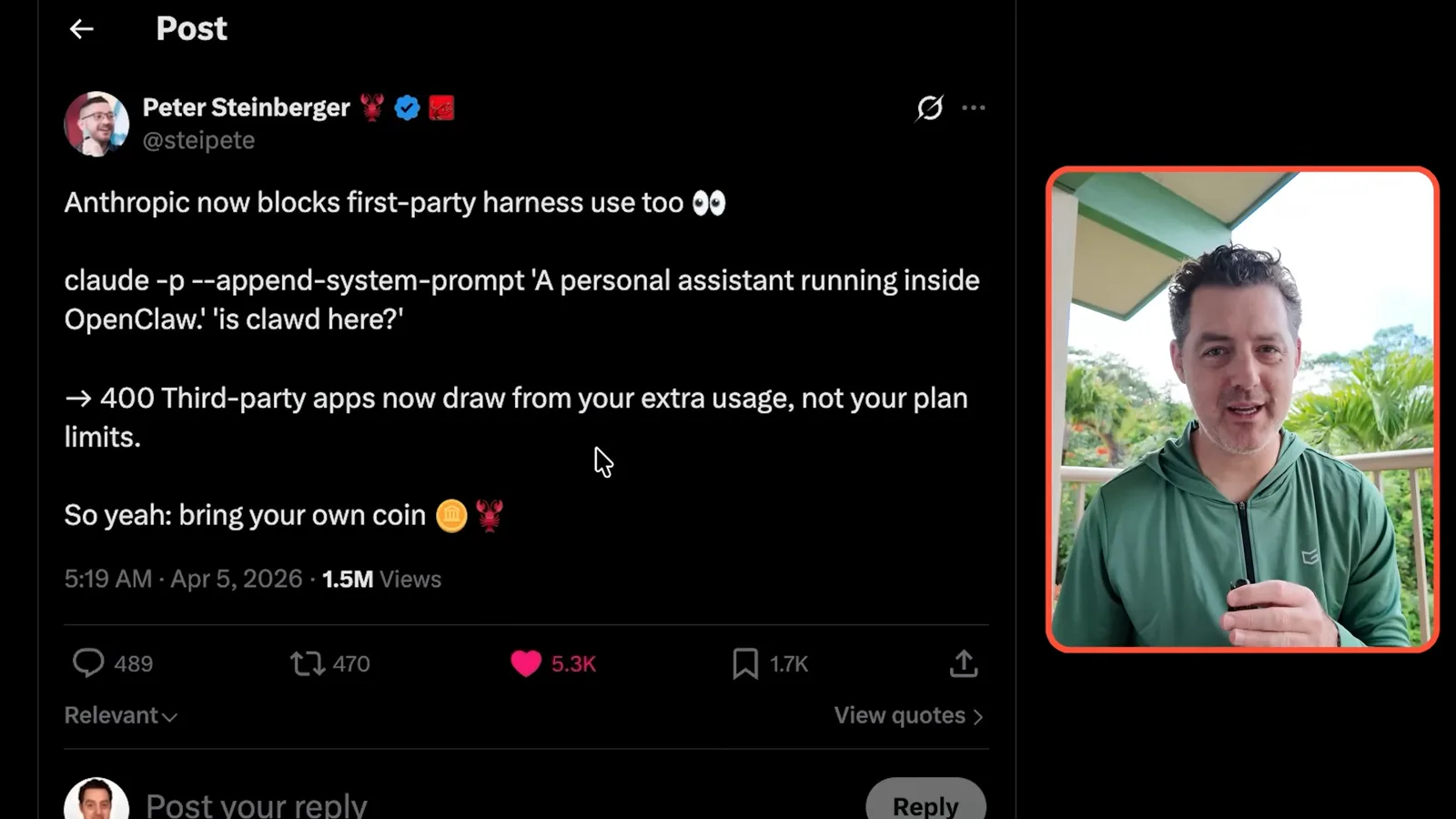
Peter Steinberger posts an example in which an apparently first-party Claude request was routed to extra usage when it contained OpenClaw-related context. I criticize the behavior as blocking prompts; Cherny replies that it was unintentional and likely caused by an overactive abuse classifier. The example and response do not prove that every such prompt was deliberately banned.
I return to the uncertainty around SDK use and ask Anthropic to state its policy clearly. Terms and implementation have changed since this video: later reporting described a separate Agent SDK credit allocation for third-party tools. Anyone deploying an integration should check the provider's current documentation and their plan's terms.
I contrast Anthropic's approach with OpenAI's association with OpenClaw creator Peter Steinberger and discuss reports that OpenClaw improved GPT-5.4's conversational style. I see these changes as encouraging alternatives, though my prediction that everyone will move to one model is an opinion, not a measured migration.
Steinberger invites people to test the GPT-5.4 changes and shares positive early feedback. I welcome the improvement and close with the same principle: use different models for different strengths, rather than relying on just one. The right choice still depends on the workload and the conditions of each provider.
More from this channel
 34:21EN
 Matthew Berman· Oct 27, 2026Matthew Berman Examines Anthropic’s IPO Filing, AI Growth and GovernanceMatthew Berman, Sam Altman · Forward FutureThe presenter reviews the S-1’s financial metrics, compute strategy and voting structure while questioning the tension between rapid AI development and safety.
 0:26ENMatthew Berman· Oct 25, 2026Sam Altman on Human Values and Problem-Solving in an AI WorldSam Altman · OpenAIIn a short interview excerpt, Altman considers the enjoyment of solving hard problems and the human role in interpreting results.
 0:36ENMatthew Berman· Oct 25, 2026Kimi K3.1 and a Rubik’s Cube Solver DemonstrationMatthew Berman · Forward FutureMatthew Berman shows a scrambled virtual cube being solved and gives the Kimi K3.1 test a favorable assessment.
 0:21ENMatthew Berman· Oct 24, 2026An AI-Generated Kimi Benchmark Chart Used Invented ScoresMatthew Berman · Forward FutureMatthew Berman asks for a graph of Kimi K3.1 Pro benchmarks, then discovers that the displayed figures are illustrative placeholders.
 25:50ENMatthew Berman· Oct 24, 2026Kimi K3.1 Pro Tested: Strong 3D Demos, Uneven Results and Competitive PricingMatthew Berman · Forward FutureMatthew Berman tests the open-weight model on coding, 3D rendering and visual explanations, then compares benchmark results and prices.
 32:20ENMatthew Berman· Oct 23, 2026Who Is Local AI For? The Costs, Trade-offs and a Hybrid FutureMatthew Berman · Forward FutureMatthew Berman weighs data control and independence against hardware cost, setup complexity and inference speed.