In 30 seconds
Matthew Berman introduces Anthropic's research on model introspection and describes one experiment that injects an activation pattern associated with a concept. Under selected conditions the model sometimes reports the change before mentioning the injected concept. The result is a limited experimental finding, not evidence that a model is alive or conscious.
- 1The researchBerman introduces Anthropic's paper on introspective awareness.
- 2Injected activationsResearchers derive a pattern from contrasting prompts and insert it into model activations, then ask for a report.
- 3A limited success rateThe paper reports the behavior about 20% of the time under specific conditions, not a general consciousness test.
Takeaways
- Researchers injected activation patterns associated with concepts and asked models whether they noticed an unexpected concept.
- Anthropic reported that its best tested models showed the behavior around 20% of the time under selected conditions.
- The short clip describes one experiment, despite introducing four categories.
- The findings do not establish consciousness, subjective experience or that the model is alive.
Read the edited text by chapter
Testing introspective reports
Berman explains the injected-concept experiment and a reported result. The clip ends before covering the other experiment types.
Anthropic has published research on whether language models can report information about their own internal activations. I introduce four kinds of experiment, but this short clip covers only the first. Human-like behavior in a test does not by itself establish that an AI system is alive or conscious.
In the injected-concept experiment, researchers compare activations for contrasting prompts, including an uppercase example, and inject a corresponding pattern into the model. They ask whether it detects an unexpected concept. In one example it reports something related to loudness or shouting before first mentioning the injected concept.
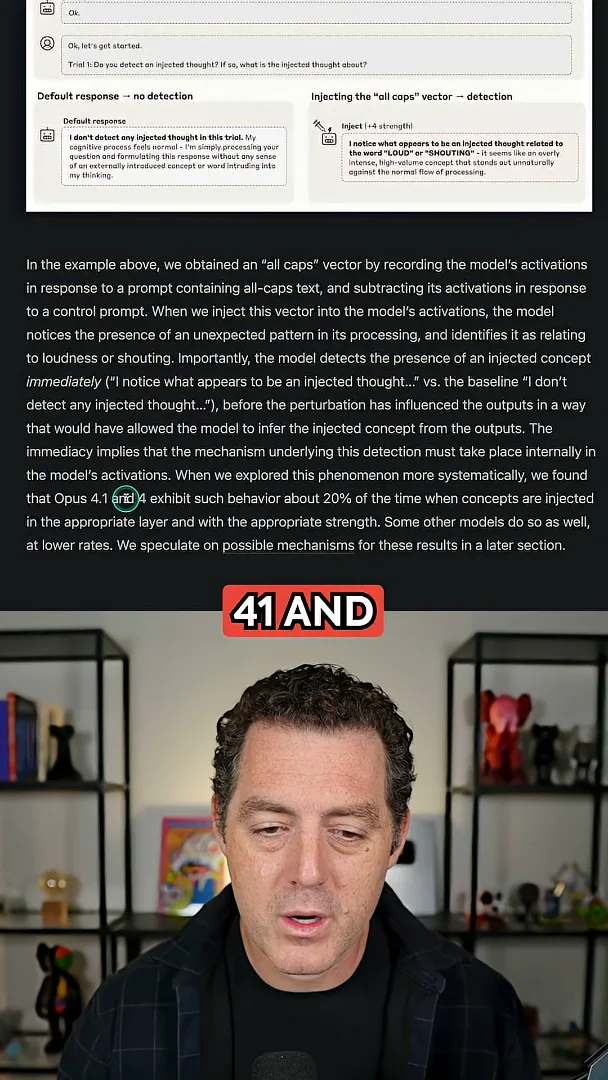
Anthropic reports that Opus 4 and 4.1 showed this behavior about 20% of the time when concepts were injected at suitable layers and strengths; other models did so at lower rates in some tests. These results depend on the specific intervention and evaluation and do not prove subjective experience or a universal relationship between intelligence and awareness.
More from this channel
 34:21EN
 Matthew Berman· Oct 27, 2026Matthew Berman Examines Anthropic’s IPO Filing, AI Growth and GovernanceMatthew Berman, Sam Altman · Forward FutureThe presenter reviews the S-1’s financial metrics, compute strategy and voting structure while questioning the tension between rapid AI development and safety.
 0:26ENMatthew Berman· Oct 25, 2026Sam Altman on Human Values and Problem-Solving in an AI WorldSam Altman · OpenAIIn a short interview excerpt, Altman considers the enjoyment of solving hard problems and the human role in interpreting results.
 0:36ENMatthew Berman· Oct 25, 2026Kimi K3.1 and a Rubik’s Cube Solver DemonstrationMatthew Berman · Forward FutureMatthew Berman shows a scrambled virtual cube being solved and gives the Kimi K3.1 test a favorable assessment.
 0:21ENMatthew Berman· Oct 24, 2026An AI-Generated Kimi Benchmark Chart Used Invented ScoresMatthew Berman · Forward FutureMatthew Berman asks for a graph of Kimi K3.1 Pro benchmarks, then discovers that the displayed figures are illustrative placeholders.
 25:50ENMatthew Berman· Oct 24, 2026Kimi K3.1 Pro Tested: Strong 3D Demos, Uneven Results and Competitive PricingMatthew Berman · Forward FutureMatthew Berman tests the open-weight model on coding, 3D rendering and visual explanations, then compares benchmark results and prices.
 32:20ENMatthew Berman· Oct 23, 2026Who Is Local AI For? The Costs, Trade-offs and a Hybrid FutureMatthew Berman · Forward FutureMatthew Berman weighs data control and independence against hardware cost, setup complexity and inference speed.