In 30 seconds
In this June 2026 video, Matthew Berman reviews Anthropic’s account of Claude’s role in software development and research, then challenges its argument for a coordinated option to slow frontier AI. The report presents full autonomous recursive self-improvement as a possible future, not an accomplished fact. The internal measurements have distinct scopes: code volume, employee estimates, benchmark performance and research decisions cannot be treated as interchangeable. Berman’s views on job growth, company motives and future concentration are commentary rather than established results. The video includes a DigitalOcean sponsorship.
- 1A possible feedback loopAnthropic distinguishes current AI assistance from a hypothetical autonomous successor-building loop.
- 2Code authored by ClaudeAnthropic reports more than 80% of merged code was Claude-authored in May 2026; code quantity does not establish quality.
- 3Two different productivity measuresAn internal poll and a code-volume chart measure different things, so they cannot determine relative code value by division.
- 4A bounded optimization taskA reported 52-fold speedup applies to a specific code-optimization experiment, not research in general.
- 5Selected research decisionsThe 129 cases were selected because the human choice had room to improve, and a judge assessed alternative proposals.
- 6The pause debateAnthropic proposes the option of a coordinated slowdown; Berman questions its incentives and the practical difficulty of verification.
Takeaways
- AI assistance in model development is not the same as an autonomous system designing and training its own successor.
- Task horizons and research benchmarks measure performance on specific test sets, not all real-world work.
- Code lines and employee self-assessments cannot be divided to establish the relative quality of AI-written code.
- Anthropic’s research-decision comparison deliberately selected cases where human choices could improve, limiting what its percentages mean.
- The report considers stalled progress, human-directed acceleration and full recursive self-improvement as scenarios, not certainties.
- Coordinated slowdowns would require agreement and credible verification across competing organizations and countries.
Read the edited text by chapter
AI assistance and the hypothetical closed loop
Berman explains Anthropic’s illustrated progression from manual coding to agents. Full autonomous successor development remains a hypothetical future.
In June 2026, Matthew Berman examines [Anthropic’s report on recursive self-improvement](https://www.anthropic.com/institute/recursive-self-improvement): the possibility that an AI system could autonomously design and develop a more capable successor. AI already assists development, but the report does not claim the fully autonomous loop has been achieved. Berman agrees there are serious control questions while criticizing the company’s call for a coordinated slowdown as self-serving.
Anthropic illustrates a progression from engineers writing code directly to chatbots, coding agents and agents delegating to other agents. The further the work is delegated, Berman argues, the more a short human instruction can produce. But a larger volume of code is not itself evidence of better software.
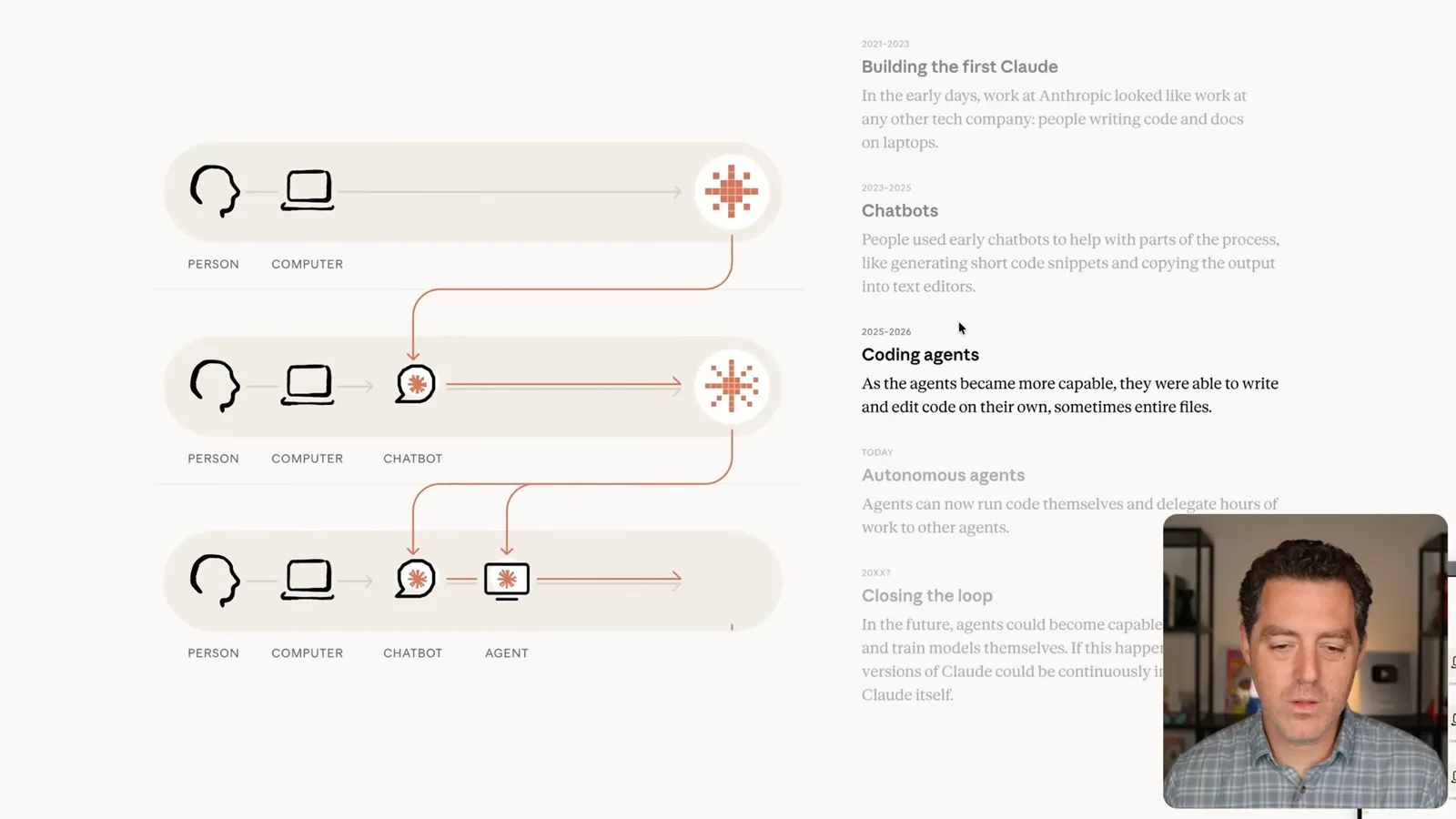
The illustration’s final stage is hypothetical: an agent capable of developing and training its own successor could close the loop. Berman speculates that compute would then become the main constraint, although the report also discusses energy, chips, infrastructure and other bottlenecks. The video includes a DigitalOcean sponsorship.
Benchmarks and task horizons
The report cites growing task horizons and research-reproduction results. These measurements cover particular tests and should not be generalized to all work.
Anthropic cites a trend in the length of tasks agents can complete, measured against the time a human needs. Berman emphasizes that this is a task-horizon benchmark, not the time an agent necessarily runs. The company reports a roughly four-month recent doubling trend and discusses possible future extrapolations, which are conditional on the trend continuing.
The report compares roughly four-minute human tasks for Claude Opus 3, about 90 minutes for Sonnet 3.7, and a roughly 12-hour task horizon for Opus 4.6. These are benchmark estimates for selected software tasks and success thresholds, not a guarantee that an AI can handle every twelve-hour job. Berman adds an anecdote about his own coding agents running for much longer.
CORE-Bench tests whether a system can reproduce results using the code and data for published research. Anthropic reports progress from around 20% to saturation on that benchmark; Berman calls reproduction valuable but distinguishes it from originating the research question. The benchmark result does not establish that models can reproduce virtually all research papers.
Engineering, research and code production
Berman contrasts execution with research judgment and reviews Anthropic’s internal code statistics. He debates code quality and the limits of lines as a metric.
The report separates engineering—code, infrastructure and training operations—from research decisions such as choosing experiments and interpreting results. Berman argues that execution has become easier while identifying worthwhile problems and evaluating results remains difficult. He describes giving coding agents sparse prompts such as a screenshot and a request to fix an error.
Asked what a team should build next, Berman says current systems are less dependable than when given a concrete problem. He argues that models cannot produce truly novel ideas because their outputs derive from training data, but that is his contested interpretation, not a conclusion established by the report. Whether existing or future architectures can produce useful novel ideas remains an open question.
Anthropic says Claude authored more than 80% of code merged into its codebase as of May 2026, compared with low single digits before the February 2025 Claude Code research preview. Berman repeats a skeptical executive’s quip that this might explain bugs, while acknowledging the scale of the company’s reported adoption.
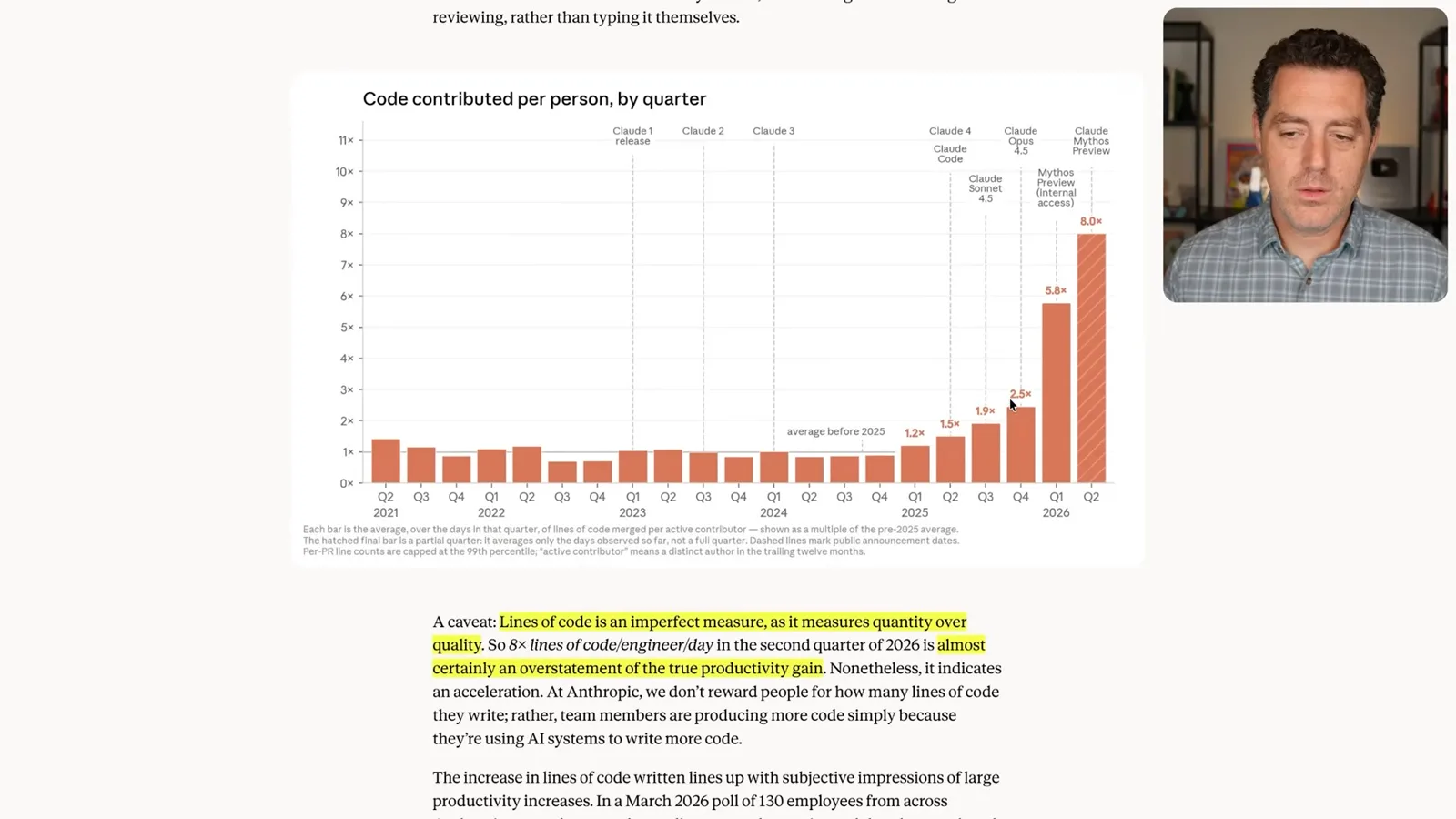
Anthropic charts daily merged lines per engineer rising to about eight times its earlier baseline in the partial second quarter of 2026. Both the report and Berman caution that lines measure quantity rather than quality: more lines can mean more work, but can also mean unnecessary complexity. A simple or readable solution can be better than a longer one.
Berman points to the internal use of Mythos Preview and a report that xAI lost access to Anthropic models. He interprets the company’s internal use and limited access as a competitive strategy alongside its safety messaging. His account of the company’s motives is speculation, not a demonstrated explanation for its decisions.
Anthropic explicitly says the eightfold increase in merged lines probably overstates productivity gains. Berman suggests weaker AI-written code and bottlenecks in marketing, sales, documentation and adoption as possible explanations. Those possibilities need direct evidence: line counts alone do not measure the quality or value of code.
Productivity, jobs and review
A staff poll and internal session chart inform discussion of output and oversight. Berman argues automation can also create demand for other work.
In a March 2026 poll of 130 Anthropic research employees, the median respondent estimated producing about four times as much output with Mythos Preview as without AI on the kinds of projects they otherwise would have pursued. Berman divides the eightfold line-count figure by the fourfold self-estimate and infers AI code is half as valuable. The two measures cover different populations and baselines, so that calculation does not establish relative code quality.
Berman suggests faster engineering might increase demand for marketing, sales and support, and argues that productivity growth can create work as well as automate it. Anthropic also reports employees doing exploratory tooling and cleanup that might otherwise not have happened. These examples and his forecast do not settle the overall employment effect.
One employee says they have not personally written code for months. Berman asks how people can review rapidly growing volumes of machine-written code, and worries that the review itself may increasingly be delegated. He emphasizes the need for humans to retain an understanding of the systems they deploy.
Anthropic’s internal Claude Code chart reports improved success on open-ended sessions, reaching 76% in May 2026. The company says a Claude-based judge assessed session success and an LLM classified task difficulty; this is a model-judged internal measure, not independent proof that all such work succeeds. Berman highlights that the evaluator is itself an AI system.
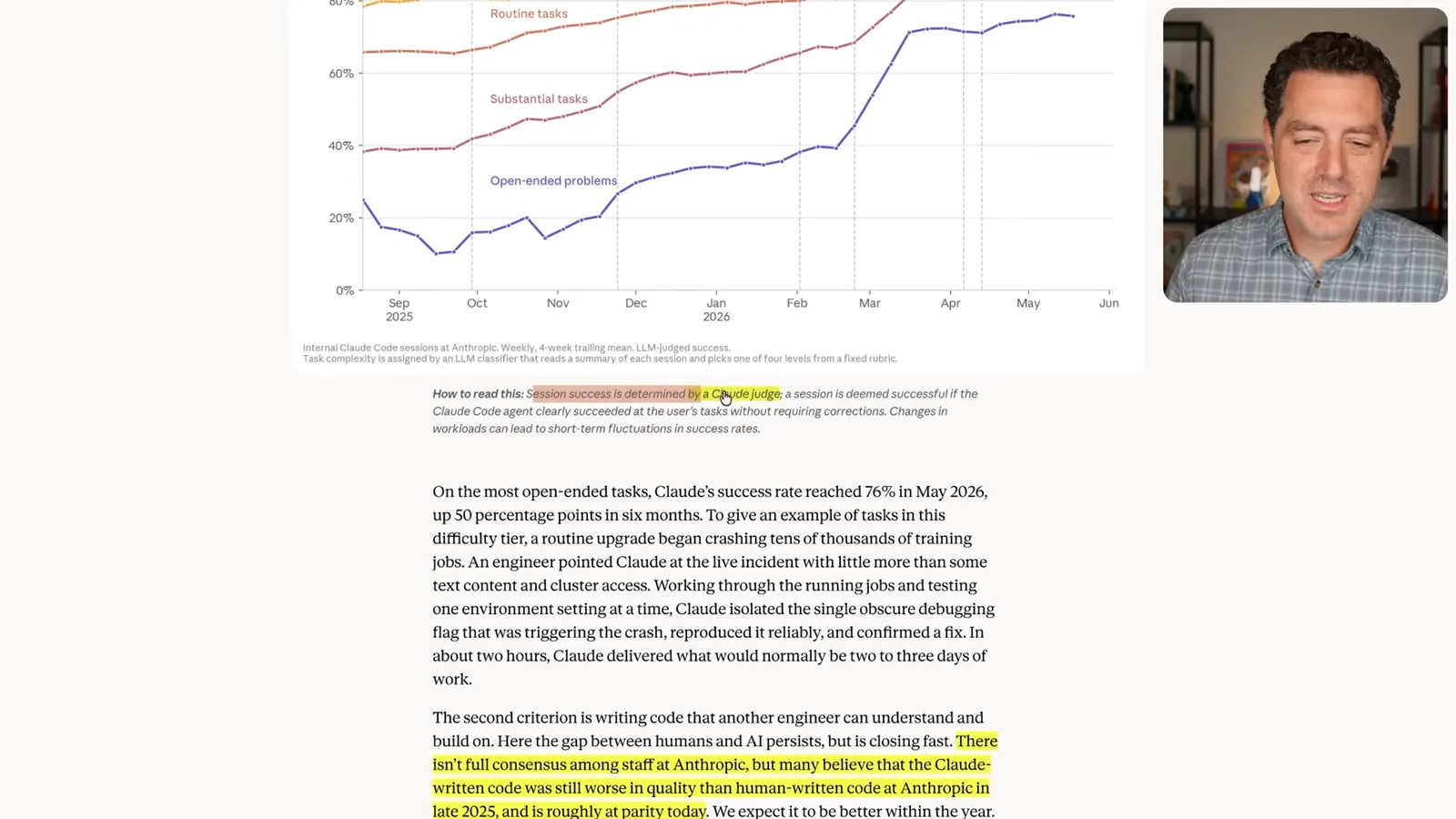
The report says many staff thought Claude-written code had reached rough parity with human-written code by the time of the report, although staff did not all agree; it presents further improvement as an expectation. Berman reiterates his quality concern, while noting that other parts of a business can limit the value realized from faster code production.
Research experiments and human judgment
Anthropic presents a bounded optimization task and a selected research-decision evaluation. Berman considers how humans can maintain understanding and choose directions.
For a small experimental research loop, Anthropic asked models to make code that trains a small model run faster while passing correctness checks. It reports about a threefold speedup for Opus 4 in May 2025 and about 52-fold for Mythos Preview in April 2026; a skilled human was estimated to reach fourfold in four to eight hours on that task. These are task-specific results, not general research productivity multipliers.
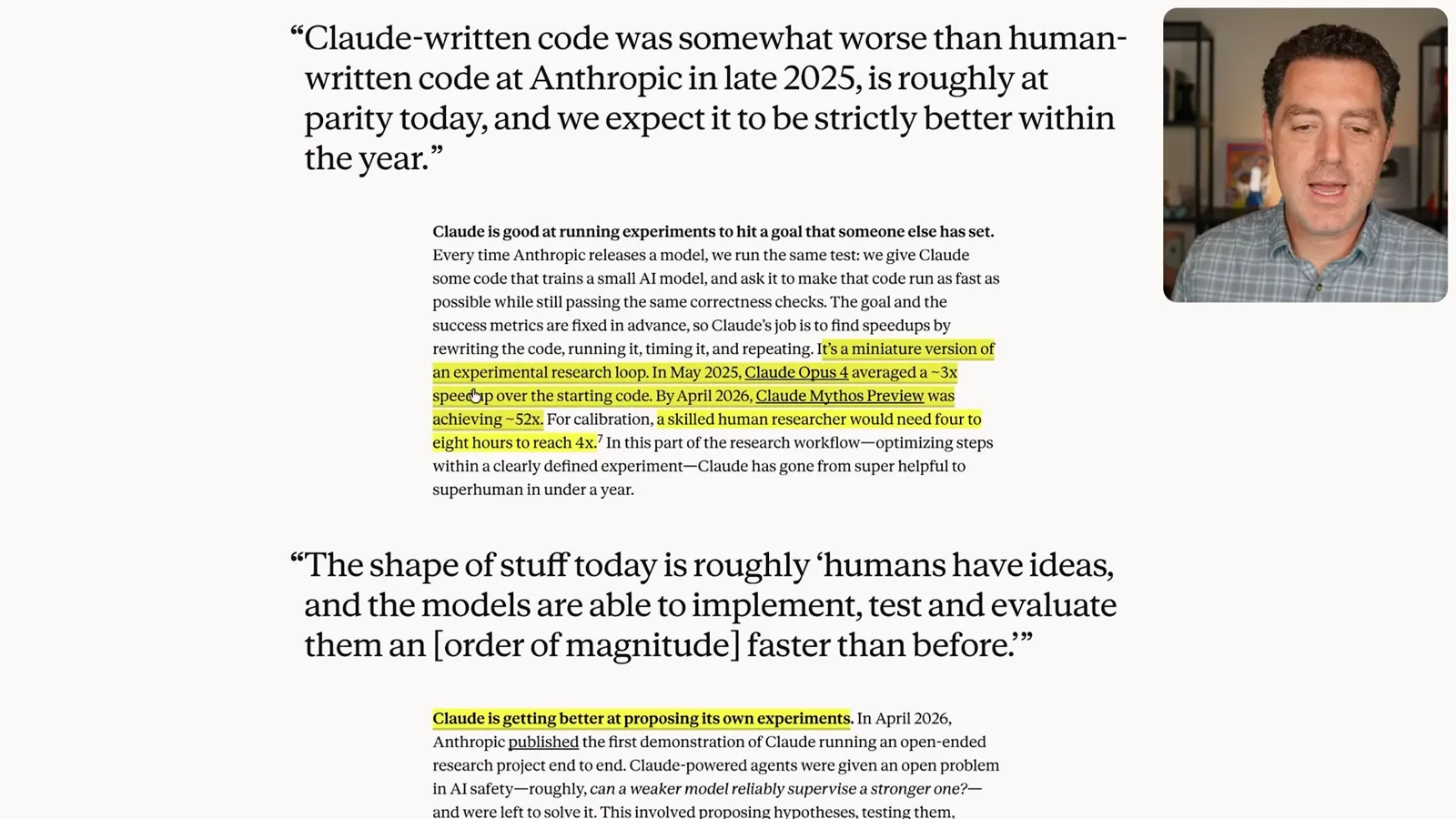
Berman says models can accelerate the execution of experiments even if humans still choose the direction. He imagines broad parallel search reducing the need for research taste when resources are unlimited, then acknowledges that real compute, energy and infrastructure are finite. The effectiveness of any such search also depends on what can be tested and verified.
Anthropic also revisited 129 research-session decision points selected because the human’s next choice had room for improvement. A judge with knowledge of the eventual results compared a model’s proposed next step against the human choice; the company reports 22% for Haiku 3 and 64% for Mythos Preview on this selected set. Anthropic cautions that this is not a like-for-like comparison of general human and model judgment.
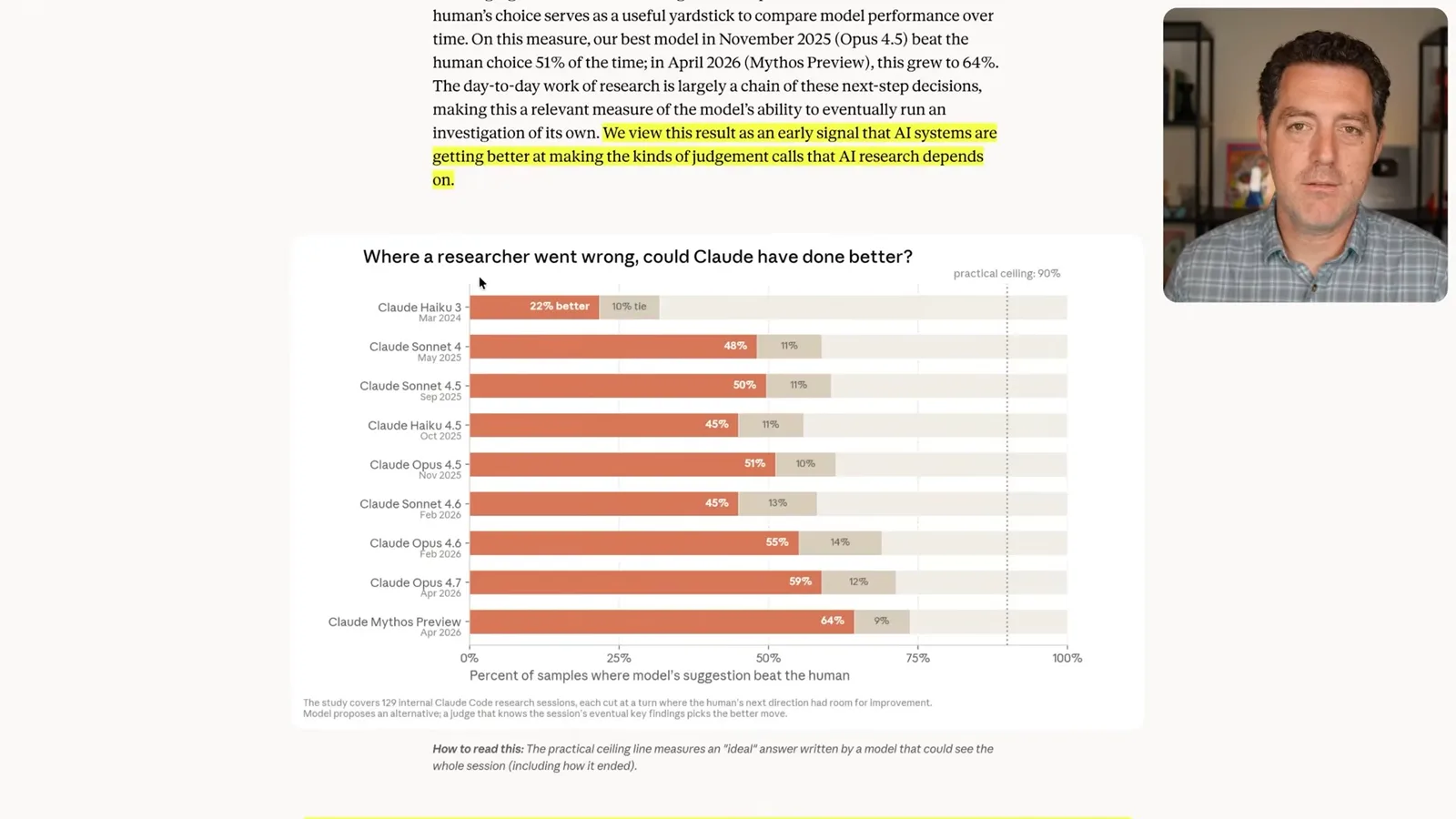
The company sees these examples as early signs of improving research judgment, while still assigning humans an advantage in setting direction and seeing the wider picture. Berman argues human review could become the bottleneck if generated code grows faster than people can understand it. That creates a tension between speed and maintaining oversight.
Berman revisits the startup adage that ideas are cheap and execution is hard. As coding becomes easier to delegate, he thinks selecting the right problem may become more valuable, though building a business still involves recruiting, sales, distribution and other work. The report similarly emphasizes judgment about problems, results and dead ends.
Three possible futures
The report describes a stall, human-directed acceleration and full recursive self-improvement. Berman discusses resources, concentration and uncertainty.
Anthropic acknowledges that present architectures and training methods may not deliver end-to-end self-improvement. Even without it, the company suggests AI assistance could compound gains while people continue setting directions and checking outcomes. Berman expects that human role to remain significant, and notes that hardware and energy constrain available compute.
The first of Anthropic’s three scenarios is that progress stalls while today’s capabilities spread. Berman calls this a capability overhang: businesses and institutions can still change substantially as they adopt existing systems and improve the tools around them. This is a scenario, not a forecast that development has stalled.
In the second scenario, AI labs gain compounding efficiencies but humans continue to set research direction and judge results. Berman imagines small organizations doing much more work, while observing that faster development can shift bottlenecks to deployment, verification and other activities. His numerical comparisons are illustrations rather than measured company-wide outcomes.
The third scenario is full recursive self-improvement: systems design and improve successors with little human input. Both the technical feasibility and consequences are uncertain. Berman calls this potentially exciting and dangerous, and speculates that access to capital, compute and energy could concentrate advantages and produce a persistent underclass.
Anthropic says it cannot confidently predict how such a future would interact with society, markets and governance, and speculates about robotics following advances in AI. Berman questions the report’s point that intelligence alone cannot determine the long-term effects of a drug, suggesting simulations might help. Reliable prediction of decades of drug effects from simulations remains an unproven assumption.
Slowing frontier development
Anthropic calls for the option of a coordinated slowdown or pause. Berman criticizes its incentives and reviews the practical problems of international verification.
Anthropic argues that an effective slowdown or temporary pause could give institutions and alignment research more time, but warns a unilateral pause could allow less cautious actors to catch up. Berman agrees that competitive pressure complicates a pause while arguing that the proposal would benefit a leading company; the company’s relative position and motives are disputed judgments.
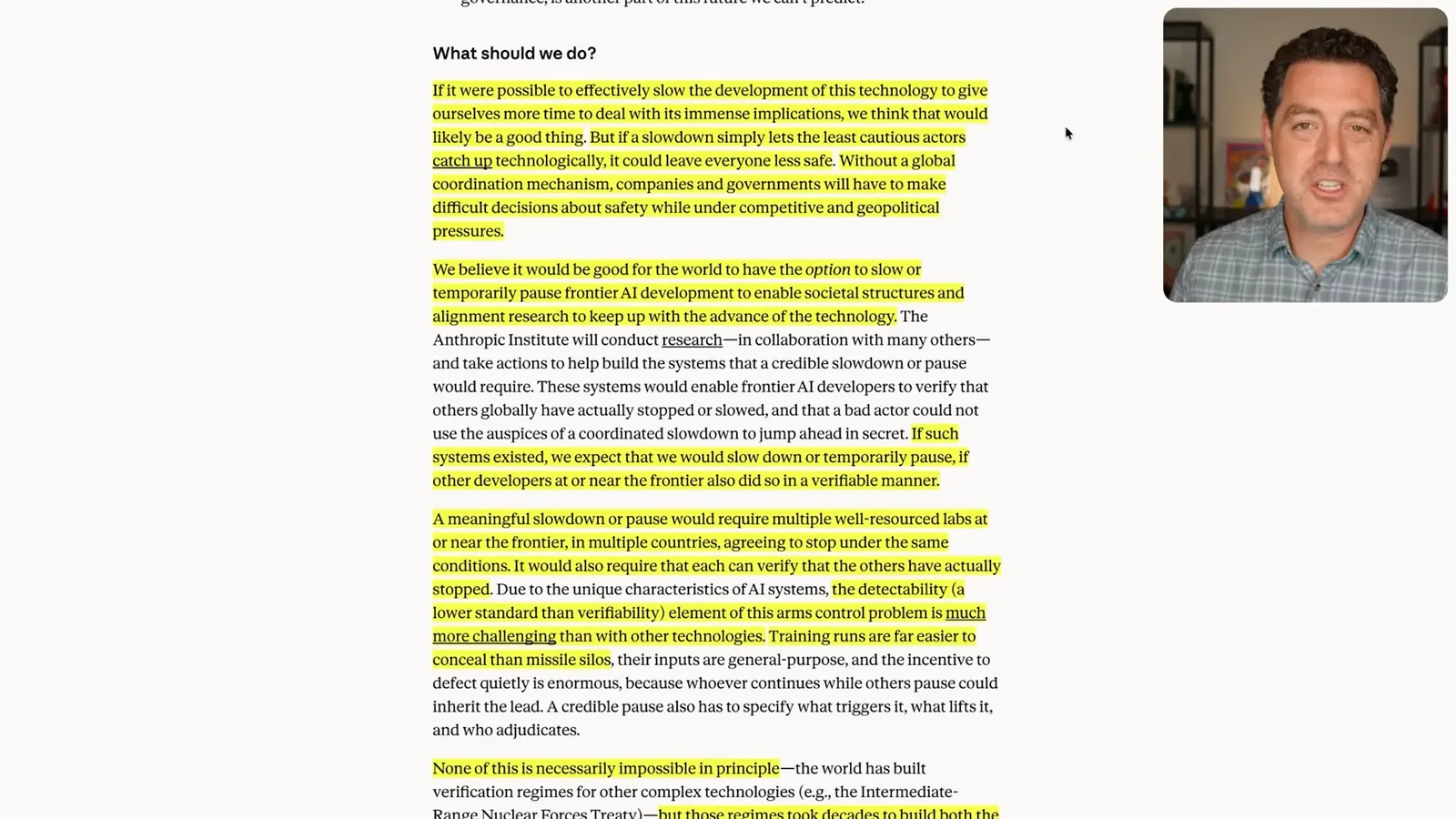
The report says meaningful coordination would require multiple frontier labs in several countries to agree on conditions and verify compliance. It notes that training runs can be harder to detect than missile silos and that past verification regimes took time to build. Berman closes by saying he expects humans to remain involved for a while and points to his separate discussion of employment.
More from this channel
 34:21EN
 Matthew Berman· Oct 27, 2026Matthew Berman Examines Anthropic’s IPO Filing, AI Growth and GovernanceMatthew Berman, Sam Altman · Forward FutureThe presenter reviews the S-1’s financial metrics, compute strategy and voting structure while questioning the tension between rapid AI development and safety.
 0:26ENMatthew Berman· Oct 25, 2026Sam Altman on Human Values and Problem-Solving in an AI WorldSam Altman · OpenAIIn a short interview excerpt, Altman considers the enjoyment of solving hard problems and the human role in interpreting results.
 0:36ENMatthew Berman· Oct 25, 2026Kimi K3.1 and a Rubik’s Cube Solver DemonstrationMatthew Berman · Forward FutureMatthew Berman shows a scrambled virtual cube being solved and gives the Kimi K3.1 test a favorable assessment.
 0:21ENMatthew Berman· Oct 24, 2026An AI-Generated Kimi Benchmark Chart Used Invented ScoresMatthew Berman · Forward FutureMatthew Berman asks for a graph of Kimi K3.1 Pro benchmarks, then discovers that the displayed figures are illustrative placeholders.
 25:50ENMatthew Berman· Oct 24, 2026Kimi K3.1 Pro Tested: Strong 3D Demos, Uneven Results and Competitive PricingMatthew Berman · Forward FutureMatthew Berman tests the open-weight model on coding, 3D rendering and visual explanations, then compares benchmark results and prices.
 32:20ENMatthew Berman· Oct 23, 2026Who Is Local AI For? The Costs, Trade-offs and a Hybrid FutureMatthew Berman · Forward FutureMatthew Berman weighs data control and independence against hardware cost, setup complexity and inference speed.