In 30 seconds
Matthew Berman reports OpenAI’s September 2026 claim about the Navier–Stokes Millennium Prize problem and its statement that an internal model outperformed GPT-6 Astra on a curated math set. OpenAI claims a finite-time singularity in a forced Navier–Stokes construction; independent scrutiny is ongoing. Clay lists the problem as active, and no prize award has been announced.
- 1A proposed mathematical resultOpenAI claims its internal system produced a proof related to the Navier–Stokes existence and smoothness problem. The claim remains under examination.
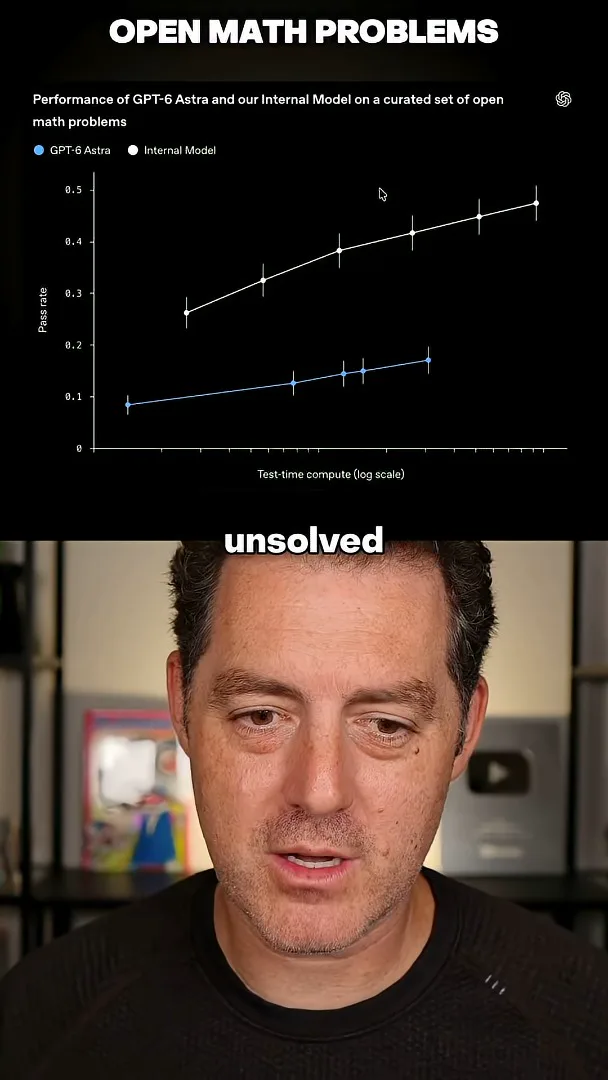
- 2A stronger internal modelOpenAI says the unreleased model is more capable than GPT-6 Astra and shows a comparison on a selected math-problem set.
- 3A chart with a specific scopeThe displayed pass-rate curves concern a curated evaluation at varying test-time compute, not a universal model ranking.
Takeaways
- OpenAI announced a proposed finite-time blowup result for a forced Navier–Stokes construction, not a universally accepted resolution or prize award.
- Clay lists the problem as active and says evaluation and credit follow its prize rules.
- A later preprint disputes whether the Lean formalization faithfully corresponds to the natural-language argument; that critique is itself part of ongoing scrutiny.
- OpenAI reports stronger performance from an unnamed internal model than GPT-6 Astra on its selected math evaluation, not every possible task.
- Potential engineering and medical consequences are speculative; the video provides no demonstrated practical applications.
Read the edited text by chapter
The Navier–Stokes claim
Berman reports OpenAI’s proposed result and suggests possible future applications. Clay’s prize process and mathematical review remain outstanding.
OpenAI has announced what it describes as a solution to the long-open Navier–Stokes existence and smoothness problem. Its [September 2026 paper and announcement](https://openai.com/index/navier-stokes-solution/) claim that a smooth forced flow can develop a finite-time singularity. This is a proposed proof, not an established award or an independently settled result. I suggest possible effects on aircraft, cars, and medicine, but the clip does not demonstrate those applications and any practical impact remains uncertain.
The internal-model comparison
He shows OpenAI’s reported comparison against GPT-6 Astra on a curated set of mathematical problems. The chart has a specific evaluation scope.
OpenAI says it used an internal model significantly more capable than GPT-6 Astra for this work. The displayed chart compares the two on a curated set of open mathematics problems as test-time compute varies; its reported advantage is specific to that evaluation. I note that training of the internal model is continuing. The chart does not establish superiority on all tasks.
The video’s title invokes the $1 million Millennium Prize, but [Clay lists Navier–Stokes as an active problem](https://www.claymath.org/millennium-problems/) and has not announced an award. Its [rules](https://www.claymath.org/millennium-problems/rules/) require publication in a qualifying outlet, at least two years, and general acceptance before consideration. Clay welcomed the announcement while stating that evaluation and credit take time. A subsequent [research preprint](https://arxiv.org/abs/2610.08144) argues that the Lean formalization does not faithfully match the natural-language proof; this critique is part of ongoing scrutiny, not itself a final adjudication.
More from this channel
 34:21EN
 Matthew Berman· Oct 27, 2026Matthew Berman Examines Anthropic’s IPO Filing, AI Growth and GovernanceMatthew Berman, Sam Altman · Forward FutureThe presenter reviews the S-1’s financial metrics, compute strategy and voting structure while questioning the tension between rapid AI development and safety.
 0:26ENMatthew Berman· Oct 25, 2026Sam Altman on Human Values and Problem-Solving in an AI WorldSam Altman · OpenAIIn a short interview excerpt, Altman considers the enjoyment of solving hard problems and the human role in interpreting results.
 0:36ENMatthew Berman· Oct 25, 2026Kimi K3.1 and a Rubik’s Cube Solver DemonstrationMatthew Berman · Forward FutureMatthew Berman shows a scrambled virtual cube being solved and gives the Kimi K3.1 test a favorable assessment.
 0:21ENMatthew Berman· Oct 24, 2026An AI-Generated Kimi Benchmark Chart Used Invented ScoresMatthew Berman · Forward FutureMatthew Berman asks for a graph of Kimi K3.1 Pro benchmarks, then discovers that the displayed figures are illustrative placeholders.
 25:50ENMatthew Berman· Oct 24, 2026Kimi K3.1 Pro Tested: Strong 3D Demos, Uneven Results and Competitive PricingMatthew Berman · Forward FutureMatthew Berman tests the open-weight model on coding, 3D rendering and visual explanations, then compares benchmark results and prices.
 32:20ENMatthew Berman· Oct 23, 2026Who Is Local AI For? The Costs, Trade-offs and a Hybrid FutureMatthew Berman · Forward FutureMatthew Berman weighs data control and independence against hardware cost, setup complexity and inference speed.