In 30 seconds
On April 3, 2026, Matthew Berman and Nick Wentz review AI model releases and Artemis II, then host three conversations. Ben Pouladian discusses Nvidia’s integrated infrastructure and compute demand; Ornn’s Wayne Nelms explains his proposed compute-price index and hedging market; and MOTS host Jayden Clark considers OpenAI’s acquisition of TBPN and its implications for media independence. Many claims about markets, future capabilities and editorial incentives are the speakers’ views, not established outcomes.
- 1Open-weight modelsThe hosts review Gemma 4 and Qwen releases, distinguishing benchmarks from daily use and considering local deployment.
- 2Meta’s AI strategyBerman proposes a coding-model feedback loop and asks whether Meta’s consumer focus changes its competitive position; Pouladian offers another view.
- 3From chips to systemsPouladian describes Nvidia’s shift toward integrated infrastructure and the growing importance of memory, interconnects and power.
- 4Compute-price transparencyNelms says Ornn aggregates transaction data to create a GPU price index and proposes financial products to manage risk.
- 5TBPN and editorial independenceClark and the hosts discuss OpenAI’s acquisition, audience trust, creator incentives and what independence may mean in practice.
Takeaways
- The hosts see a role for small open-weight models on devices alongside larger hosted systems, while noting that benchmarks are not the same as real-world workflows.
- Pouladian argues that AI infrastructure is becoming an integrated system of processors, memory, networking, cooling and power, rather than a single chip.
- Nelms says Ornn is collecting transaction prices to build an index and financial tools for a fragmented compute market; transparency and manipulation controls remain important questions.
- Clark and the hosts debate OpenAI’s stated commitment to TBPN’s editorial independence and the incentives created by ownership.
- The speakers’ forecasts about compute shortages, employment, company strategies and media acquisitions are uncertain and reflect their perspectives.
Read the edited text by chapter
Open models and coding tools
The hosts discuss Gemma 4, Qwen and Cursor, including local deployment, context and agent interfaces. They distinguish benchmark results from practical use.
Matthew Berman and Nick Wentz open the April 3, 2026 show with a review of recent releases before welcoming Ben Pouladian, Wayne Nelms and Jayden Clark. Their discussion covers open models, AI infrastructure and the business of technology media.
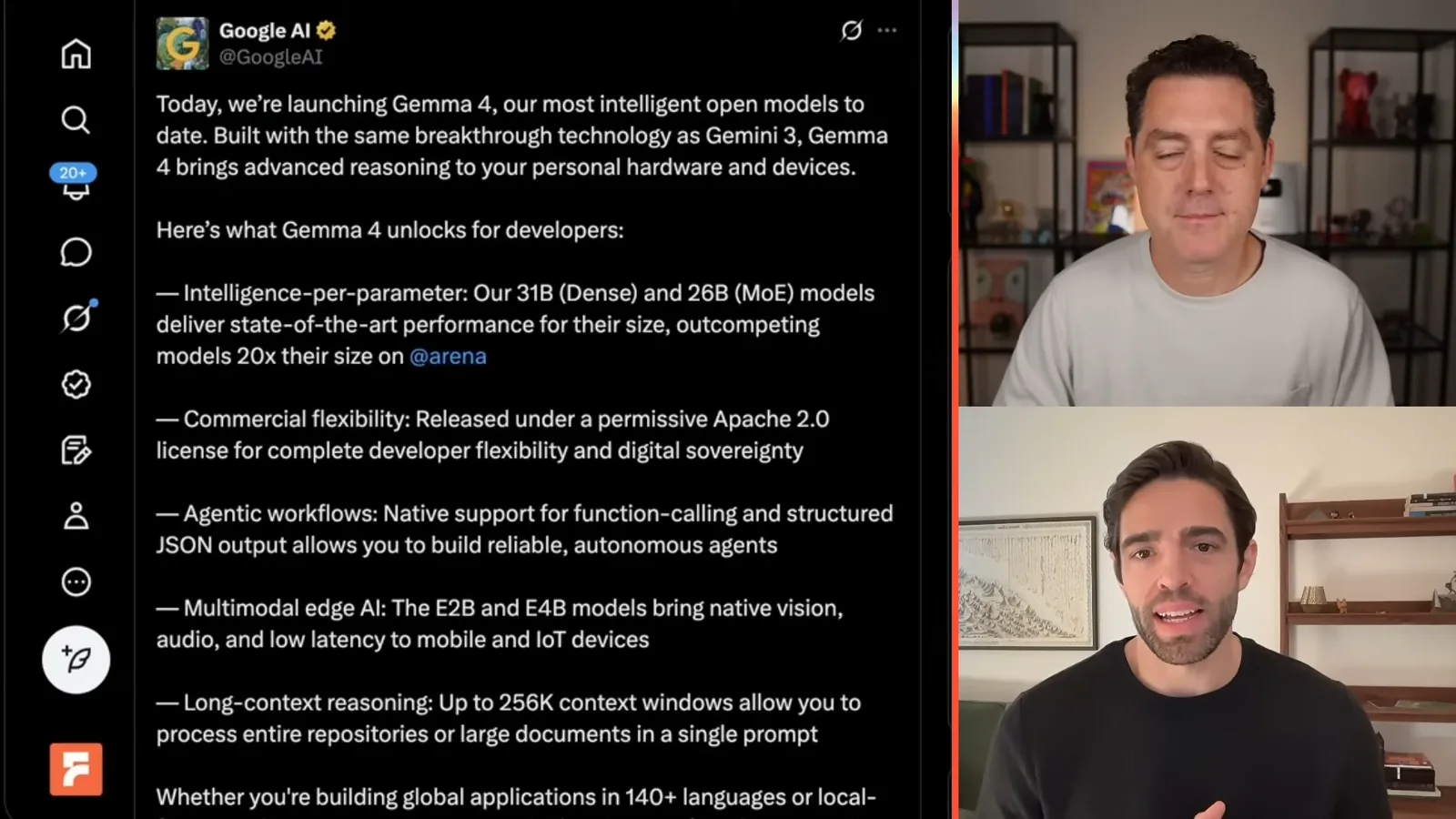
The hosts start with Google’s Gemma 4 family: E2B, E4B, a 26B mixture-of-experts model and a 31B dense model. Google described the releases as open models with a permissive license. Berman welcomes the prospect of smaller models that can run locally as well as commercially useful larger versions.
Berman imagines a hybrid future in which hosted frontier models handle demanding research and coding while smaller models perform many ordinary tasks on devices. Local processing has potential advantages, but whether a particular model runs well on a device depends on its memory, format and workload.
Wentz asks whether local deployment itself is the main obstacle to adoption. Berman thinks a bigger obstacle is that people do not yet know what current systems can do. He expects adoption to grow when companies integrate AI into familiar products and make useful actions seamless rather than requiring users to learn a separate interface.
The hosts discuss Google Workspace as an example of a product surface with many users, while Berman says its AI still feels bolted on. Wentz notes that large companies can learn from an extensive user feedback loop. Both treat seamless integration as an opportunity rather than proof that a particular product has solved it.
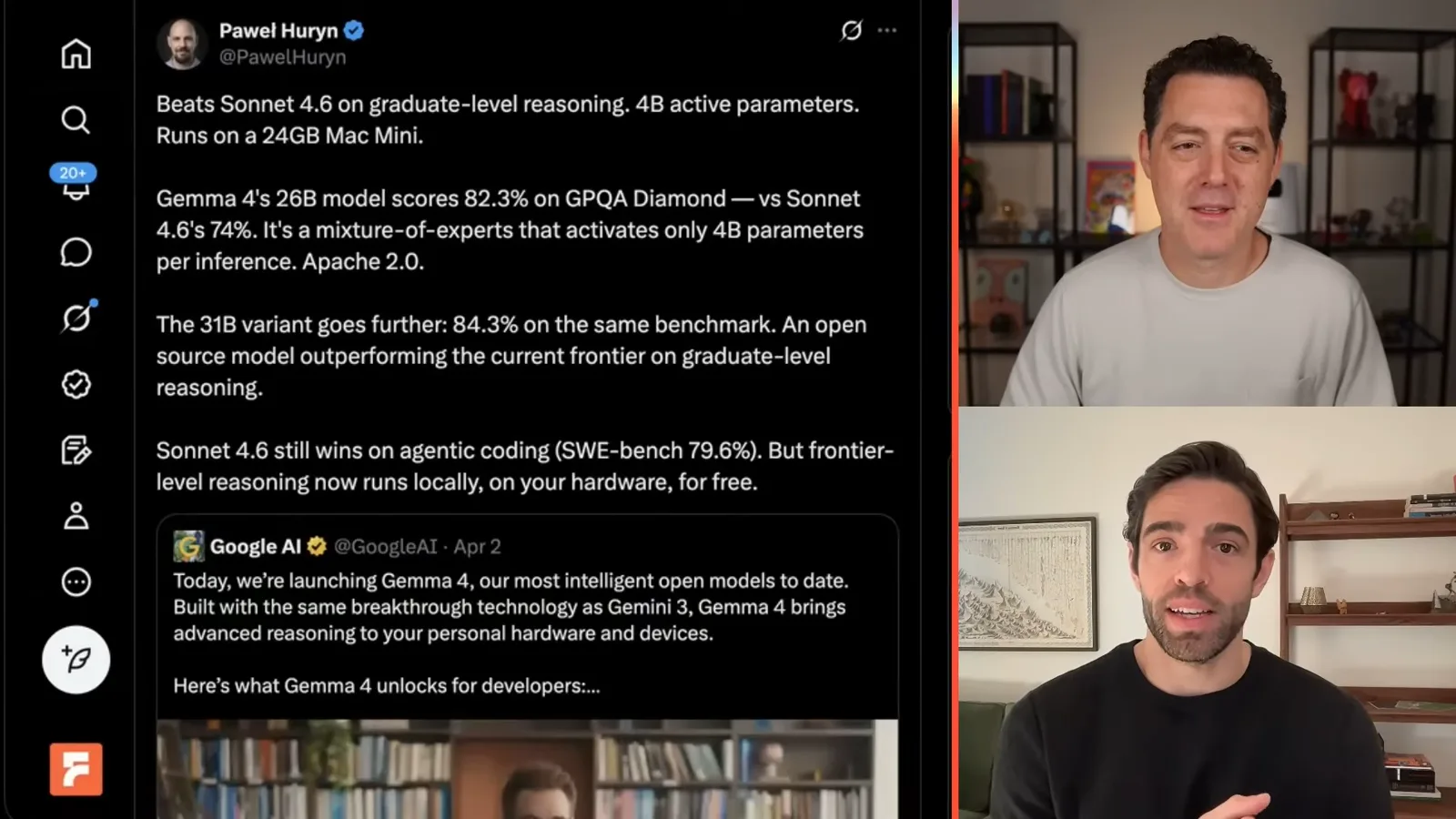
They cite early Arena rankings and a post comparing Gemma’s graduate-level reasoning score with Claude Sonnet 4.6. Berman cautions that a benchmark is not the same as using a model as a reliable workhorse. He says he uses both Sonnet and Opus and intends to test Gemma locally before judging its practical value.
Berman says he has run Gemma on a DGX Station and observed roughly 100 tokens per second in his setup, while expecting software optimizations to improve performance. This is a single hardware and configuration report, not a universal speed figure.
The hosts next discuss Alibaba’s Qwen 3.6 Plus, described as a hosted multimodal model aimed in part at agentic coding. They mention a one-million-token context window and reported pricing and benchmarks. Berman had not tested it yet and notes the privacy and hosting tradeoffs for users who prefer to keep data local.
Berman compares the context window with Gemma and says his own local setup has used a roughly 27-billion-parameter Qwen 3.5 model. He likes that size for his workflows. He also admits that his rapidly growing OpenClaw codebase has accumulated complexity and needs attention, a familiar problem in fast-moving software projects.
The hosts mention a rapid increase in Qwen users but are uncertain about the time period and what the figure counts; it should be treated as an unverified claim. Berman argues that organizations may choose open-weight models when local control and cost matter more than using the most capable hosted model.
They discuss reported departures from Qwen and speculate that shifting from research to product development can create tensions. Neither claims direct knowledge of the departing researchers’ motives. Berman notes that similar transitions can occur as research labs commercialize their work.
Cursor 3 is the next topic. Wentz likes its agent window and the ability to run parallel agents in isolated worktrees. Berman says he had early access, likes the simpler interface and believes coding tools are converging on a workflow organized around conversations with agents and the context needed to supervise them.
Berman discloses that Cursor gives him free tokens and that he is biased in its favor. Wentz suggests the product is trying to become an operating layer for software development rather than only a code editor. Berman says he personally prefers an interface to a terminal, even though he is comfortable using both.
Artemis II and Meta’s AI strategy
The hosts celebrate a crewed lunar flyby and discuss Meta’s consumer focus. They frame their ideas about competitive advantages and recursive development as hypotheses.
The hosts turn to the Artemis II launch. Berman describes watching it with his son, who began making model rockets afterward. For him, that immediate excitement shows how spaceflight can inspire children to explore science and technology.
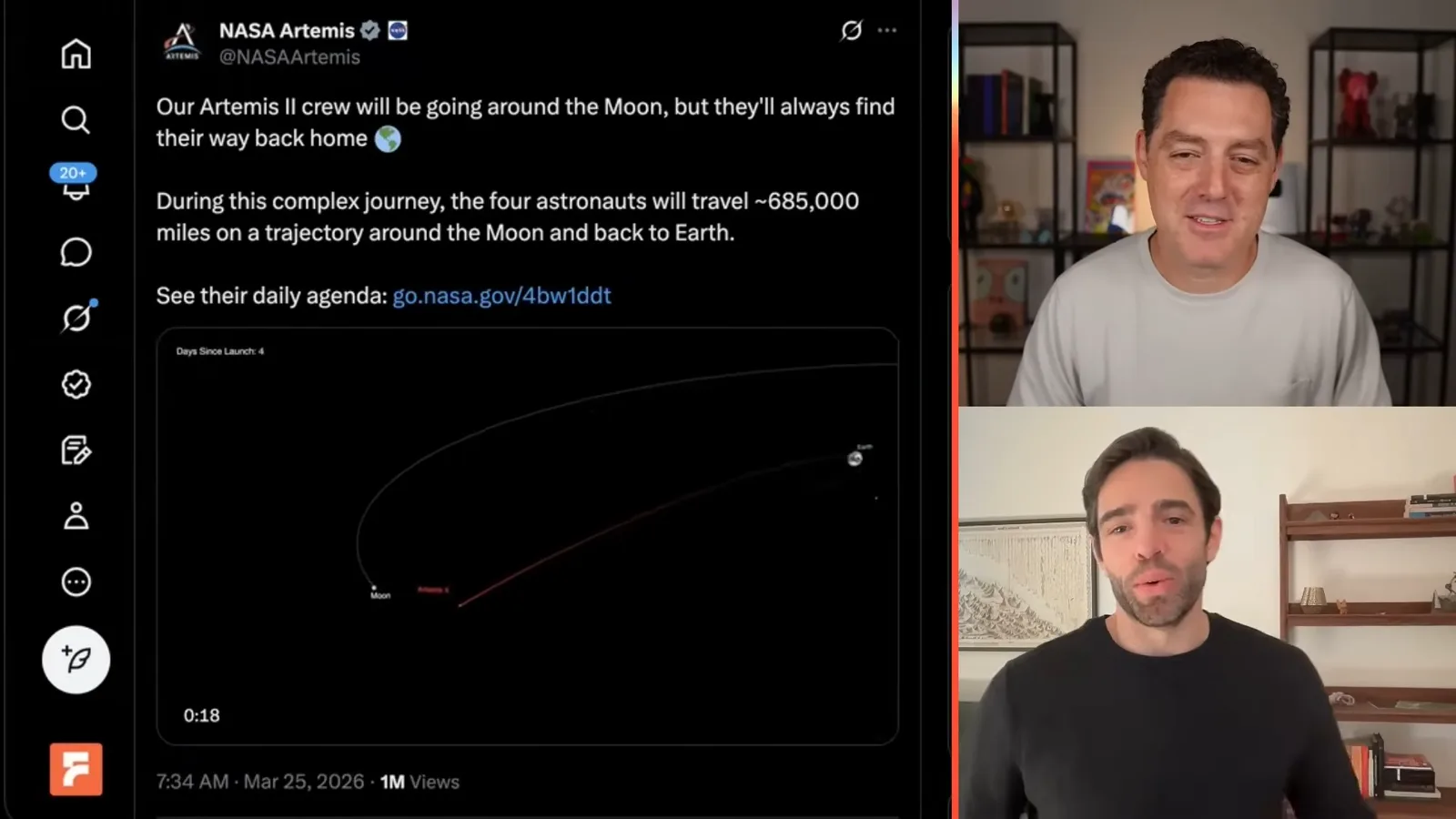
They show NASA’s planned trajectory, an approximately 685,000-mile journey around the Moon and back for four astronauts. Artemis II is a crewed flight test rather than a landing. The hosts refer to Artemis III as the next landing, but NASA’s February 2026 revised plan assigned Artemis III an Earth-orbit systems test and targeted a landing on Artemis IV in 2028; schedules can change.
The hosts briefly connect the mission’s excitement to science fiction and discuss Project Hail Mary and The Martian. Berman enjoyed the film but says its tone was lighter than the darker science fiction he generally prefers.
Wentz asks where Meta fits among companies pursuing advanced AI. Berman sketches a theory about a feedback loop: coding models can earn enterprise revenue and help build the tools used for later models. He believes OpenAI and Anthropic benefit from such a loop, while Meta’s consumer products create different priorities. This is his hypothesis, not a demonstrated causal account of those companies’ development.
Berman wonders whether Meta’s focus on Facebook, Instagram and WhatsApp leaves it less incentive to specialize in coding, math and science. He also considers the opposite possibility: a strong coding model could generalize to consumer tasks. He treats the tradeoff as an open question and asks viewers for their views.
Wentz replies that Meta’s advertising revenue gives it substantial financial resources, but agrees that the feedback-loop question is interesting. The hosts see Google as having both enterprise and consumer channels. Their comparative judgments are strategic interpretations, not measured rankings of any company’s future prospects.
Ben Pouladian: Nvidia and compute demand
Pouladian discusses his background, Meta’s potential distribution and Nvidia’s move from chips toward integrated systems. He offers his view of compute, energy and token economics.
The first guest, Ben Pouladian of BEP Holdings and BEP Research, joins to discuss AI infrastructure. Asked about Meta, he suggests its social graph and WhatsApp distribution could support an inexpensive consumer assistant or a broader commerce-oriented app, particularly outside the United States. That is his proposed scenario rather than a product guarantee.
Pouladian says social context, purchases and life events could make personalized services useful, subject to how data is actually used and governed. Berman adds that an advertising-supported offering might not need to be the best coding model to serve a large audience. Both are speculating about possible strategies and tradeoffs.
Pouladian recounts studying electrical engineering, working around semiconductor equipment and investment banking, and running an LED lighting business. He says he began investing in Nvidia around the DGX-1 period and later started writing to explain the company’s hardware and software stack to friends and readers.
He describes attending Nvidia’s GTC conference and speaking with engineers. The hosts praise Jensen Huang’s detailed keynote and his ability to explain a broad roadmap. Their enthusiasm reflects personal experience at the event and Pouladian’s long-standing interest in the company.
Pouladian says Nvidia has moved from selling individual chips toward integrated racks and what he calls token factories: data centers designed to produce AI outputs. Berman asks how that evolution combines processors, memory, networking and cooling into a full stack.
Pouladian recalls earlier GTC predictions about software generating software and AI assisting scientific work. He describes feedback between better tools and improved chips or models as a form of recursion. The strength and speed of any self-improving cycle are his interpretation, not a result measured in this conversation.
In Pouladian’s view, the constraint is no longer just the speed of a processor. Memory access, moving data among components, interconnects and heat all affect the performance of a larger system. The unit of design therefore grows from an individual chip toward the rack and data center.
Berman adds that agents may read and write data much more frequently than human-directed workflows, exposing bottlenecks in infrastructure built for different usage patterns. The hosts discuss storage endurance and flash as examples. Their illustrative read counts are not measurements from a specific workload.
Pouladian sees ChatGPT as an earlier inflection point in AI adoption and agent workflows as a potential next one. He says parallel agents and tool calls can consume more compute and tokens. The numerical multipliers he mentions are illustrative rather than a quantified industry-wide result.
Both Berman and Pouladian describe experiencing rate limits and interpret them as signs of strong demand. Wentz asks about reports that AWS had not retired A100 GPUs. Pouladian argues that older accelerators can retain value if software improvements make them useful for workloads even as new hardware arrives.
Pouladian suggests that newer hardware can lower cost per unit of output, while older equipment may still serve customers. Actual economics depend on acquisition cost, utilization, power, software and workload. He expects tighter hardware–software integration but notes that other suppliers are competing on inference cost.
Asked what people should watch, Pouladian says the industry is becoming more complex and increasingly organized around full-stack design. He regards inference as central to the business and compares training to preparing ingredients and inference to making the bread.
Pouladian presents his ‘token dollar’ thesis: many AI services buy compute, add software and sell access to model output, so the cost and pricing of compute affect their margins. He predicts that compute scarcity will matter more than oil scarcity. This is an investment-oriented view and a forecast, not a settled assessment of energy or commodity markets.
He says data-center financing, power and capacity planning are hard, and introduces the next guest’s proposed market for hedging compute prices. Berman says he hopes energy constraints become less severe. Pouladian closes by pointing listeners to BEP Research and his hardware interviews.
Wayne Nelms: a market for compute
Nelms describes Ornn’s proposed financial infrastructure, transaction-based price index, partnerships and the challenges of market opacity and manipulation.
Wayne Nelms, co-founder and CTO of Ornn, joins to discuss financial infrastructure for AI compute. He describes studying mathematics and computer science at MIT, trading equity options and then starting the company with a friend. Ornn’s proposed products include price data and instruments intended to help allocate and manage compute-related risk.
Nelms argues that data centers require large capital commitments and that financiers want more certainty about future revenue and costs. He suggests futures, swaps and other hedges could help transfer some risks and make financing easier. These are his company’s proposed uses, not proof that such instruments eliminate investment risk.
Wentz asks why GPU deals vary so much. Nelms says contracts are bespoke and prices opaque, with differences in capacity, terms and reliability making planning difficult. He believes participants with better information or bargaining power can benefit from that opacity.
The hosts ask for a basic explanation of compute trading. Nelms describes buyers seeking capacity and owners seeking to rent GPUs, often through brokers. He says several intermediaries can stand between the parties and argues that better market information and liquidity could make transactions more efficient.
Berman asks how a market works if demand seems consistently greater than supply. Nelms responds that prices can help balance demand and supply and that the ability to buy future capacity can help participants plan. Trading reallocates or transfers exposure; it does not itself create physical compute.
Asked about Hyperbolic, Nelms says Ornn helps procure and deliver capacity through its relationships with data centers, and receives transaction history in return. He describes data collection as a foundation for a price index, including what buyers actually pay per hour for GPU clusters.
Nelms also mentions Hydra Host as a source of deal information. His stated goal is to aggregate prices across fragmented parts of the market. He emphasizes that the quality and breadth of that feed matter if users are to compare contracts and assess market conditions.
The hosts ask about Ornn’s GPU price index appearing on Bloomberg. Nelms says wider access could help buyers and sellers compare their deals with a reference price. A quoted index is useful only to the extent its underlying data and methodology match the contracts being compared.
Nelms says Ornn also wants to help data centers monetize spare GPU capacity, which otherwise expires unused. He describes a potential feedback loop: more supply-side partners could improve transaction data and support greater liquidity. That is a business plan and does not guarantee a buyer or a minimum return.
Wentz raises the possibility of index manipulation, referring to LIBOR. Nelms acknowledges data integrity concerns and says Ornn is trying to broaden its sources so a handful of deals cannot move the index. He argues that recording actual transaction prices rather than offers helps, but neither that design choice nor a Bloomberg listing proves an index is immune to manipulation.
Nelms explains that a trade tape means a record of completed transaction prices. He says Ornn wants to combine such data with a marketplace for underused capacity. The hosts summarize the exchange: suppliers may find renters, while the company gathers information about actual deals.
Nelms says his team believes infrastructure and cost per token may become increasingly important as models become easier to substitute. He sees financing the underlying facilities as a promising opportunity. After he leaves, the hosts agree that individual models may be replaceable, while established agent workflows can make switching more difficult.
Jayden Clark: OpenAI, TBPN and new media
Clark and the hosts examine the TBPN acquisition, independence and the economics of creator audiences. They finish with Clark’s own production strategy and views on X and YouTube.
Jayden Clark, founder and host of the MOTS Podcast, joins for a discussion of OpenAI’s acquisition of the technology show TBPN. Clark jokes that he checked the date to make sure the announcement was not an April Fools’ joke, then congratulates the TBPN team. OpenAI announced the acquisition on April 2, 2026 and said editorial independence would be central to the arrangement.
Asked what OpenAI gains, Clark suggests the show’s hosts, John Coogan and Jordi Hays, are approachable and could improve the company’s public messaging. He describes their style as optimistic and relatively neutral. This is Clark’s interpretation of the appeal and the buyer’s incentives, not a statement of OpenAI’s private motives.
Clark says he briefly worked with the show in its early days and describes its hosts as likable on and off camera. Wentz appreciates their optimistic but, in his view, balanced tone. Berman argues that the show has always had a perspective and questions criticism that assumes it was previously free of bias.
The group considers whether a large payment and new owner could influence coverage even without explicit intervention. Clark says the practical meaning of editorial independence remains to be seen. OpenAI’s public promise is a commitment about the arrangement; it does not by itself establish how every future editorial decision will be made.
Berman asks how OpenAI can seek better public messaging while promising not to control the show. Clark says he cannot know the answer, but perceives OpenAI’s communications culture as relatively permissive. He speculates about how rival labs might respond and explicitly describes this as an outsider’s view.
Wentz says trust and the range of guest perspectives are valuable to the audience, but worries about potential self-censorship when a funder also owns the show. The hosts and Clark agree that the relationship’s effects will become clearer through its actual operation rather than the announcement alone.
The group discusses the timing of the sale and reported revenue growth. Clark says creators must manage sponsor renewals and the pressure to sustain audience growth, so selling during an upswing might offer certainty. He also offers a possible downside scenario, while acknowledging that he does not know TBPN’s private metrics or reasons for selling.
Berman asks what the acquisition signals for new media. Clark hopes technology firms recognize that independent creators can communicate effectively to audiences that technical teams may struggle to reach directly. He thinks technically knowledgeable creators who also understand media may become attractive partners or acquisition targets, though a wave of deals is only his prediction.
Asked whether live broadcasting is essential, Clark emphasizes the value of an audience to a sponsor or buyer over format alone. He says a relatively small audience of founders, executives and investors can be valuable to companies seeking to reach them. His assessment reflects his own experience in the technology-media niche.
Clark describes experimenting with how MOTS appeared on X, then posting episodes with timestamps so viewers can select sections. He contrasts this with YouTube, where he finds longer viewing sessions more natural. These are observations about his distribution strategy, not a universal measurement of either platform.
The hosts joke about Clark’s gym interviews and sponsorships. Clark says the low-production format makes it easier to publish quickly, including timely episodes about breaking news. For YouTube, he also experiments with a more deliberate gym-interview series and a physical challenge to retain viewers.
Clark says he wants to continue the core MOTS format while developing the higher-production series. The group briefly discusses a guest’s 72 push-ups in a minute as an example of that show’s challenge. Clark values the flexibility of a simple format alongside experiments designed for longer viewing.
Berman proposes that X is a place to build influence and YouTube a place to build reach. Clark agrees that X can distribute an idea quickly while long-form viewing is more natural on YouTube. Both are describing their experience as creators, and different audiences may behave differently.
Clark contrasts his perception of an earlier, more follower-centered X feed with a newer recommendation system that can show posts beyond a user’s existing network. He thinks the potential speed and reach of viral posts explain why technology companies pay attention to the platform. This is his characterization of platform behavior, not an independent audit of its algorithms.
The hosts thank Clark, joking about the possibility of another AI company acquiring MOTS. They close by thanking Pouladian and Nelms as well and reflecting on the range of topics: open models, hardware, markets for compute and the changing business of technology media.
More from this channel
 34:21EN
 Matthew Berman· Oct 27, 2026Matthew Berman Examines Anthropic’s IPO Filing, AI Growth and GovernanceMatthew Berman, Sam Altman · Forward FutureThe presenter reviews the S-1’s financial metrics, compute strategy and voting structure while questioning the tension between rapid AI development and safety.
 0:36ENMatthew Berman· Oct 25, 2026Kimi K3.1 and a Rubik’s Cube Solver DemonstrationMatthew Berman · Forward FutureMatthew Berman shows a scrambled virtual cube being solved and gives the Kimi K3.1 test a favorable assessment.
 25:50ENMatthew Berman· Oct 24, 2026Kimi K3.1 Pro Tested: Strong 3D Demos, Uneven Results and Competitive PricingMatthew Berman · Forward FutureMatthew Berman tests the open-weight model on coding, 3D rendering and visual explanations, then compares benchmark results and prices.
 32:20ENMatthew Berman· Oct 23, 2026Who Is Local AI For? The Costs, Trade-offs and a Hybrid FutureMatthew Berman · Forward FutureMatthew Berman weighs data control and independence against hardware cost, setup complexity and inference speed.
 1:03:37ENMatthew Berman· Oct 23, 2026Matthew Berman’s Team Tests Kimi K3.1 on Animation, Games, and ChartsMatthew Berman, Alex, Brian · Forward FutureA live team AMA turns into an informal test of Kimi K3.1, from personal-agent workflows to motion graphics, a browser game, and a benchmark chart.
 0:53ENMatthew Berman· Oct 22, 2026Sam Altman on AI and the Discovery of New KnowledgeSam Altman · OpenAIAltman expects progress in mathematical discovery to extend to biology, materials and energy.