In 30 seconds
In September 2025, Matthew Berman explores a hypothetical future in which AI substitutes for knowledge work and ownership of compute determines economic opportunity. He cites early labor-market indicators and interviews with Aaron Levie and Reid Hoffman, then offers a more optimistic view of human oversight, new jobs and abundance. These outcomes are forecasts, and the cited employment data do not alone establish that AI caused the changes.
- 1The mobility concernBerman outlines a scenario in which highly capable AI makes capital and compute more valuable than human knowledge labor.
- 2Early labor indicatorsA Stanford study and Handshake platform data show patterns involving young workers and job competition; neither proves AI alone caused them.
- 3Cheaper compute and demandBerman invokes Jevons’ paradox to argue that greater efficiency can increase overall use, though the size of the rebound is an empirical question.
- 4Income supportHe describes universal basic income and universal high income as proposed ways to distribute gains, alongside concerns and uncertainties.
- 5Complementary hiringBox CEO Aaron Levie argues that greater efficiency can create new bottlenecks and potentially require more workers elsewhere.
Takeaways
- The permanent-underclass scenario concerns economic mobility if labor loses bargaining power and returns accrue to owners of capital and compute.
- Berman cites 2025 employment and job-posting indicators, which describe particular populations and do not by themselves establish causation.
- Lower computing costs can increase demand, but Jevons-style rebound does not guarantee that total spending will rise in every market.
- Universal basic or high income is proposed as a response, with effects depending on policy design and economic conditions.
- Berman and his interviewees predict opportunities for human oversight, complementary jobs and entrepreneurship, but the scale of these effects is uncertain.
Read the edited text by chapter
A permanent underclass?
Berman describes a hypothetical economy in which AI can perform knowledge work and access to compute determines who benefits. He frames the concern as one of mobility as well as income.
Could reaching artificial general intelligence lock people into a permanent underclass? I have heard this concern from people working around AI in Silicon Valley, and I want to examine it because the social implications would be enormous. I will also explain why I remain more optimistic about the outcome.
For this discussion, I use AGI to mean AI that outperforms people at knowledge work, from programming and customer service to data analysis. The worried scenario assumes that, once such systems are available, buying compute becomes the main constraint on producing that work. If human labor loses much of its economic leverage, people who already own capital could have an enormous advantage. These are assumptions about a possible future, not established facts.
AI companies are investing heavily in computing infrastructure. In this scenario, owners could use capital and electricity to replicate AI capability at scale without the constraints associated with human employees. The fear is not only poverty: if returns are concentrated and people have little means to build wealth, economic mobility could stall.
Early evidence and cheaper compute
He cites employment data for young workers and job-posting trends. He then discusses the possibility that cheaper compute increases demand for it.
I hear some people express urgency about accumulating capital before AGI arrives, because they fear their position could become fixed afterward. This is a concern rather than a demonstrated inevitability. I also point to a difficult entry-level job market as an early indicator worth examining.
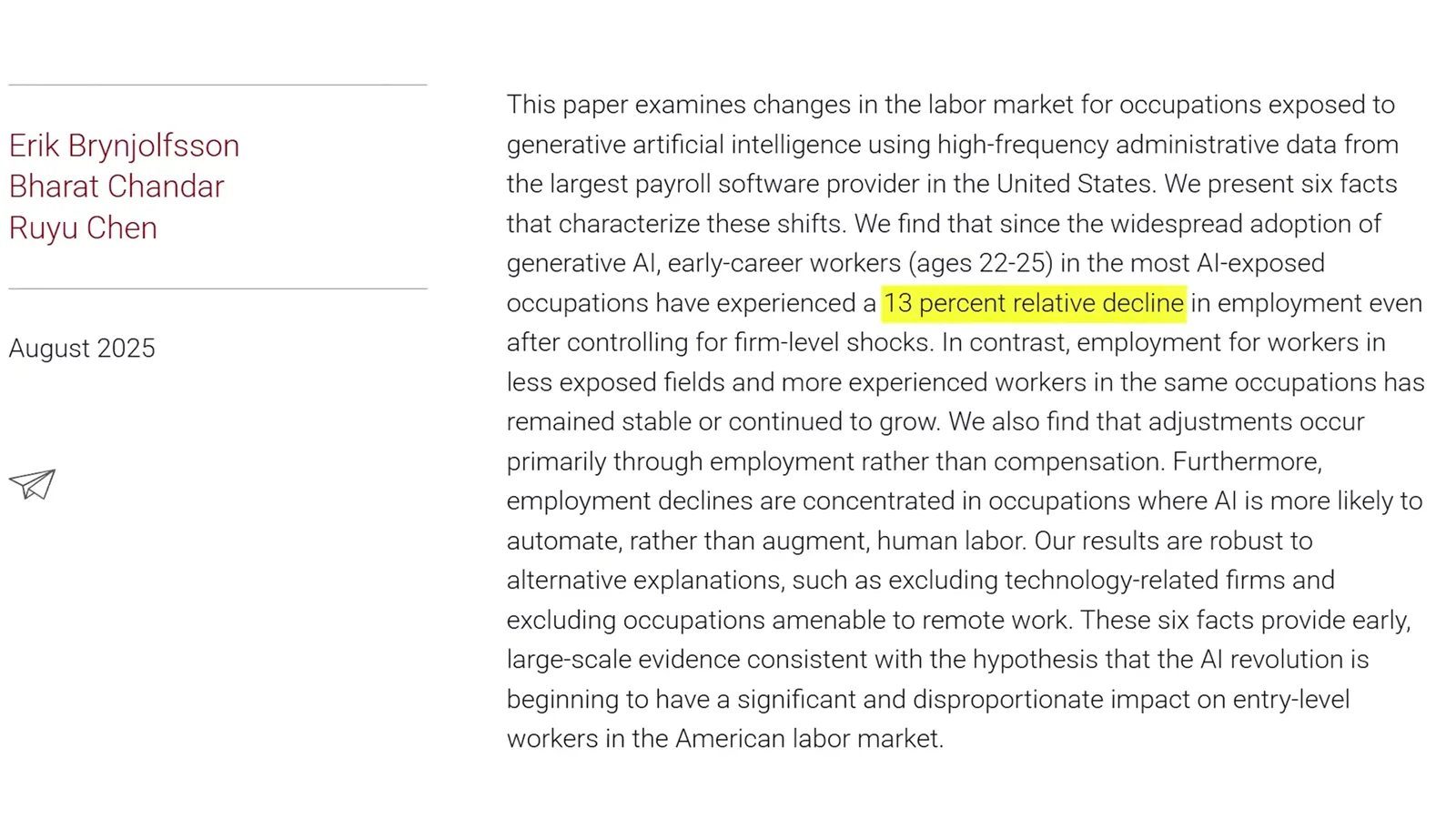
The Stanford Digital Economy Lab’s 2025 ‘Canaries in the Coal Mine’ study used ADP payroll data and reported an approximately 13% relative employment decline for workers aged 22–25 in highly AI-exposed occupations, controlling for firm-level shocks. More experienced workers in those occupations were stable or growing, and the paper described adjustment primarily through employment rather than pay. The comparison is descriptive evidence of a pattern, not proof that AI alone caused it.
Handshake also reported that job postings on its platform fell 15% over the year while applications per job increased 30% for the class of 2025. That indicates greater competition in this platform’s data; it is not a measure of all jobs or a causal estimate of AI’s effect. These observations deserve attention without being treated as proof of a permanent underclass.
Large infrastructure investments may also make inference cheaper. I expect the cost of running AI to fall toward the costs of hardware and electricity, though actual prices will depend on many factors. Cheaper access could widen the benefits, but it does not by itself settle who owns the resources or captures the gains.
I raise Jevons’ paradox: when a resource becomes more efficient or less expensive, new uses can become economical, increasing total consumption. If that happens with compute, demand could expand even as the cost per unit falls. Whether overall spending rises depends on the size of the demand response; it is not automatic.
Income support and human oversight
Berman explains proposed basic and high income policies and their critics. He gives his own argument that people may continue to initiate, orchestrate and verify work.
One proposed response is universal basic income: regular unconditional cash payments intended to help people meet basic needs. Some, including Elon Musk, have also discussed universal high income, a more ambitious idea in which people would have enough resources to choose how to spend their time. Both depend on how they are funded and designed.
Critics argue that basic income resembles socialism or could contribute to inflation. I refer to a conversation with advocate Scott Santens, who argues that financial security can encourage entrepreneurship and free people to address problems or start businesses. That remains an argument about policy effects, not a guarantee that AI would not also perform those tasks.
My more optimistic view draws on an argument that AI will often handle the middle of a task while people remain at its edges. A person might define a goal, prompt or orchestrate agents, then review and verify the output. The boundary may move as systems improve, and how much oversight remains necessary will vary by task; I expect many jobs to change rather than disappear entirely.
Growth and new bottlenecks
Aaron Levie argues that AI-driven growth could create demand for workers in other functions. Another interview clip addresses mistakes and the tolerance for error.
In an interview clip, Box CEO Aaron Levie argues that companies should reward teams that use AI to become more efficient, allocating them resources to pursue additional problems. In a later conversation he says his view has not changed: if AI lets a company grow faster, new bottlenecks may create demand for more people in sales, consulting or customer success. This is his prediction about possible complementary hiring, not a measured outcome for every company.
An OpenAI technology leader in another clip notes that the human role at the edges may become thinner, but models still hallucinate and make mistakes. The appropriate amount of oversight depends on the error tolerance of the task. The clip identifies the speaker by role but does not name them in the narration.
New work and the transition
Berman and Reid Hoffman discuss new tasks and creative opportunities. Berman closes with his predictions about deployment, augmentation and abundance.
I expect new jobs that are difficult to imagine today, as well as opportunities for founders and individuals to do more with fewer resources. That is a forecast, not evidence that new positions will necessarily offset every job lost or that the transition will be smooth.
In a clip from our interview, Reid Hoffman suggests that cheaper software creation can unlock demand for tools tailored to individual tasks. His example is visual-effects software: if creation becomes less expensive, smaller productions such as documentaries might access capabilities once limited to large-budget films. He presents this as a possible expansion of creative demand.
I expect significant changes in knowledge work and think people will need support learning to use AI tools productively. Deployment also takes time: a model’s capability does not mean an organization has the infrastructure or processes to use it everywhere immediately. My prediction is that some jobs will be automated while many others are transformed.
Basic income or high income might work in a more productive economy, but their feasibility and consequences remain open questions. I am hopeful that AI will expand creativity and entrepreneurship, improve health and create abundance. Whether this transition resembles earlier technological shifts, and how broadly the benefits are shared, remains to be seen.
More from this channel
 34:21EN
 Matthew Berman· Oct 27, 2026Matthew Berman Examines Anthropic’s IPO Filing, AI Growth and GovernanceMatthew Berman, Sam Altman · Forward FutureThe presenter reviews the S-1’s financial metrics, compute strategy and voting structure while questioning the tension between rapid AI development and safety.
 0:26ENMatthew Berman· Oct 25, 2026Sam Altman on Human Values and Problem-Solving in an AI WorldSam Altman · OpenAIIn a short interview excerpt, Altman considers the enjoyment of solving hard problems and the human role in interpreting results.
 0:36ENMatthew Berman· Oct 25, 2026Kimi K3.1 and a Rubik’s Cube Solver DemonstrationMatthew Berman · Forward FutureMatthew Berman shows a scrambled virtual cube being solved and gives the Kimi K3.1 test a favorable assessment.
 0:21ENMatthew Berman· Oct 24, 2026An AI-Generated Kimi Benchmark Chart Used Invented ScoresMatthew Berman · Forward FutureMatthew Berman asks for a graph of Kimi K3.1 Pro benchmarks, then discovers that the displayed figures are illustrative placeholders.
 25:50ENMatthew Berman· Oct 24, 2026Kimi K3.1 Pro Tested: Strong 3D Demos, Uneven Results and Competitive PricingMatthew Berman · Forward FutureMatthew Berman tests the open-weight model on coding, 3D rendering and visual explanations, then compares benchmark results and prices.
 32:20ENMatthew Berman· Oct 23, 2026Who Is Local AI For? The Costs, Trade-offs and a Hybrid FutureMatthew Berman · Forward FutureMatthew Berman weighs data control and independence against hardware cost, setup complexity and inference speed.