In 30 seconds
Matthew Berman covers the founding of Safe Superintelligence, a tree-search research paper, Meta releases, Groq transcription, Claude 3.5 Sonnet and ARC Prize. The roundup distinguishes company-reported results and speculation about Q* from established findings.
- 1A new safety-focused companyIlya Sutskever, Daniel Gross and Daniel Levy announced Safe Superintelligence Inc.
- 2Search and self-refinementA research paper combines LLaMA-3 8B with Monte Carlo tree search. Its connection to Q* is unverified.
- 3Meta research releasesChameleon, multi-token prediction, JASCO and AudioSeal cover distinct modalities and have different license terms.
- 4Claude 3.5 SonnetAnthropic reported gains on selected evaluations and introduced an Artifacts preview.
- 5ARC PrizeThe competition targets a private benchmark threshold under defined conditions, rather than providing a universal proof of AGI.
Takeaways
- SSI announced a single mission focused on safe superintelligence; its safety outcomes were not established by the announcement.
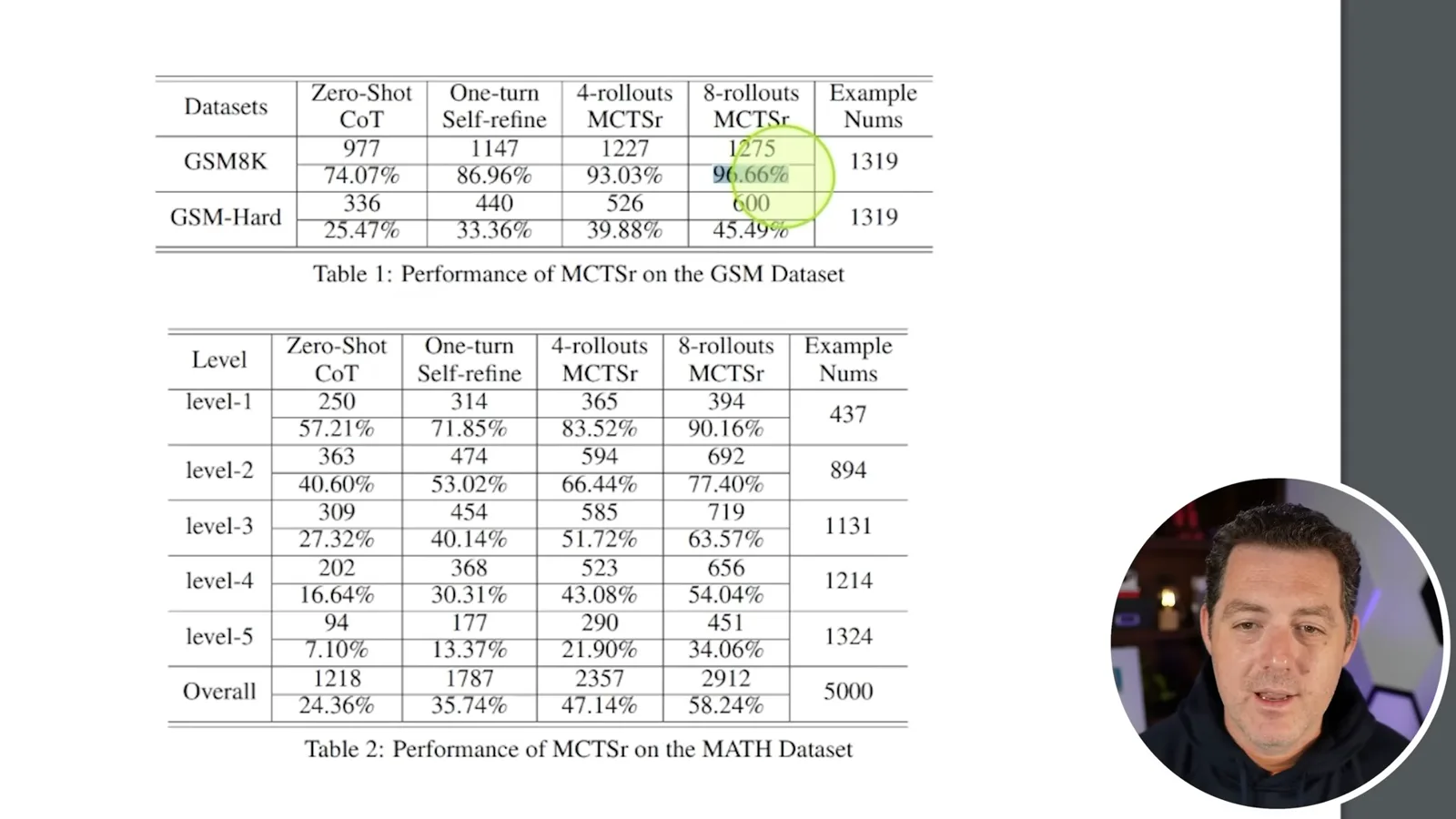
- The MCTSr paper used eight search rollouts to report 96.66% on GSM8K with LLaMA-3 8B; its connection to Q* is speculative.
- Meta announced multimodal, code, music and audio-watermarking research with different license conditions.
- Anthropic reported strong Claude 3.5 Sonnet results on selected benchmarks, not a win on every measure.
- ARC Prize rewarded progress on a specific benchmark; meeting its threshold would not itself prove AGI.
Read the edited text by chapter
A week of AI announcements
Berman introduces a set of June 2024 AI news stories. They range from research and hardware to model releases and a benchmark competition.
In this June 2024 AI news roundup, I discuss Ilya Sutskever's new company, an AI infrastructure announcement, a tree-search paper, several Meta research releases, Groq speech transcription, Claude 3.5 Sonnet and the ARC Prize. These announcements and performance comparisons reflect the state of the field at the time.
Safe Superintelligence Inc.
Ilya Sutskever and two co-founders announce a company focused on safe superintelligence. Berman considers its mission and commercial incentives.
After leaving OpenAI, co-founder Ilya Sutskever announced Safe Superintelligence Inc. (SSI) with Daniel Gross and Daniel Levy. The company said it would pursue safe superintelligence as its single focus, pairing capability and safety research. I welcome another team making safety central to its stated mission, though a mission statement is not proof of a particular safety outcome.
I read SSI's claim that its business model will insulate safety, security and progress from short-term commercial pressures, and contrast that with my concerns about OpenAI's incentives. Former OpenAI safety researcher Jan Leike had criticized the balance between product work and safety and said promised computing resources did not materialize; these are his reported concerns, not independently established details of every internal decision.
SSI said it would operate from Palo Alto and Tel Aviv. I look at the co-founders' backgrounds: Gross has invested in technology companies and worked at Apple and Y Combinator, while Levy previously worked at OpenAI and other major technology companies. I am curious how a company with such a long-term mission will align its investors and business model.
AI infrastructure and tree search
Dell announces infrastructure for xAI. A separate research paper explores Monte Carlo search and model self-refinement; a link to Q* remains speculative.
Michael Dell announced a Dell AI Factory with NVIDIA to power Grok for xAI. I show images discussed alongside the announcement and focus on the cooling challenge posed by large numbers of GPUs. The images and commentary alone do not establish the location, complete design or ownership of the planned xAI system.
A separate research paper from Fudan University and the Shanghai Artificial Intelligence Laboratory explores Monte Carlo Tree Self-Refine, or MCTSr. Some commentators compare it to the rumored OpenAI project Q*, and I find that possibility interesting. The public paper does not establish that it implements Q* or reveal what OpenAI's internal project is.
The method applies Monte Carlo tree search to candidate answers: it selects a solution, generates feedback and refinements, scores alternatives and updates the search tree. I see this kind of iterative search as a promising way to augment a language model. It is an inference-time procedure and should not be confused with evidence that the model has autonomously trained itself through self-play.
In the researchers' [reported results](https://arxiv.org/html/2406.07394), LLaMA-3 8B went from 74.07% with zero-shot chain-of-thought to 96.66% on GSM8K with eight MCTSr rollouts. The video repeats a claim that this beat GPT-4; the paper's own comparison table lists GPT-4 Turbo at 97.1% on GSM8K. It also reports 45.49% on GSM-Hard with eight rollouts, so the results depend on the benchmark and extra search compute.
Meta’s multimodal and audio research
Berman reviews Chameleon, multi-token prediction, JASCO and AudioSeal. The releases have different uses and licensing terms.
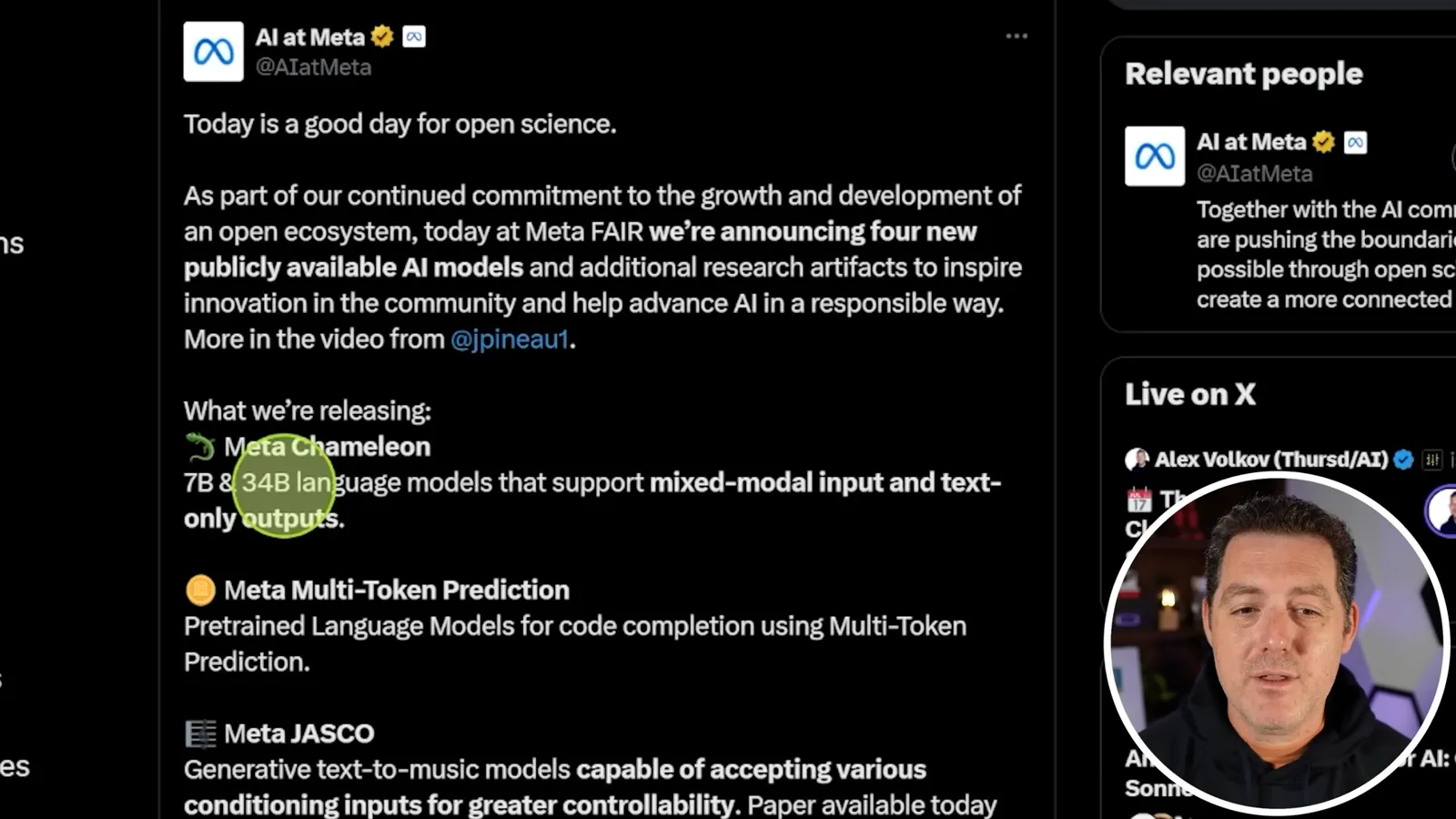
Meta announced Chameleon models in 7B and 34B sizes, supporting mixed-modal inputs and text outputs in the release described here. The appeal is integrating modalities within the model rather than treating vision as a separate add-on. The [Chameleon research license](https://github.com/facebookresearch/chameleon/blob/main/LICENSE) limits use to noncommercial research; it is not an unrestricted open-source release.
Meta also presented multi-token prediction for code completion. Instead of training only to predict the next token, the method predicts several future tokens, which Meta says can improve training efficiency and speed. The announced pretrained code models were under a noncommercial research license, a restriction I would prefer not to see.
JASCO is Meta's text-to-music work, with additional conditioning inputs to give users more control. At the time, the paper was available and the model was promised for later release. I play samples that transform musical ideas into different arrangements, including an electronic pop sound, a Chinese traditional arrangement, country and psychedelic trance.
Meta also announced AudioSeal, a watermarking model intended to detect and localize AI-generated speech, plus research data and code addressing geographical and cultural representation. I see watermarking as a potentially useful tool as synthetic audio spreads, though a watermarking system alone is not a universal detector for every deepfake.
Groq and Claude 3.5 Sonnet
The roundup covers fast Whisper transcription and Anthropic’s model launch. Its benchmarks are vendor-reported and historical.
Groq announced fast speech-to-text using Whisper large-v3. While recording, I also saw Anthropic launch Claude 3.5 Sonnet, the first release in its 3.5 family. These were 2024 announcements, so availability, model options and prices should not be assumed to be current.
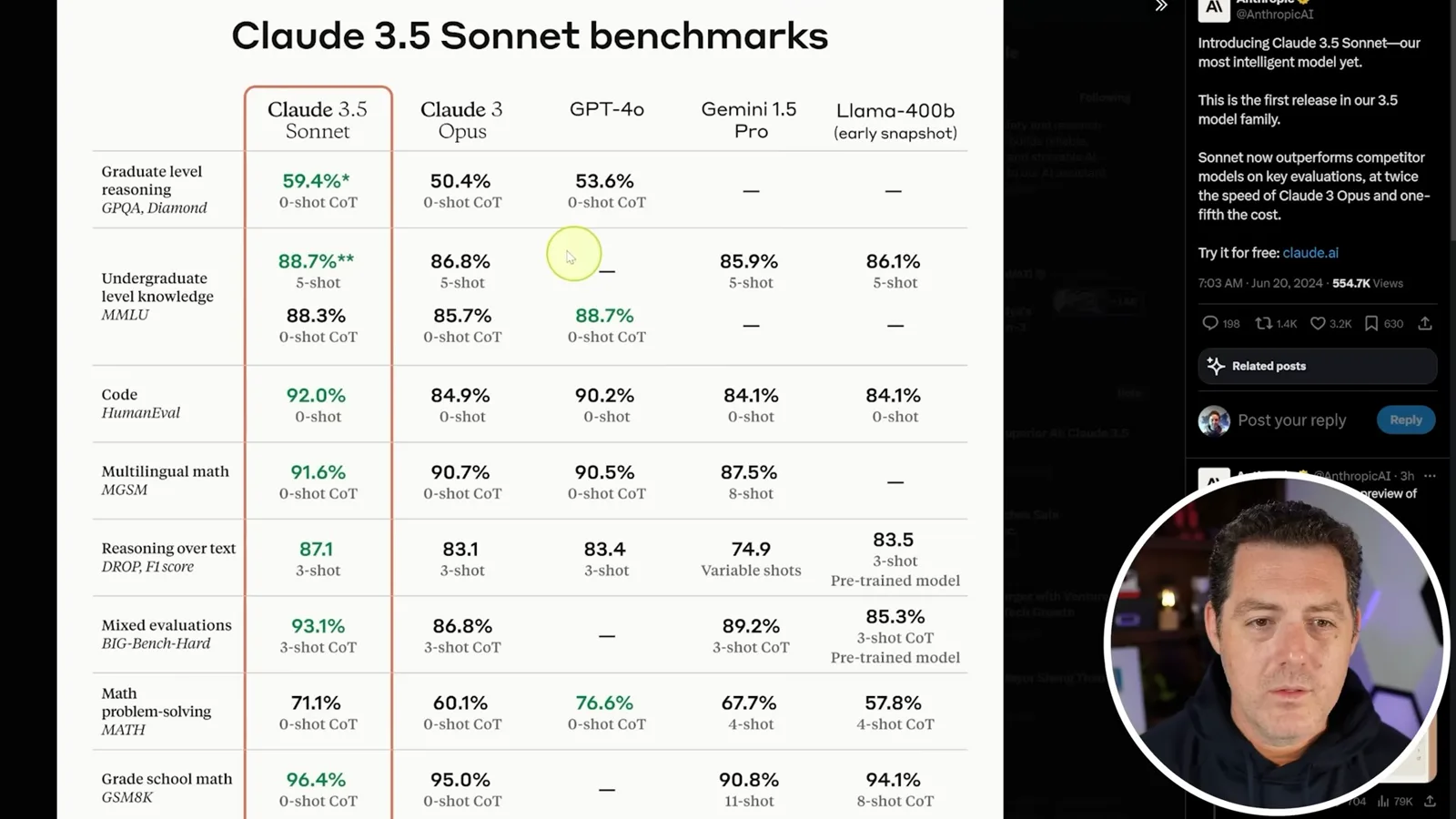
Anthropic's [launch benchmarks](https://www.anthropic.com/news/claude-3-5-sonnet) reported 96.4% on GSM8K, 59.4% on GPQA Diamond and 92% on HumanEval for Claude 3.5 Sonnet under the listed prompting conditions. Anthropic also claimed it ran twice as fast as Claude 3 Opus at lower cost. These are company-reported results; the model did not lead every row, and comparisons depend on evaluation settings.
Anthropic also introduced an Artifacts preview: Claude could generate documents, code, Mermaid diagrams, vector graphics and simple games in a workspace beside the conversation. I am excited by competition that improves capability and brings prices down, and I am interested in testing the models myself.
ARC Prize and abstract reasoning
Berman demonstrates a visual pattern puzzle and reviews the early leaderboard. The prize concerns a specific benchmark and competition rules.
The ARC Prize launched a public competition around ARC-AGI, a benchmark of visual pattern tasks. Its organizers use the benchmark as a measure of progress toward general intelligence; I describe a million-dollar prize, but that is the broader prize fund rather than a simple payment for proving AGI. The 2024 [technical report](https://arcprize.org/media/arc-prize-2024-technical-report.pdf) describes a $600,000 grand prize for reaching 85% on the private evaluation set, alongside other awards and conditions.
ARC examples give input-output grids and ask the solver to infer a transformation. I solve one in which colored pieces are completed into squares and describe another in which colors move downward. Such puzzles test a particular form of abstraction; success on this benchmark alone would not settle the broader question of whether a system has achieved AGI.
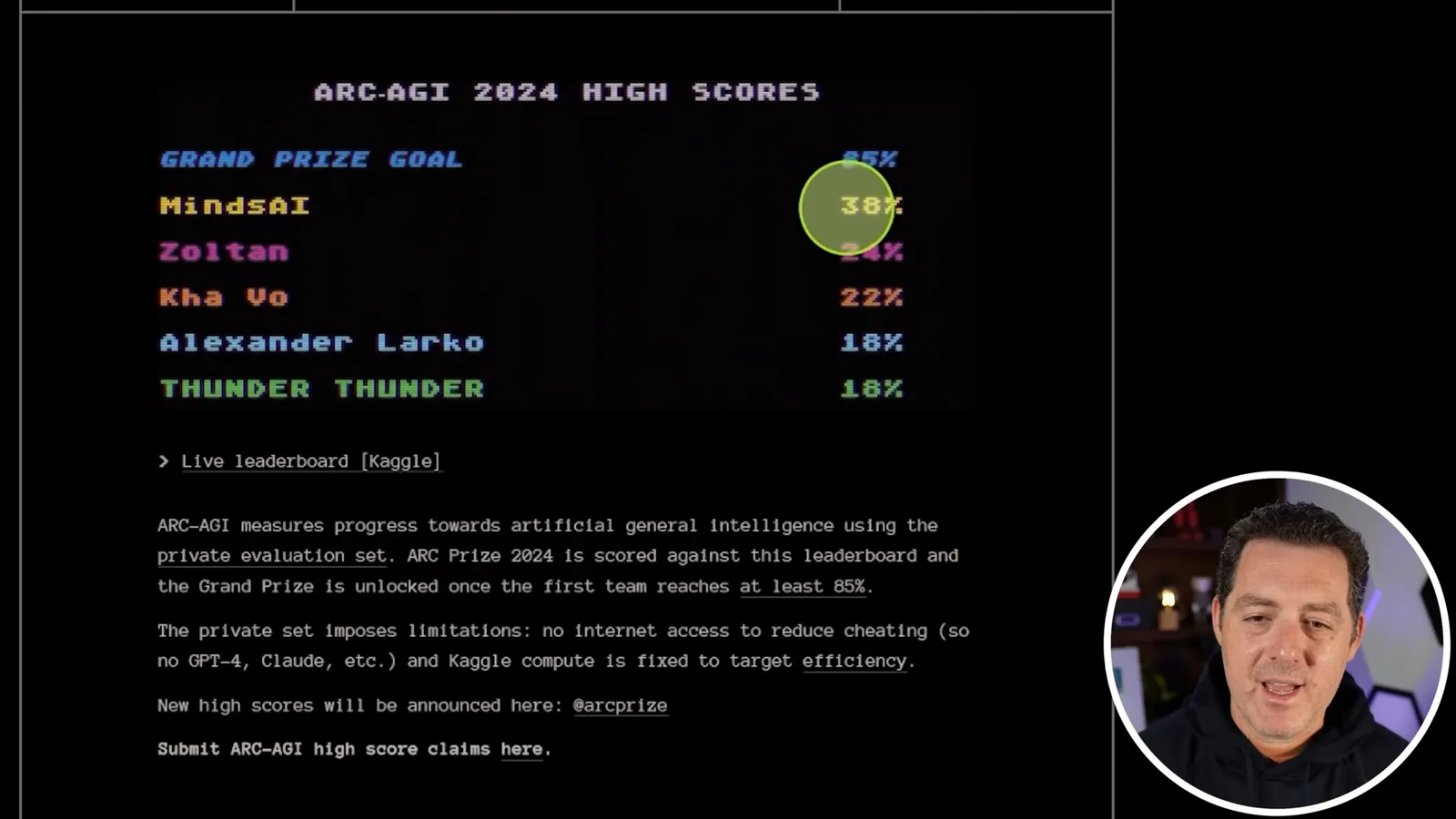
At the time I look at an early leaderboard showing MindsAI around 38%, well below the 85% goal. That is a historical snapshot, not the final competition result or a present-day ranking. The 2024 grand prize ultimately went unclaimed, according to the organizers' report.
More from this channel
 34:21EN
 Matthew Berman· Oct 27, 2026Matthew Berman Examines Anthropic’s IPO Filing, AI Growth and GovernanceMatthew Berman, Sam Altman · Forward FutureThe presenter reviews the S-1’s financial metrics, compute strategy and voting structure while questioning the tension between rapid AI development and safety.
 0:26ENMatthew Berman· Oct 25, 2026Sam Altman on Human Values and Problem-Solving in an AI WorldSam Altman · OpenAIIn a short interview excerpt, Altman considers the enjoyment of solving hard problems and the human role in interpreting results.
 0:36ENMatthew Berman· Oct 25, 2026Kimi K3.1 and a Rubik’s Cube Solver DemonstrationMatthew Berman · Forward FutureMatthew Berman shows a scrambled virtual cube being solved and gives the Kimi K3.1 test a favorable assessment.
 0:21ENMatthew Berman· Oct 24, 2026An AI-Generated Kimi Benchmark Chart Used Invented ScoresMatthew Berman · Forward FutureMatthew Berman asks for a graph of Kimi K3.1 Pro benchmarks, then discovers that the displayed figures are illustrative placeholders.
 25:50ENMatthew Berman· Oct 24, 2026Kimi K3.1 Pro Tested: Strong 3D Demos, Uneven Results and Competitive PricingMatthew Berman · Forward FutureMatthew Berman tests the open-weight model on coding, 3D rendering and visual explanations, then compares benchmark results and prices.
 32:20ENMatthew Berman· Oct 23, 2026Who Is Local AI For? The Costs, Trade-offs and a Hybrid FutureMatthew Berman · Forward FutureMatthew Berman weighs data control and independence against hardware cost, setup complexity and inference speed.