In 30 seconds
In November 2024, Matthew Berman explored a materials-science preprint and speculated about automated research and an intelligence explosion. **In May 2025, MIT said it had no confidence in the paper’s data or research and asked for withdrawal; arXiv administrators withdrew it.** Its figures must not be treated as evidence. The video also discusses AlphaFold and Sakana AI’s experimental AI Scientist, neither of which establishes runaway self-improvement.
- 1The study was withdrawnMIT expressed no confidence in the preprint’s data or research, and arXiv administrators withdrew it in 2025.
- 2AlphaFold’s actual contributionThe 2024 Nobel Prize recognized protein structure prediction and computational protein design, not prediction of every possible protein.
- 3Do not rely on the figuresThe video quotes productivity and patent increases from the withdrawn paper; MIT advised against relying on its findings.
- 4A speculative feedback loopBerman’s intelligence-explosion scenario is a prediction, not a demonstrated outcome of the experiments he cites.
Takeaways
- The central preprint was withdrawn after MIT expressed no confidence in its data or research; its numerical findings should not be relied on.
- AI-proposed materials still require validation and development before becoming usable products.
- AlphaFold advances protein structure prediction but does not verify every possible protein structure.
- Sakana AI’s 2024 demonstration was limited to machine-learning research workflows and does not prove an intelligence explosion.
- Recursive self-improvement and its societal consequences are hypotheses discussed by the host, not established results.
Read the edited text by chapter
A research correction and the intelligence-explosion hypothesis
The video’s central preprint was later withdrawn after MIT raised serious concerns about its data. Berman introduces a speculative recursive-improvement scenario.
**Research update:** The main materials-science paper discussed in this November 2024 video was later withdrawn. In May 2025, MIT said it had no confidence in the provenance, reliability or validity of the data or the research, and asked that the paper be withdrawn; arXiv administrators withdrew it over data-validity and incomplete review requirements. Its reported results should not be relied on as evidence. ([MIT statement](https://economics.mit.edu/news/assuring-accurate-research-record); [arXiv withdrawal notice](https://arxiv.org/abs/2412.17866))
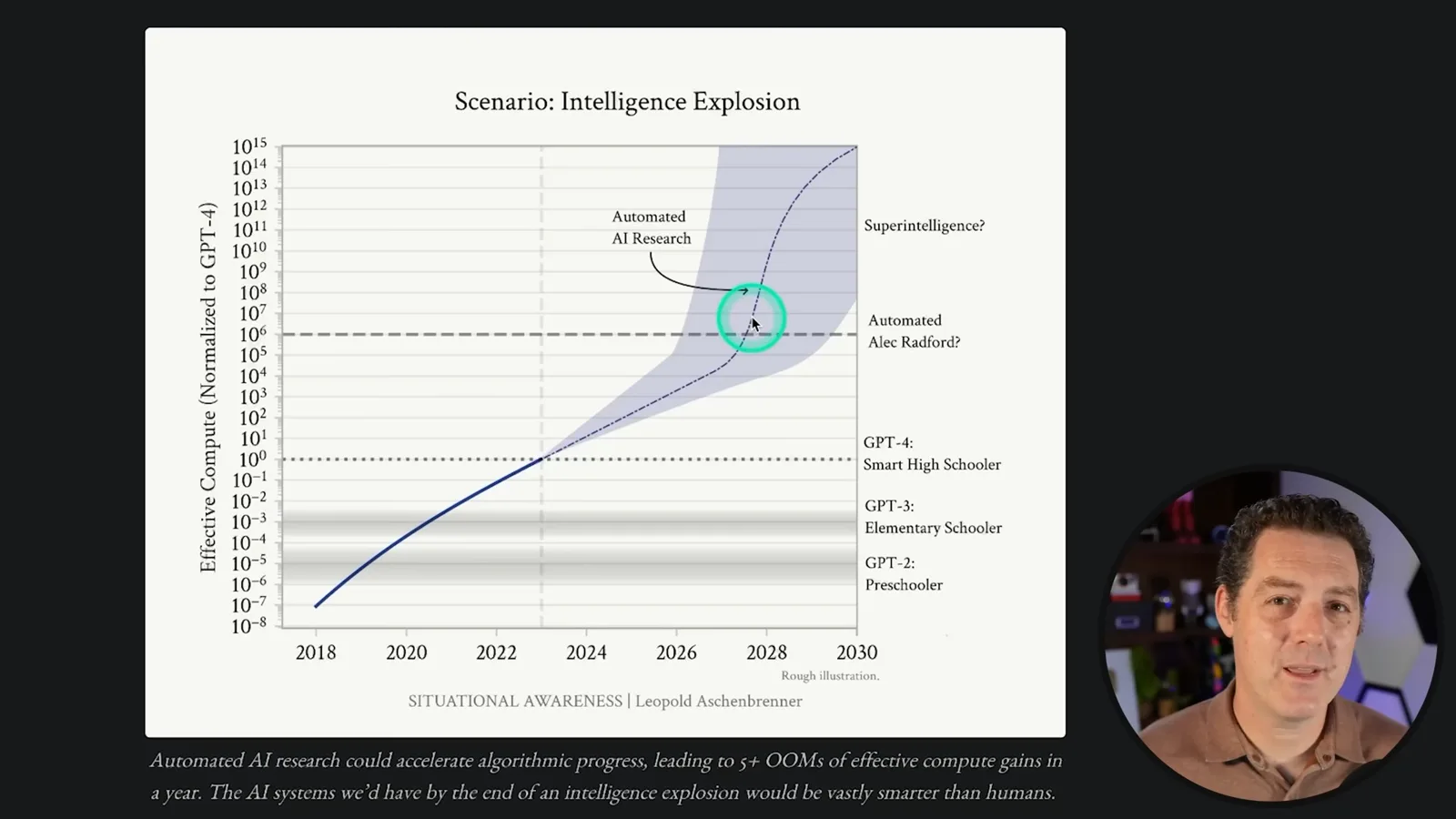
Matthew Berman opens with the idea of an “intelligence explosion”: a hypothetical system that improves AI research, uses the resulting advances to improve itself, and accelerates the cycle. He connects this scenario to Leopold Aschenbrenner's writing. It is a forecast about possible future systems, not an outcome established by the research in the video.
Materials research and AI tools
Berman describes the preprint’s claimed experiment, AlphaFold and material candidate generation. The withdrawn study’s design and results cannot be assumed valid.
The video centers on Aidan Toner-Rodgers's preprint, *Artificial Intelligence, Scientific Discovery, and Product Innovation*. Berman describes it as a randomized rollout of a materials-discovery tool to 1,018 scientists at a large US firm's R&D lab. That was the paper's reported design; following MIT's review and the withdrawal, even the provenance and validity of the underlying data are in doubt.
Berman also mentions Sakana AI's *The AI Scientist* as an example of a system that generates ideas, writes code, runs experiments and prepares research reports. Its authors demonstrated the framework on three machine-learning subfields and assessed outputs with an automated reviewer. Those results do not establish autonomous, reliable scientific discovery across disciplines or prove recursive self-improvement.
The video contrasts human-led trial and error in materials research with systems that propose candidates for scientists to evaluate. A model can predict properties of hypothetical compounds, but a predicted recipe is not itself a validated material: experimental checks and downstream development remain necessary.
Berman cites AlphaFold as an example of AI's scientific potential. The 2024 Nobel Prize in Chemistry recognized Demis Hassabis and John Jumper for protein structure prediction, alongside David Baker for computational protein design. Berman's suggestion that these tools can predict the entire universe of possible proteins overstates the demonstrated result; predictions have limits and are not experimental verification of every structure.
Returning to the disputed preprint, he describes a model trained on known compositions and properties that proposes candidates with desired characteristics. He imagines lighter, cheaper or stronger materials helping solve previously difficult problems. That is a possible application, not proof that arbitrary materials or previously unsolvable problems can now be produced or solved.
Claimed productivity and job satisfaction
The video reports figures about discovery, patents and satisfaction. All come from the discredited preprint and should not be used as evidence.
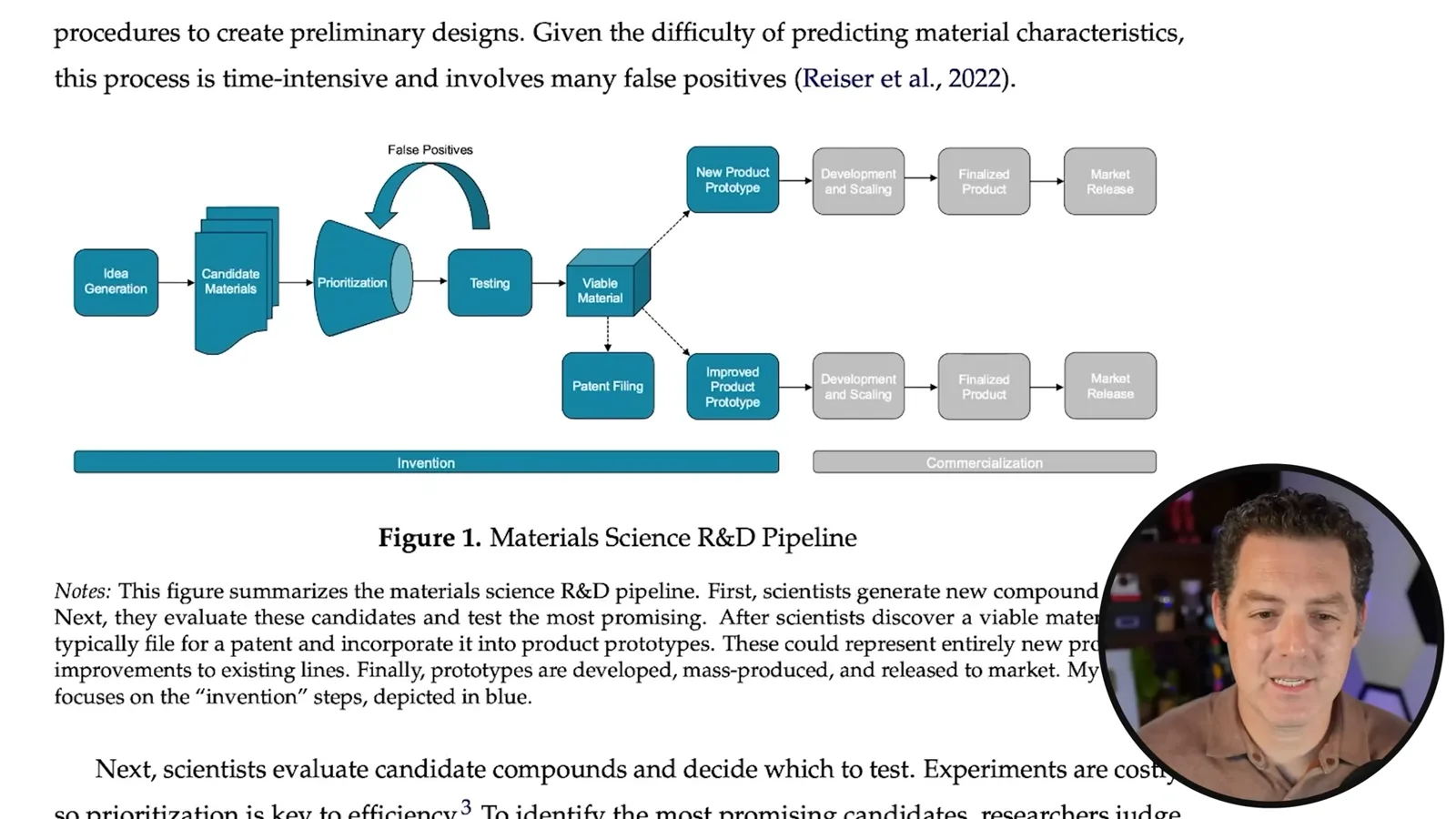
The video presents a workflow in which AI proposes candidates, researchers prioritize and test them, false positives are rejected and promising materials can progress toward patents or product prototypes. This is the preprint's claimed account of a process; the study's withdrawn status means its specific reported outcomes cannot be treated as verified evidence.
Berman quotes the preprint's claimed increases of 44% in materials discoveries, 39% in patent filings and 17% in downstream product innovation. He also reports the paper's claims that the strongest researchers benefited most and that 57% of idea-generation work was automated. MIT later rejected reliance on the paper's findings, so these numbers are historical claims in the video, not reliable estimates.
The video also cites a claim that 82% of scientists were less satisfied because they perceived reduced creativity and unused skills. That figure comes from the same discredited preprint and cannot establish job satisfaction outcomes. Berman uses it to raise a broader question about how automation might affect meaningful work; the question remains open.
AI research and human understanding
Berman discusses possible stages of AI and Sakana AI’s research automation demonstration. He closes with questions about oversight and understanding.
Berman describes a sequence of AI capabilities from conversational systems to reasoning, agents and tools that aid invention. He suggests progress in several areas may occur in parallel. These labels are a conceptual framing, not experimentally demonstrated stages that every system must pass through.
He returns to the intelligence-explosion hypothesis: if systems could conduct AI research and repeatedly apply improvements to themselves, progress might accelerate. He cites Sakana AI's experimental workflow, but its machine-learning demonstrations do not show that such a runaway process has occurred or is inevitable.
Berman ends with an open concern: if people increasingly delegate coding and research, they may struggle to understand or evaluate the results. He does not claim an answer. Maintaining human understanding and scrutiny is a separate issue from whether a model can generate plausible research artifacts.
More from this channel
 34:21EN
 Matthew Berman· Oct 27, 2026Matthew Berman Examines Anthropic’s IPO Filing, AI Growth and GovernanceMatthew Berman, Sam Altman · Forward FutureThe presenter reviews the S-1’s financial metrics, compute strategy and voting structure while questioning the tension between rapid AI development and safety.
 0:36ENMatthew Berman· Oct 25, 2026Kimi K3.1 and a Rubik’s Cube Solver DemonstrationMatthew Berman · Forward FutureMatthew Berman shows a scrambled virtual cube being solved and gives the Kimi K3.1 test a favorable assessment.
 25:50ENMatthew Berman· Oct 24, 2026Kimi K3.1 Pro Tested: Strong 3D Demos, Uneven Results and Competitive PricingMatthew Berman · Forward FutureMatthew Berman tests the open-weight model on coding, 3D rendering and visual explanations, then compares benchmark results and prices.
 32:20ENMatthew Berman· Oct 23, 2026Who Is Local AI For? The Costs, Trade-offs and a Hybrid FutureMatthew Berman · Forward FutureMatthew Berman weighs data control and independence against hardware cost, setup complexity and inference speed.
 1:03:37ENMatthew Berman· Oct 23, 2026Matthew Berman’s Team Tests Kimi K3.1 on Animation, Games, and ChartsMatthew Berman, Alex, Brian · Forward FutureA live team AMA turns into an informal test of Kimi K3.1, from personal-agent workflows to motion graphics, a browser game, and a benchmark chart.
 0:53ENMatthew Berman· Oct 22, 2026Sam Altman on AI and the Discovery of New KnowledgeSam Altman · OpenAIAltman expects progress in mathematical discovery to extend to biology, materials and energy.