In 30 seconds
Matthew Berman reviews GPT-6 Sol and Luna, focusing on their lower API prices and OpenAI’s reported results on business automation, coding and computer use. He argues that cheaper models can be valuable for routine work while more expensive models may be preferable for the most demanding tasks. The benchmark results are specific to their tasks, effort settings and reported costs; his estimates about the share of tasks Luna can handle and the reasons for release timing are speculation. Prices and availability describe the September 2026 launch.
- 1Historical API pricingOpenAI listed $2/$10 per million input/output tokens for Sol and $0.10/$0.50 for Luna, compared with previous promotional prices.
- 2AutomationBenchOpenAI reported 33.2% for Sol at xhigh effort and $0.27 per task on its business-workflow benchmark comparison.
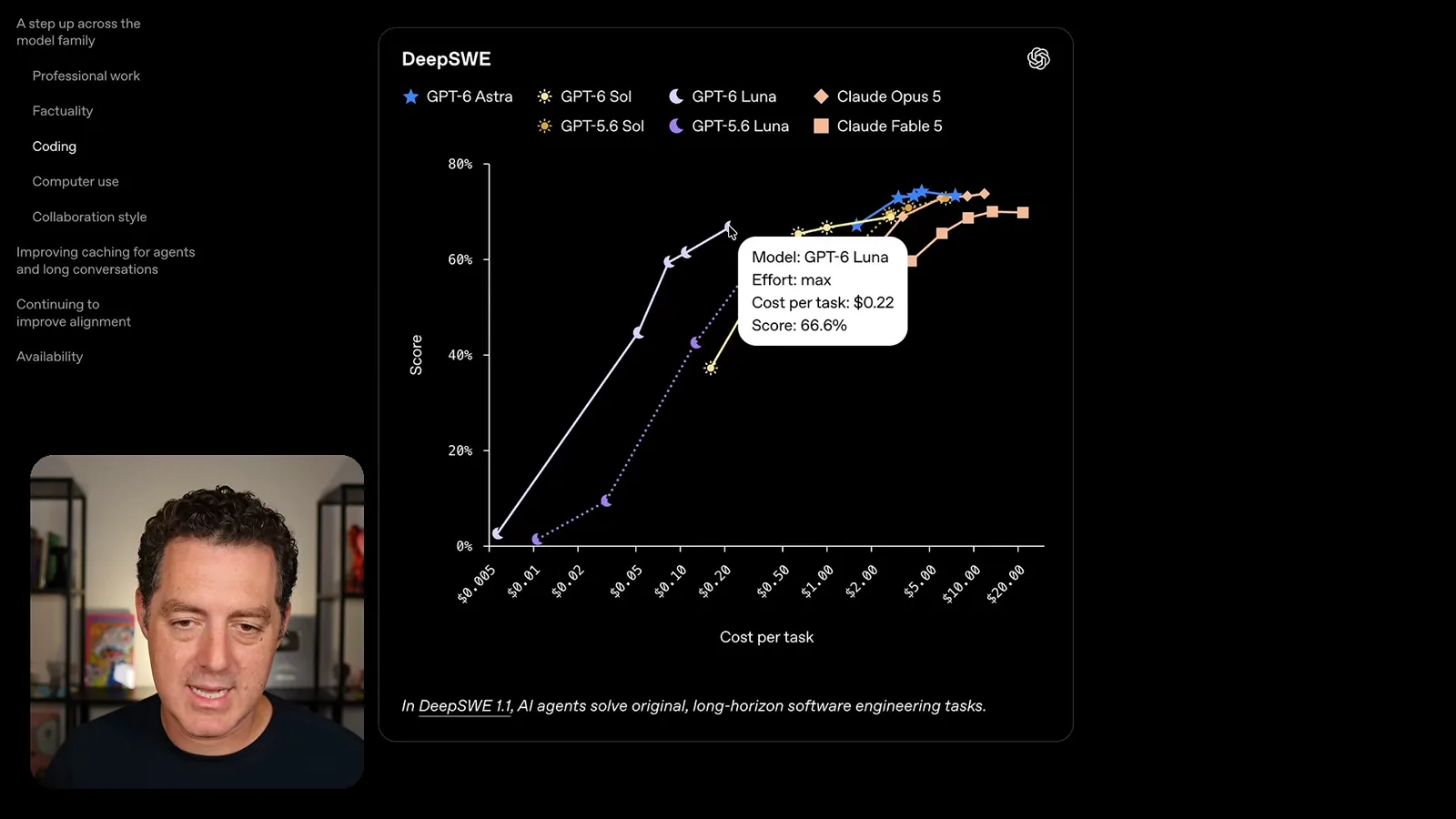
- 3Coding benchmarksBerman compares FrontierCode results and highlights Luna’s 66.6% at $0.22 per task on DeepSWE, according to the displayed chart.
- 4Computer useThe displayed OSWorld comparison shows a sizable gap between Luna and Astra; it reflects specific settings and an offline evaluation.
- 5Release availabilityOpenAI announced availability in ChatGPT Work and Codex for eligible plans and Luna access for Free and Go users in the desktop app.
- 6Speculation about release strategyBerman suggests cheaper models may follow larger releases for reasons including efficiency and possible distillation; those architecture and motive claims are not established.
Takeaways
- At launch, OpenAI listed Sol at $2 input and $10 output per million tokens, and Luna at $0.10 and $0.50.
- OpenAI reported Sol at 33.2% on AutomationBench at xhigh effort and $0.27 per task in its evaluation.
- Luna at max effort scored 66.6% on the reported DeepSWE evaluation at $0.22 per task.
- Benchmark results and per-task costs depend on the evaluation, tool setup and reasoning effort.
- Berman’s estimate that Luna can handle 90–95% of tasks and his claims about model distillation are not established by the charts.
- Availability and API pricing are snapshots of the September 2026 announcement.
Read the edited text by chapter
Sol and Luna pricing
Berman introduces the two models and the price reductions shown at launch. He offers an unmeasured estimate of Luna’s suitability for routine tasks.
OpenAI has introduced GPT-6 Sol and Luna, in a week that also brought other model releases. I have particularly liked the earlier Luna for its combination of speed and cost. This is a September 2026 review; model access and prices can change.
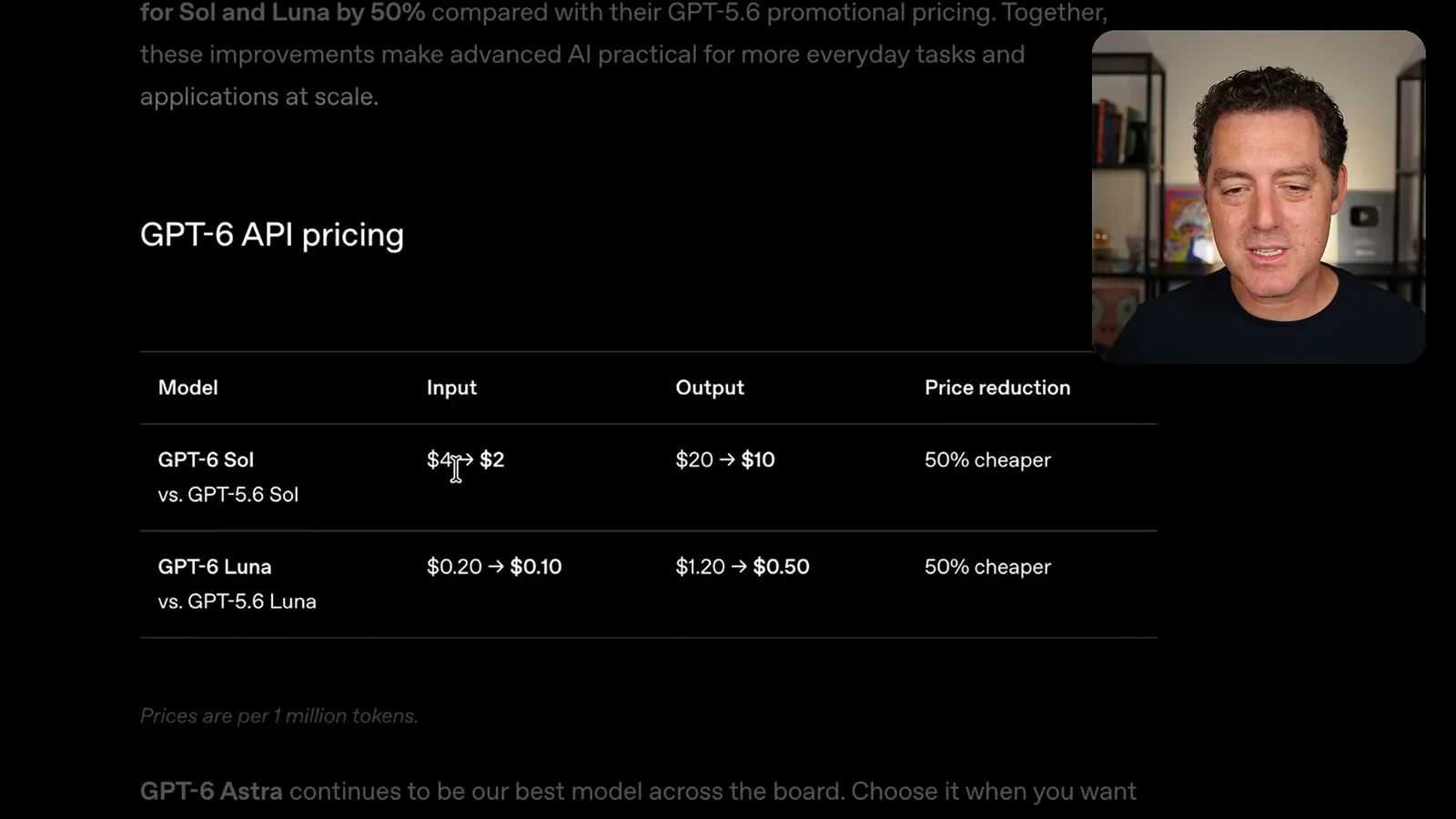
At launch, OpenAI listed GPT-6 Sol at $2 per million input tokens and $10 per million output tokens, and GPT-6 Luna at $0.10 and $0.50 respectively. The company compared these with GPT-5.6 promotional prices: Sol was $4/$20, while Luna was $0.20/$1.20. Thus the Luna output change from $1.20 to $0.50 is about 58%, even though the announcement labels the overall reduction 50%. See [OpenAI’s launch page](https://openai.com/index/introducing-gpt-6-sol-and-luna/).
I see Sol and Luna as workhorse models below the more expensive Astra tier. I estimate Luna could handle 90–95% of tasks people give it, but that is my judgment rather than a measured result. The right choice depends on the task, failure cost and actual workload.
Automation, coding and computer-use benchmarks
He reads OpenAI’s score-versus-cost graphs. The comparisons depend on each evaluation and reasoning-effort setting.
On OpenAI’s AutomationBench chart, the vertical axis shows score and the horizontal axis shows cost per task. GPT-5.6 Sol at max effort is shown at 28.8%; GPT-6 Sol at xhigh reaches 33.2% at $0.27 per task. These are results on a defined business-workflow benchmark and specific settings, not overall intelligence scores.
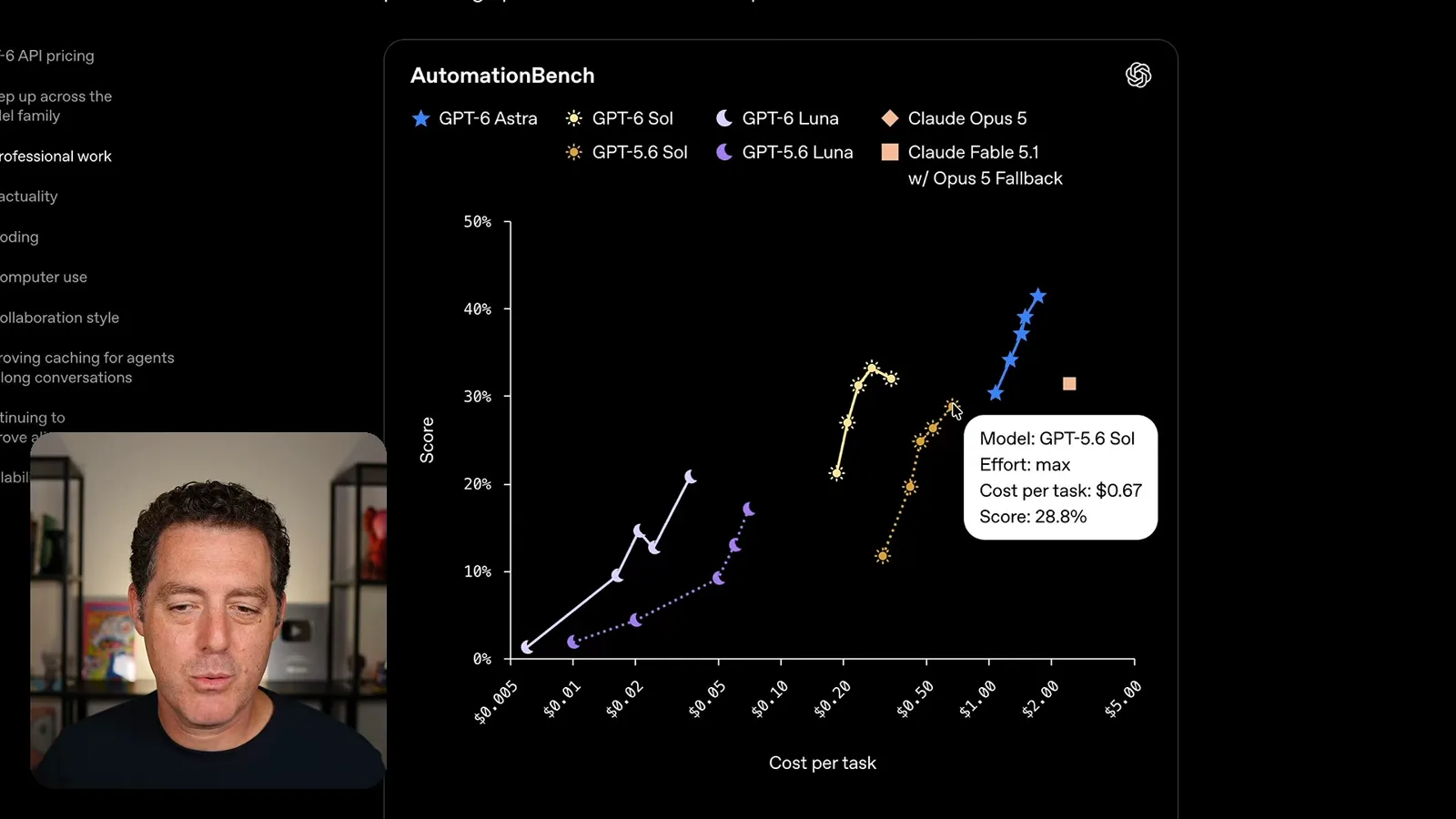
Astra scores higher in the chart, while Luna costs much less and scores lower. OpenAI also reports Sol outperforming particular Claude and low-effort Astra configurations in this evaluation. Competitor numbers come from public reports, and the announcement notes that one Fable fallback cost is not fully included, which limits direct cost comparison.
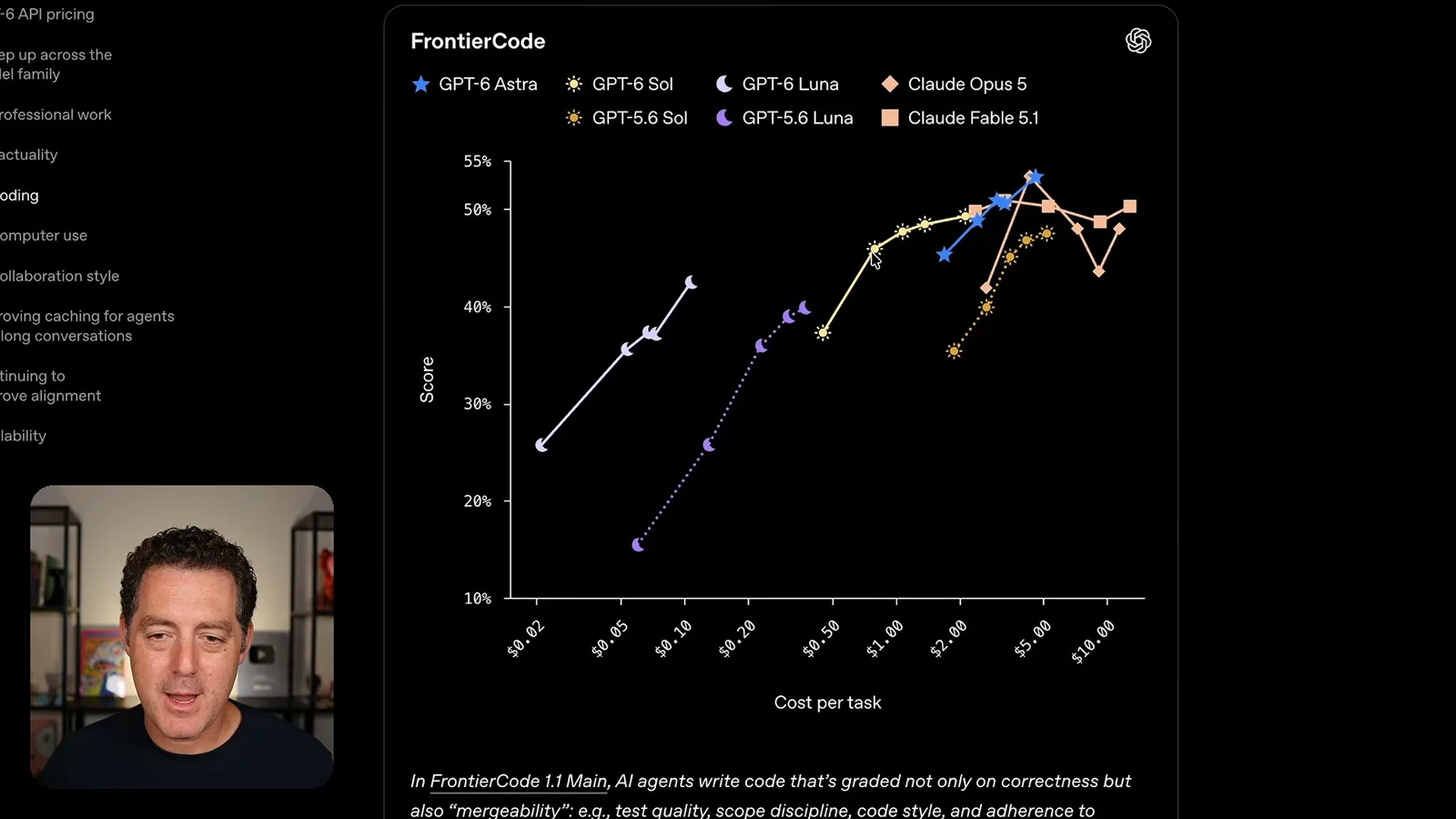
The FrontierCode chart compares coding-agent changes, including correctness and mergeability, at different cost and effort settings. On the separate DeepSWE 1.1 chart, Luna at max effort is shown at 66.6% and $0.22 per task. I find that cost-performance point impressive, but it applies to that evaluation and configuration.
For computer use, the displayed OSWorld chart shows Luna well below Astra in the compared configurations. OpenAI says its OSWorld 2.0 figures use partial reward on an offline set. The scores are useful within that evaluation but should not be read as success rates across every computer task.
Comparison, availability and model strategy
Berman compares the launch prices and reported benchmarks, then reviews availability. He speculates about why efficient models follow larger releases.
I also show a comparison chart assembled with Astra, placing Sol, Luna and Claude Opus 5.5 alongside each other on prices and reported benchmark scores. Its FrontierCode bars are separated by several percentage points while input prices differ substantially. The chart combines published figures rather than a new controlled head-to-head experiment.
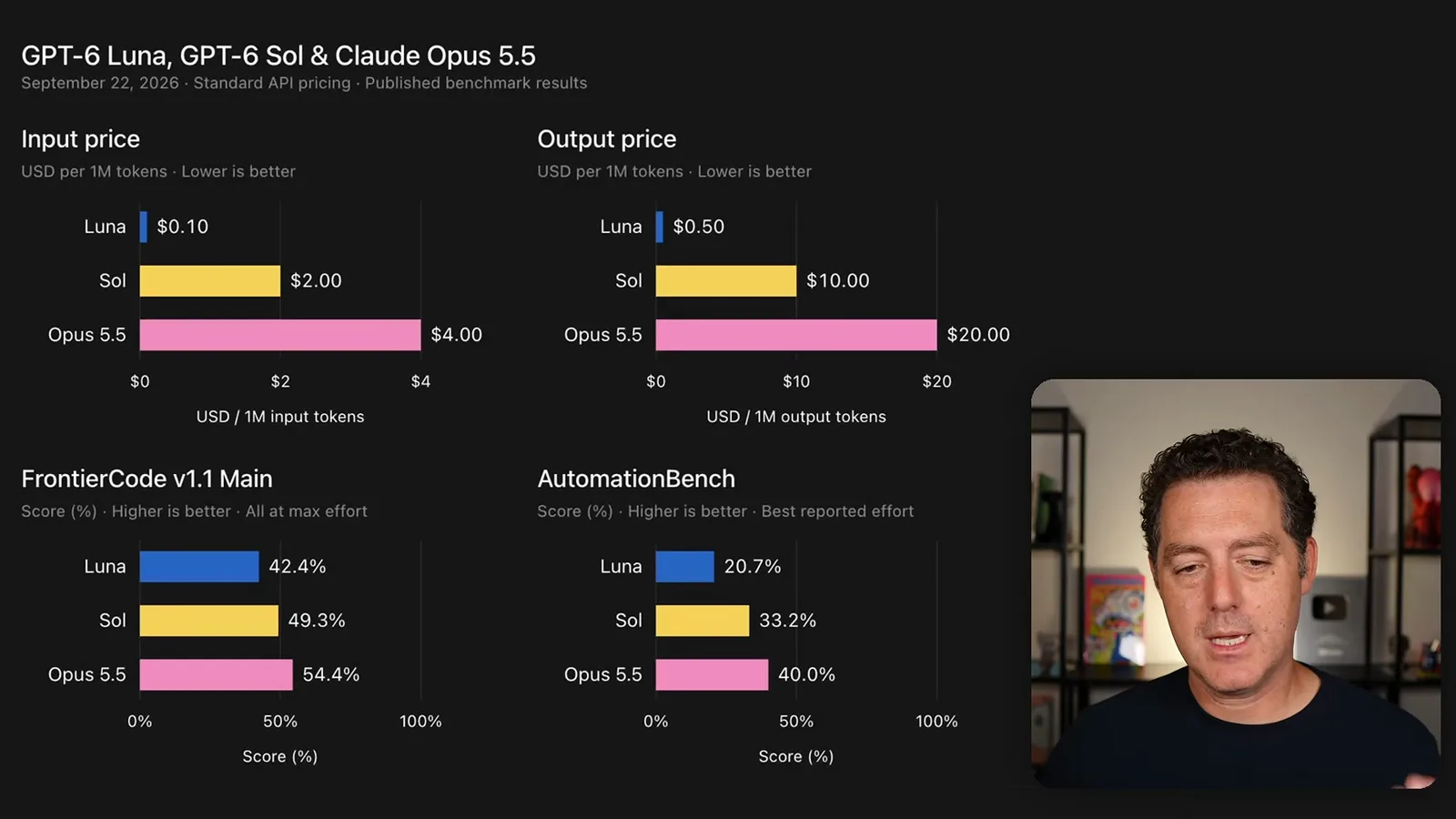
At launch, OpenAI said Sol and Luna were available in ChatGPT Work and Codex for Plus, Pro, Business, Enterprise and Edu users, with Luna available to Free and Go users in the desktop app. The announcement said they were not yet available in Chat and that rollout was gradual. These are historical launch conditions.
I speculate that the lower prices and focus on efficiency reflect a pattern in which companies first release larger, more expensive models and then cheaper workhorse versions. I also wonder whether the smaller models are architecturally related or distilled from larger ones. Those are possibilities, not conclusions established by the video or its charts.
More from this channel
 34:21EN
 Matthew Berman· Oct 27, 2026Matthew Berman Examines Anthropic’s IPO Filing, AI Growth and GovernanceMatthew Berman, Sam Altman · Forward FutureThe presenter reviews the S-1’s financial metrics, compute strategy and voting structure while questioning the tension between rapid AI development and safety.
 0:36ENMatthew Berman· Oct 25, 2026Kimi K3.1 and a Rubik’s Cube Solver DemonstrationMatthew Berman · Forward FutureMatthew Berman shows a scrambled virtual cube being solved and gives the Kimi K3.1 test a favorable assessment.
 25:50ENMatthew Berman· Oct 24, 2026Kimi K3.1 Pro Tested: Strong 3D Demos, Uneven Results and Competitive PricingMatthew Berman · Forward FutureMatthew Berman tests the open-weight model on coding, 3D rendering and visual explanations, then compares benchmark results and prices.
 32:20ENMatthew Berman· Oct 23, 2026Who Is Local AI For? The Costs, Trade-offs and a Hybrid FutureMatthew Berman · Forward FutureMatthew Berman weighs data control and independence against hardware cost, setup complexity and inference speed.
 1:03:37ENMatthew Berman· Oct 23, 2026Matthew Berman’s Team Tests Kimi K3.1 on Animation, Games, and ChartsMatthew Berman, Alex, Brian · Forward FutureA live team AMA turns into an informal test of Kimi K3.1, from personal-agent workflows to motion graphics, a browser game, and a benchmark chart.
 0:53ENMatthew Berman· Oct 22, 2026Sam Altman on AI and the Discovery of New KnowledgeSam Altman · OpenAIAltman expects progress in mathematical discovery to extend to biology, materials and energy.