In 30 seconds
In this May 2026 video, Matthew Berman describes Codex as an AI assistant for coding and other computer tasks. He demonstrates a request for a spreadsheet charting human population over time and says the result can be revised through follow-up conversation.
- 1An assistant for multiple tasksBerman describes computer control, search, spreadsheets, presentations and coding as possible uses.
- 2Population chart demonstrationHe asks for a spreadsheet charting human population over time and shows the completed workbook.
- 3Iterate in conversationBerman says users can ask follow-up questions to change or extend the result.
Takeaways
- Berman presents Codex as an assistant for coding, research and creating documents.
- His example asks the agent to retrieve population data and build a spreadsheet with a chart.
- A follow-up request can be used to revise the generated spreadsheet.
Read the edited text by chapter
Codex as a general assistant
Berman compares Codex with ChatGPT and describes a range of possible tasks. His broad claims are his own assessment.
I see ChatGPT as one of the most important pieces of software ever released, and many people are calling Codex a sequel. Although it may look similar at first, I describe it as an assistant that can tackle a range of tasks: controlling a computer, searching the web, creating spreadsheets and presentations, generating media and writing code.
Building a spreadsheet
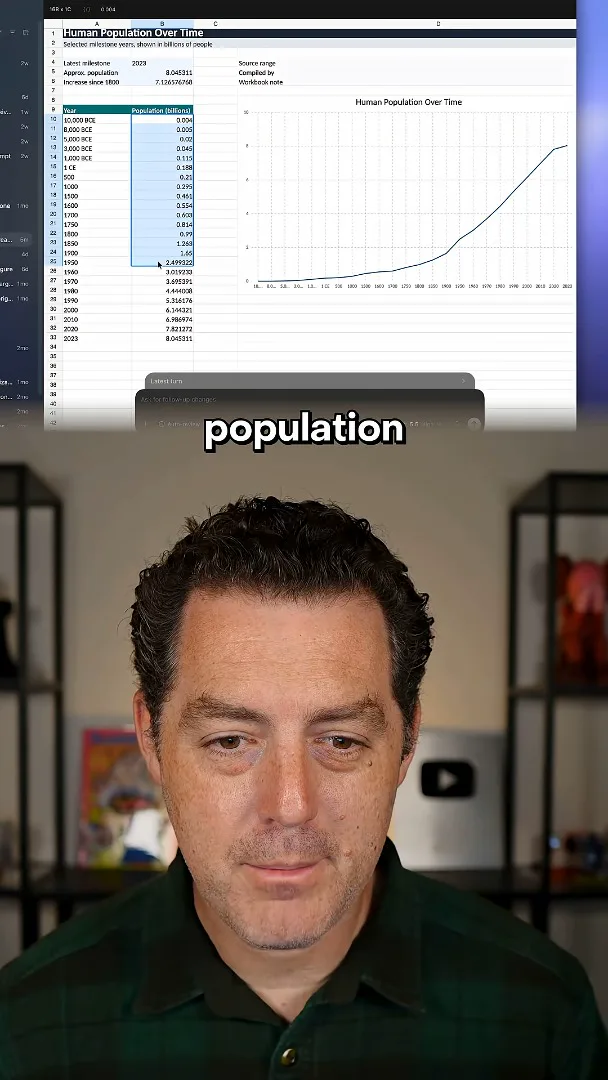
A prompt asks for a graph of human population over time. The demonstration shows the agent gathering data and producing a spreadsheet.

To demonstrate, I ask Codex to create a spreadsheet with a graph of human population over time. It explores files, uses a spreadsheet skill and downloads population data from the internet. The finished workbook shows a population table and a chart measured in billions.
Continuing the conversation
Berman describes using follow-up requests to modify the result and supplying files or photos as input.
Once the spreadsheet is ready, I can continue the conversation and ask the agent to change or expand it. I can also supply files and photos for it to work with.
More from this channel
 34:21EN
 Matthew Berman· Oct 27, 2026Matthew Berman Examines Anthropic’s IPO Filing, AI Growth and GovernanceMatthew Berman, Sam Altman · Forward FutureThe presenter reviews the S-1’s financial metrics, compute strategy and voting structure while questioning the tension between rapid AI development and safety.
 0:36ENMatthew Berman· Oct 25, 2026Kimi K3.1 and a Rubik’s Cube Solver DemonstrationMatthew Berman · Forward FutureMatthew Berman shows a scrambled virtual cube being solved and gives the Kimi K3.1 test a favorable assessment.
 25:50ENMatthew Berman· Oct 24, 2026Kimi K3.1 Pro Tested: Strong 3D Demos, Uneven Results and Competitive PricingMatthew Berman · Forward FutureMatthew Berman tests the open-weight model on coding, 3D rendering and visual explanations, then compares benchmark results and prices.
 32:20ENMatthew Berman· Oct 23, 2026Who Is Local AI For? The Costs, Trade-offs and a Hybrid FutureMatthew Berman · Forward FutureMatthew Berman weighs data control and independence against hardware cost, setup complexity and inference speed.
 1:03:37ENMatthew Berman· Oct 23, 2026Matthew Berman’s Team Tests Kimi K3.1 on Animation, Games, and ChartsMatthew Berman, Alex, Brian · Forward FutureA live team AMA turns into an informal test of Kimi K3.1, from personal-agent workflows to motion graphics, a browser game, and a benchmark chart.
 0:53ENMatthew Berman· Oct 22, 2026Sam Altman on AI and the Discovery of New KnowledgeSam Altman · OpenAIAltman expects progress in mathematical discovery to extend to biology, materials and energy.