In 30 seconds
Matthew Berman responds to Ted Gioia’s August 2023 argument that falling traffic and weak search market share suggest AI is a fad. Berman argues that adoption and useful applications need time to develop, while acknowledging misuse, copyright disputes and safety concerns.
- 1Bing and entrenched habitsBerman disputes the expectation that an AI feature would quickly dislodge Google. He expects people to discover uses gradually and says he already uses ChatGPT for coding and direct answers.
- 2Traffic and adoptionHe challenges the notion that ChatGPT visitors must double every few weeks to show value. A burst of curiosity followed by a decline may precede a different pattern of adoption, though that is his interpretation.
- 3Creative assistanceBerman agrees that AI-generated books and music were not yet competitive with human creativity in his view. He expects gradual collaboration and describes refining his own drafts with ChatGPT.
- 4Safety and legal disputesBerman says public concern, copyright cases, the writers’ strike and criminal use are real issues. He argues that these do not by themselves prove a lack of useful demand.
Takeaways
- Search market share and short-term website traffic alone do not establish the long-term usefulness of AI.
- Berman sees value in conversational answers, coding assistance and help refining human-written drafts.
- He expects AI to augment creative work gradually, although this is a prediction rather than a demonstrated outcome.
- Concern about safety and a desire to slow development need not imply that people reject every AI application.
- Fraud, copyright disputes and labor concerns require attention even if AI becomes widely useful.
Read the edited text by chapter
The case against AI and Bing’s market share
Berman introduces Gioia’s critique and challenges the expectation that Bing would quickly overtake Google. He describes his own early uses of ChatGPT.
I want to respond to an article a friend sent me about the supposed death of AI. Ted Gioia, writing as The Honest Broker, argues that demand is shrinking and that the main flourishing uses are spam, scams and deception. He makes some worthwhile points, but I disagree with his overall conclusion.
Gioia begins with Microsoft’s investment in AI and the failure of Bing to make a large dent in Google’s search dominance. Microsoft has invested heavily in OpenAI and is integrating AI across its products. But I do not think it expected the addition of AI to Bing to overturn established search habits in a few months.
I am an early adopter, and I use ChatGPT for questions that ordinary search does not answer directly: recipes, travel and coding, for example. As a coding assistant it has become part of my workflow. Many people still default to Google out of habit, and it may take time to discover where a conversational tool is useful.
The interface is still awkward, and integration into products people already use could change how often they encounter AI. We are at an early stage of this particular wave: ChatGPT launched in November 2022, less than a year before this video. Its early adoption is not the whole history of artificial intelligence.
Search, community knowledge and unreliable answers
He considers why people search community sites and imagines their data contributing to future models. He acknowledges errors but expects models to improve.
Gioia asks why people have not abandoned search if results have deteriorated. He points to Reddit and TikTok; I would add Stack Overflow. These sites contain user-generated material that can be assessed through votes, likes or other community signals, rather than just content-farm pages.
I expect platforms with valuable community data to use it to build or train AI products. The appeal of a conversational system is that I can ask for an answer directly instead of opening many pages and sorting through ads. That possibility does not remove the need to check what the model says.
Gioia is right that people do not want answers full of errors or outrageous claims. In my experience ChatGPT often handles everyday questions well, though it can hallucinate; my experience is not a guarantee of reliability. I expect better data and future models to reduce these problems, but that is a prediction.
Traffic, adoption curves and creative work
Berman disputes the expectation of endless doubling and reads a dip as potentially normal for an emerging technology. He argues that AI can assist creators rather than simply replace them.
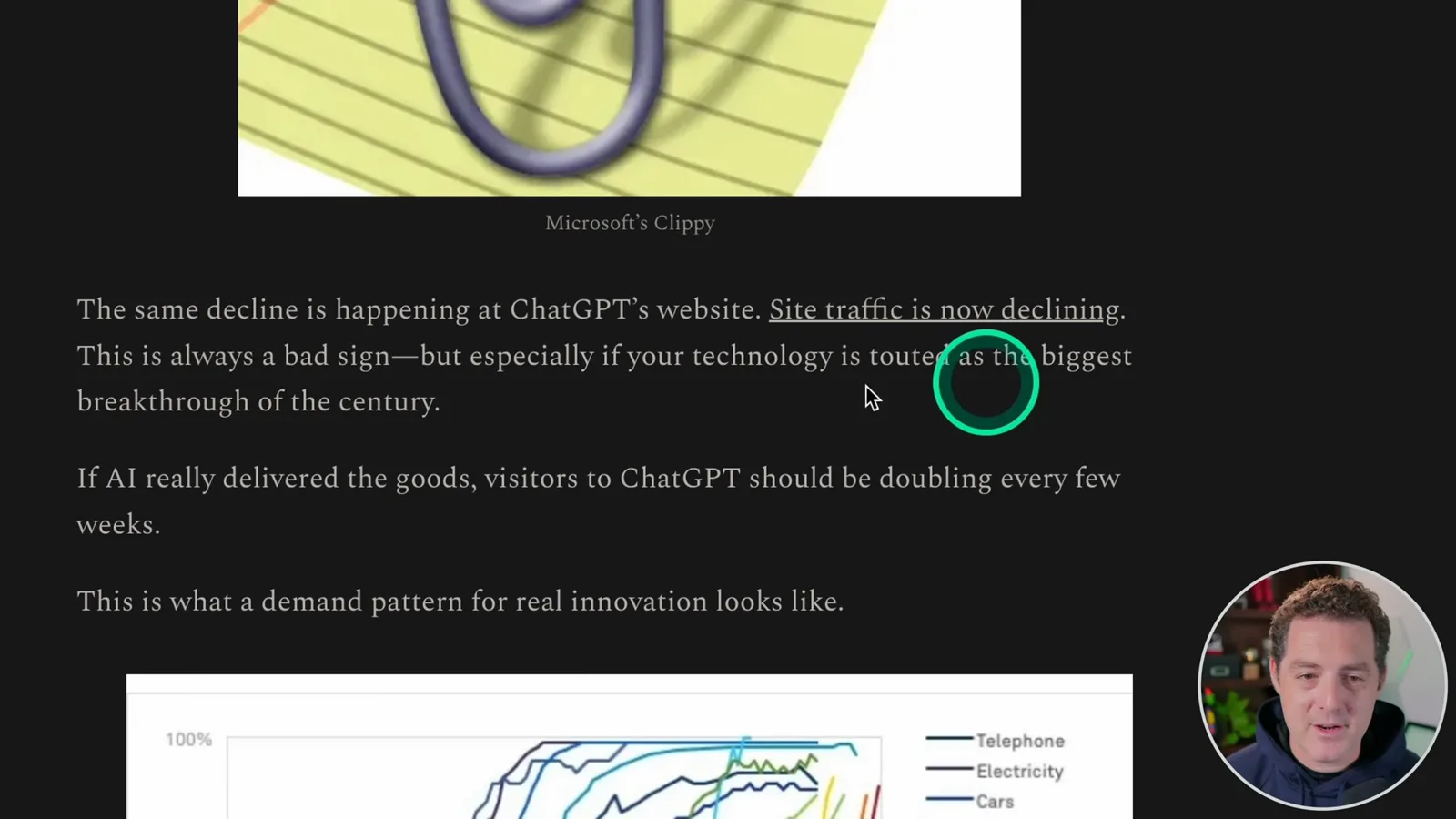
The article treats falling ChatGPT website traffic as a bad sign and suggests visitors should double every few weeks if the technology delivers. I disagree with the expectation of sustained doubling: a product cannot keep doubling indefinitely. Some early visitors were trying it out because of the initial excitement, and a decline in visits is not the same measure as the number of users.
It took me time to find my own use cases, and now I use ChatGPT daily. Other people may take longer. Looking at the article’s technology adoption chart, I see some earlier technologies rising, dipping and then growing again; I think AI could follow a similar path as useful applications and integrations emerge.
Some newer products had very steep adoption curves because people already knew related devices and technologies. A tablet, for example, arrived in a world familiar with smartphones, cameras and the internet. I see conversational AI as a less familiar experience, so I would not expect every curve to look identical.
I disagree with the comparison to unwanted AOL startup disks. I expect AI to be integrated into many everyday products and to make tasks easier and more productive. The delivery mechanism matters: the basic ChatGPT interface may not be the long-term answer, and I speculated that Apple’s eventual approach might offer another model.
Gioia asks who wants AI-written books, AI-made music or AI journalism, and who would trust AI in a critical job. Those are fair questions. In 2023 I do not think generated books or music can compete with human creativity, but I do not expect an overnight, binary replacement of artists.
A more gradual path is artists using AI to help write songs or authors using it as an assistant. In my own work I research, make notes and write a first or second draft, then use ChatGPT to help refine it. It participates in the process rather than originating the whole piece for me.
Misuse, legal conflict and a cautious conclusion
The response turns to public concern, model quality, copyright, labor and criminal uses. Berman remains optimistic while calling for criticism and safeguards.
The article also says AI is useful for scams and spam. New technologies can be abused, and those uses must be addressed, but they do not exhaust the legitimate applications. Gioia cites a poll reporting that 72% of Americans wanted development slowed and 8% wanted it accelerated; such figures depend on the poll and its wording.
People have understandable fears about the dangers of AI, including fears amplified by AI company leaders. Wanting development to proceed more slowly and safely is not necessarily the same as wanting no AI at all. Likewise, concessions to screenwriters in the 2023 Hollywood strike can protect workers while AI still becomes a useful writing aid.
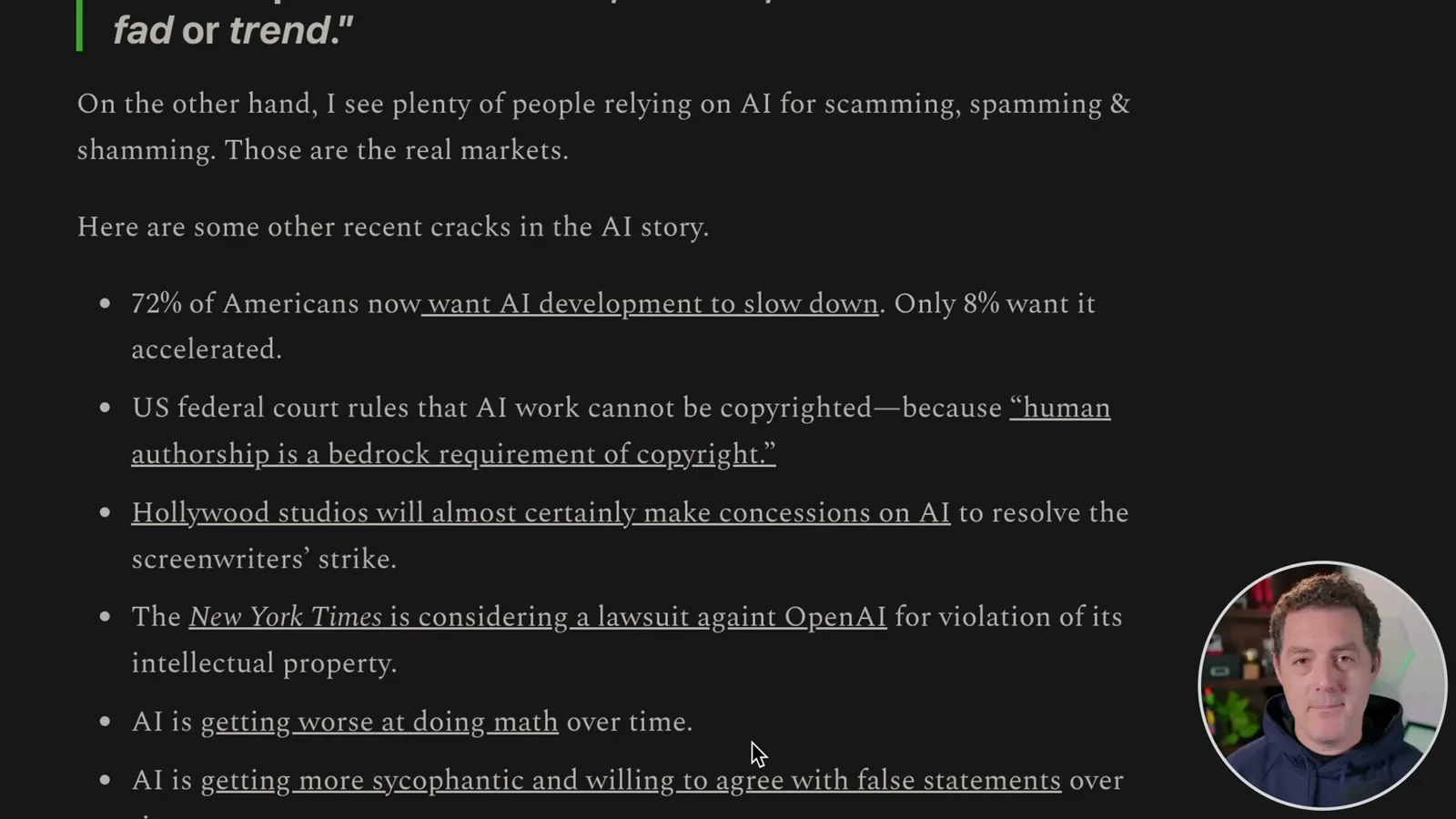
Gioia also cites reports of models getting worse at math. I had discussed observed performance changes and speculated that safety guardrails could affect quality, though that explanation is not established by the examples alone. I hope new techniques will improve safety without sacrificing performance.
Copyright is another conflict. Gioia points to objections from Universal Music and lawsuits against AI companies over training data; I also note reports of music companies exploring AI tools. Those are distinct issues: a company can object to unauthorized uses while investigating tools and arrangements intended to protect artists.
I compare the clash between technology and law to Napster and the emergence of digital music services. Napster itself disappeared, while later streaming services developed under different business and licensing arrangements. The analogy is about how disputes and technologies evolve; MP3 existed before Napster, and this history does not settle AI copyright questions.
Gioia lists ransom scams, malware, cheap AI music and student cheating. These are real concerns, and we need ways to deal with misuse. He also argues that public suspicion, weak performance in some uses and the possibility of job losses all weigh against the technology; I do not think those points alone show that demand will disappear.
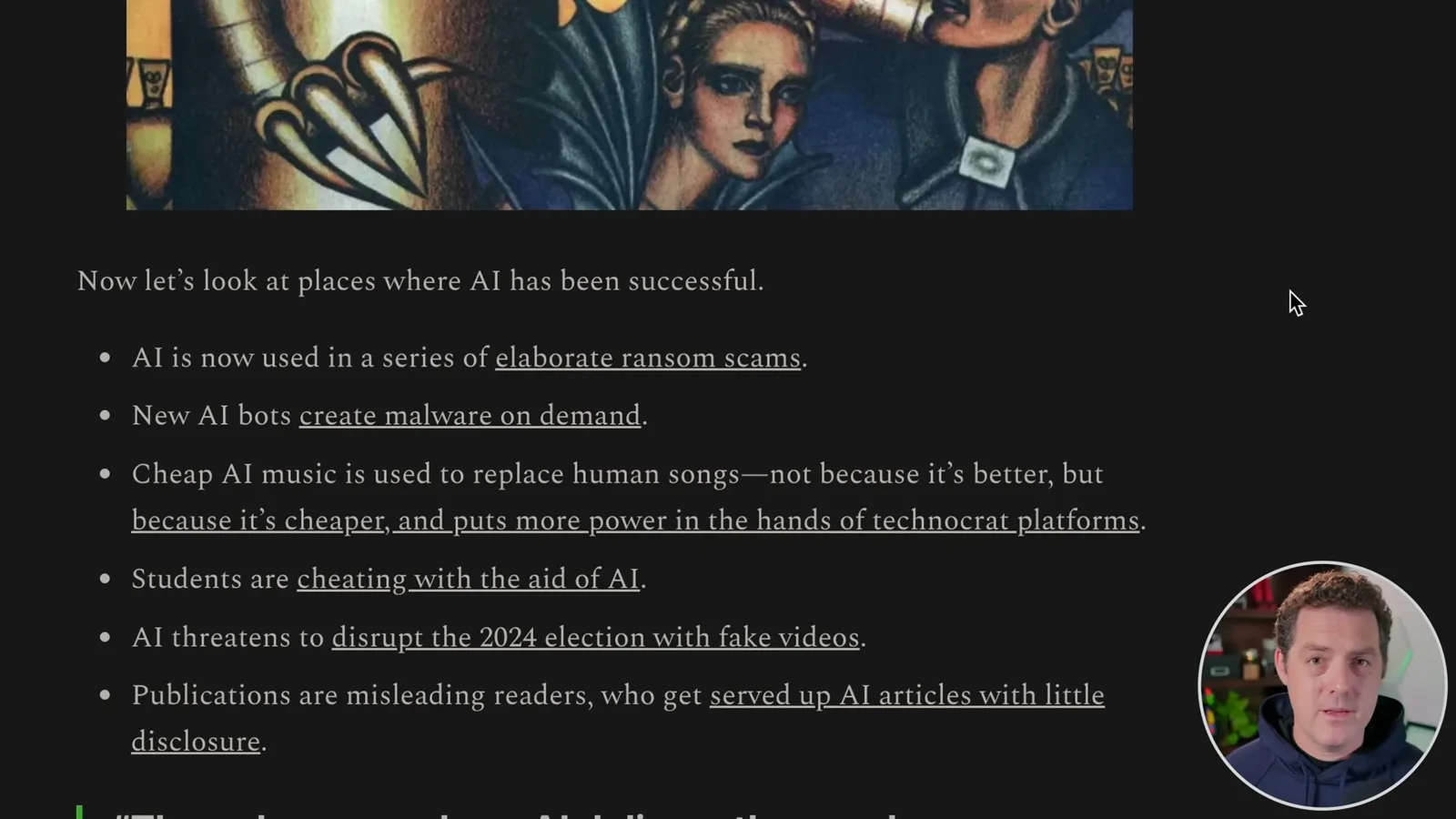
In my own work, coding assistance, writing support and answers to questions have been valuable. Legal and regulatory obstacles are real, as is the risk of deception. We should build safeguards and keep criticizing the technology rather than assume either that all of its uses are harmless or that it should simply be abandoned.
Gioia suggests putting the genie back in the bottle. I do not see how that would work or why we should stop trying to improve the technology. Skeptics have a role in challenging AI and its risks, but I remain optimistic that, developed thoughtfully, it can make the world better.
More from this channel
 34:21EN
 Matthew Berman· Oct 27, 2026Matthew Berman Examines Anthropic’s IPO Filing, AI Growth and GovernanceMatthew Berman, Sam Altman · Forward FutureThe presenter reviews the S-1’s financial metrics, compute strategy and voting structure while questioning the tension between rapid AI development and safety.
 25:50ENMatthew Berman· Oct 24, 2026Kimi K3.1 Pro Tested: Strong 3D Demos, Uneven Results and Competitive PricingMatthew Berman · Forward FutureMatthew Berman tests the open-weight model on coding, 3D rendering and visual explanations, then compares benchmark results and prices.
 32:20ENMatthew Berman· Oct 23, 2026Who Is Local AI For? The Costs, Trade-offs and a Hybrid FutureMatthew Berman · Forward FutureMatthew Berman weighs data control and independence against hardware cost, setup complexity and inference speed.
 1:03:37ENMatthew Berman· Oct 23, 2026Matthew Berman’s Team Tests Kimi K3.1 on Animation, Games, and ChartsMatthew Berman, Alex, Brian · Forward FutureA live team AMA turns into an informal test of Kimi K3.1, from personal-agent workflows to motion graphics, a browser game, and a benchmark chart.
 0:53ENMatthew Berman· Oct 22, 2026Sam Altman on AI and the Discovery of New KnowledgeSam Altman · OpenAIAltman expects progress in mathematical discovery to extend to biology, materials and energy.
 0:22ENMatthew Berman· Oct 21, 2026A Robot Bodyguard Video Shows Dramatic Rescue ScenariosMatthew Berman · Forward FutureMatthew Berman reacts to a short robot demonstration depicting fighting and vehicle-rescue scenarios.