In 30 seconds
After Gemini 3’s release in November 2025, Matthew Berman examines a reported Sam Altman memo and compares eight companies across his own strategic criteria. He argues Google is best positioned because it combines a strong model with infrastructure, chips, existing revenue and distribution. The scorecard and future market outcomes are his judgments, while the reported memo and possible chip deal are attributed to their sources.
- 1Reported OpenAI memoThe Information reported that Sam Altman expected temporary headwinds from Google while remaining confident in OpenAI.
- 2Benchmark resultsA displayed comparison puts Gemini 3 Pro ahead on many listed tests, but Berman says benchmarks are only one consideration.
- 3Strategy scorecardHis chart rates eight companies against ten factors; the ratings reflect his judgment at the time.
- 4Model choiceBerman argues that serving multiple providers’ models gives enterprise customers flexibility.
- 5Custom siliconHe sees chip design and integration as potential sources of cost and efficiency advantages.
- 6Revised Google ratingAfter learning Google Cloud served Anthropic models, he changes its diversified-model score and reinforces his conclusion.
- 7Reported chip discussionsMeta was reportedly in talks to buy Google TPUs; Berman interprets this as a way to reduce dependence on a single supplier.
Takeaways
- Berman regards Gemini 3 Pro as a leading model but argues benchmarks are only one part of an AI strategy.
- His scorecard considers infrastructure, model choice, custom silicon, existing revenue, researchers, hardware, users, data and integration.
- Cloud providers can offer customers multiple companies’ models, reducing dependence on any one provider.
- Established businesses have diversified revenue to fund AI investment, while AI-focused companies face different financing pressures.
- Possession of user or platform data does not by itself establish permission or ability to use it for model training.
- Berman ranks Google first and Microsoft second; these rankings and predictions are subjective.
- Meta’s reported talks about Google chips were talks at the time, not a confirmed purchase.
Read the edited text by chapter
Gemini and the reported memo
Berman discusses Google’s progress and a reported internal OpenAI memo. He argues that competitive positioning involves more than benchmark scores.
Following Gemini 3’s release in November 2025, I think Google is exceptionally well positioned in AI. The Information reported an internal Sam Altman memo acknowledging Google’s progress and warning of temporary headwinds for OpenAI, while expressing confidence that OpenAI would emerge ahead. I use that report to examine the competitive landscape.
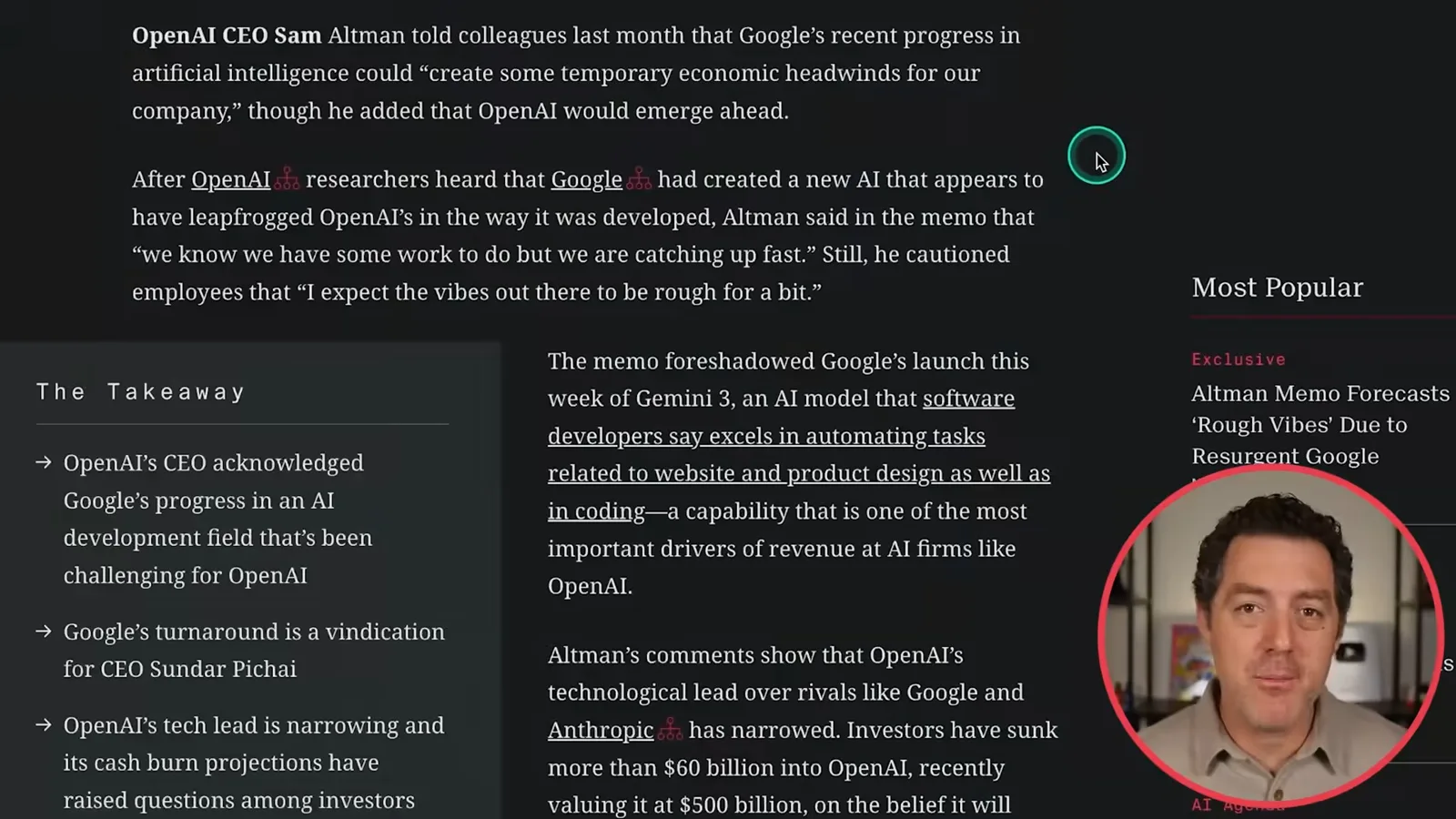
I see the model-performance gap narrowing, with Google and Anthropic surpassing OpenAI on some tests. Altman reportedly said ChatGPT remains synonymous with AI for many people; I agree its brand is powerful, but that advantage may erode as rivals integrate AI into products people already use.
The reported memo also describes the challenge of being a leading research lab, infrastructure company and product platform simultaneously. I admire the ambition, but think that list illustrates the difficulty of OpenAI’s position. My comparison asks which companies already possess the pieces needed to compete.
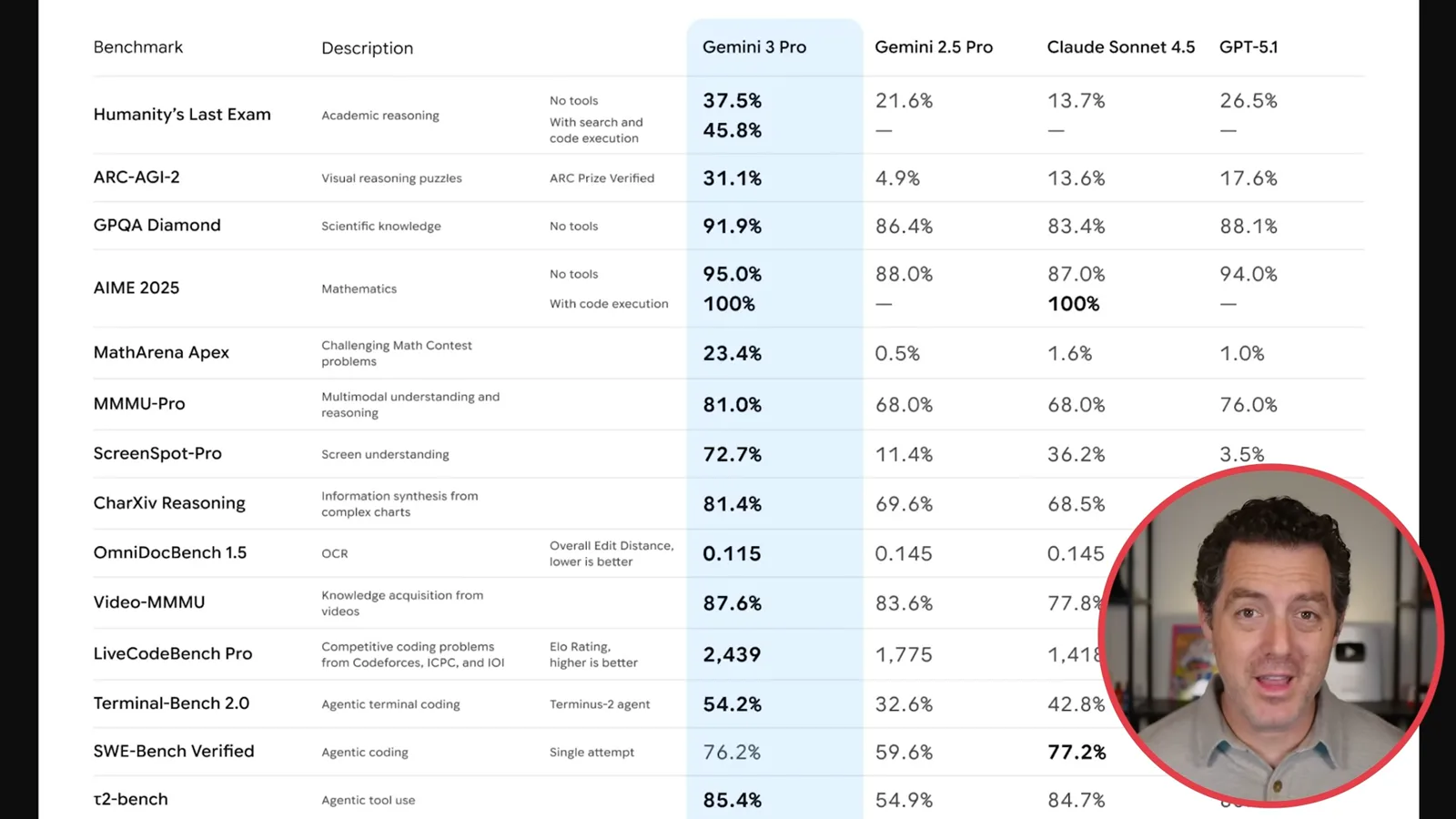
The displayed benchmark table shows Gemini 3 Pro ahead of GPT-5.1 on many listed measures. I regard Gemini as a leading model, while stressing that benchmarks are only one piece of the puzzle. I connect Google’s recent stock rise to investors recognizing its broader strengths, though that causal explanation is my interpretation.
Building the scorecard
He defines the factors in his comparison, then assesses models, infrastructure and financial resources. His ratings are subjective and time-specific.
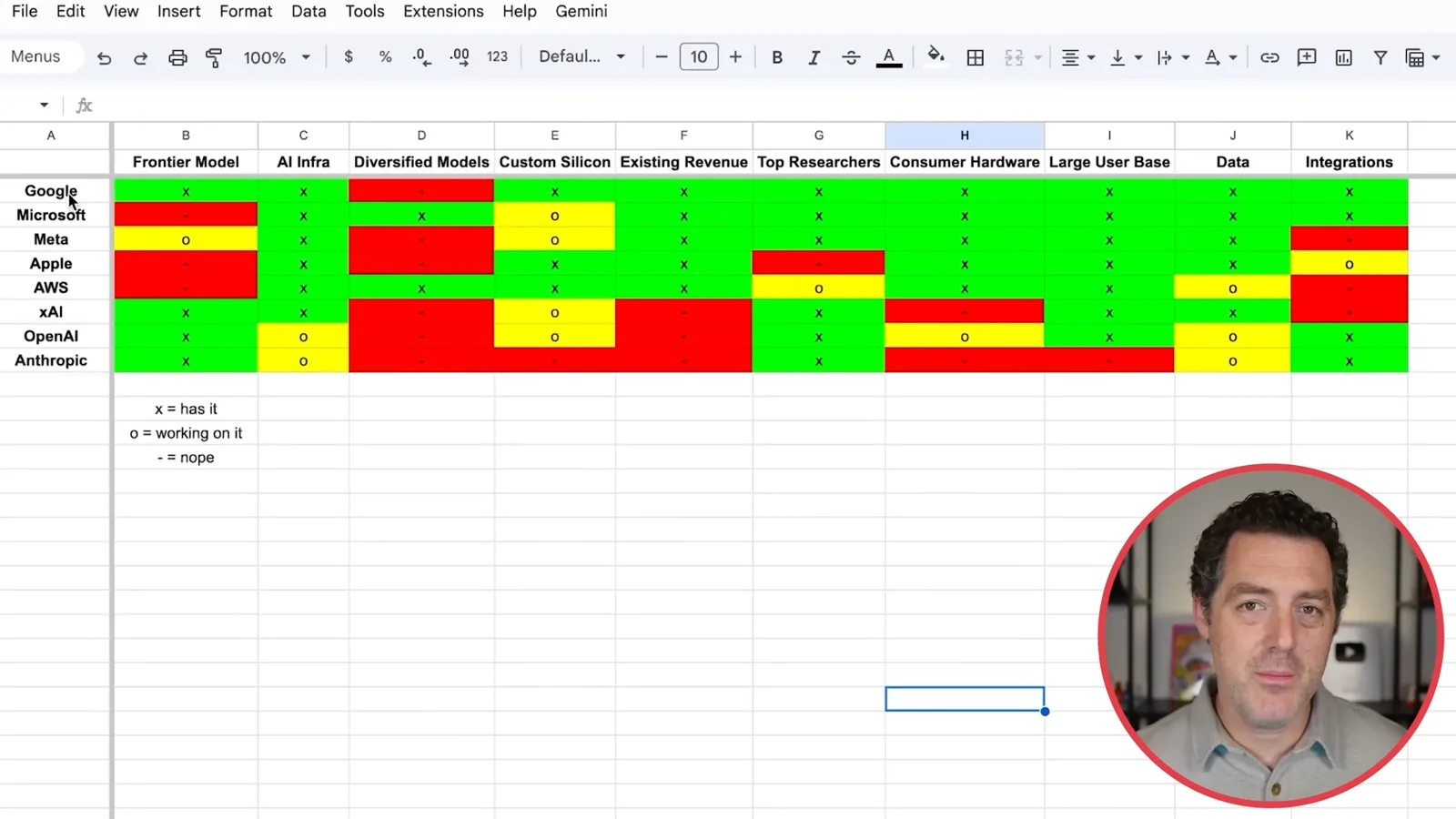
My scorecard compares Google, Microsoft, Meta, Apple, AWS, xAI, OpenAI and Anthropic. The criteria are frontier models, infrastructure, model diversity, custom silicon, existing revenue, researchers, consumer hardware, user base, data and product integration. Green means I think a company has a capability, yellow that it is working on it, and red that I do not see it; these are simplified judgments.
On frontier models, I rate Gemini 3 Pro alongside offerings from xAI, OpenAI and Anthropic. I mark Meta as working toward a stronger model and say Microsoft, Apple and AWS do not have a comparable frontier model in my assessment. Those ratings describe my view at recording time and do not mean the other companies have no AI models.
I count Google, Microsoft, Meta, AWS and xAI as having AI infrastructure, and include Apple because its chips run models locally and in its private cloud. I mark OpenAI and Anthropic as building out infrastructure. This is a simplified comparison of different kinds of capacity, rather than a detailed accounting of ownership or cloud access.
Infrastructure is capital intensive. I argue that established companies with diversified revenue and cash can make large AI investments while absorbing mistakes, whereas OpenAI and Anthropic face greater financing pressure. I cite Mark Zuckerberg’s willingness to invest heavily and his view that Meta could survive a wrong bet; my bankruptcy scenarios are risks I perceive, not established outcomes.
Models, chips and financing
Berman discusses the value of offering multiple models and developing custom silicon. He compares established revenue streams with funding needs at AI-focused companies.
Serving other companies’ models is another advantage. Enterprise customers may want to switch among models for price, efficiency or a particular task rather than rely on one provider. I highlight Microsoft and AWS as examples of platforms with broad model offerings, even though I do not rank their own models at the frontier.
Custom silicon can potentially improve efficiency, cost and latency by coordinating hardware and model workloads. I highlight Google’s established TPUs, Apple silicon and AWS Trainium, and say Microsoft and Meta are developing their own chips. My chart also marks xAI and OpenAI as working on chips, while I express uncertainty about Anthropic.
Existing revenue gives a company room to fund infrastructure even if AI investments take time to pay off. Google, Microsoft, Meta, Apple and Amazon have established businesses, while I see xAI, OpenAI and Anthropic as more dependent on financing for their buildouts. This comparison concerns diversified funding sources, not a claim that the AI companies have no revenue.
Hardware, users, data and integration
He assesses distribution through devices and products, the value of large user bases and potential data advantages. He also compares how firms integrate AI into services.
Top researchers are essential, in my view. I am uncertain about the specifics of Apple’s research team because the company is secretive, and I wonder how AWS is deploying its researchers. These are my impressions, not a comprehensive assessment of each company’s talent.
Consumer hardware could become a major interface for AI, whether through phones, glasses or earbuds. Google, Microsoft, Meta, Apple and Amazon already have devices or platforms; I note OpenAI’s work with Jony Ive on future hardware. Anthropic appears to me to be taking a different, enterprise-focused approach.
An existing user base provides distribution when a new AI feature launches. I point to Google Search, Microsoft products, Meta’s social platforms, Apple devices, Amazon customers, X and ChatGPT. I see Anthropic as more focused on enterprise than building the same sort of consumer audience.
I consider proprietary data another possible advantage, especially across Google Search, YouTube, Maps, Android and workspace products. Microsoft, Meta, Apple, Amazon and X also have data from their services. The existence of data does not establish that private user content may be used for training: permissions, privacy policies and technical access matter.
The final category is integration: turning models into useful features in products that consumers and businesses already use. I see Google and Microsoft as especially well placed to distribute AI through existing suites. I view Meta’s social focus as narrower, think Apple has more integration potential, and note that OpenAI and Anthropic must often connect to other companies’ products.
On balance I rank Google first. After recording, I learn that Google Cloud serves Anthropic models and revise my initial score for model diversity from red to yellow. That correction strengthens my assessment, but the categories and ratings remain my own rather than an objective ranking.
Rankings and chip competition
Berman updates his Google rating and explains his ranking. He closes by discussing reported Meta–Google chip talks and NVIDIA.
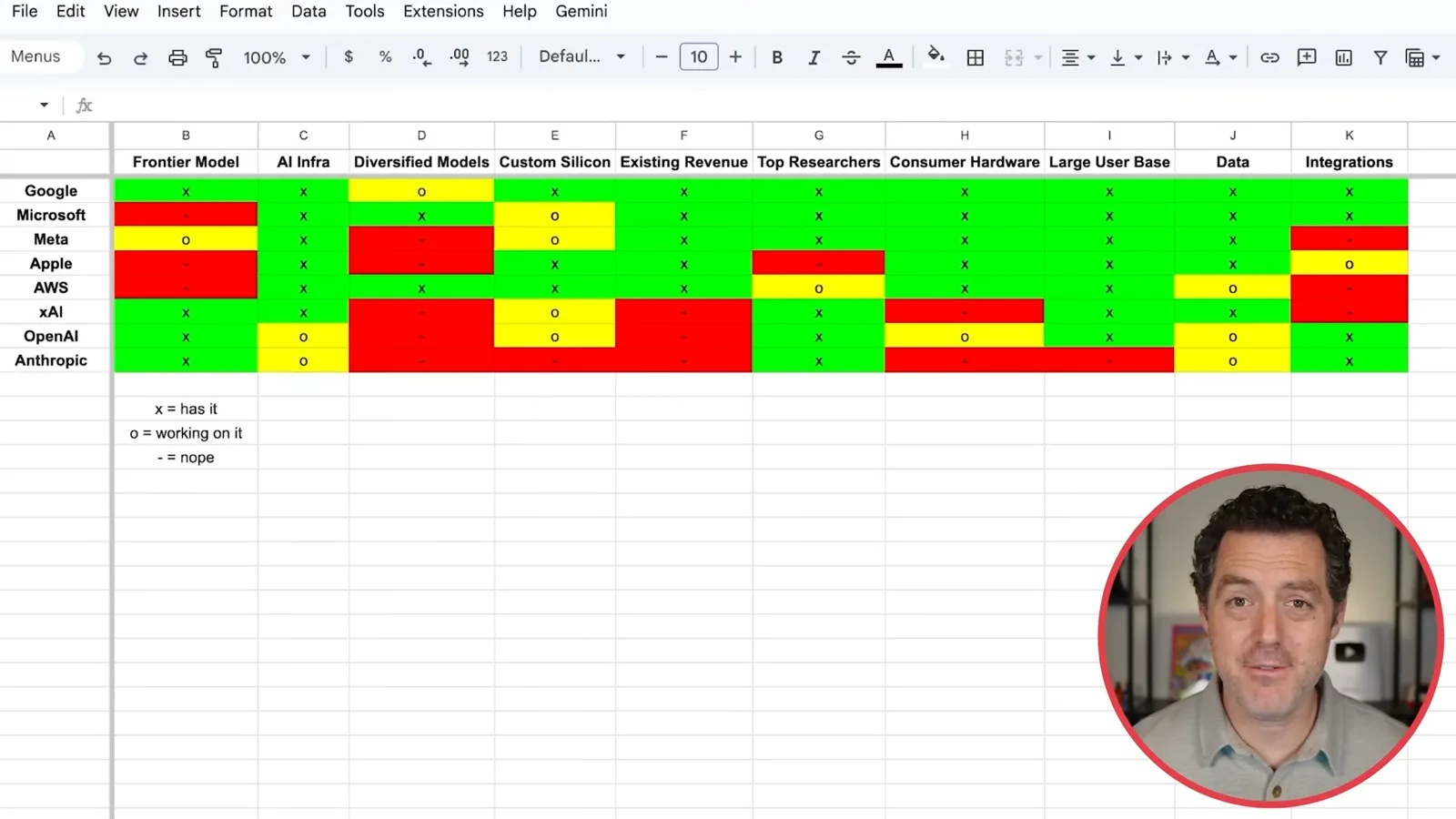
My case for Google combines a leading model, infrastructure, TPUs, existing revenue, researchers, devices, users, data and product integration. I rank Microsoft second because of its platform and model distribution, despite my view that it lacks a frontier model of its own. I also see opportunities for Meta and Apple if they improve their AI offerings.

Finally, reporting at the time says Meta is in advanced talks to spend billions on Google TPUs. I interpret potential purchases as a hedge against reliance on a single chip provider and a sign Google could compete with NVIDIA in more parts of the stack. The report describes discussions, not a completed deal; the strategic implications are my interpretation.
More from this channel
 34:21EN
 Matthew Berman· Oct 27, 2026Matthew Berman Examines Anthropic’s IPO Filing, AI Growth and GovernanceMatthew Berman, Sam Altman · Forward FutureThe presenter reviews the S-1’s financial metrics, compute strategy and voting structure while questioning the tension between rapid AI development and safety.
 0:26ENMatthew Berman· Oct 25, 2026Sam Altman on Human Values and Problem-Solving in an AI WorldSam Altman · OpenAIIn a short interview excerpt, Altman considers the enjoyment of solving hard problems and the human role in interpreting results.
 0:36ENMatthew Berman· Oct 25, 2026Kimi K3.1 and a Rubik’s Cube Solver DemonstrationMatthew Berman · Forward FutureMatthew Berman shows a scrambled virtual cube being solved and gives the Kimi K3.1 test a favorable assessment.
 0:21ENMatthew Berman· Oct 24, 2026An AI-Generated Kimi Benchmark Chart Used Invented ScoresMatthew Berman · Forward FutureMatthew Berman asks for a graph of Kimi K3.1 Pro benchmarks, then discovers that the displayed figures are illustrative placeholders.
 25:50ENMatthew Berman· Oct 24, 2026Kimi K3.1 Pro Tested: Strong 3D Demos, Uneven Results and Competitive PricingMatthew Berman · Forward FutureMatthew Berman tests the open-weight model on coding, 3D rendering and visual explanations, then compares benchmark results and prices.
 32:20ENMatthew Berman· Oct 23, 2026Who Is Local AI For? The Costs, Trade-offs and a Hybrid FutureMatthew Berman · Forward FutureMatthew Berman weighs data control and independence against hardware cost, setup complexity and inference speed.