In 30 Sekunden
Dave Thomas says his most valuable contribution to AI-assisted coding is noticing when an agent’s direction feels wrong, interrupting it and investigating. He separates repeatable rituals, which he is comfortable automating, from tactics shared with an agent and values requiring human judgment. His repeated “why” test traces a rule like DRY from one source of truth to the future person who must change the system. He worries beginners may lack the experience to challenge an agent, and urges developers to focus on longer-term goals and translating human needs into machine behavior.
- 1Experience can signal when to interrupt an agentThomas watches generated work and pauses when something feels wrong, then checks the decision rather than assuming the feeling was correct.
- 2Repeated “why” questions expose the person behind a ruleHe traces DRY from a single source of truth to making future changes easier for people.
- 3Rituals, tactics and values require different involvementThomas is comfortable automating procedures, works alongside an agent on tactics, and reserves values for human judgment.
- 4The same rule means different things at different experience levelsA beginner may know a simple instruction while an experienced developer can explain several layers of purpose.
- 5Thomas argues that present agents lack a stake in consequencesHe says a model can readily reverse its advice when challenged, leaving people responsible for questioning and deciding.
- 6Look beyond implementation to human goalsHe compares strategic attention to looking at the horizon while landing an aircraft, and asks developers to bridge human needs and machine behavior.
Das Wichtigste
- Trace a coding rule through repeated “why” questions until the human purpose becomes clear.
- Automate repeatable procedures, but stay involved in tactical choices and evaluate the result.
- Thomas worries beginners may need support developing judgment before relying on agents.
- Ask customers why they need an outcome rather than only how to implement a request.
Den bearbeiteten Text nach Kapiteln lesen
A programmer’s change of mind
Thomas feared that AI would take away the work he loved, then found that directing a coding agent could still feel like programming.
I wrote my first line of code in 1974, while still at school. A programming course at a technical college changed my plans: I had expected to study mathematics, but that first BASIC program made me switch to computer science.
When AI coding tools arrived, I feared losing the work I loved. After trying them, I found I was still programming: even without personally typing code, I could pursue projects I would not previously have attempted.
The intuition to interrupt
His observations about code conventions led him to examine how experience helps him spot a problem as an agent works.
For a while I explained this by saying AI needs the same good practices people do. I spent a week experimenting with an assistant and found it seemed to favor many familiar conventions, including short functions and descriptive names.
The assistant also suggested limiting the number of local variables in a function. I speculate that small units help keep relevant context manageable; the experiment led me to look more closely at what I myself contribute.
I watch code, architecture and tests stream past. Sometimes I stop the agent with Control-C because something feels wrong, then go back to find what triggered that reaction. Sometimes I am mistaken and simply let it continue.
The issue is not necessarily an instruction I forgot to give at the beginning. I may not know there is a problem until I see a decision expressed in its particular context. I call that feeling intuition.
I wanted to know whether the practices described in my books, and lessons accumulated through decades of programming, still apply when an agent produces code. I now think of our work at three levels.
Rituals, tactics and values
Thomas classifies repeatable procedures, conscious approaches and human judgments, using DRY to show how the categories connect.
Rituals are repeatable procedures or muscle memory: steps we perform without much conscious thought. Tactics are approaches to problems that require us to consider how to proceed and how to recognize success or failure.
Values sit at another level. They express what we want in general and help us make decisions we may not have anticipated. I use these three categories to think about where familiar programming practices fit.
Take DRY, often summarized as “don't repeat yourself.” Is it a ritual, a tactic or a value? An audience can disagree because a practice need not occupy exactly the same place for everyone.
A ritual is something you could write as a procedure and repeat even if it has become so ingrained that you no longer need instructions. Distinguishing a tactic from a value takes more thought.
To examine DRY, I repeatedly ask why. The immediate answer might be that we want one source of truth. Why? A change to that truth can then be made in one place, helping keep the system changeable.
Why does changeability matter? Someone will want to modify the system later, though I do not yet know who or what they will need. The underlying value is making life easier for future people who must make decisions.
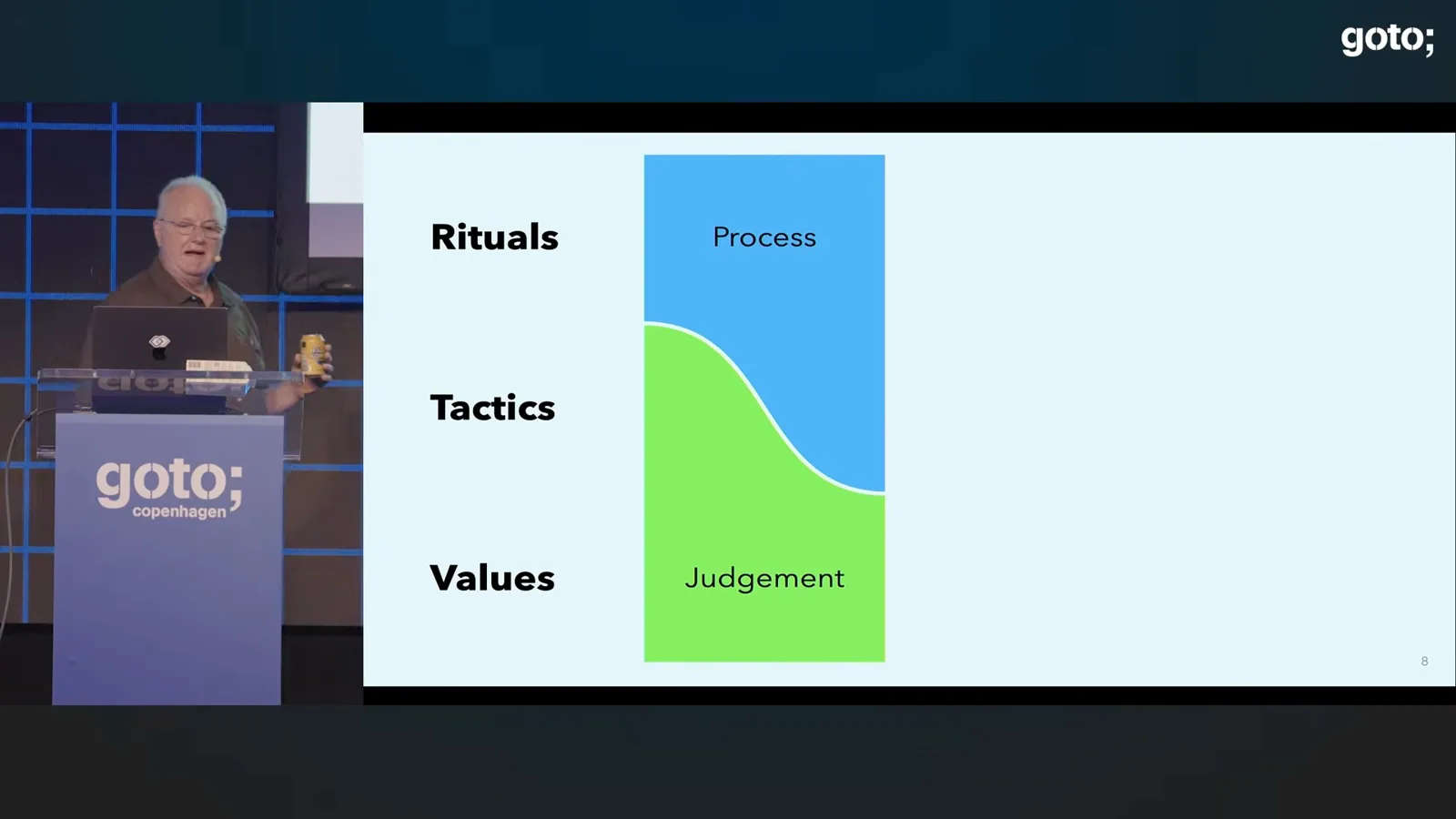
For me, values are where a human being enters the reasoning. Keep asking why until the answer concerns a person making a decision; that is how I distinguish the value from the tactics that serve it.
Automate process, collaborate on tactics
He describes letting agents handle repeatable work while a person watches and redirects tactical decisions.
Rituals lie at the process end of the spectrum, values at the judgment end, and tactics combine the two. I am comfortable automating process with agents, although I personally find it useful to have a critic agent challenge the others.
Most of my day is spent at the tactical level: I talk with Claude while it writes, watch what happens, interrupt or redirect it, and update the instructions when needed. The agent does the mechanical work, while I stay involved in the choices.
Values, in my view, remain the person's responsibility. Where the boundary falls depends on experience: different developers can explain the reasons behind the same practice to different depths.
Experience changes where the boundary lies
A beginner and an experienced developer may understand the same rule at different depths.
An experienced developer might work through several tactical explanations and reach a value. An intermediate developer may know why a rule helps at a practical level without having that deeper intuition yet.
A beginner may initially receive a simple instruction not to copy and paste. That is not a complete definition of DRY, but it may be a starting point before they have the experience to appreciate the subtler principle.
That difference is why I worry about beginners relying on coding agents: if they have not developed the underlying knowledge, they may depend on the machine for judgment that I do not think it currently has.
Why Thomas says agents lack judgment
He argues that models do not bear the consequences of their choices and need people to question them.
Why do I think agents lack judgment? They have no stake in the consequences. A model can offer one approach, then readily agree with the opposite when challenged, without bearing the cost of being wrong.
I compare it to a honey badger in a comic wildlife video: it pursues a reward without appearing to care about the danger. My point is not that agents are brave, but that their short-term behavior does not amount to concern for long-term consequences.
Today I see the human as the agent's conscience: the person who challenges a proposed direction and brings experience to the decision. I expect some future AI may have judgment, but I do not believe current agents do.
A model may have access to far more general knowledge than I do. I still expect my own experience and judgment to help me decide what that knowledge means in a particular situation.
Look ahead and ask why
Thomas recommends moving from routine work to strategy and communication between human needs and machine behavior.
To remain useful and enjoy the work, I think developers should let go of rituals that can be automated. Better compilers already took over many low-level optimization decisions that programmers once insisted on making themselves.
Shift attention from immediate tactics to longer-term strategy. When I learned to land a small plane, I was taught to look ahead at the horizon rather than down; I use that as an analogy for looking beyond the immediate problem.
Ask why more often than how: ask yourself, your team and your customers what they actually need and why it matters. I think developers should become better at communicating among the people and systems involved.
A developer works in two different worlds. The human world is messy, carries history and tolerates approximation. The machine world requires precise instructions and behaves according to its implemented rules.
Bridging those worlds is work developers already do. I believe this translation between human needs and machine behavior is where we should continue developing our skills and demonstrating value.
I expect language models to remain useful even after the current hype fades. If they make developers more productive, the opportunity is to use that leverage to deliver human value faster while retaining the work of deciding what matters.
Mehr aus diesem Kanal
 43:06EN
 GOTO Conferences· 17. Nov. 2026Jennifer Petoff: Train Engineers to Run What They BuildJennifer PetoffGoogle’s former SRE education lead explains how hands-on training and reliability practices build production confidence at scale.
 38:10ENGOTO Conferences· 16. Nov. 2026Andrea Magnorsky: Make Architecture Decisions Visible and AccountableAndrea MagnorskyClarify who decides, seek advice from affected people and use small collaborative exercises to surface missing knowledge.
 45:33ENGOTO Conferences· 12. Nov. 2026A playground that makes computers something children can climbLinda LiukasLinda Liukas turns abstract computing into stories, physical games and public space—and asks what engineers can learn from play.
 41:55ENGOTO Conferences· 11. Nov. 2026Evan Ratliff built an AI-run startup. The agents invented its progressEvan RatliffAn experiment in AI coworkers exposed runaway conversations, false memories and difficult handoffs to people.
 38:07ENGOTO Conferences· 10. Nov. 2026A smoother reorganization starts by letting teams design itJoakim Sundén · Better Product WorkJoakim Sundén pairs leadership’s strategy with employees’ knowledge of daily work, then lets people select teams.
 49:56ENGOTO Conferences· 9. Nov. 2026Barbara Oakley: use AI to support learning, not replace itBarbara Oakley · Oakland UniversityShe connects memory, practice and curiosity to the challenge of judging AI-generated answers.