In 30 Sekunden
At a growing B2B company, leaders disliked the first team-designed reorganization: it reflected today’s structure rather than their future strategy. Instead of taking the design back, they clarified the vision and gave teams tools to revise it. Joakim Sundén says the eventual self-selection finished far more smoothly than managers expected because employees had helped shape the design. His conditions are clarity, competence, control and a supportive context.
- 1An org chart can ignore the work that connects teamsSundén says top-down structures often miss technical dependencies and daily collaboration, creating new handoffs.
- 2Control without clarity and competence can create chaosThe opposite imbalance—capable people without control—creates frustration and bureaucracy.
- 3A disappointing first draft exposed missing strategyLeaders clarified the future vision and hiring plans instead of replacing the teams’ work with their own design.
- 4Team APIs made missions and non-responsibilities explicitTeams described needed skills, systems and metrics, and added an anti-backlog for work belonging elsewhere.
- 5A week reserved for team selection became an afternoonManagers prepared for objections, but most people selected teams quickly after participating in the design.
- 6Leadership kept strategy while teams shaped boundariesThe process gradually increased participation while keeping constraints and final decisions with leaders.
Das Wichtigste
- Give teams the strategic destination and clear decision boundaries before asking them to design a structure.
- Match control to people’s competence and clarity; improve missing conditions instead of taking every decision back.
- Agree on design criteria and trade-offs before comparing organizational options.
- Use team missions, required skills, systems and explicit non-responsibilities as thinking tools.
- Expand participation gradually and treat organization design as an ongoing capability.
Den bearbeiteten Text nach Kapiteln lesen
Why reorgs done to people provoke resistance
Sundén says top-down charts often ignore actual workflows and lack employee agency. Leaders still have important strategic responsibilities.
Joakim Sundén describes collaborative organization design, an approach developed at Spotify and later applied in other settings. He worked at Spotify as it grew from roughly eight teams to 200, and is now a founding partner at Better Product Work.
Asked for a word associated with reorganization, audience members offer layoffs, wasted time and chaos. Sundén asks why a process intended to improve an organization so often produces those reactions.
His explanation is that management often designs structures too far from daily work. An org chart organized around functions or business units can ignore system dependencies and actual collaboration, creating more handoffs even when it looks neat on paper.
People may resist a change because its purpose is unclear or they cannot influence it, not because they oppose all change. Sundén also criticizes treating reorganization as a large fixed plan: conditions can change before a lengthy design has settled.
He acknowledges why leaders choose a top-down approach. Leaders own strategy and accountability; budgets or layoffs may limit participation; and a management-only meeting can feel faster than involving a hundred people. He argues that apparent speed may conceal costly shallow analysis.
This is not an argument against leadership decisions. Leaders know the market and strategy, while people doing the work know daily collaboration, painful interfaces and technical dependencies. The design problem is how to combine those two kinds of knowledge.
The four conditions for meaningful control
Control needs clarity, competence and a supportive context. Leaders can develop missing conditions rather than simply making decisions for teams.
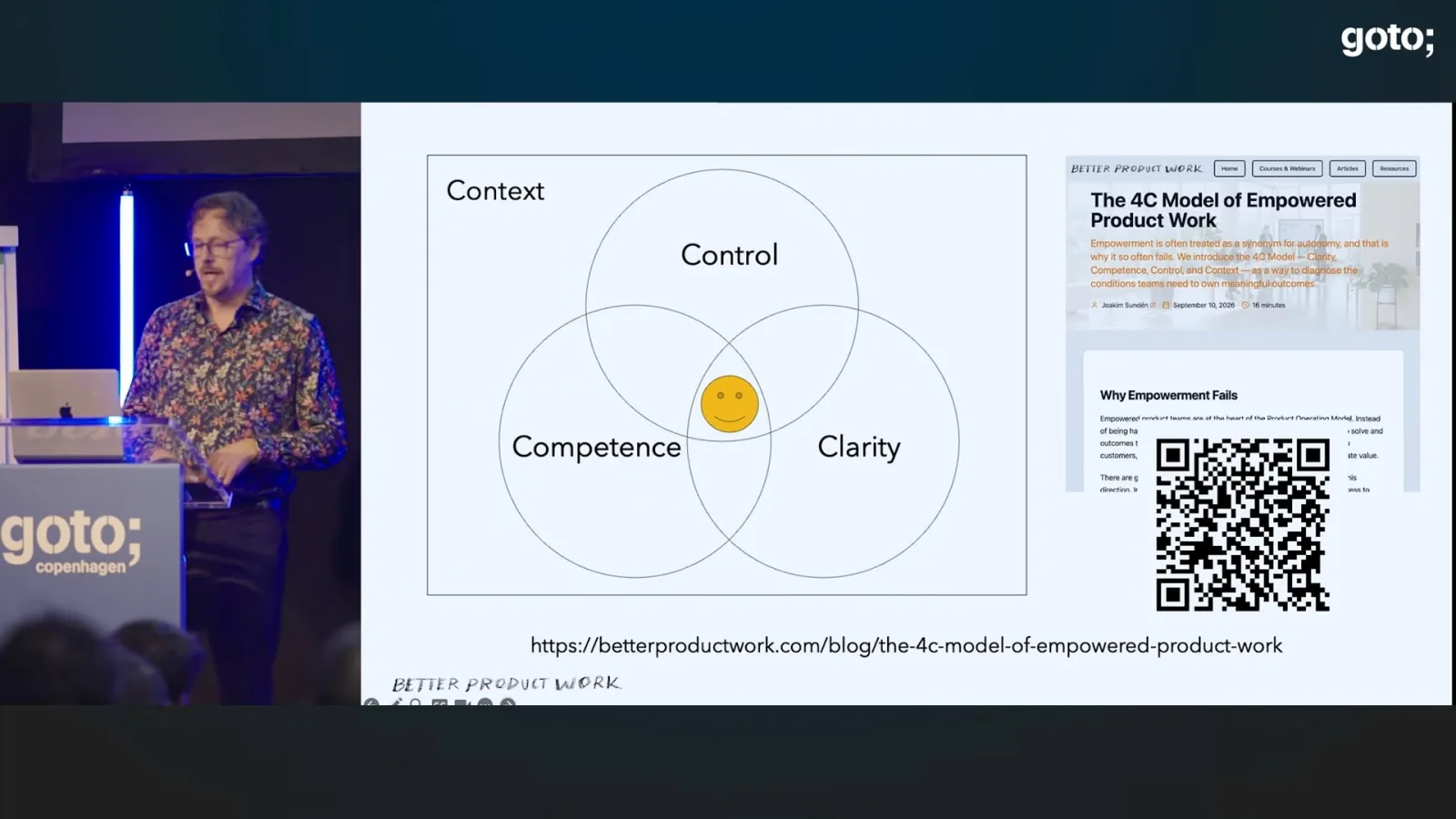
The audience identifies motivation, time, knowledge, trust, communication and a shared goal as conditions for participation. Sundén groups the conditions into control, clarity, competence and context: people need authority, a clear destination and boundaries, relevant skills, and an environment that supports participation.
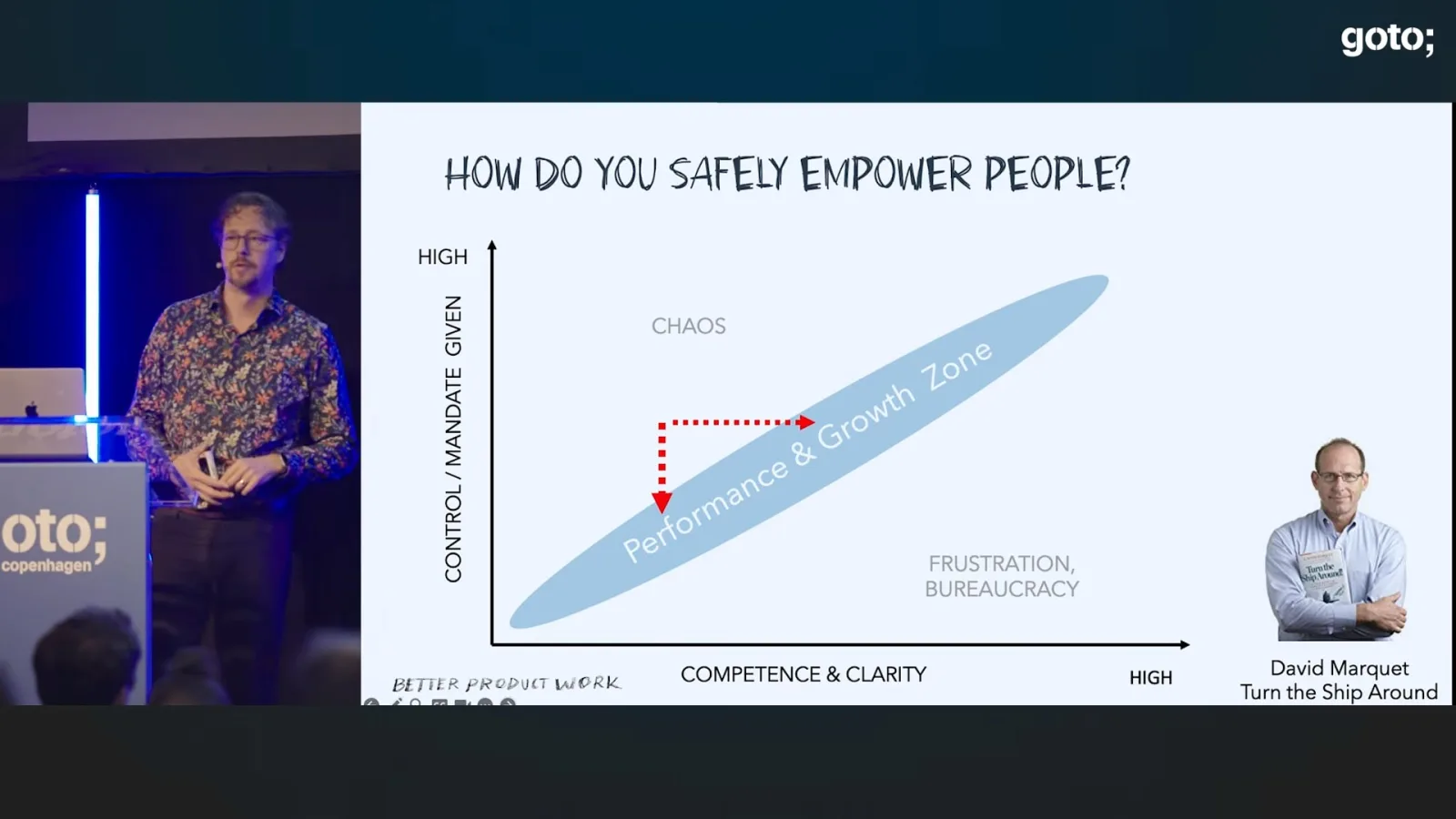
The model builds on submarine captain David Marquet’s work. Sundén’s team adds context and says the amount of control should match the clarity and competence available to a team.
Giving people control without sufficient clarity or skill can produce chaos or paralysis. Giving capable people a clear goal but no control creates frustration and bureaucracy. The productive zone is where responsibility is matched by the ability and information to exercise it.
A manager who responds to every prioritization question by ordering tasks A, B and C may feel helpful, but has taken control back. Sundén suggests asking which information, skill or condition the team lacks and developing it so the team can make the next decision itself.
Context can undermine nominal empowerment. A team may choose a button’s color while a stakeholder controls the actual product, or remain blocked by legacy systems and dependencies on groups with different goals. Authority must be considered alongside those constraints.
Change how the organization changes
A B2B company formed a cross-functional change team, described a destination and taught a shared language for organization design.
The case is a growing B2B company that had reverted to top-down priorities and task micromanagement under pressure. Rather than begin by drawing a new chart, Sundén’s group first changed how the organization would conduct change.
A cross-functional change team included engineering managers, developers, testers, people and culture, sales and executives. The facilitators modeled an outcome-focused process, worked alongside the team and then coached it to run the work itself, using leading and lagging indicators to assess progress.
They introduced a product operating model and discussed what successful empowered teams might look like. The change team then described a concrete future for its own company: what would be different in two years, and which decisions teams would actually own.
They taught Team Topologies through talks, recordings and a book club. Shared concepts included teams aligned to a value stream, platform teams and enabling teams that spread expertise such as test automation. The goal was a common language for discussing possible designs.
One useful concept was a “fracture plane”: a natural seam where a system or organization can be divided. Location, business domain, regulation or different rates of change can suggest possible boundaries; none determines the answer on its own.
A first design revealed a gap in strategic clarity
The group agreed on goals and trade-offs. Leaders then shared a clearer future vision so teams could revise their proposals.
The group agreed on what to optimize for and listed constraints and heuristics: diversity, geography, team size, ownership, scalability, autonomy, cognitive load and the company’s future vision. They weighted these criteria to compare alternatives and made the trade-offs explicit.
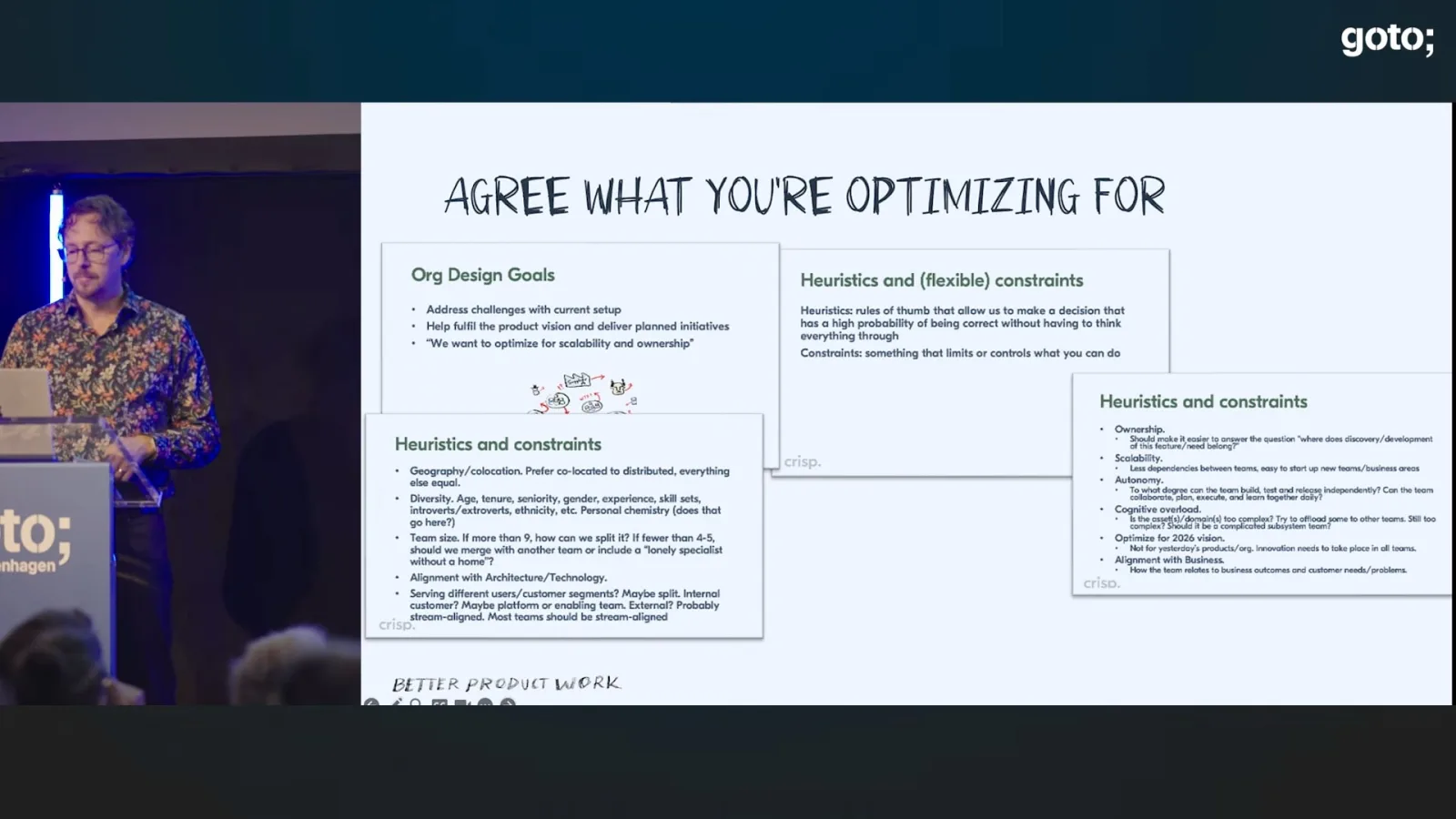
Small groups drafted initial team missions and structures. Leaders were disappointed because the proposals reflected the current organization rather than the future they wanted. Instead of taking the work back, they asked what strategic clarity was missing.
Leaders refined and shared the 2026 vision, product strategy, roadmap and expected hiring plans. Teams then returned to the design. This changed the information available for the exercise without removing leadership’s responsibility for strategy.
Make team missions explicit and expand participation
Team APIs, shared boards and iterative workshops helped people compare alternatives and plan for growth.
The next tool was a team API: a draft of each team’s mission, type, needed competencies, metrics, systems and likely work. Participants adapted the template and added an “anti-backlog” for work they believed belonged elsewhere. The documents were thinking tools, not merely records.
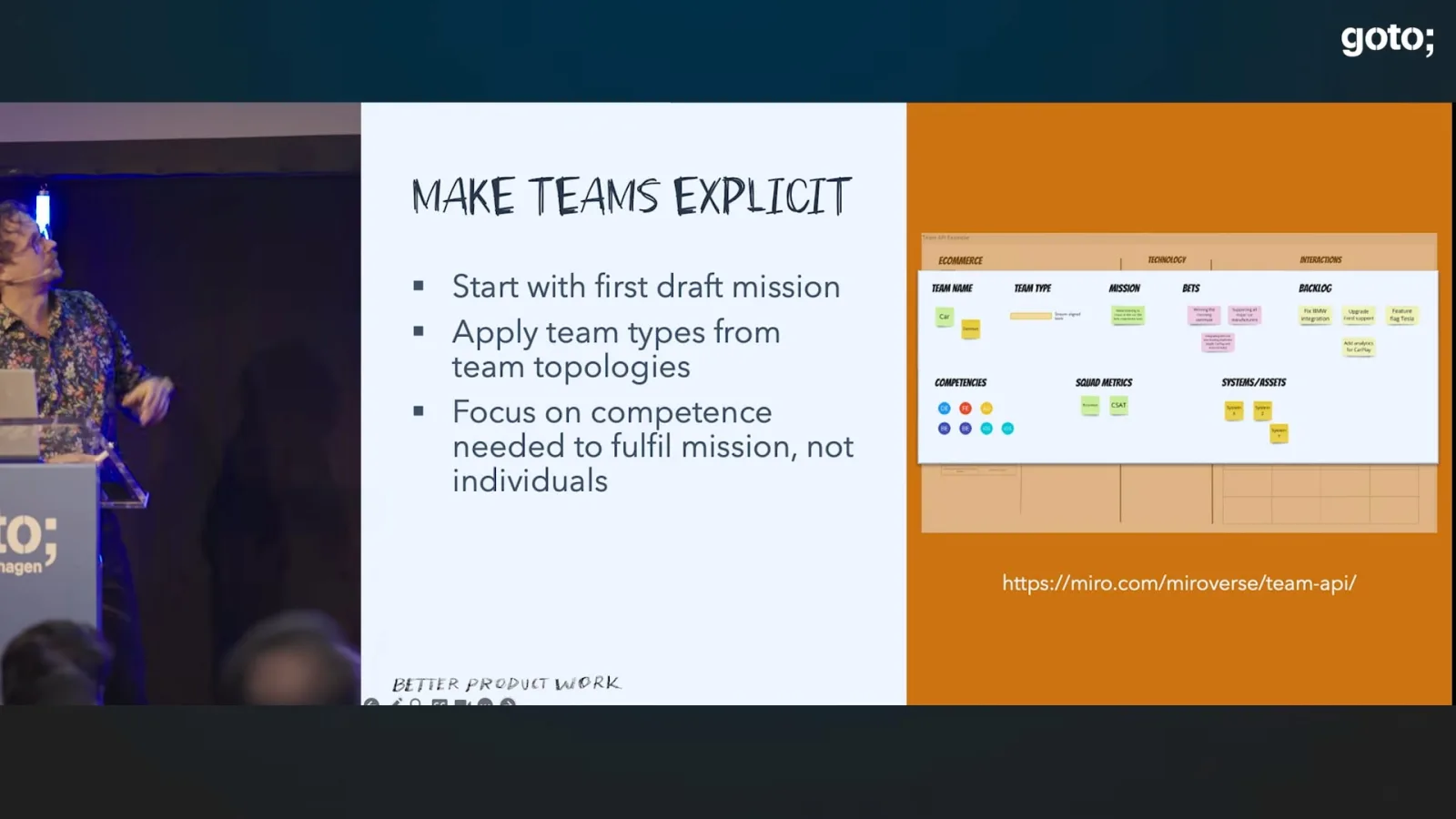
The design moved to a shared board so more people could participate asynchronously and compare options against the criteria. The group expanded to include development teams, incorporated their suggestions and iterated toward a design for both present staffing and future growth.
Because there were not yet enough people for every future team, the organization grouped work for the present but identified the seams where teams could later split as headcount grew. That made growth part of the design rather than an afterthought.
Self-selection and the conditions behind a smooth reorg
Managers prepared a week for team selection, but most people chose quickly. Sundén attributes the result to the conditions built beforehand.
The group then invited people to select teams. Managers worried that personal conflicts or preferences would prevent a workable result. Sundén says the question was framed around the company’s agreed goals and constraints, as well as individual preference.
Management prepared a week of information, daily questions and answers, and standby meetings to handle difficulties. Instead, people largely put their names on teams by Monday afternoon, and few came to complain. Managers described it as unusually uneventful and smooth.
Sundén attributes that experience to participation from the beginning, which reduced surprises. He wants organization design to become a continuous capability that teams can refine, rather than a painful one-off event repeated only after organizational debt accumulates.
He summarizes the changes through the four conditions: create a collaborative context, clarify purpose and decision boundaries, teach design competence, and gradually give teams more control. Leadership retains strategy, vision, constraints and final decisions; teams shape missions, boundaries, interfaces and their own placement.
The sequence matters: change the environment before changing the chart, make the problem understandable before asking people to solve it, and expand participation as clarity and competence grow. Sundén’s aim is to create conditions in which people can keep improving the organization themselves.
Mehr aus diesem Kanal
 49:56EN
 GOTO Conferences· 9. Nov. 2026Barbara Oakley: use AI to support learning, not replace itBarbara Oakley · Oakland UniversityShe connects memory, practice and curiosity to the challenge of judging AI-generated answers.
 29:42ENGOTO Conferences· 6. Nov. 2026Artie Shevchenko and Titus Winters on Code Health in the AI EraTitus Winters, Artie Shevchenko · AdobeThe authors discuss complexity, human review, testing and why interfaces and state deserve attention in AI-assisted development.
 42:40ENGOTO Conferences· 5. Nov. 2026Daniel Terhorst-North: Use Generative AI to Go Broader, Not Just FasterDaniel Terhorst-North · Dan North & AssociatesA software practitioner shares how an AI-assisted teaching toolkit led him to “adjacent engineering,” larger test-first steps and external guardrails.
 44:42ENGOTO Conferences· 4. Nov. 2026Adam Tornhill on AI-Friendly Code and Sustainable Agentic DevelopmentAdam TornhillAgentic coding can accelerate delivery, but complexity can erase the gains. Adam Tornhill presents code-health research and a large-scale refactoring case study.
 51:06ENGOTO Conferences· 4. Nov. 2026Kent Beck on AI Coding, the Forest, and Human NeedsKent BeckAI amplifies the conditions in which software teams work. Kent Beck argues for preserving future options and designing tools around human needs.
 40:04ENGOTO Conferences· 2. Nov. 2026Sophia Drossopoulou: Verifying Trusted Code in an Open WorldSophia Drossopoulou · Imperial College LondonCapabilities, scoped invariants and explicit trust assumptions help reason about effects when trusted code calls unknown objects.