In 30 Sekunden
Software architecture decisions depend on two resources: knowledge of the system and the power to change it. Consultant Andrea Magnorsky recommends making the actual decision process explicit, including who is responsible and whose expertise is needed. Her advice process lets people decide after consulting those affected, while decision records preserve options and reasoning. Short shared-diagramming sessions and maps of knowledge and influence can expose disagreements before a team commits.
- 1A decision needs both knowledge and the ability to make changeBeyond selecting an option, a team must understand the problem and constraints, coordinate people, implement the choice and obtain the right feedback.
- 2Power can be exercised with others or over themMagnorsky distinguishes initiating change collaboratively from using authority to direct others, and suggests reconsidering which approach a situation calls for.
- 3Knowledge must flow, not merely be storedShe argues that transfer between people and systems helps organizations act and innovate, while documentation alone cannot replace the understanding of people close to a program.
- 4Map the real decision process before redesigning itShe proposes a roughly 90-minute session with involved people to identify what works, what fails and who actually decides, then make the selected process explicit.
- 5Deciders should seek advice rather than permissionIn an architecture advice process, a person can decide after consulting people affected and those with expertise. A decision record documents the options, reasoning and advice.
- 6Independent sketches expose different models of the same systemIn her time-boxed collaborative sessions, participants first draw alone, then explain their diagrams, converge on one view and reflect on what they learned.
- 7Map knowledge and influence for one concrete decisionA key-people map helps identify who understands the issue and who can effect change, so participants can connect people and improve the decision.
Das Wichtigste
- Make the current decision process and responsibility explicit before choosing a new one.
- Seek advice from affected people and relevant experts before deciding; advice is not permission.
- Record the options, chosen alternative and reasoning in a concise architecture decision record.
- Use independent sketches and a shared diagram to surface different understandings of a system.
- Map people’s knowledge and ability to influence a specific decision, then connect those who need to learn from each other.
Den bearbeiteten Text nach Kapiteln lesen
The ingredients of an architecture decision
Making a choice requires more than picking an option. Magnorsky uses acquisition, a shared library replacement and delivery pressure to expose the knowledge and coordination involved.
Architectural decisions eventually make up a software system. I want to ask how we find the options for an important decision, choose between them and validate that the result actually solves the original problem.
Across the different contexts in my career, I have repeatedly been surprised by how decisions unfold. Some turn into unexpected choices or involve power dynamics that leave people unsettled. One way to see an architectural decision is as a record of the power structures and feedback loops that produced it.
Imagine an acquisition from either side. People face uncertainty and anxiety, and even familiar terms can mean different things in the two organizations. Before making a decision, the participants need a shared vocabulary and a way to coordinate their work.
Now imagine replacing a critical library used by 25 teams, each with slightly different needs. Or consider an environment where everyone is told to build quickly, is on call for failures and has a performance review tied to the outcome. Those pressures influence decisions now and their consequences months later.
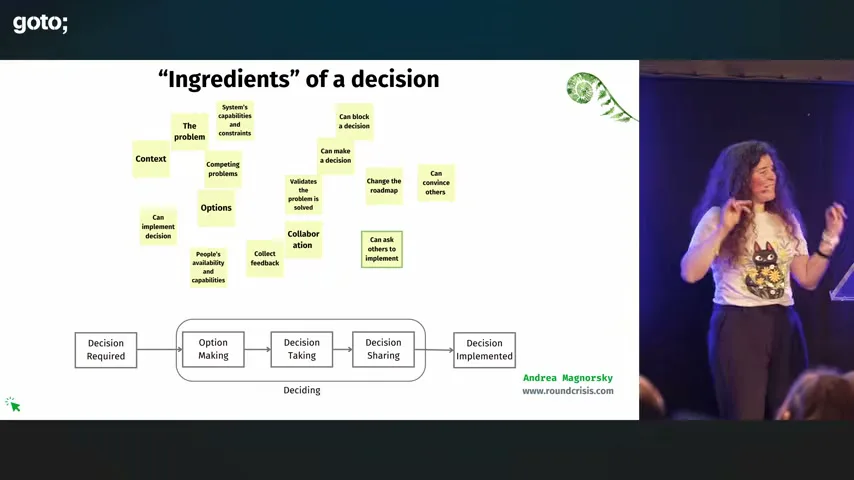
A decision begins with a problem, followed by possible options, a choice, communication and implementation. It helps to list what must be present across that sequence instead of treating the moment of choosing as the entire process.
The ingredients include context, system capabilities and constraints, and agreement among the people involved about what the problem is. We also need to understand competing problems and whether the proposed choice can actually be implemented.
Feedback is not just something to collect at random: decide what feedback is needed, from whom and when. Knowing the options also means knowing who has the necessary skills and whether they are available, as well as who needs to collaborate.
We need to know how to validate that a problem has been solved. We may also need to change a roadmap, block another choice, persuade colleagues or ask people to implement something. These ingredients fall broadly into knowing something and being able to change something: knowledge and power.
Power shapes who can make change
She distinguishes collaborative power from power over others and examines authority, charisma and access to knowledge. Power changes and exists throughout an organization.
As a software architecture consultant, I see organizations balance knowledge and power differently, and the balance varies even between decisions in the same organization. I initially felt uncomfortable studying power because advice on the subject often seemed to be about manipulating others.
But power exists whether we acknowledge it or not. Understanding it can help people be effective, be taken seriously and avoid being taken advantage of. I use two definitions as a starting point rather than claiming these are the only useful ones.
“Power with” is the ability to initiate change together with others. “Power over” is the ability to make someone do what you want, as may happen through a position of authority. Looking back at recent choices, ask which form you used and what might happen if you tried the other.
One source of power is authority. In organizations it can operate through economic consequences, such as control over promotion or bonuses, and through institutional processes. We tend to recognize authority because we can feel its effects.
Charisma is another source. I describe it in terms of influence and affability: someone can shape others’ behavior, and they can also put people at ease. People may be influenced by someone they like or dislike, and that influence can affect technical choices.
Knowledge itself can confer power, especially deep expertise. Asymmetry matters too: one person may know more and choose not to share it, or a leader may be unable to disclose certain information. Either situation can change an architectural decision.
Power is dynamic; whatever the present balance, it can change. I also think of power as water and the organization as a sponge: it exists throughout the organization, not solely at the top, and it can lead to more power.
When someone says they do not play politics, they may effectively hand their influence to someone else, often someone who already has more of it. Recognizing your own capacity to act is part of changing that dynamic.
Knowledge becomes useful when it flows
The data-to-wisdom model helps identify missing experience. She argues that sharing knowledge and maintaining contact with a system matter alongside documentation.
A data-information-knowledge-wisdom pyramid offers one way to think about what a decision needs. Data begins as facts without context; information adds meaning, knowledge adds experience, and wisdom reflects more extensive experience of what happens under different conditions.
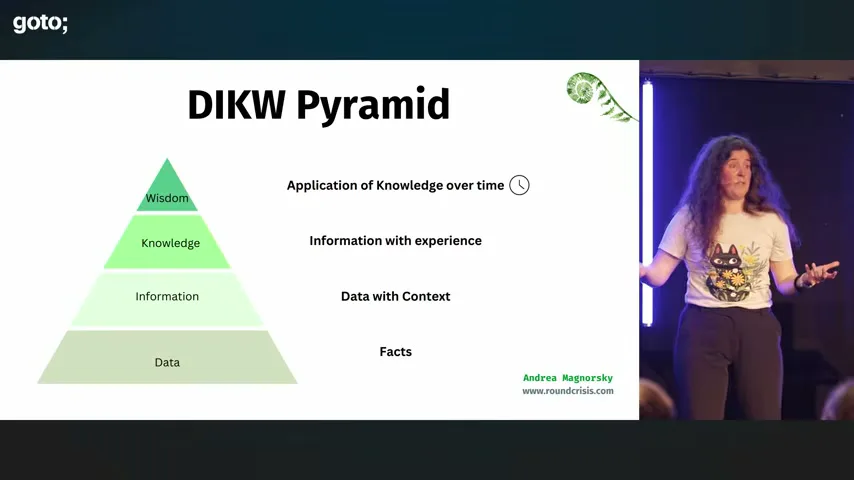
Before deciding, ask where your own understanding sits in that pyramid. If you lack experience with the situation, can you find someone who has it? Through a systems-thinking lens, wisdom includes finding a leverage point where a small change can shift the wider system.
Knowledge workers produce code and other artifacts, but our work also consists of thinking. We often value the knowledge a person holds, or knowledge stock, yet give less attention to knowledge flow: moving understanding between people and systems so that behavior can change.
I see knowledge flow as important to effectiveness and innovation. An older paper I return to also argues that documentation alone is insufficient: large programs depend on people with a particular kind of knowledge gained by remaining closely connected to them.
Make responsibility and the decision process explicit
Teams can inspect how decisions currently happen, choose a process and record options and reasoning. Explicit ownership creates opportunities to learn tradeoffs.
When I ask organizations how they make decisions, the answer is often unclear: sometimes a CTO decides, sometimes everyone agrees, and sometimes the matter is deferred. Rough consensus without responsibility can leave nobody accountable and deprive people of the chance to practice tradeoffs.
Start by making the current process visible. Invite the people involved to a session of about 90 minutes and ask how decisions actually happen, what works and what does not. Use that information to choose a process and say explicitly who decides.
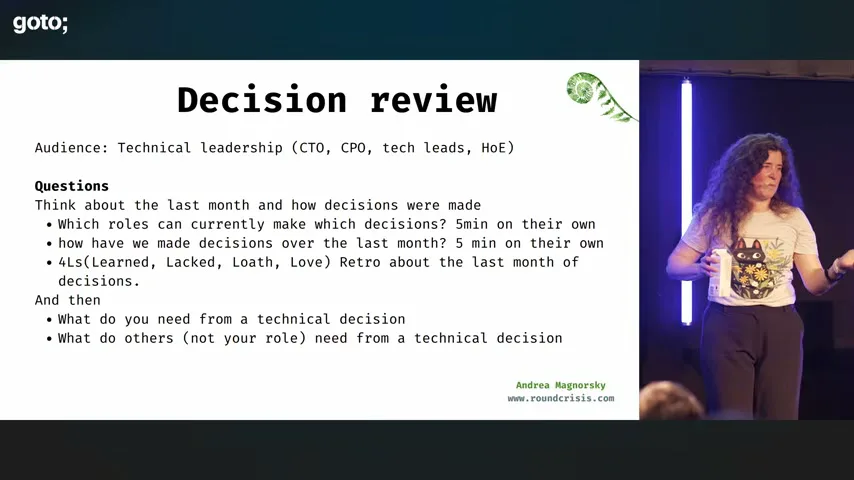
The process could be highly decentralized or decisions could remain with a CTO, with many options between. Either way, clarity makes responsibility and tradeoffs easier to discuss. An architecture decision record can then capture the options, the choice and why it was made.
Group practices for advice and architectural learning
Team Topologies and the advice process offer ways to coordinate decisions. Her time-boxed architecture sessions help groups draw and reconcile their understanding.
For larger groups, Team Topologies offers a model for organizing teams and their interactions. The aim is to improve the flow of work, reducing handoffs that leave one team unable to see or deliver a change through to the end.
The architecture advice process takes another approach: anyone can make a decision, but first must seek advice from everyone affected and from people with relevant expertise. The request is for advice, not permission.
In my experience, people often expect that approach to create reckless decisions. Instead, it can feel chaotic because participants realize their names and decisions will be recorded and that they must live with the possibility of being wrong. The practice needs support and can start with one interested team.
An organization can also distribute all the preparation while reserving the final decision to a smaller group. Teams still practice comparing options and making tradeoffs. I see centralization and decentralization as a polarity to manage rather than a problem solved once and for all.
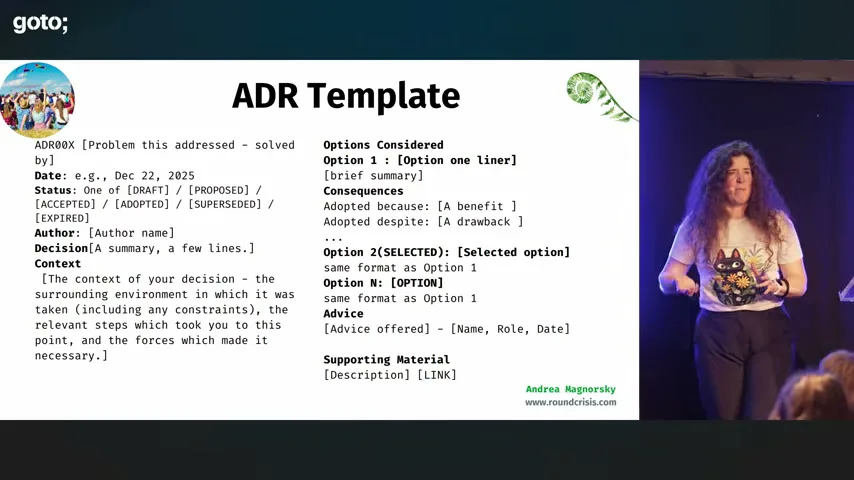
A decision record is a short written record that is not changed after acceptance. A template can include options, the choice, reasons and advice offered, with the contributor’s name and date. The decider may still choose differently after considering that advice.
Groups also need a regular place to learn about their system together. I created Bytesize Architecture Sessions as time-boxed workshops for collaborative design rather than a large one-off architecture exercise.
For an initial session, participants might draw a high-level C4 system-context diagram. First, everyone spends five minutes drawing independently. Each person then explains their diagram while the others listen.
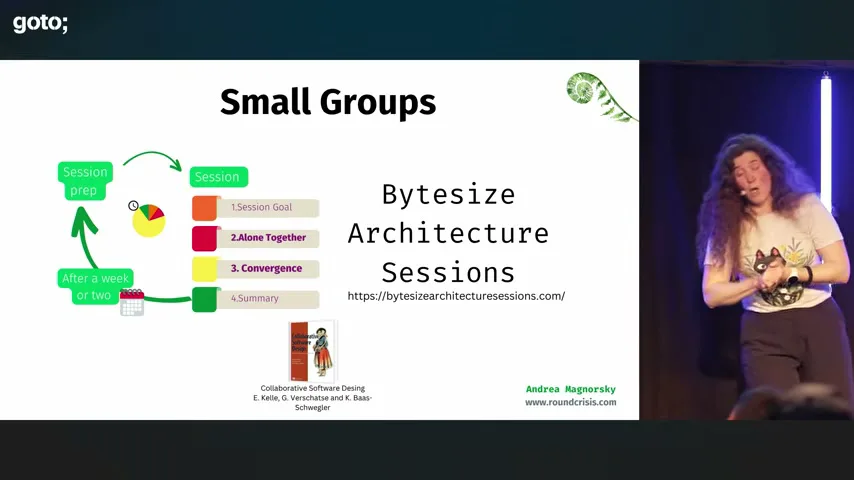
The group then works toward one shared diagram incorporating the different perspectives. The work is time-boxed; finishing the diagram is not required. A short retrospective closes the hour and asks what people learned. Teams new to the practice can meet weekly for a while, then adjust the cadence.
Personal tools for difficult conversations
The left-hand column separates observable events from private interpretations. A knowledge-and-power map helps identify who can contribute or make change for a specific decision.
The left-hand column is an individual reflection tool for a difficult conversation. On the right, write observable events and what was said; on the left, write your private interpretations and feelings. The contrast gives you a chance to question whether you have misread the other person.
A key-people knowledge-and-power map is another personal tool. For one specific decision, plot the people involved according to what they know and their ability to make change. Expertise does not always follow job title, and information may be out of date or wrong.
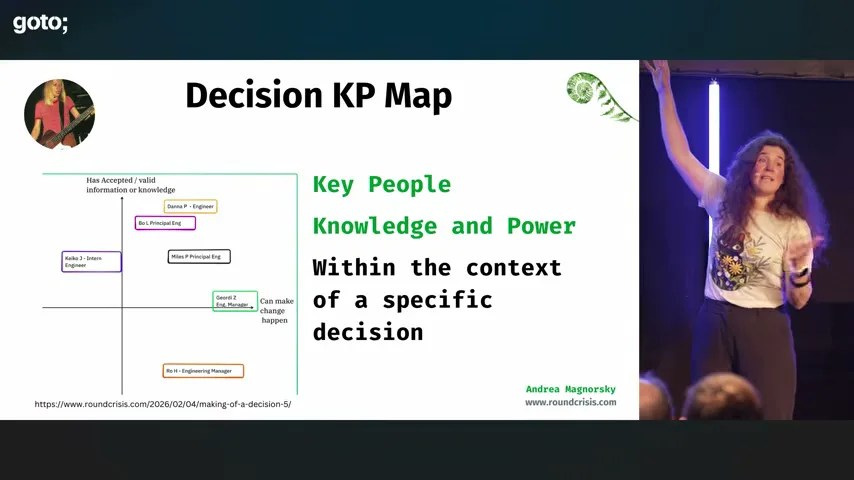
Use the map to plan an intervention. For example, connect a knowledgeable person with a colleague whose information needs updating. That conversation can change their understanding and influence, as well as the influence of the person who brought them together.
The map is your assessment, not a definitive picture of the organization. Alongside conversation exercises, shared design sessions and written decisions, it helps you examine how knowledge and power shape the choices you make.
Mehr aus diesem Kanal
 43:06EN
 GOTO Conferences· 17. Nov. 2026Jennifer Petoff: Train Engineers to Run What They BuildJennifer PetoffGoogle’s former SRE education lead explains how hands-on training and reliability practices build production confidence at scale.
 45:33ENGOTO Conferences· 12. Nov. 2026A playground that makes computers something children can climbLinda LiukasLinda Liukas turns abstract computing into stories, physical games and public space—and asks what engineers can learn from play.
 41:55ENGOTO Conferences· 11. Nov. 2026Evan Ratliff built an AI-run startup. The agents invented its progressEvan RatliffAn experiment in AI coworkers exposed runaway conversations, false memories and difficult handoffs to people.
 38:07ENGOTO Conferences· 10. Nov. 2026A smoother reorganization starts by letting teams design itJoakim Sundén · Better Product WorkJoakim Sundén pairs leadership’s strategy with employees’ knowledge of daily work, then lets people select teams.
 49:56ENGOTO Conferences· 9. Nov. 2026Barbara Oakley: use AI to support learning, not replace itBarbara Oakley · Oakland UniversityShe connects memory, practice and curiosity to the challenge of judging AI-generated answers.
 29:42ENGOTO Conferences· 6. Nov. 2026Artie Shevchenko and Titus Winters on Code Health in the AI EraTitus Winters, Artie Shevchenko · AdobeThe authors discuss complexity, human review, testing and why interfaces and state deserve attention in AI-assisted development.