In 30 Sekunden
At Neuralink’s 2022 show-and-tell, the team demonstrated monkeys controlling a cursor and a surgical robot placing threads in simulated brain tissue. Engineers described the challenges of signal drift, wireless power, device longevity and removal. Musk proposed applications for paralysis and vision, but those were research goals rather than treatments demonstrated at the event. Neuralink later reported its first human implant in January 2024, after the six-month forecast made in 2022.
- 1A human implant was a forecast, not an accomplished resultMusk expected an implant in about six months; Neuralink later reported the first human implantation in January 2024.
- 2The monkey selected prompted keys rather than spelling freelyMusk explicitly says the animal moved the cursor to highlighted targets and did not independently compose the message.
- 3The insertion robot worked on a simulated brainThe team showed targeting and placement of electrode threads in a proxy, not a patient.
- 4Neural signals change across daysEngineers describe signal drift and experiments to make cursor decoding more reliable.
- 5Vision restoration was an experimental goalA researcher describes animal stimulation and a possible visual prosthesis; the presentation did not establish restored vision in a patient.
- 6The team identifies explant safety and testing as challengesPresenters describe ongoing work on removal, heating and biocompatibility ahead of a human trial.
Das Wichtigste
- The monkey cursor task followed highlighted keys; Musk said the animal could not independently spell.
- The R1 robot inserted threads into a brain proxy, not a human patient, during the live demonstration.
- Engineers described signal drift across days, power limits and tissue response as unresolved reliability challenges.
- The 2022 claims about restoring vision or movement were future ambitions, not clinical outcomes demonstrated at the event.
- Neuralink reports its first human implantation occurred in January 2024; the initial study assessed safety and computer control for people with paralysis.
Den bearbeiteten Text nach Kapiteln lesen
Waiting for the event
The livestream begins with about an hour of music before the presentation.
The livestream opens with approximately one hour of music and waiting before the Neuralink presentation begins.
Musk introduces the goals and animal demonstrations
Musk outlines long-term ambitions, testing plans and the limits of a monkey cursor task.
Elon Musk welcomes viewers to Neuralink’s 2022 show-and-tell and says engineers will follow his overview with technical presentations.
Musk describes an eventual brain interface that could record and stimulate signals across many areas. He presents treating disabling conditions as a nearer-term aim and a generalized interface as a long-term ambition.
He speculates that higher-bandwidth interaction between people and computers could help humanity participate in a future with advanced AI. That is a motivation and hypothesis, not a result shown in the presentation.
Musk compares communication through phones with direct neural interaction and describes existing manual input as a bottleneck. He says clinical applications could be valuable even if the broader AI goal is not achieved.
He describes a proposed interface that could both read and write neural signals and eventually communicate across a spinal injury. Restoring body function is an aspiration here, not a demonstrated treatment.
A video revisits Pager, a monkey trained to play a cursor game first with a joystick and then using signals from an implant. Musk stresses that the device sits beneath the skin.
Musk says moving from a prototype to a safe, reliable and affordable device produced at scale is difficult. He says the team is preparing for human research.
Musk predicts a first human implant in about six months, subject to regulatory steps. [Neuralink later reported](https://neuralink.com/updates/prime-study-progress-update/) FDA approval for its first-in-human study in May 2023 and its first human implantation in January 2024.
He describes bench and accelerated-life testing, including a brain-like simulator, before animal procedures. He says the company wants animal experiments to confirm results after preliminary testing.
Musk says Neuralink has expanded work to six monkeys performing different tasks and is checking device stability and repeatability. A display shows what he identifies as recorded neural activity.
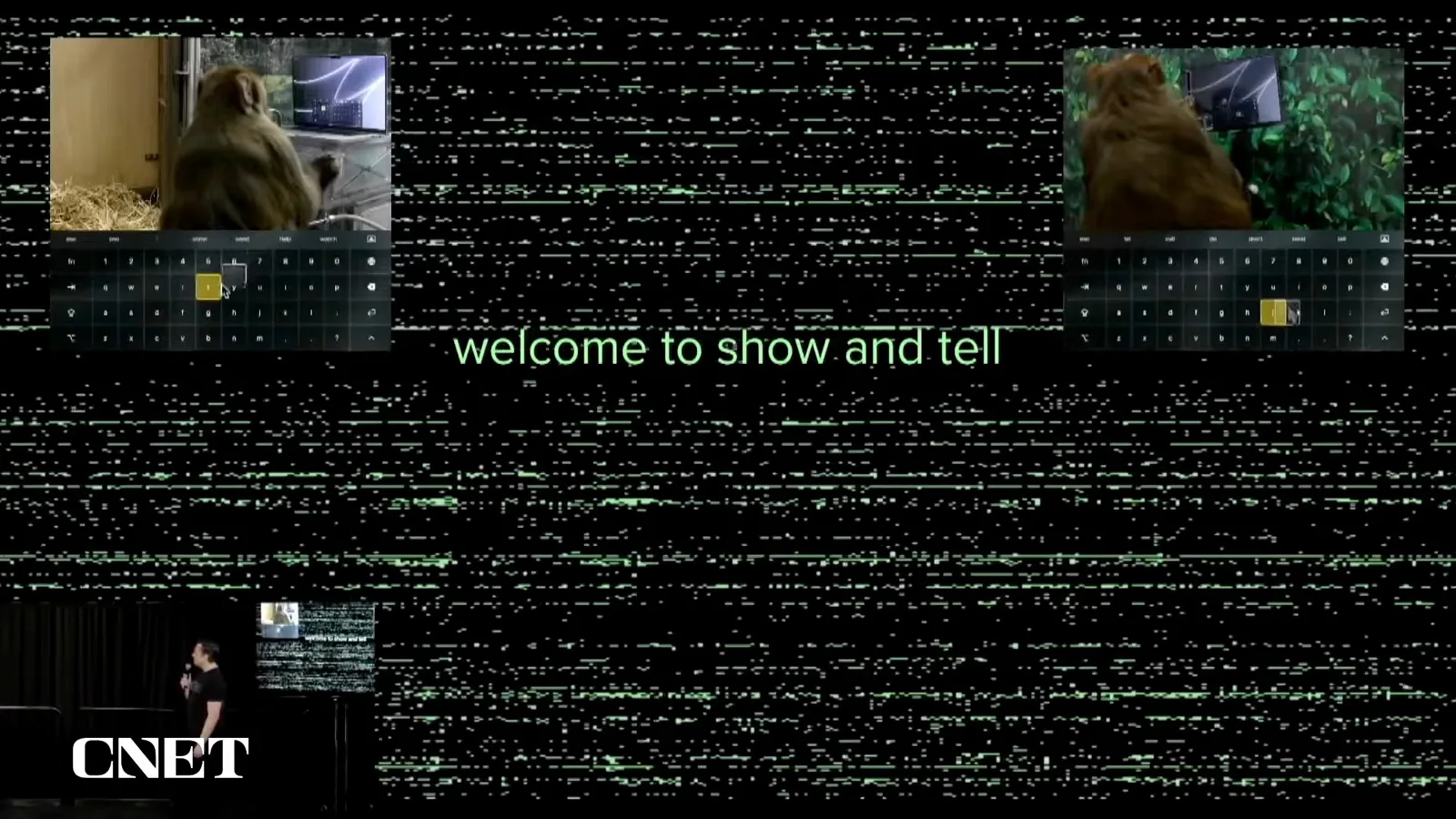
Another video shows a monkey moving a cursor to highlighted letters. Musk explicitly says the animal cannot spell independently: it follows targets rather than composing its own message.
He proposes cursor and phone control as potential aids for people with paralysis. His comparison with the speed of a person using working hands is a prediction, not an outcome proven by this demonstration.
Musk says an implant should be removable and replaceable, and describes upgrading two animal implants. The company says it observed no ill effects in those examples; the presentation is not an independent long-term safety assessment.
He says the monkey was not restrained for the demonstration and received banana smoothie rewards, and asserts that the company cares about animal welfare. Those statements do not independently establish welfare across all experiments.
Musk describes possible future vision restoration, including in people born blind, and possible neural bridges around spinal injury. Neither restored vision nor restored walking in a person is demonstrated here.
Musk says recruiting is a major purpose of the event. He lists software, electronics, batteries, wireless charging, animal care and clinical work as relevant disciplines.
Musk introduces Neuralink co-founder DJ Seo, who describes the team’s aim of creating a safe, scalable interface capable of accessing different brain regions.
The implant, robot and neural decoding
The team introduces N1 and R1, demonstrates insertion in a proxy and discusses computer control.
Seo introduces the N1 implant: a small wireless device with over 1,000 recording and stimulation channels on flexible threads. He says the implant is designed to sit beneath the skin and charge wirelessly.
Seo introduces the R1 robot, designed to insert fine electrode threads while avoiding blood vessels. He announces a live demonstration on an artificial brain proxy, not a human patient.
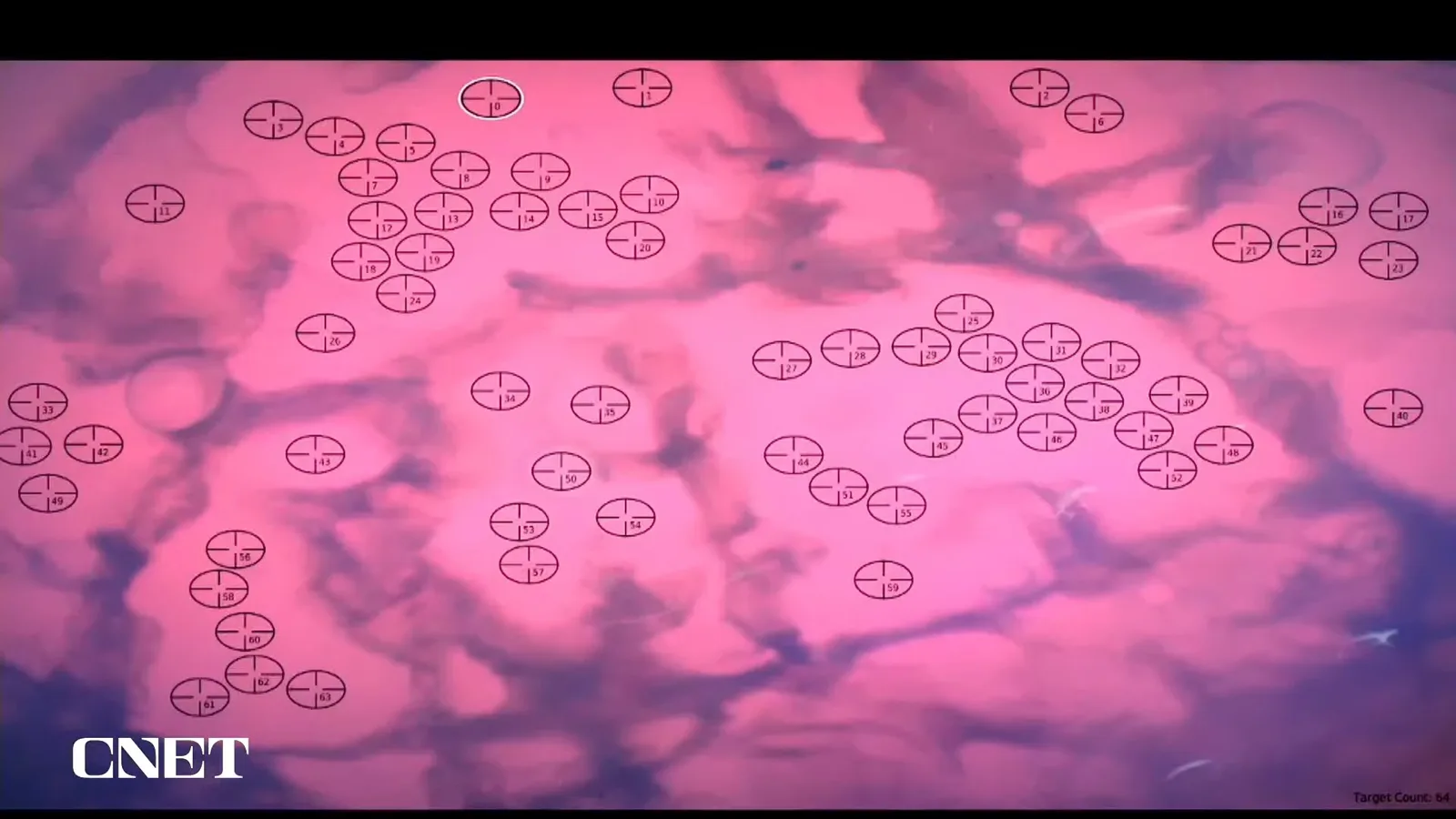
The robot’s targeting view marks planned thread locations on simulated tissue. The team says the robot will lift each thread from its backing and place it at the selected location.
Seo shows the first insertions and says inserting approximately 64 threads is expected to take around 15 minutes in the intended process. The demonstration continues in the background.
Seo says Neuralink moved device manufacturing to a dedicated Austin facility and involved design engineers in building and debugging hardware. The team describes dedicated operating facilities as preparation for future clinical work.
He says the initial goal is helping people with paralysis use digital devices. He describes work toward an FDA-authorized human trial; the clinical trial was not yet a demonstrated result at this event.
The neural-decoding team explains that it recorded motor-cortex activity while a monkey used a joystick, then trained a model to predict cursor movement from neural activity.
The team compares cursor performance across demonstrations and says speed improved. It describes tasks including clicking, dragging and virtual typing as ways to build a usable computer interface.
An engineer describes visual feedback for a neural click, such as changing cursor color, as a possible substitute for the physical feedback of a button.
The team references earlier academic work decoding imagined handwriting. In its own animal work, it trained a monkey to trace digits; the animal was not independently writing a message.
Instead of training a separate neural decoder for every character, the team explores decoding a hand trajectory and passing it to a handwriting classifier. This is a research approach, not a demonstrated general language-reading device.
Software engineer Bliss describes an integration test that sends synthetic neural activity through an implant and its software stack. Such a simulated test can catch system problems but does not guarantee real-world reliability.
She explains that recorded neural signals can change from day to day, potentially biasing cursor movement. The team is testing models trained across days and updated signal statistics to reduce that drift.
She says latency and jitter make a cursor harder to control. A timing change aligning data packets with Bluetooth activity reduced delay and variability in the team’s tests.
The team says it has improved consistency across animal sessions but still has substantial work before the system is reliably plug-and-play for people.
Power, charging and reliability testing
Engineers explain signal processing, wireless charging, diagnostics and accelerated tests.
An ASIC engineer introduces a custom chip for 1,024 recording and stimulation channels. He says it must detect small signals while respecting power and space limits.
He describes moving spike detection onto the implant so it can transmit compressed events instead of every raw sample. The team reports 32 milliwatts of system power in its test configuration.
The signal-processing pipeline filters the input, estimates a noise threshold for each channel and records points describing a detected spike. Those points can help distinguish waveforms near an electrode.
He explains a memory-access optimization: infrequently used state is accessed only after a threshold is crossed, reducing power consumed by repeated reads and writes.
A presenter returns to the simulated-brain demonstration and says all 64 threads were inserted into the proxy while avoiding marked vessels. This is a bench demonstration, not surgery on a person.
The team describes a planned chip with more channels and processing capability. Its discussion of future 16,000-channel implants is an engineering plan, not a clinical result.
The electrical engineering team discusses wireless charging. It says a fully implanted battery must charge reliably across different alignments without excessive heating of nearby tissue.
An engineer shows a charging setup in the animals’ environment: a trained monkey approaches the charging coil and receives a reward while the device charges.
The team explains dynamic tuning of coils to preserve efficient power transfer as distance changes and says it is developing another charger with improved communication and thermal control.
Embedded-software lead Julian describes acceptance tests for manufactured devices, hardware-in-the-loop tests and automated monitoring of implant electronics.
He says modular test boards make it easier to reuse infrastructure across prototypes and parallelize the test suite. Simulated neural signals can be passed through the system from chip to phone.
The device logs metrics such as humidity, voltage and power, which the team uses to investigate enclosure integrity and battery health. These are monitoring methods rather than proof of lifetime safety.
He describes measuring electrode impedance to detect open or shorted channels. By moving more processing onto the device and parallelizing tests, the team reports shortening a full scan substantially.
Engineer Joshua Hess describes accelerated lifetime testing: the team uses a tissue-like chemical environment, elevated stress and electronics cycling to seek failure modes sooner.
He discusses moisture entering implant enclosures and shows how humidity data from bench tests and animal devices are compared. The acceleration factor is a testing model, not a guarantee of years in a person.
Hess describes building progressively more automated, dense test systems and plans to add mechanical motion and tissue-growth simulations to better represent real conditions.
Surgery, replacement and materials
The team discusses the surgical process, tissue response, new tools and synthetic testing materials.
Surgery engineering lead Christine outlines the proposed procedure: prepare the target area, open the skull and dura, insert threads with R1, place the implant and close the incision.
She says the robot performs the fine thread insertion while a neurosurgeon handles the remaining steps. The process described at the event was not a fully automated human operation.
Christine discusses the difficulty of making specialist surgery accessible at scale, drawing on her family’s experience with ALS. She presents greater surgical automation as a long-term objective.
The team combines visible imaging and optical coherence tomography to track brain movement and avoid blood vessels during insertion.
Christine says skull opening and dura removal require significant surgical skill. The team explores cutting tools and feedback systems to make the process more precise, but these are research prototypes.
Mechanical engineer Alex explains why replacing an implant is difficult: healing tissue can encapsulate the device and electrode threads. He says the problem is not yet solved.
A proposed less invasive approach would retain the dura. The team is exploring imaging methods to see vessels beneath it; accuracy and repeatability still need validation.
Needle engineer Sam describes the challenge of passing a very fine needle and thread through a tough dura over soft moving tissue without buckling or pulling the thread back.
He explains laser manufacturing and rapid iteration on needle designs. The team reports improved production time and yield in its own manufacturing process.
The team says proxy tests can reveal failure modes such as a thread moving after insertion. Because results depend on proxy material, it is trying to match mechanical properties to tissue.
Microfabrication researchers describe building synthetic brain and tissue proxies. They want bench tests that better reproduce motion, healing and material interactions, reducing reliance on animal experiments.
The team says more work is needed to model vascular motion, biocompatibility and stimulation. A bench proxy can accelerate learning but is not equivalent to a human clinical outcome.
Vision and spinal-cord research
Researchers present animal experiments and potential future sensory and motor applications.
A visual-neuroscience researcher describes an experimental goal of stimulating visual cortex to create perceptions of light for people with vision loss. It is presented as a future prosthesis, not a demonstrated restoration of sight.
He explains that the visual cortex maps parts of the visual field unevenly, with disproportionately large representation near the point of fixation.
The team records visual-cortex activity from two rhesus monkeys and uses controlled screen patterns and eye tracking to map receptive fields associated with recorded signals.
The researcher describes training an animal to look toward a visible flash, then interleaving visual trials with electrical stimulation. Eye movements may provide evidence of a perceived location, but the animal cannot describe its subjective experience.
He sketches a hypothetical system in which a camera and external computer convert an image into patterns of neural stimulation. The images and future channel counts are illustrations and goals, not evidence of normal vision.
A Neuralink engineer introduces a separate spinal-cord research direction. She describes the anatomy of motor signals and the interruption that can occur after spinal injury.
The team explores placing electrodes near spinal motor circuits. The speaker notes that the spinal cord is delicate and moves within the spine, presenting risks and technical challenges.
A video shows a pig with brain and spinal implants. Researchers record neural data and track joint movement, then describe stimulation experiments in which electrodes produce leg movements.
The team shows different stimulation patterns and measured muscle activity, including sustained contractions. The demonstration does not show a person with paralysis regaining voluntary movement.
The presenter outlines a possible closed loop: decode intended movement from the brain, stimulate spinal circuits, and eventually return sensory information to the brain. She says substantial work remains to realize it.
Audience questions begin. Asked about research access, Musk says Neuralink could eventually provide devices and robots to universities and hospitals once production and appropriate approvals are in place.
Audience questions on safety and engineering
The panel answers questions about signals, welfare, removal, clinical testing and future research.
Musk says the company would consider publishing datasets for researchers. This is a statement of willingness at the event, not evidence that particular data were released.
A questioner asks about scarring and declining electrode signals. An engineer says flexible, small threads may limit tissue response, while discussing work on smaller devices and coatings.
The team cites animal implants with useful signals over hundreds of days. These are company-reported animal observations and do not establish human long-term safety or durability.
Asked why signal rates vary over time, a software lead says it is difficult to know whether a channel records exactly the same neurons each day; stable waveform shapes provide some evidence, but not a definitive answer.
Musk speculates about possible health-monitoring uses, including detecting signs of illness or stroke. The presentation does not establish that these are validated clinical functions.
Asked about stimulation precision, a researcher says the number of cells affected depends on electrode properties, current and other factors. He gives a rough estimate for an animal experiment and discusses adjusting stimulation.
On longevity, an engineer distinguishes the enclosure, electronics and battery, and electrode threads. He reports bench and animal test durations while emphasizing that thread durability remains an active area of work.
The team describes experimental coatings and insulation for longer-lived threads. Proposed multi-year durability remains to be tested and cannot be inferred solely from accelerated testing.
Asked what the team learned, engineers emphasize brain motion, tissue changes during healing and the need for careful validation of tiny mechanical systems.
They add that making an interface work once is easier than making it work reliably across animals and days. Musk describes the brain’s softness and motion as engineering challenges.
Asked about wireless bandwidth, engineers discuss compression, running more computation on the implant and considering alternative radios for higher-channel-count devices.
An audience member asks how to work with a brain that learns and changes. The team describes possible adaptation on both sides: users learn the interface while algorithms adjust over time.
Asked about careers, Musk and Seo describe the range of relevant disciplines, from chips and software to materials and animal care.
The animal-care team describes training based on rewards and says it works to reduce restraint. These are company descriptions of its program, not an independent welfare audit.
A questioner asks about tissue damage during implant replacement. An engineer says the goal is reimplantation in the same area and describes animal experience, while acknowledging the challenge of tissue formed around threads.
The team says monkeys learned to use replacement devices after training, but it does not establish that removal or repeated implantation is risk-free in people.
Asked what signals are transmitted, an engineer says the chip detects spikes locally and generally sends compressed events, with raw samples available selectively. Current wireless bandwidth limits streaming every raw channel.
Musk speculates that leaving the dura intact might one day shorten procedures. The team’s earlier discussion makes clear that insertion through the dura and safe replacement still require engineering validation.
A questioner asks about long-term tissue pathology and safety in healthy people. A team member describes animal studies and says proving safe removal in humans remains work in progress.
Another question asks about FDA concerns. The team identifies removal safety, heat testing and biocompatibility as areas requiring rigorous evidence, and notes that novel components cannot simply rely on prior devices’ safety data.
Asked whether people with motor disabilities are consulted, a team member describes a consumer advisory group and examples of everyday computer activities that potential users want.
Musk describes ambitions to build devices at scale, while acknowledging that initial human progress may be slow. Manufacturing targets are plans, not approved clinical deployment.
A questioner asks about reaching deeper brain structures. Engineers discuss imaging and needle challenges; their suggestions and timelines are speculative, not demonstrated capabilities.
The audience asks about channel faults and checking thread placement. Engineers discuss redundant channels and testing placement in carefully designed proxies, while acknowledging that the approach depends on representative testing.
Asked about neuroscience beyond engineering, Musk says others could build on a general interface. A team member stresses that decades of prior academic and clinical research underpin the work.
The final question asks how to increase communication bandwidth. The team discusses handwriting decoding and user-interface design as research directions, not proven results in the proposed patient population.
Musk thanks the audience and closes the presentation.
Mehr aus diesem Kanal
 3:35:00EN
 CNET Highlights· 2. März 2023Tesla’s 2023 Investor Day: the plan to scale clean energy and carsElon Musk, Zach Kirkhorn, Drew Baglino, Franz von Holzhausen, Lars Moravy, Colin Campbell, Pete Bannon, David Lau, Ashok Elluswamy, Rebecca Tinucci, Karn Budhiraj, Roshan Thomas, Tom Zhu, Mike Snyder, Laurie Shelby, Brandon Ehrhart · TeslaTesla leaders outline a global electrification scenario, a lower-cost vehicle platform and the factories and supply chains needed to scale.
 41:04ENCNET Highlights· 2. März 2023Tesla’s 2023 investor Q&A puts battery supply and costs in focusElon Musk · TeslaExecutives explain refining, factory localization and dry-electrode scaling, while Musk discusses affordability and a future autonomous fleet.
 8:15ENCNET Highlights· 1. März 2023Tesla’s 2023 plan estimates the scale of a fully electrified energy systemElon Musk, Drew Baglino · TeslaMusk and Drew Baglino describe a proposed energy transition requiring batteries, renewable generation and manufacturing investment.
 53:25ENCNET Highlights· 1. Dez. 2022Neuralink researchers on implant durability, safety and wireless dataElon Musk · NeuralinkAt a 2022 Q&A, the team explained animal results, device-removal concerns and ways to compress brain signals.
 7:20ENCNET Highlights· 1. Dez. 2022Neuralink’s 2022 monkey demo selected highlighted keysElon Musk · NeuralinkMusk showed cursor control with an implant, while stressing the monkey was following prompts rather than spelling independently.
 55:08ENCNET Highlights· 1. Okt. 2022Tesla engineers explain robot hands and driving-model testsElon Musk · TeslaAt AI Day 2022, the panel described Optimus design trade-offs, curated failure cases and offline models that label driving data.