In 30 Sekunden
In a 2022 Neuralink presentation, Elon Musk showed a monkey moving a cursor to highlighted letters using neural signals. He explicitly said the animal was not spelling independently. Musk presented computer control as a possible future aid for people with paralysis and forecast a human implant within roughly six months; Neuralink later reported its first human implant in January 2024.
- 1The first human implant came after the 2022 forecastMusk expected an implant in about six months; Neuralink later reported the first human implantation in January 2024.
- 2Musk describes bench tests before animal implantsHe says the company used accelerated testing and a brain-like simulator before considering animal procedures.
- 3The monkey followed highlighted keys rather than spelling freelyMusk says the animal used neural signals to move a cursor to targets, not to compose a message independently.
- 4Communication for people with paralysis was a proposed useMusk presents phone and cursor control as a possible application; the animal demo did not establish his projected human performance.
- 5The implant is intended to be replaceableMusk argues that a device should be removable and upgradable, and says the company updated animal implants.
Das Wichtigste
- The monkey moved a cursor to highlighted targets; it did not independently compose or spell the message.
- Musk described bench and animal testing as steps toward a reliable, scalable implant.
- He proposed cursor and phone control for people with paralysis, but his performance comparison was a forecast.
- Musk said implants should be removable and upgradable and described updated animal implants.
- The expected six-month human timeline in 2022 was a prediction; Neuralink reports the first human implantation in January 2024.
Den bearbeiteten Text nach Kapiteln lesen
From prototype to tests and a human-study forecast
Musk discusses production, regulatory preparation and bench testing.
At Neuralink’s 2022 show-and-tell event, Elon Musk says turning a prototype into a safe, reliable, affordable product that can be produced at scale is much harder than demonstrating an initial idea.
Musk says the company is preparing for its first human implant and expects it might happen in about six months, subject to regulatory steps. This was a forecast: [Neuralink later reported](https://neuralink.com/updates/prime-study-progress-update/) FDA approval for a first-in-human study in May 2023 and its first human implantation in January 2024.
He describes bench testing and accelerated life testing, including a brain-like simulator, before considering an animal implant. Musk says the intention is for animal work to confirm results after extensive preliminary testing.
The monkey cursor demonstration
Musk describes neural signals, target selection and a potential use for people with paralysis.
Musk says the group expanded its work to six monkeys performing varied tasks, and that it is looking for repeatable operation and device durability. A display shows what he identifies as recorded neural activity.
A demonstration shows a monkey moving a cursor toward highlighted letters on a screen. Musk explicitly says the animal cannot spell independently: it follows the indicated targets, rather than composing a message of its own.
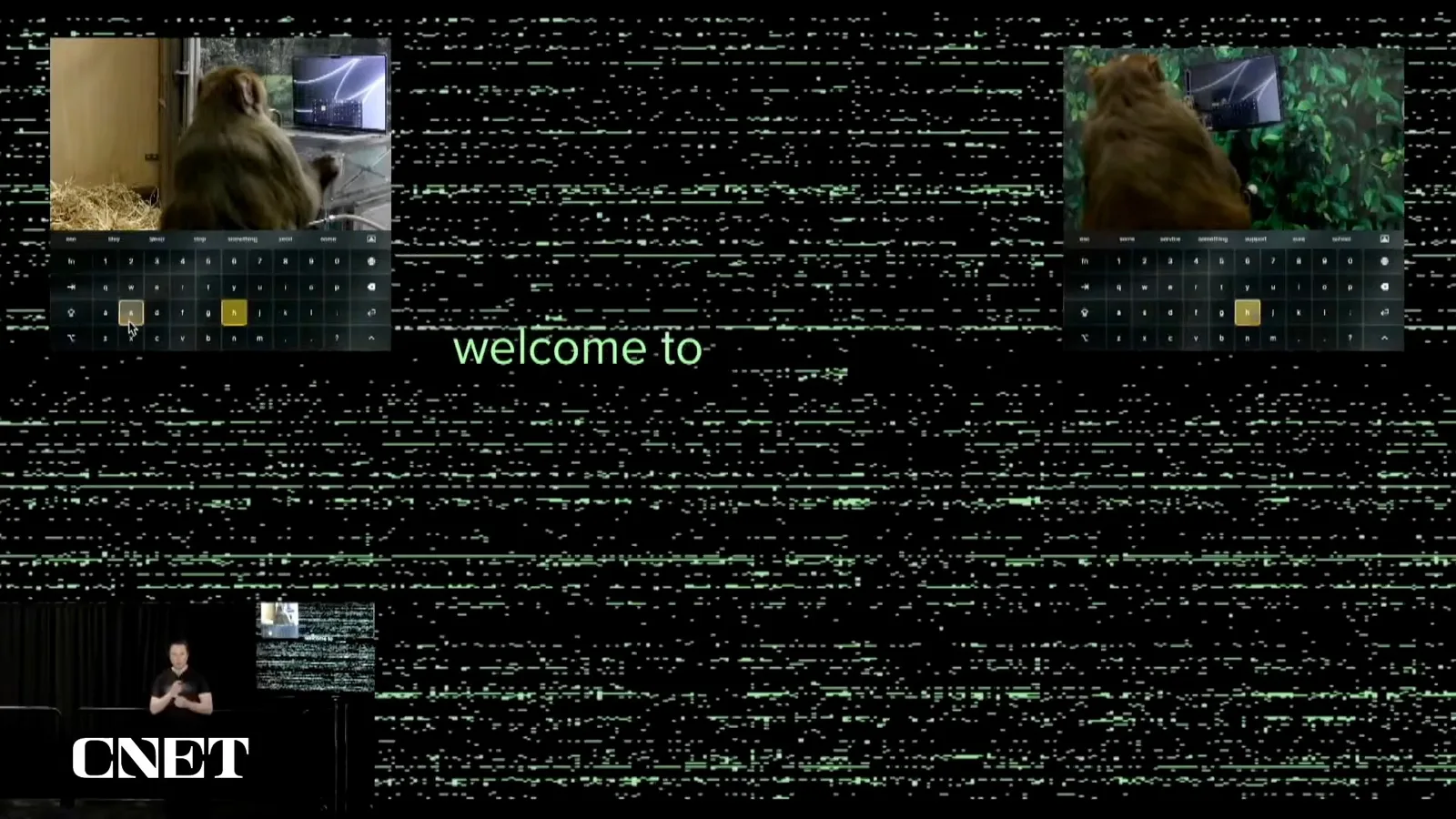
Musk presents cursor and phone control as possible applications for people with paralysis, and predicts that an implant might eventually allow control better than a person using working hands. That performance comparison is a prediction, not a result established by the animal demonstration.
Replacement and animal welfare
He discusses upgrading implants and describes the company’s approach to animal testing.
He argues that implants should be removable and replaceable so users can receive newer devices or replace a malfunctioning one. He says two monkeys had received updated implants after earlier versions.
Musk says the monkeys were not strapped into the demonstration and received banana smoothie rewards, and asserts that Neuralink cares about animal welfare. The short presentation itself is not an independent assessment of welfare or long-term safety.
The excerpt ends as Musk comments on the animal choosing fruit. The video shows a targeted cursor task and does not demonstrate a monkey independently composing language or a human clinical outcome.
Mehr aus diesem Kanal
 3:35:00EN
 CNET Highlights· 2. März 2023Tesla’s 2023 Investor Day: the plan to scale clean energy and carsElon Musk, Zach Kirkhorn, Drew Baglino, Franz von Holzhausen, Lars Moravy, Colin Campbell, Pete Bannon, David Lau, Ashok Elluswamy, Rebecca Tinucci, Karn Budhiraj, Roshan Thomas, Tom Zhu, Mike Snyder, Laurie Shelby, Brandon Ehrhart · TeslaTesla leaders outline a global electrification scenario, a lower-cost vehicle platform and the factories and supply chains needed to scale.
 41:04ENCNET Highlights· 2. März 2023Tesla’s 2023 investor Q&A puts battery supply and costs in focusElon Musk · TeslaExecutives explain refining, factory localization and dry-electrode scaling, while Musk discusses affordability and a future autonomous fleet.
 8:15ENCNET Highlights· 1. März 2023Tesla’s 2023 plan estimates the scale of a fully electrified energy systemElon Musk, Drew Baglino · TeslaMusk and Drew Baglino describe a proposed energy transition requiring batteries, renewable generation and manufacturing investment.
 53:25ENCNET Highlights· 1. Dez. 2022Neuralink researchers on implant durability, safety and wireless dataElon Musk · NeuralinkAt a 2022 Q&A, the team explained animal results, device-removal concerns and ways to compress brain signals.
 3:39:05ENCNET Highlights· 1. Dez. 2022Neuralink’s 2022 update: from neural signals to a working interfaceElon Musk, DJ Seo · NeuralinkEngineers explain cursor decoding, implants and robot-assisted insertion, while separating animal demonstrations from clinical ambitions.
 55:08ENCNET Highlights· 1. Okt. 2022Tesla engineers explain robot hands and driving-model testsElon Musk · TeslaAt AI Day 2022, the panel described Optimus design trade-offs, curated failure cases and offline models that label driving data.