In 30 Sekunden
Michael Shimeles treats a “software factory” as a way to encode his engineering workflow, not permission to leave an agent running unchecked. Each task gets an isolated worktree; an agent builds to a chosen structure, produces evidence of behavior and responds to automated pull-request review. Shimeles still tests features himself and uses human code review for client work. He also discusses conversational planning, model costs and why a wrong initial assumption can make a long autonomous run wasteful.
- 1Separate worktrees let agents work on different tasks without editing the same filesShimeles creates a worktree from the main branch for each new task. His instructions also warn that worktrees do not isolate shared resources such as ports or databases.
- 2A service-layer pattern makes code easier for him and agents to navigateHis build skill separates orchestration from reusable mechanics. He favors consistent names and structure to reduce duplication and improve readability.
- 3Evidence starts by reproducing a reported bugHe asks an agent for before-and-after video, screenshots or measurements. For non-visual performance work, he shows timing comparisons instead of screenshots.
- 4The feature still gets a human testShimeles says he tries features himself, especially when real users or clients depend on them. Client work also receives human code review from his team.
- 5Automated review feedback drives a bounded revision loopHis agent responds to actionable pull-request comments and requests another review, stopping at a target score or an iteration limit. The result is a PR for him to inspect.
- 6A conversation can be his planning documentShimeles talks through an idea with the agent before building. For setup steps he will need later, he asks for a durable Markdown file.
- 7Workflows may shrink as tools improve, but personal preferences remainHe tests new models without instructions first, then adds the workflow back. Both speakers think skills encoding individual preferences can retain value.
Das Wichtigste
- Isolate parallel tasks in separate worktrees, while remembering they can still share ports and databases.
- For a reported bug, reproduce it before the fix and capture evidence afterward; use measurements when screenshots do not fit.
- An automated review score can guide another review cycle, but Shimeles still tests the feature himself.
- Discuss assumptions before a long run; write durable setup notes when they will be needed later.
- Choose models and verification effort for the task and its consequences.
Den bearbeiteten Text nach Kapiteln lesen
Isolate parallel work
Shimeles defines his factory as a workflow of instructions and skills. Separate worktrees reduce file conflicts but do not isolate every shared resource.
Michael Shimeles, also known as Ras Mic, is skeptical of a fully autonomous “software factory”: a wrong assumption at the start can propagate through a long run. He instead uses the term for a set of workflow instructions, skills and engineering preferences that guide an agent while he remains involved.
His workflow is intended to work across models and tools. An AGENTS.md file explains how he wants the agent to work, while separate skills handle stages. He says models can inspect the repository themselves for many structural details.
The first stage isolates a new feature or fix in a Git worktree branched from the main branch. This lets him run several agents on separate tasks without having them edit the same files. He demonstrates several agents working in terminal tabs.
His worktree skill also tells the agent to fetch and verify the repository state. It warns that worktrees isolate files, not shared resources such as development-server ports or a shared database. Shimeles says he used AI to help write the Git instructions.
Build to a readable structure
His service-layer pattern separates orchestration and reusable functions. He chooses it to make code easier to understand and avoid duplication.
The build stage calls a code-structure skill. Shimeles favors a service-layer pattern: actions and boundaries coordinate business rules and timing, while reusable mechanics live in services with explicit inputs and structured results.
He chose the structure partly so that he or another developer can read the code later. Consistent function names also give agents clues about existing behavior and may reduce duplicated helpers. He acknowledges that engineers differ on architecture choices.
Prove behavior and test it yourself
For bugs, the agent records evidence before and after; other work can use screenshots or measurements. Shimeles personally tests features and uses human review for clients.
During the prove stage, an evidence-driven skill attempts to reproduce a reported bug before the fix and capture the result afterward. On supported setups, it can record video of the behavior. This helps distinguish a reproducible defect from a report that cannot yet be confirmed.
For visual changes, a before-and-after skill can capture screenshots. For a performance change that cannot be shown in an image, he shows measurements instead: in one example navigation times fell from roughly 815 milliseconds to about 60 milliseconds. He uses these artifacts to assess the claimed improvement.
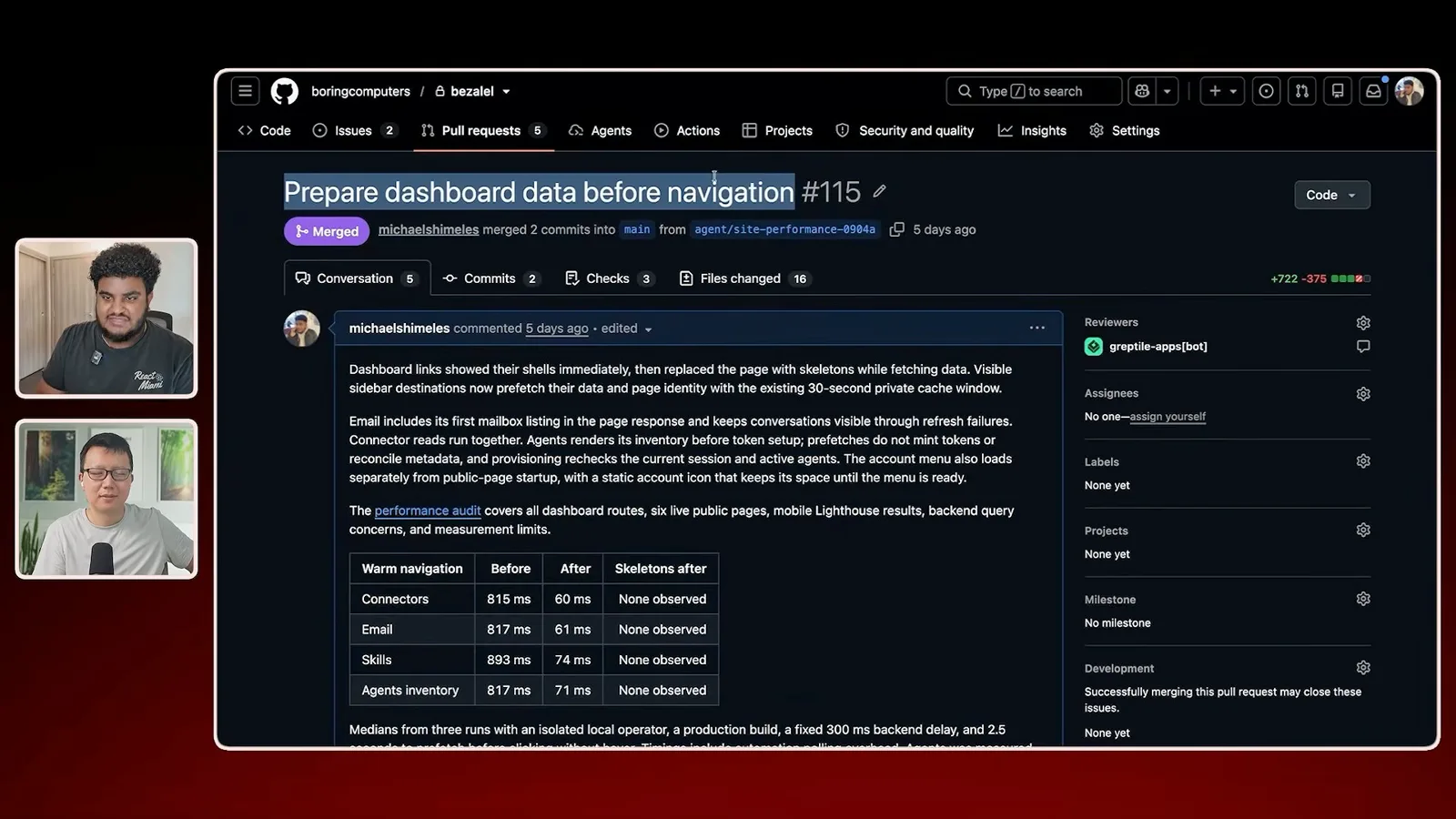
If there is no prior bug to reproduce, the agent may record only the resulting behavior. Shimeles says the evidence step sometimes causes an agent to notice that a change did not improve the result and continue working. Some recording tools depend on the operating system and installed software.
Some models follow all stages automatically in his experience, while another sometimes needs a reminder to run a review loop. He has not determined whether the cause is the model or his instructions. The workflow is therefore something he monitors, not a guarantee that every step ran.
Shimeles still tests features himself, particularly when other people use the software. For client work, developers on his team also review the code. For a small personal utility, he may accept a faster and less formal process if it works for him.
He describes splitting work across machines: a Linux computer handles some tasks, while he uses a Mac for user-facing work and computer-use testing. He also wants to work from his phone and switch between models, which shapes his setup.
Ship through an automated review loop
A review agent comments on pull requests, and the coding agent revises within an iteration limit. Shimeles receives the result for his own review.
The shipping stage uses an automated pull-request reviewer, Greptile. When the reviewer leaves actionable feedback or a confidence score below his target, the coding agent revises the code, repeats appropriate evidence checks, pushes changes and requests another review.
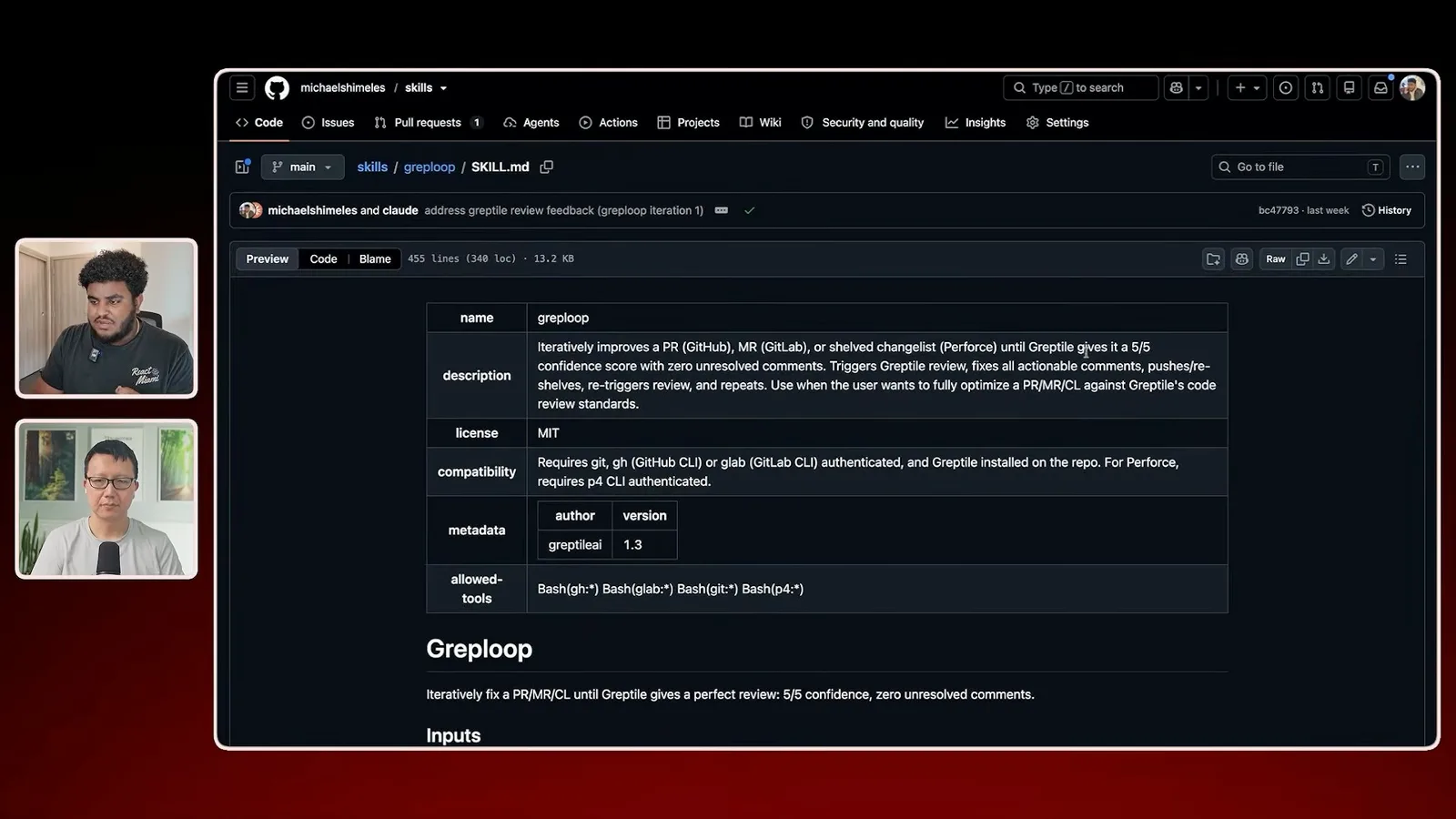
The loop stops when it reaches the target or an iteration limit; his version allows up to ten iterations. He then receives the pull request and evidence to inspect. The review score is part of his process, while he still decides what to test and merge.
Shimeles summarizes the chain: isolate, build to a structure, prove the bug or result, then submit a pull request and respond to review. Yang observes that the last two stages emphasize verification. Shimeles says he does not trust an agent to make every decision correctly in one pass.
For a personal screenshot utility or image-sharing tool, he may skip the full chain because the consequence of a mistake is lower. Yang notes that even a personal overnight run can waste effort when an early assumption is wrong. Shimeles agrees that communication matters before the agent runs far ahead.
Planning, model choice and future workflows
He plans by talking through ideas and saves notes when needed. He compares model strengths, costs and scheduled security checks as personal observations.
For planning, Shimeles talks through an idea with the agent for several minutes. The conversation becomes the immediate specification. When there are setup steps he needs to return to later, he asks the agent to write a Markdown file in the relevant project directory.
Asked whether a personal project needs worktrees and pull requests, he says speed and experimentation can be more important when the stakes are low. A developer can choose a stricter process when practicing skills or building for other users.
On model choice, he says one model has been useful in his own performance audits, security reviews and computer-use tests. He gives an example of a payment application where an audit surfaced a serious issue, and urges people operating applications for real users to review security.
For interface design, he finds that visual references improve results. He says another model often writes code he prefers, while his preferred auditing model is stronger for some other tasks in his experience. These are observations from his own workflow, not a universal ranking.
He uses terminal tools partly because they make switching between agents and models familiar. Since the strongest subscriptions can be expensive, he suggests choosing a model appropriate to the work and using smaller models for routine tasks where they are sufficient.
For client applications, Shimeles runs scheduled security checks. He is also building an agent workspace across machines in a home lab. Yang notes that scheduled jobs can become hard to track when spread across devices and cloud services.
A recent cleanup revealed thousands of worktrees on Shimeles’s machine. Both discuss the need to keep track of accumulated resources. The same flexibility that enables parallel agents can create operational clutter.
Shimeles expects parts of his workflow to disappear as tools incorporate better defaults, while instructions reflecting how he personally works may remain useful. When a new model arrives, he first tries it without his usual instruction files and then adds the workflow back.
Yang cautions that advice from model labs may assume access to more compute than ordinary users have. Shimeles agrees that cost and resource limits affect practical choices, and says he values open models that can be run locally as an alternative.
Mehr aus diesem Kanal
 46:40EN
 Peter Yang· 8. Nov. 2026Podcast · 2 StimmenAshley Alexander: How AI Helps Me Care for My Parents With CancerGast: Ashley Alexander · Moderation: Peter YangA caregiver uses AI to prepare for appointments, organize records and ask better questions—while keeping doctors at the center of treatment.
 17:50ENPeter Yang· 4. Nov. 2026PodcastPeter Yang’s Five Steps for Using AI to Help Care for His MotherYang uses a shared care brief and organized records to navigate appointments, while making time for family.
 15:03ENPeter Yang· 3. Nov. 2026PodcastHow Peter Yang Used an AI Phone Agent to Negotiate His Internet BillAn AI call negotiated a lower price and faster service, but Yang still had to approve the change himself.
 33:09ENPeter Yang· 1. Nov. 2026Podcast · 2 StimmenJaclyn Konzelmann: When AI Can Build More, Choose What Deserves to ExistGast: Jaclyn Konzelmann · Moderation: Peter YangGoogle Labs pairs short strategy documents with prototypes, user co-creation and lessons from experiments that end.
 13:05ENPeter Yang· 28. Okt. 2026PodcastPeter Yang Tests Genie 4: Convincing Worlds, Unfinished GameplayFive live demonstrations show scenes that respond to prompts and sound, alongside inconsistent actions and limited game mechanics.
 1:06ENPeter Yang· 26. Okt. 2026PodcastPeter Yang on Setting Up Payroll for a One-Person BusinessIn a paid partnership, Yang describes the paperwork he encountered and a payroll product integrated with a business account.