In 30 Sekunden
Peter Yang tests an early version of Google’s Genie 4 by generating five interactive scenes, from a San Francisco monster attack to a Tokyo ramen stand. The model adds voices and responds to changes in the scene, but it also stacks bowls, makes animals appear suddenly and struggles with a shooting-game request. Yang sees potential for visual effects and personally created games, while stressing that attractive graphics alone do not make a satisfying game.
- 1The model responds to input by generating the next visual frameYang describes a loop in which a prompt produces a scene and movement or further instructions affect what appears next. He highlights audio and live changes.
- 2A peaceful street becomes a monster scene through new promptsYang first adds a dog and warm light, then asks for a giant creature to attack. The demo changes the same scene as he types.
- 3The chef speaks, but the requested action does not fully workThe ramen stand produces a talking chef and music, yet two bowls appear stacked and the scene does not show the requested eating action.
- 4Objects and animals can appear suddenly or behave unexpectedlyIn the safari, the jeep does not appear to drive and antelope appear abruptly. The alien scene looks like a shooter but does not reliably deliver the requested gameplay.
- 5Graphics are further along than gameplay in this testYang sees potential for visual effects but says a good game also needs a core loop, progression and other mechanics.
Das Wichtigste
- A world model generates subsequent visual frames in response to actions and prompts, as Yang explains it.
- Live scene changes and generated audio can add interaction, but requested actions may not behave consistently.
- A game needs mechanics and progression as well as graphics.
- Yang sees potential for lower-cost visual effects and user-created games if the technology improves.
Den bearbeiteten Text nach Kapiteln lesen
How Yang describes a world model
He explains frame generation in response to user input and identifies audio, live changes and multi-step planning as capabilities in the demonstration.
I tested an early version of Google’s Genie 4 by creating five worlds: a San Francisco street attacked by a giant creature, a Tokyo ramen stand, a dragon battle, a safari and an alien attack on New York. I will also discuss what the results might mean for movies and games.
I describe a world model as predicting the next visual frame based on user input. A prompt creates an initial scene; pressing a movement key changes what the model predicts next, and the process repeats while retaining information about what has already appeared.
The features I highlight are generated sound, the ability to change a scene with a live prompt, and Gemini 4 planning multi-step events behind the scenes. Sound can include voices, engines, wind or music.
A monster attacks San Francisco
Yang generates a street scene and changes it from peaceful to chaotic with successive prompts.
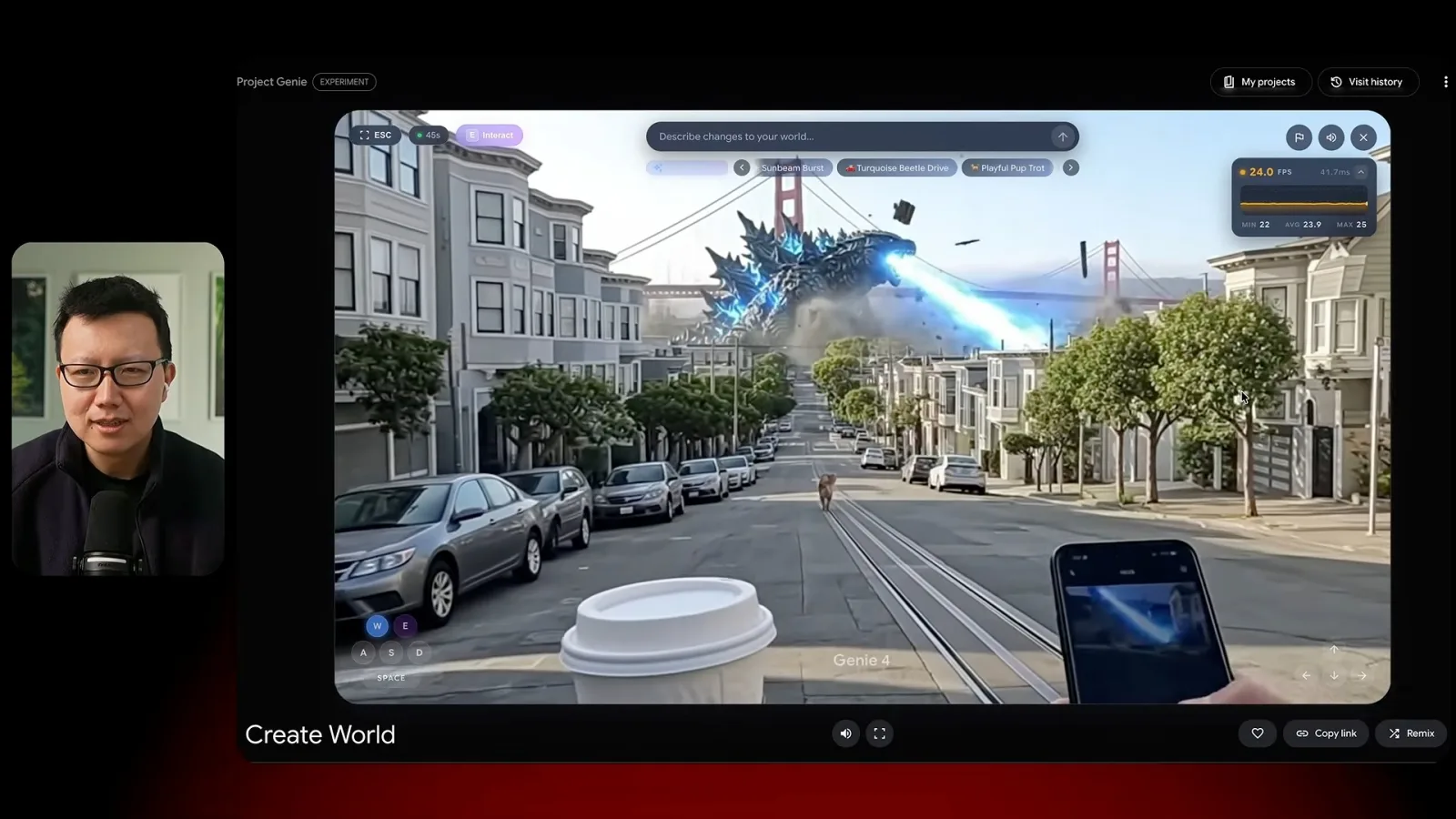
For the first world I provide prompts for the environment and character. A San Francisco street appears in about ten seconds, with a cable car and a first-person character holding coffee and a phone. I add a golden retriever and a warm glow.
I then ask for a giant monster to destroy buildings and breathe fire down the street, followed by a bridge collapse. The scene becomes chaotic, although the character continues holding the phone. The demonstration shows how I can alter the same scene as it runs.
A talking ramen chef in Tokyo
The generated chef responds and music plays, but the eating action and bowls are inconsistent.
In the second scene, a ramen chef welcomes me to a rainy Tokyo stand and speaks. I ask for ramen and for the scene to show me eating it. The chef serves two stacked bowls, but the requested eating action does not appear.
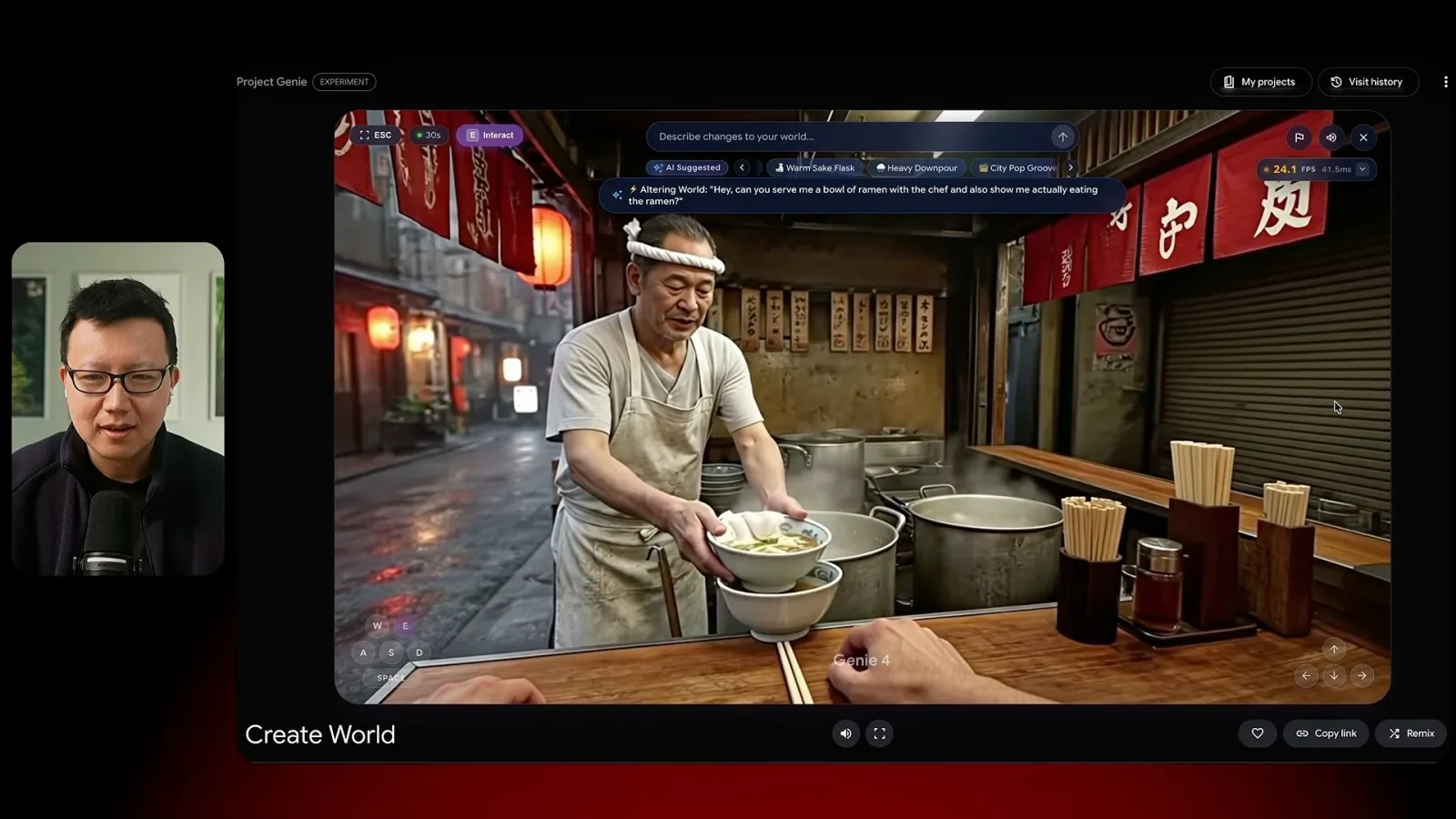
I add a sleeping cat, warm sake, cherry blossoms and a saxophone solo on the radio. Music becomes audible. The scene is evocative, but the stacked bowls are one example of an imperfect result.
A dragon battle and a safari
Yang adds arrows and a spaceship to a castle scene, then prompts animals in a safari. The results include abrupt appearances and unexpected behavior.
For a castle battle I generate a rider on a dragon, then request a flame burst, arrows and a dive. The generated sound resembles a person imitating a dragon more than the creature I expected. I also ask for a spaceship to fight it; the ship appears and then seems to vanish.
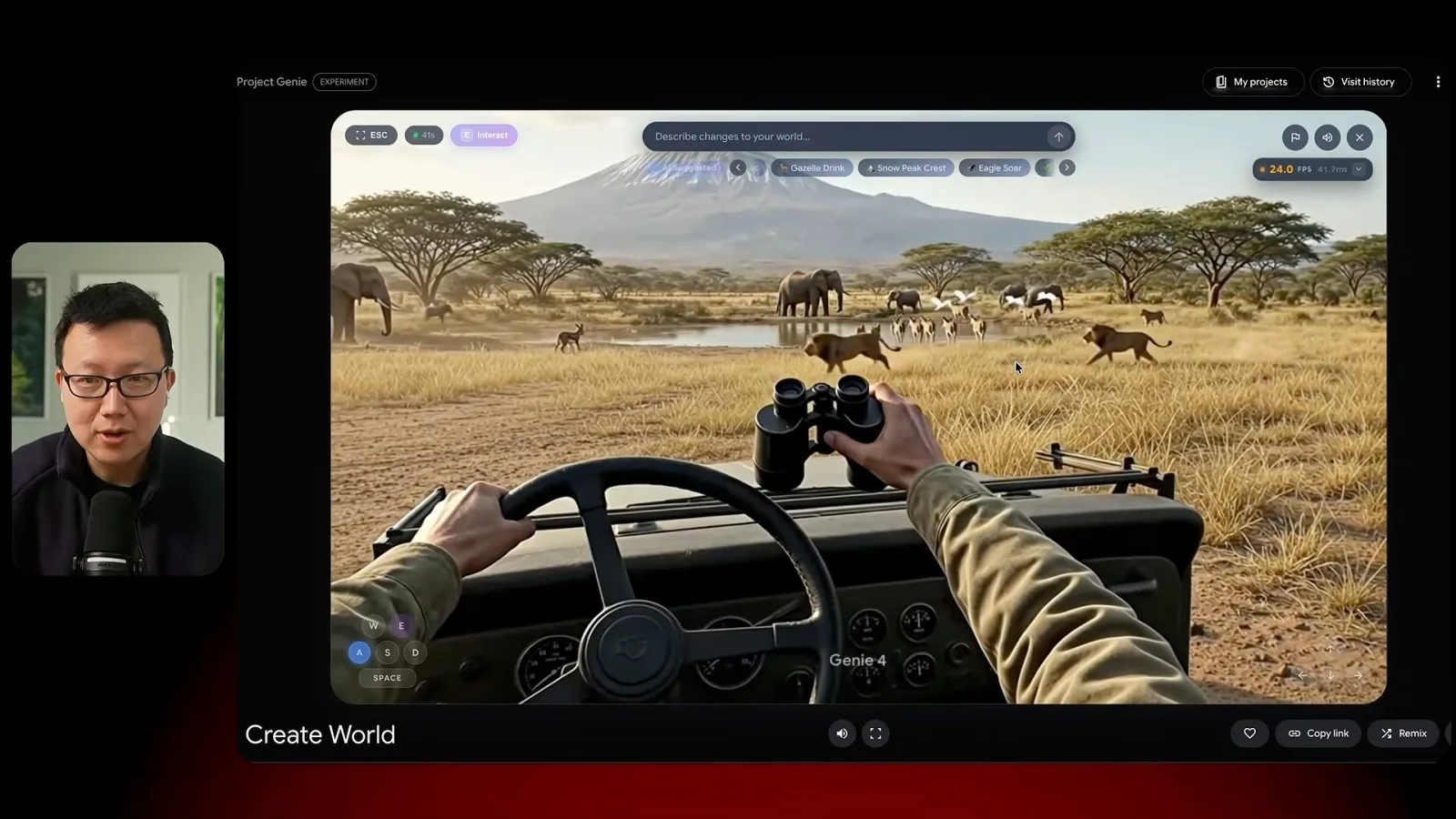
Next I create a jeep safari with elephants, lions and antelope. The jeep does not seem to drive. When I ask a lion to chase an antelope and then request a migration, animals appear abruptly and the action is not always coherent.
An alien shooter and the limits of gameplay
A New York scene has voices and graphics, but the requested shooting interaction falls short. Yang discusses possible uses in visual effects and future games.
For the final scene I request a first-person shooter style and a rock soundtrack as aliens attack New York. The world produces voices, a mothership strike and a helicopter. When I ask the gun to shoot and eliminate the aliens, however, the gameplay does not work as I hoped.
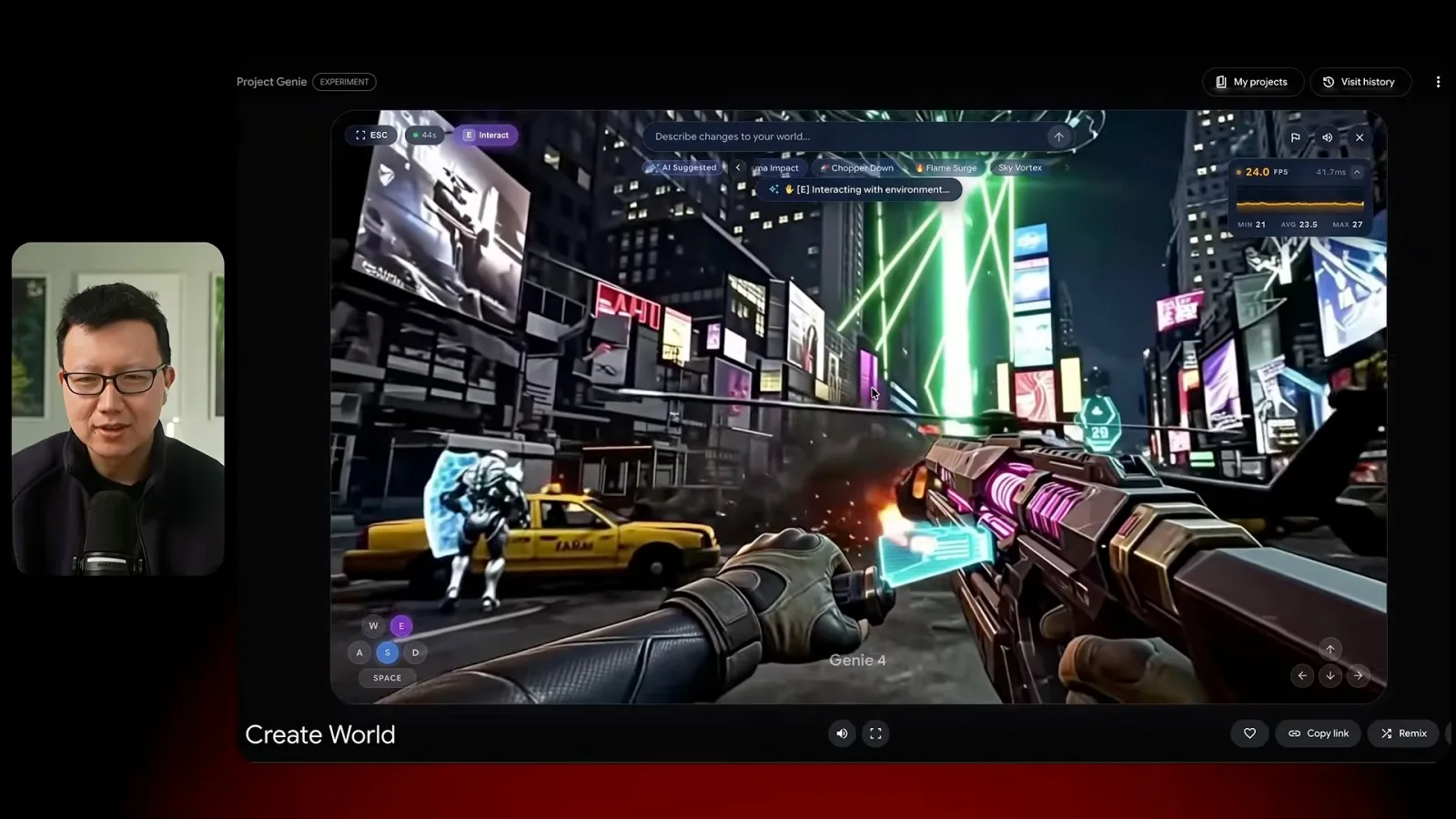
I do not want to present the technology as better than it is: in this test it is good at producing graphics but not yet at producing satisfying gameplay. A good game also needs a core loop, progression and mechanics beyond its appearance.
For movies, I think world models could eventually reduce the cost of visual effects by generating alternative takes of elaborate scenes from prompts. For games, they may allow people to create personalized worlds, but the shooter demo shows why graphics alone are insufficient.
I compare the technology to an early stage of language models: it can already create impressive scenes, but objects appear unexpectedly and there are still bugs. If the models improve, I can imagine people prompting short films and games; that remains a future possibility rather than what this demo already delivers.
Mehr aus diesem Kanal
 46:40EN
 Peter Yang· 8. Nov. 2026Podcast · 2 StimmenAshley Alexander: How AI Helps Me Care for My Parents With CancerGast: Ashley Alexander · Moderation: Peter YangA caregiver uses AI to prepare for appointments, organize records and ask better questions—while keeping doctors at the center of treatment.
 17:50ENPeter Yang· 4. Nov. 2026PodcastPeter Yang’s Five Steps for Using AI to Help Care for His MotherYang uses a shared care brief and organized records to navigate appointments, while making time for family.
 15:03ENPeter Yang· 3. Nov. 2026PodcastHow Peter Yang Used an AI Phone Agent to Negotiate His Internet BillAn AI call negotiated a lower price and faster service, but Yang still had to approve the change himself.
 33:09ENPeter Yang· 1. Nov. 2026Podcast · 2 StimmenJaclyn Konzelmann: When AI Can Build More, Choose What Deserves to ExistGast: Jaclyn Konzelmann · Moderation: Peter YangGoogle Labs pairs short strategy documents with prototypes, user co-creation and lessons from experiments that end.
 1:06ENPeter Yang· 26. Okt. 2026PodcastPeter Yang on Setting Up Payroll for a One-Person BusinessIn a paid partnership, Yang describes the paperwork he encountered and a payroll product integrated with a business account.
 41:41ENPeter Yang· 25. Okt. 2026Podcast · 2 StimmenJake Moran’s AI Video Workflow Starts With a Story and Good TimestampsGast: Jake Moran · Moderation: Peter YangThe HyperFrames creator shows how he guides an agent through rough cuts, storyboards, references and frame-by-frame feedback.