In 30 Sekunden
Matthew Berman discusses Kimi K3.1 Pro, NorthCUA, PRISM, Hydrogen, Pika H3 Flex and other models. Benchmark scores, pricing and performance claims are attributed to the speaker or developers and depend on the test configuration.
- 1Kimi weightsBerman shows a large multi-part weight download and discusses its deployment requirements.
- 2Computer useNorthCUA uses an observe–decide–act loop in the demonstrated desktop harness.
- 3Faster image generationPruna’s demonstration compares an eight-step image model with a longer baseline.
- 4A decision modelSarvam PRISM assigns probabilities to predefined options rather than generating a text response.
- 5Scientific workflowHydrogen is shown generating code and a molecular simulation.
- 6Cost and performanceThe final segment compares a closed-weight model’s reported price and benchmark results.
Das Wichtigste
- Kimi K3.1 Pro weights are large enough that deploying the full model requires substantial resources.
- Computer-use and decision models offer interfaces tailored to specific tasks.
- Reported benchmark and speed claims depend on workloads, hardware and evaluation conditions.
- Small specialized models target tasks including retrieval, 3D coding, speech and on-device use.
- Scientific outputs and selected demos still require independent validation.
Den bearbeiteten Text nach Kapiteln lesen
Open weights and computer use
Berman discusses Kimi K3.1 Pro and the NorthCUA model family.
This week brought a wide range of model releases: open weights for Kimi K3.1 Pro, a computer-use model, image and scientific models, and several smaller specialized systems. I will walk through the examples and reported benchmarks, which should be read in the context of each developer’s test setup.
Moonshot has released [Kimi K3.1 Pro weights](https://huggingface.co/moonshotai/Kimi-K3.1-Pro). I consider this a strong open-weight model, but it is very large: the files shown are split across 96 parts of roughly 17 GB each, so an ordinary local machine is unlikely to run the full version.
I estimate that running the model could require more than a terabyte of VRAM, depending on precision and deployment, and expect the community to explore quantized variants. The exact hardware requirement depends on the implementation; open weights do not automatically mean an unrestricted open-source license.
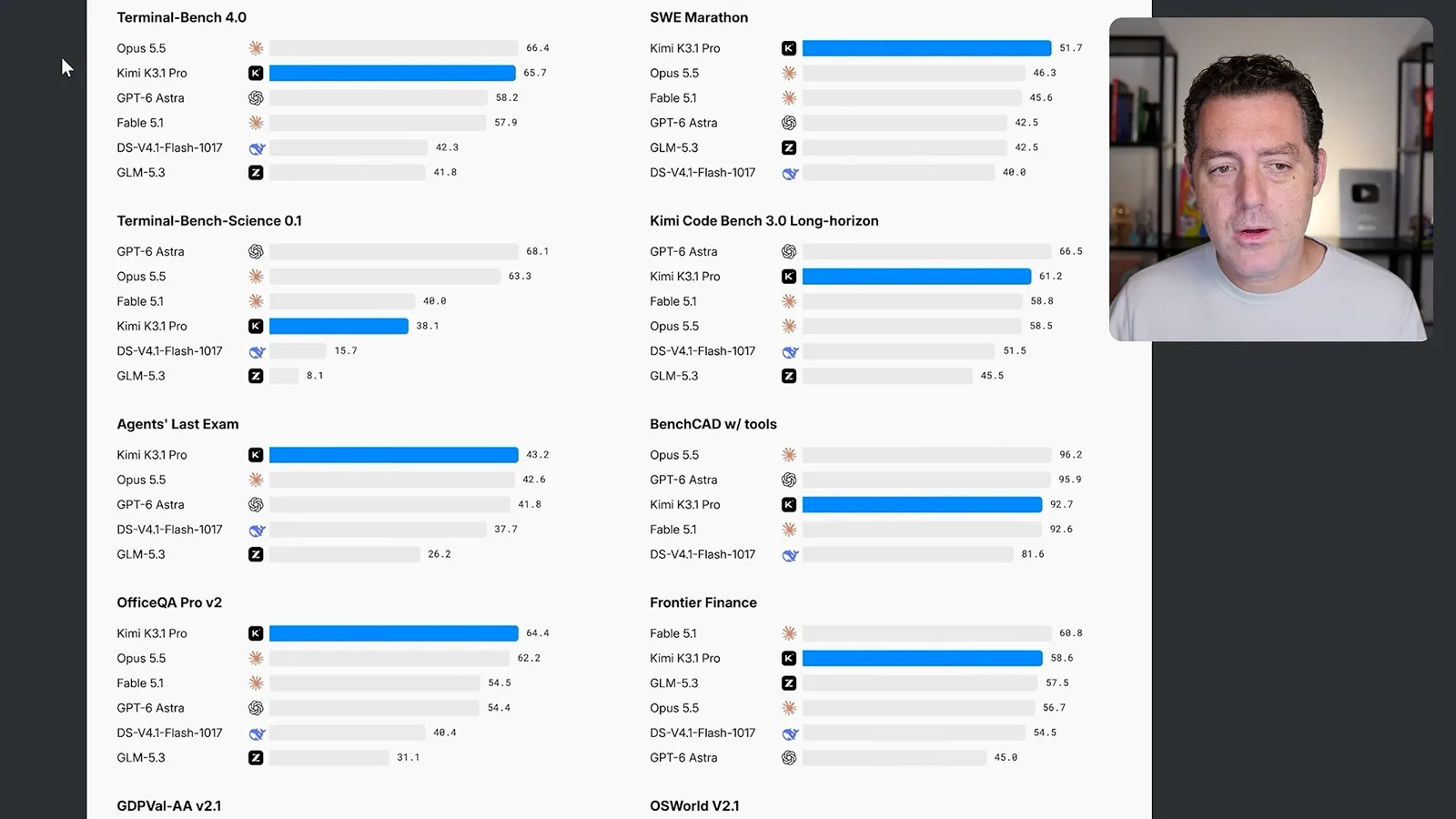
The published chart compares Kimi with several closed models on terminal, agent and other benchmarks. These results are useful comparisons for the tested configurations, but a high score on a particular benchmark does not establish the best model for every task.
[NorthCUA](https://huggingface.co/beipo-ai/NorthCUA-Pro) is a computer-use model family from Beipo AI. I describe the Pro version as a mixture-of-experts model with 397 billion total and 17 billion active parameters, alongside smaller Mini and Nano versions.
The team also provides a harness. In the desktop-agent loop I show, the system observes a screenshot, decides what to do and takes an action, then repeats. I quote OSWorld Verified results from the release; those are reported scores, not my independent reproduction.
Image and decision models
He presents P-H3-Image and Sarvam PRISM.
Pruna AI’s P-H3-Image adapts MiniMax H3 for image generation and editing. The demonstration compares eight generation steps against 50 and claims faster output with a smaller model; measured speed and quality depend on hardware and the chosen comparison.
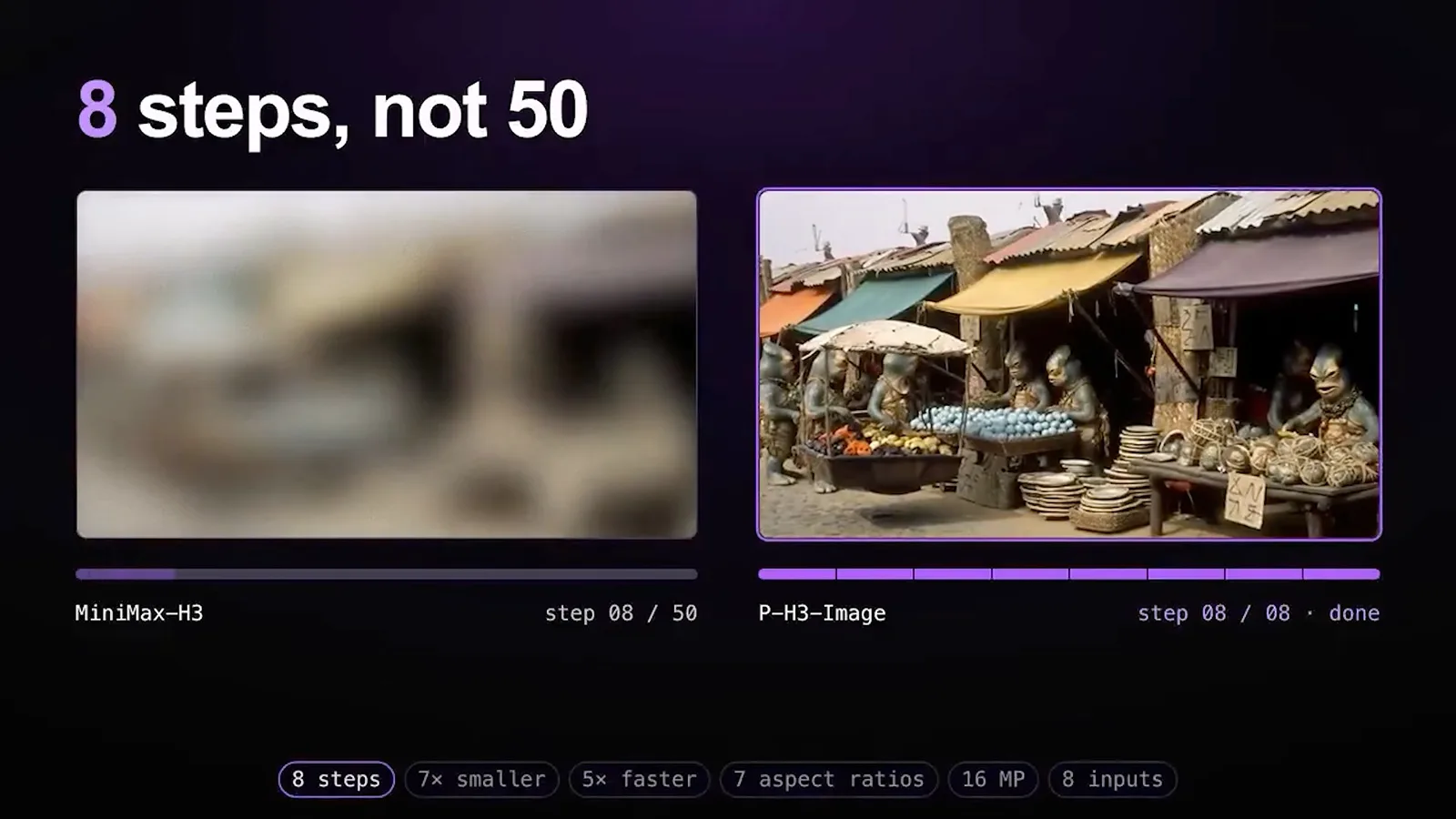
The examples include photorealistic and anime-style images and a handwritten-looking recipe. I prefer some of the displayed outputs, but those are subjective judgments based on selected examples rather than a broad quality evaluation.
[Sarvam PRISM](https://huggingface.co/sarvamai/prism) is presented as a decision model rather than a text generator. Given context and fixed answer options, it returns probabilities for those options; that makes its interface different from asking a chat model to write an answer.
I note that the model weights occupy substantial disk space and the model card recommends data-center-class GPUs. Whether a particular local machine can run it depends on memory, precision and the available implementation.
Science, retrieval and 3D coding
The roundup covers Hydrogen, Perplexity embeddings and a specialized Qwen fine-tune.
Hydrogen 1.0 is presented as a model for scientific work, post-trained from GLM 5.3. I show a Frontier Science comparison and a reported cost per problem. Those numbers come from the release’s chosen benchmark and do not by themselves establish scientific reliability.
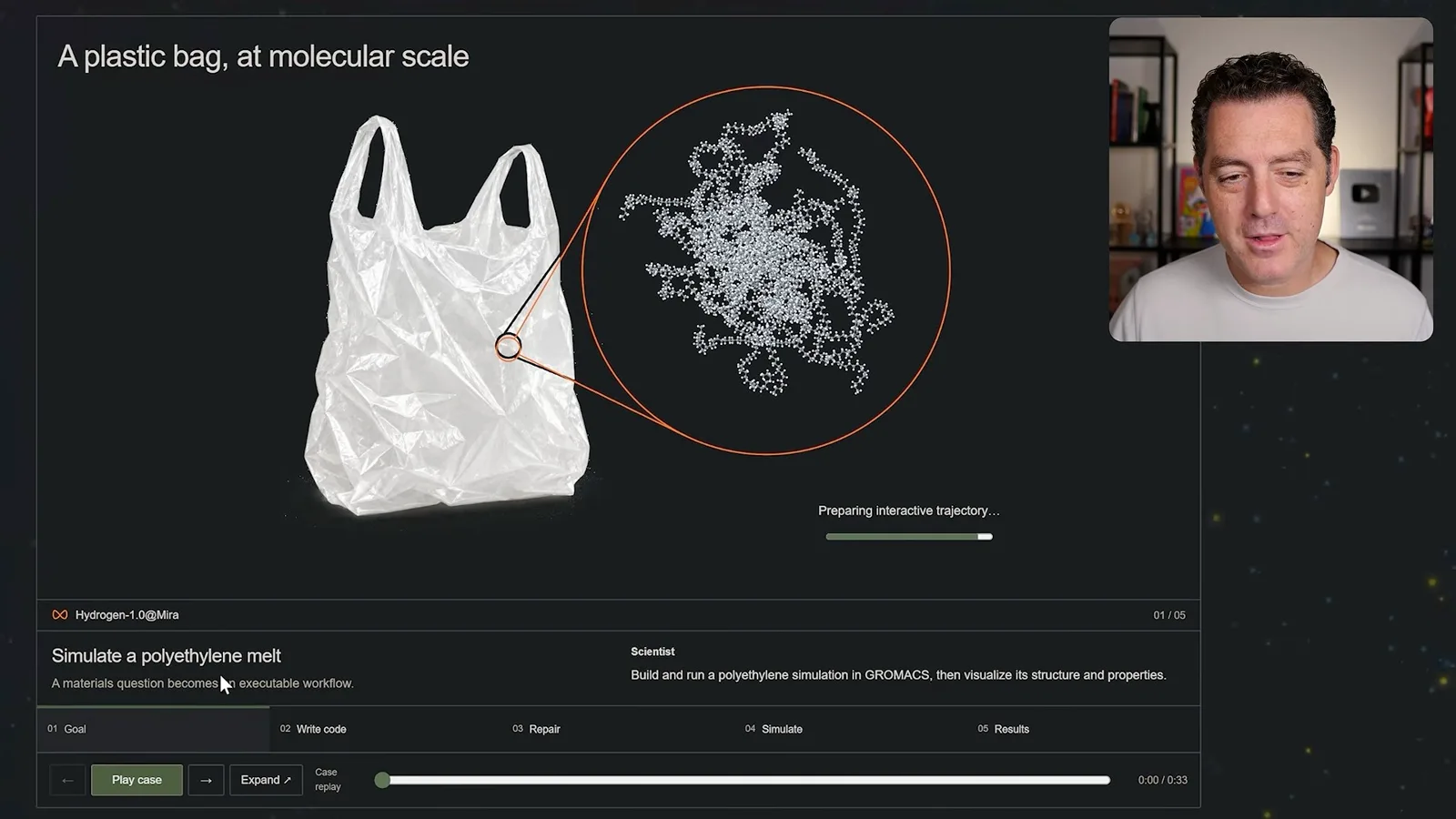
The demonstration asks for a polyethylene-melt simulation and shows code and a molecular visualization. A model-generated simulation is an example of a workflow; its assumptions and results still need domain-expert validation.
Perplexity Embed v2 Context is described as an open-weight vision-language embedding family in 9B and 600M sizes, aimed at retrieval across text, images and visual documents. I point viewers to the accompanying paper and model details.
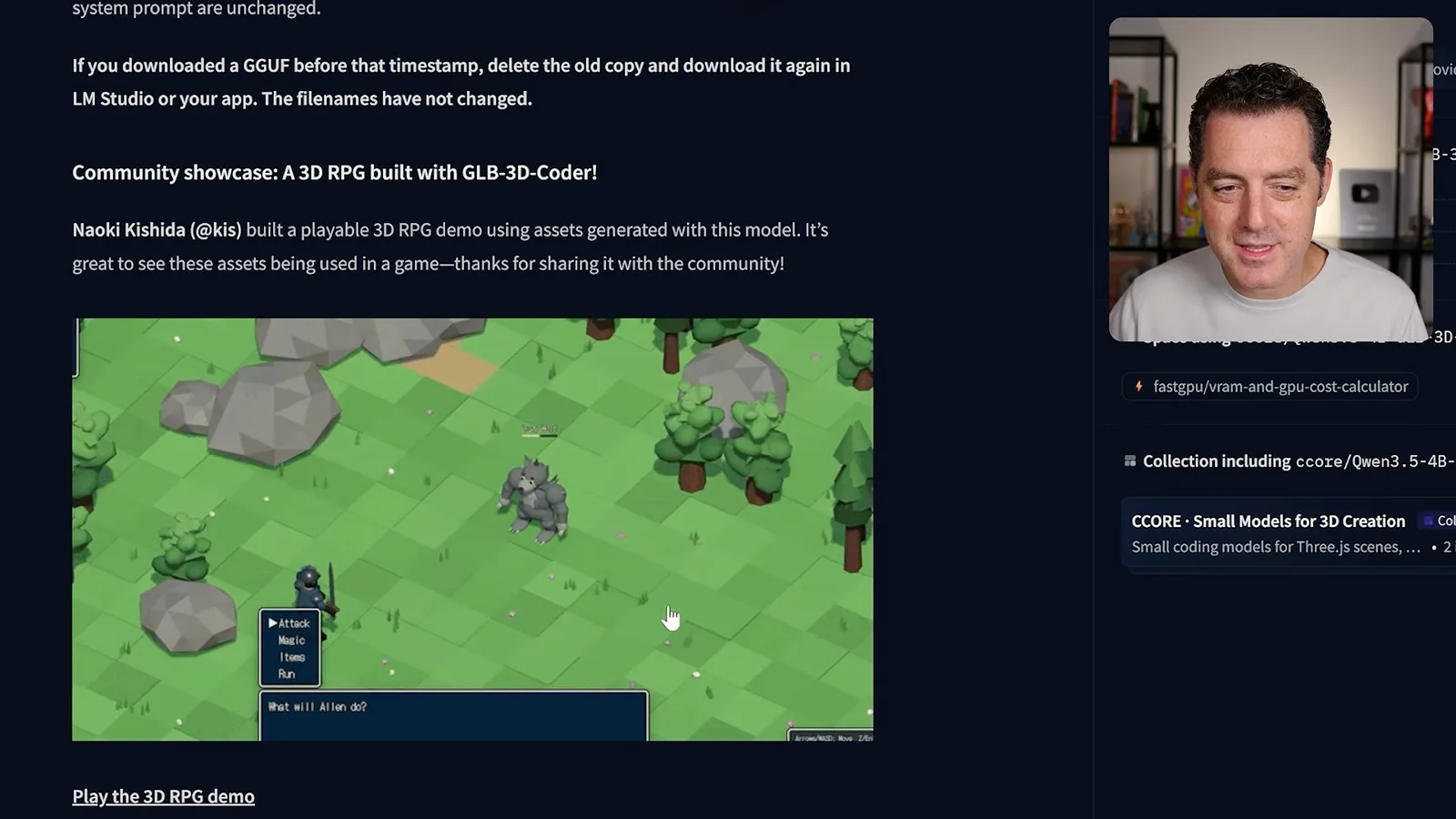
A community fine-tune of Qwen3.5 4B targets 3D coding, including Three.js scenes and GLB export. I show a small game-style example and suggest such a specialized small model could be useful for asset prototyping; quality will vary by task.
Video, voice and diffusion
He shows Pika H3 Flex, Apriel Voice and DiffuSpace Clover.
Pika H3 Flex is a video model based on MiniMax H3. I show sample clips and the developer’s claims about output speed, resolution and pricing; the price and performance depend on service terms and configuration.
In the demonstrated editing flow, several images and an audio file are combined into a generated clip, with later changes to individual elements. I find the examples promising, but they are selected demonstrations rather than a controlled comparison.
ServiceNow’s [Apriel Voice 27B preview](https://huggingface.co/ServiceNow-AI/Apriel-Voice-27B-preview) is described as accepting speech, text and images for task-oriented interactions, with speech output. I discuss its reported benchmarks; running it locally still depends on available hardware and precision.
DiffuSpace Clover is a diffusion-based model described as 35B total and 3B active parameters. I show a computer-use example in which it completes the demonstrated task faster than a comparison model; one example does not measure performance on every task.
On-device models, OCR and Terra
The final stories cover LFM3, Unlimited OCR 2 and GPT-6.1 Terra.
Liquid AI’s [LFM3](https://www.liquid.ai/blog/lfm3) targets on-device use. I highlight its small model size, a 256K context claim and reported improvements over an earlier version. Memory usage and attainable speed will vary by device and configuration.
Baidu’s [Unlimited OCR 2](https://github.com/baidu/Unlimited-OCR) is a document OCR system. I discuss its reported long-document tests and my positive impression; accuracy can still vary with document quality and layout.
Finally I discuss OpenAI’s GPT-6.1 Terra, the closed-weight model in this roundup. I relay the stated price and benchmark comparisons and my colleagues’ positive impressions of video editing. These are time-specific claims, and actual costs depend on the workload and current pricing.
Mehr aus diesem Kanal
 26:47EN
 Matthew Berman· 4. Nov. 2026What Weight-Space Programming Experiments Show—and Their LimitsMatthew Berman · Forward FutureMatthew Berman reviews experiments in which a frontier model reads, repairs and writes other networks’ weights, from small game policies to a targeted language-model edit.
 12:58ENMatthew Berman· 3. Nov. 2026Matthew Berman on Building Personal Software With AIMatthew Berman · Forward FutureA homemade PDF reader leads Berman to argue that coding agents could make customized consumer software more accessible.
 14:45ENMatthew Berman· 29. Okt. 2026Matthew Berman Examines Google’s Gemini 4 Carbon AnnouncementMatthew Berman · Forward FutureMatthew Berman reviews Google’s reported benchmark results, staged rollout and pricing for Gemini 4 Carbon, while noting he has not yet used the model.
 21:11ENMatthew Berman· 28. Okt. 2026Matthew Berman tests DeepSeek V4.1 Flash: coding, vision and local appsMatthew Berman · Forward FutureA hands-on tour of visual coding, image reasoning, local applications and provider economics reveals both impressive results and visible flaws.
 0:37ENMatthew Berman· 28. Okt. 2026Google Announces Gemini 4 CarbonMatthew Berman · Forward FutureMatthew Berman briefly discusses the model announcement and phased access.
 34:21ENMatthew Berman· 27. Okt. 2026Matthew Berman Examines Anthropic’s IPO Filing, AI Growth and GovernanceMatthew Berman, Sam Altman · Forward FutureThe presenter reviews the S-1’s financial metrics, compute strategy and voting structure while questioning the tension between rapid AI development and safety.