30초 요약
A coding agent can make choices so quickly that its creator no longer understands the result. Former Anthropic engineer Thariq Shihipar is experimenting with a remedy in his fighting game: a readable, rule-checked layer that describes character moves while the model maintains the engine beneath it. He argues that increasingly capable models can work in many formats, freeing developers to choose workflows that preserve creative control rather than conforming to a single tool.
- 1Bash and React did not become the only viable interfacesShihipar says early strengths led him to expect command lines or React to dominate. Models can now work through other tools and formats as well.
- 2Capability grows inside the frontier, not only at its edgeHe calls the broad range of tasks that models can do in multiple ways the “smooth interior,” contrasting it with uneven performance on the hardest tasks.
- 3Unspecified game rules let the model make too many decisionsWhen asking an agent to add a rock-throwing move, he found he did not know how it interacted with a wall, or what its speed and size were.
- 4Readable game rules give the creator a ground truthHe separates engine code from a rule-checked folder describing characters and their abilities in terms he can inspect and edit.
- 5A small code edit changes a move while the model handles complexityIn the demo, he adjusts a rock’s size and describes using editor completion, asking Claude to create lower-level building blocks when needed.
핵심 정리
- Separate the readable behavior you want to control from implementation details the agent can maintain.
- Give the agent rules for a human-facing specification so you can understand and adjust its decisions.
- Shihipar argues that model improvements broaden the ways a task can be done, not just the hardest benchmark a model can pass.
- Treat AI-generated software as an opportunity to improve quality and creative choices, not only production speed.
챕터별로 다듬은 전문 읽기
The predictions that did not hold
Shihipar revisits predictions about models and creative tools. He says several fears that one interface or medium would dominate proved misplaced.
I have been reflecting on what I got right and wrong since leaving Anthropic. I was right that models would help edit video, use HTML to understand their work, and help people explore unfamiliar questions and plan.
It is easy to remember only the successful predictions. I also expected Bash to be the universal interface because early agents, including Claude Code, used it so effectively.
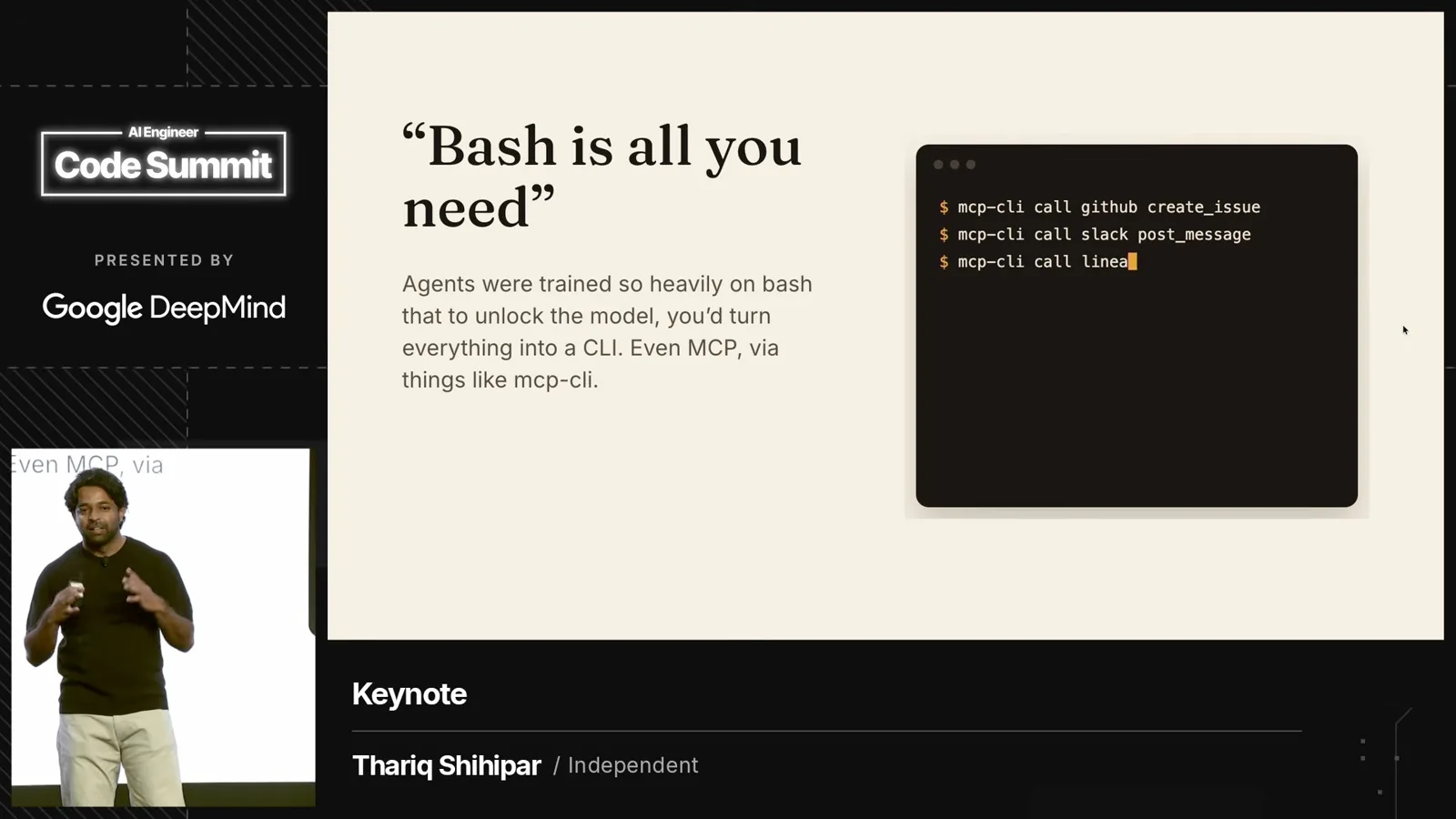
That did not happen. I now prefer MCP to command-line interfaces in some cases, and code mode, skills and progressive disclosure provide other ways for agents to act. Bash’s prominence reflected part of how early models were trained.
I also feared that React would become the last language people needed because models wrote it well. Now they can produce HTML, React, Swift or Figma’s JSON format, so the result need not lock us into one technology.
I worried that diffusion models would consume art and leave people little control. Instead, language models can also make art through code or operate tools such as Blender, Photoshop and Figma.
Those fears share a picture of an alien intelligence with a fixed way of working that humans must accept. I no longer think that is the only outcome; the question is how to stay human-centered as models improve.
Software production and creative quality advance together
He compares automation to an industrial revolution and a renaissance. He argues that developers can aim for quality as production becomes easier.
Software engineers are at the leading edge of adoption. How we respond to low-quality output and use new capabilities may offer lessons for other knowledge work.
I see AI as both an industrial revolution and a renaissance. Software production is becoming more reliable and less constrained by the difficulty of implementing an idea.
At the same time, people want better software. Creativity, usefulness and care can become more valuable as routine production becomes easier, even though holding both ideas together is difficult.
The smooth interior beneath the capability frontier
He distinguishes frontier benchmarks from a growing range of familiar tasks models can perform in multiple formats. A map exercise illustrates model knowledge.
Capability is often described as a jagged frontier. A few years ago we asked for a function, then a feature or a simple app; now the striking examples involve much larger projects.
I also think about the “smooth interior”: the broad set of tasks comfortably within a model’s ability. If a model can implement an interface in React, it may also be able to express it in HTML or Figma’s format.
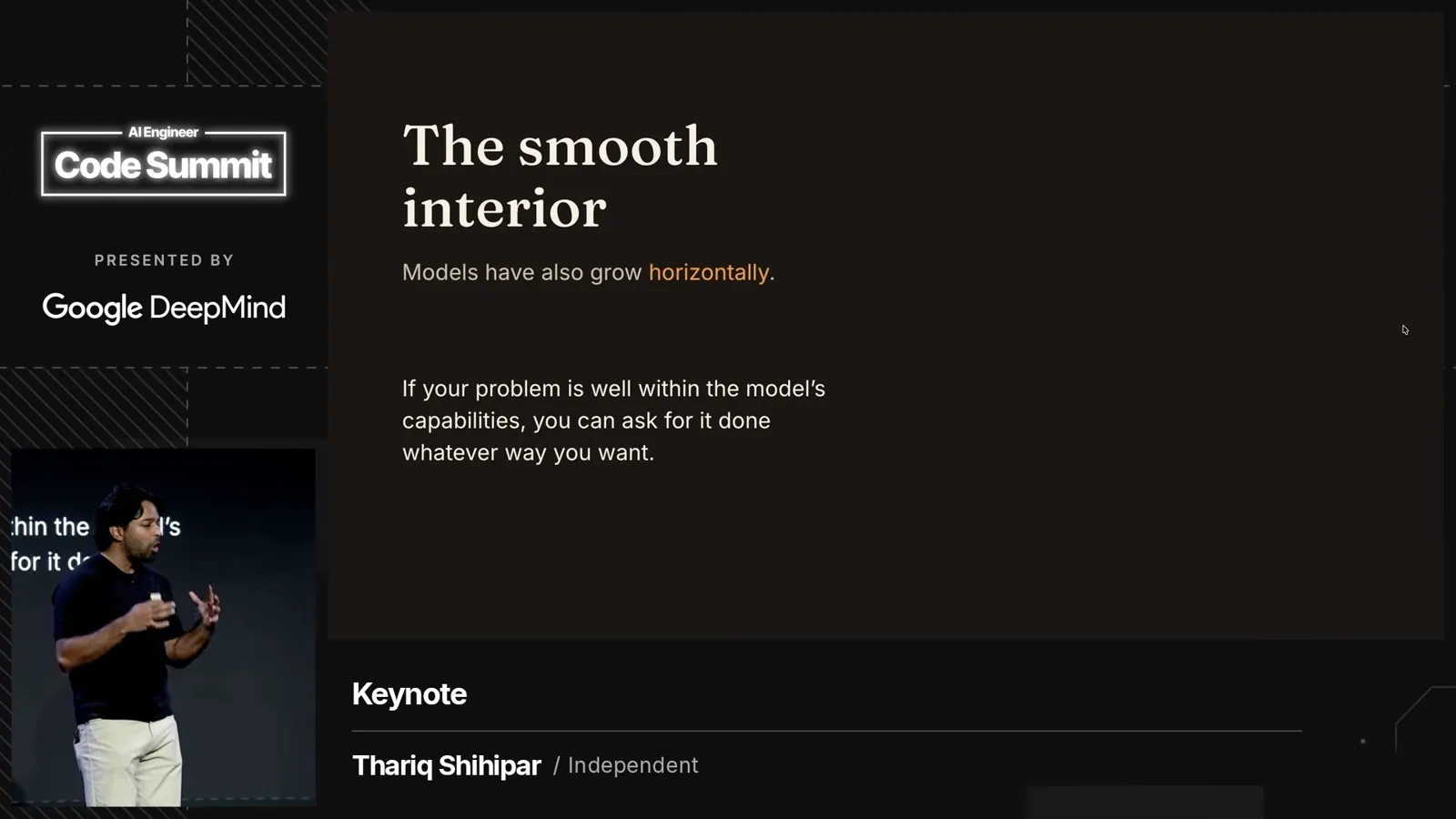
That breadth matters more to me than another impressive edge-case benchmark. I can choose how to build a mockup or video and focus on whether the result is good.
Today we build scaffolding and review model output. I expect more work to move into that smooth interior as models improve. In an idealized future, a sufficiently capable model would satisfy the specification without extensive review.
One illustration of model knowledge asks whether latitude-longitude points are land or water, then plots the answers. The maps become sharper across model generations, showing a kind of general knowledge that a coding benchmark alone does not capture.
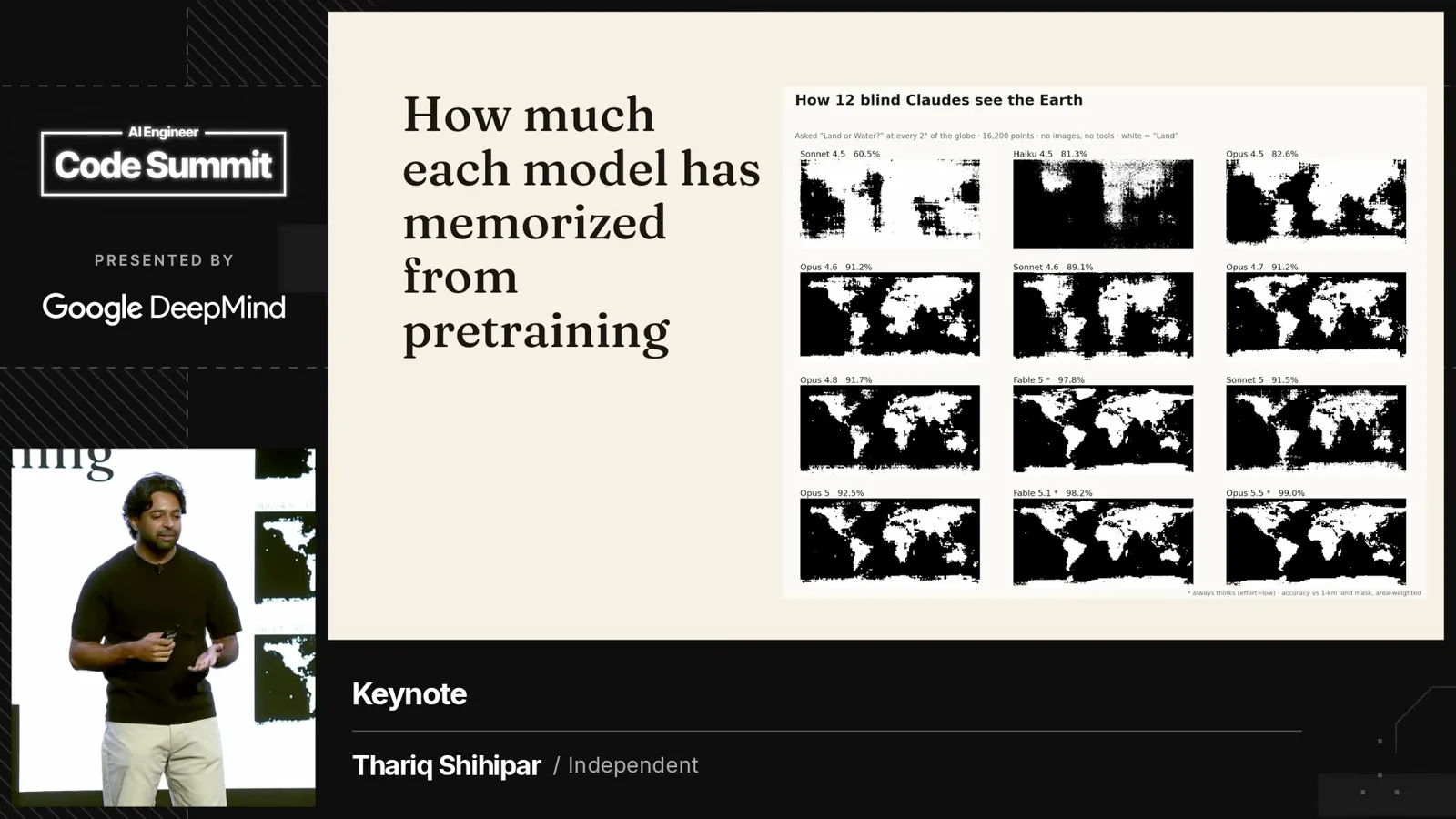
We can use intelligence to understand and shape how we use intelligence. I think that may become a focus after a period spent industrializing software production.
A game exposes lost control over agent decisions
Vague requests led the model to choose mechanics the creator did not understand. He began separating engine code from readable rules.
I have been building a two-dimensional fighting game inspired by Avatar and Smash Brothers. Asking a model to add moves is fun, but it also leaves me uncertain what my characters actually do.
For example, a request to throw a rock leaves many choices open. Can the rock pass through a wall another character summons? How large is it, how quickly does it travel, and can it be charged?
The model fills in those details. I try the result without understanding it, get distracted while waiting for prompts, and sometimes make less progress. I do not think that has to be the permanent shape of AI-assisted work.
Good work often involves messy judgment about what to include and omit. To make something excellent, I need enough understanding of the game to make those choices rather than merely accept the model’s defaults.
My early approach divides the codebase into an engine and a folder of human-facing rules. Claude receives checks and instructions to keep that folder readable, almost like English or a specification.
When I read this layer, I can understand and adjust the behavior without understanding every engine detail. It gives me a ground truth for what the game is supposed to do.
Editing a game through a human-readable layer
The demo shows character abilities represented in code he can read and tune. The model still creates complex primitives beneath that layer.
In the demo, the engine contains implementation details such as camera handling. A separate area holds characters and their abilities, including the rock move.
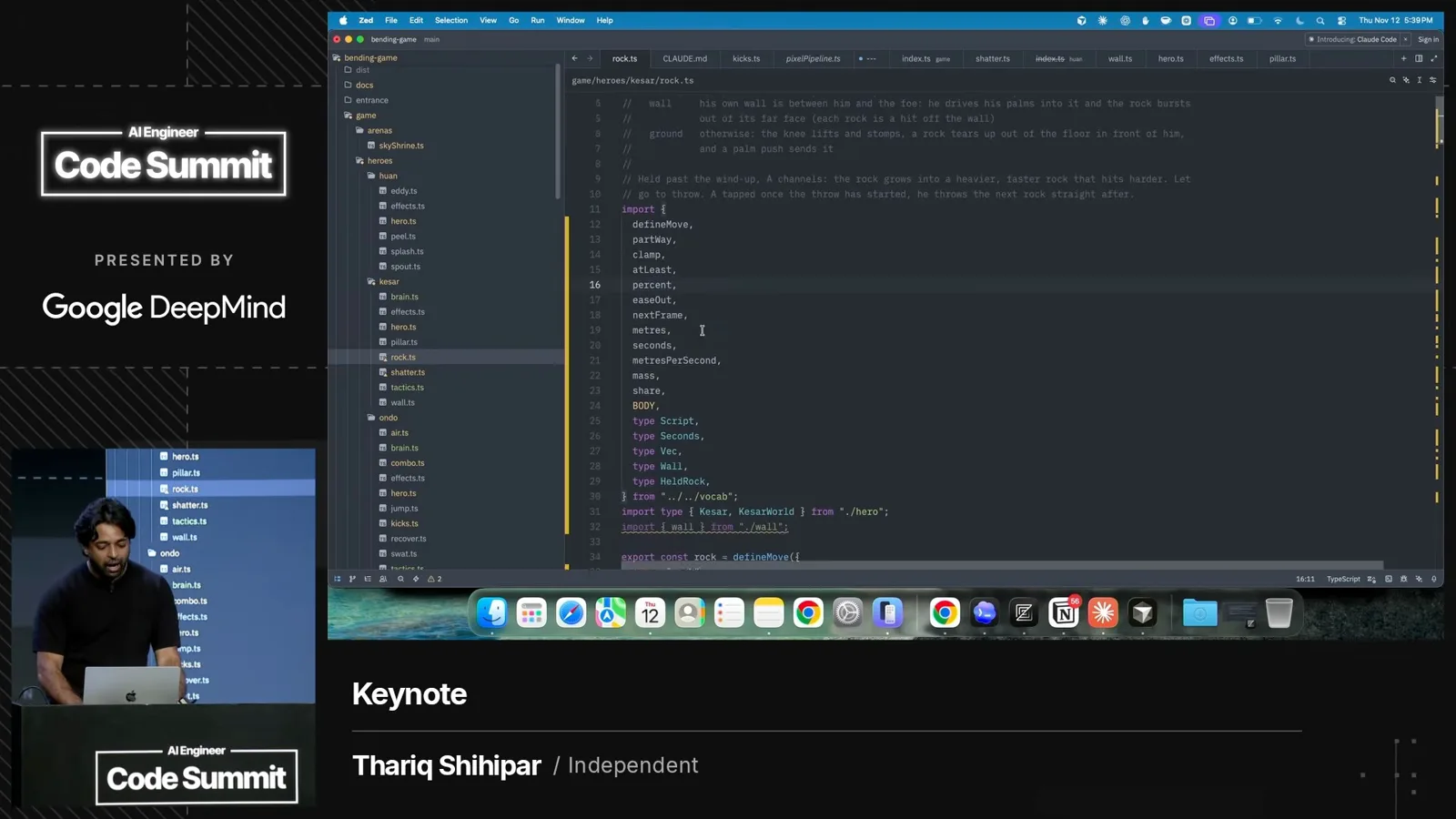
The move is commented and uses meaningful units such as meters. I can see that the character can obtain a rock in different ways, such as from the ground or a wall, without reading all the underlying implementation.
This is almost a custom scripting language for the game. I can change a number to make a rock larger, return to the game, charge it and throw it.
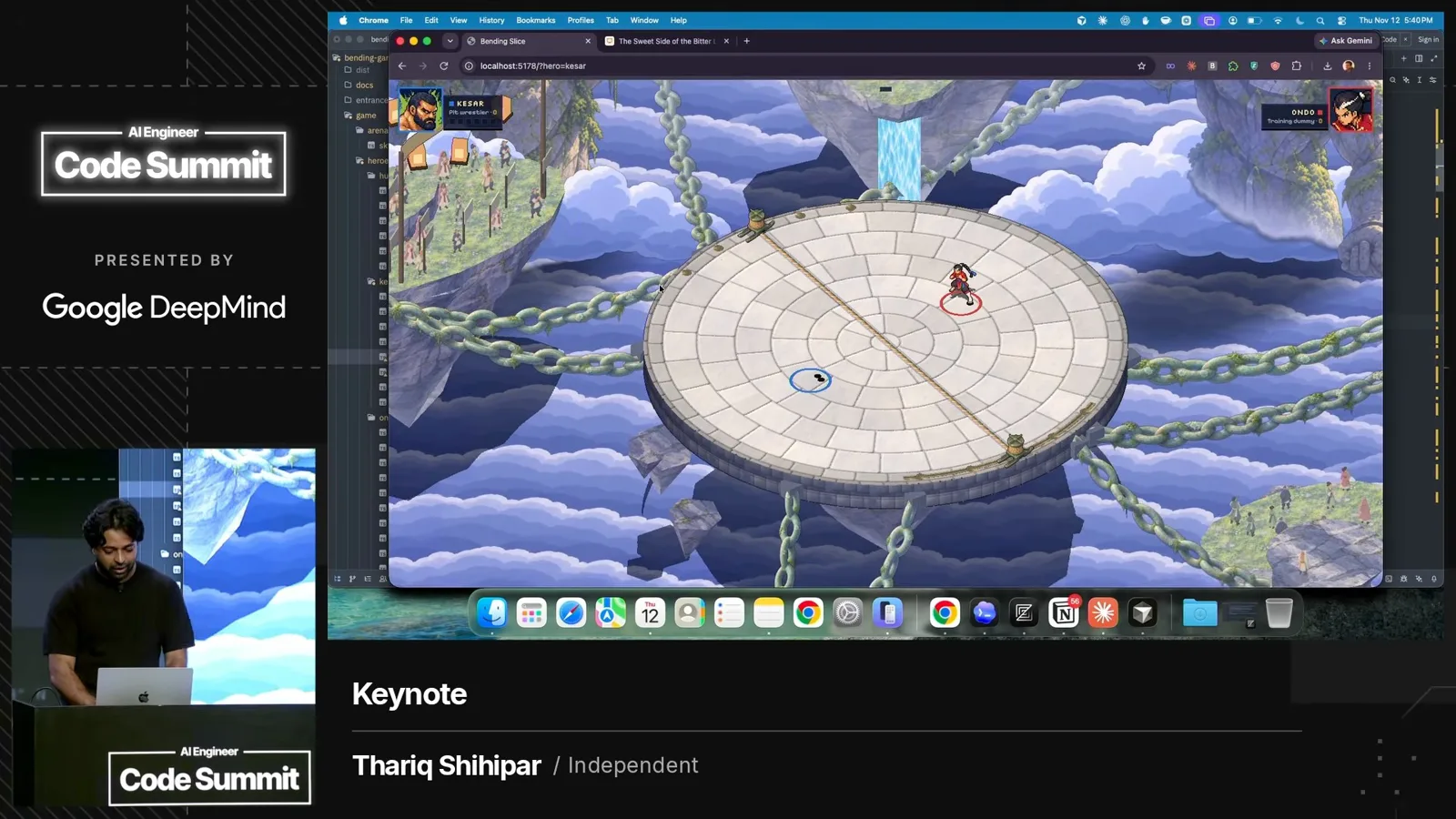
I have also been using editor completion to add small rules, such as queuing an action when a wall appears. It resembles specification-driven development, except the specification is executable game code.
I do not know whether this will be my final method. For complicated behavior I still ask Claude to create the primitives, but the readable layer lets me review and work alongside it with more control.
The takeaway for me is to ask how I can deliver high-quality software rather than assume I must follow the model’s preferred language or workflow.
Choose the working experience and pursue quality
Shihipar suggests new languages, interactions and aesthetics as possible directions. He asks developers to decide what experience they want from AI-assisted work.
There may be room for efficient, modular and readable languages, new databases and operating-system interactions, and a return to ideas from human-computer interaction research.
New aesthetics and interaction patterns are possible too. We need to decide what the future of work and our ideal experience should look like; I believe models will increasingly be able to accommodate those choices.
같은 채널의 다른 글
 22:25EN
 AI Engineer· 2026년 11월 19일Fabian Hedin: How Lovable keeps coding agents working for hoursFabian Hedin · LovableLovable separates agent history from execution, checkpoints working computers, and feeds verification results back into each task.
 17:50ENAI Engineer· 2026년 11월 18일Melvin Johnson: Train coding agents to solve tasks, not game testsMelvin Johnson · Google DeepMindGoogle DeepMind’s post-training lead explains harder tasks, reviewer-style grading and rewards for honest reports.
 14:07ENAI Engineer· 2026년 11월 18일Walden Yan: Build the Feedback Loops That Let Coding Agents WorkWalden Yan · CognitionCognition reports 40 times more merged changes after making its code testable by agents and assigning longer-running goals.
 58:03ENAI Engineer· 2026년 11월 17일How Codex Connects Context, Cloud Work and Agent DelegationDominik Kundel, Charlie Guo · OpenAIOpenAI’s Dominik Kundel and Charlie Guo show how connected context, quick feedback and remote agents fit into real work.
 19:38ENAI Engineer· 2026년 11월 17일Simon Willison: AI Agents Can Solve More, but Engineering Still Feels HardSimon Willison · DatasetteA beeping detector, a strategy game and a pelican benchmark show how coding agents changed his work in 2026.
 19:55ENAI Engineer· 2026년 11월 16일Brandon Thomas: AI Agents Can Help Rebuild Creative Apps in the OpenBrandon Thomas · ArtCraftArtCraft’s team built an initial Photoshop-like editor in about a day, then enlisted a community to expand open creative tools.