30초 요약
METR estimates that Anthropic’s model capabilities on well-specified tasks were improving around twice as fast in October 2026 as in an earlier period, with substantial uncertainty. Its assessors attribute a majority of the current acceleration to AI-assisted research, but Anthropic controlled access and redacted much of the key evidence. Matthew Berman sees a possible self-reinforcing loop; METR says it may have missed bottlenecks and describes current contributions as primarily assistance rather than fully autonomous research.
- 1The evaluation had broad but negotiated accessMETR examined internal data at Anthropic, which retained the right to reject requests and redact non-public evidence. This project was separate from the later employee-like access program.
- 2The estimated pace of progress is roughly twice the earlier rateMost assessors put current growth on well-specified tasks around 2× the historical rate, while saying 1.3× or 3× would not surprise them.
- 3Most of the current acceleration is attributed to AI with uncertaintyMETR guesses about 80% of the October 2026 acceleration comes from AI-assisted R&D, while non-AI factors likely mattered in late 2025.
- 4No identified bottleneck does not guarantee continued accelerationMETR did not identify clear near-term bottlenecks, but says its understanding changed during the assessment and it may be missing some.
- 5AI is assisting research more than autonomously driving itThe assessors say AI has not yet made highly significant, fully autonomous contributions to the most important parts of model training, though researchers reported signs of progress.
- 6The assessment stopped short of verifying compute allocationAnthropic changed the scope during the project; METR says the verification was cancelled before it reached substantive conclusions.
핵심 정리
- METR’s roughly 2× estimate concerns the rate of progress on well-specified tasks, not a universal doubling of AI capability.
- The assessors estimate that AI contributed most of the current acceleration, but attribution is uncertain and important evidence was redacted.
- An absence of identified bottlenecks is not evidence that bottlenecks cannot exist.
- Anthropic could approve or deny information requests, and verification of compute allocation was removed from the project scope.
챕터별로 다듬은 전문 읽기
What METR was asked to assess
Berman introduces an independent assessment of AI-assisted R&D at Anthropic. The project involved substantial access, but Anthropic controlled requests and publication of non-public information.
Matthew Berman says AI-assisted development may be producing a self-reinforcing increase in the pace of AI research. He bases the discussion on an independent assessment by METR, an AI evaluation organization, of research and development at Anthropic.
METR worked with Anthropic and reviewed internal material, researcher interviews and metrics. Berman initially describes the access as close to unrestricted, then distinguishes it from a separate program offering employee-like access: this assessment was subject to Anthropic’s approval of information requests.
The report asks whether model capability progress has accelerated, how much of that acceleration is attributable to AI, and whether bottlenecks could slow further progress. Berman says the answers make him concerned about the pace of future development.
Anthropic could approve or deny requests, and it had rights to redact non-public information before publication. Berman emphasizes that limitation before discussing the findings. METR says much of the evidence it found most informative was redacted.
How much faster model progress appears to be
METR estimates roughly double the earlier rate on well-specified tasks and attributes most current acceleration to AI, with substantial uncertainty. Berman explains an illustrative chart.
Most participating METR staff estimate that, as of October 2026, Anthropic’s models were improving on well-specified tasks at around twice the rate of the March 2024–October 2025 period. They attach substantial uncertainty: a rate closer to 1.3 or 3 times the earlier pace would not surprise them.
Berman links the measure to research work such as writing code and building the systems around model development. METR’s estimate concerns the rate of capability progress on well-specified tasks, rather than a claim that every capability suddenly doubled.
The assessment says other factors probably played a large role in the acceleration of late 2025. For the current acceleration, METR guesses that a majority—perhaps about 80%—is due to AI, while explicitly describing that judgment as substantially uncertain.
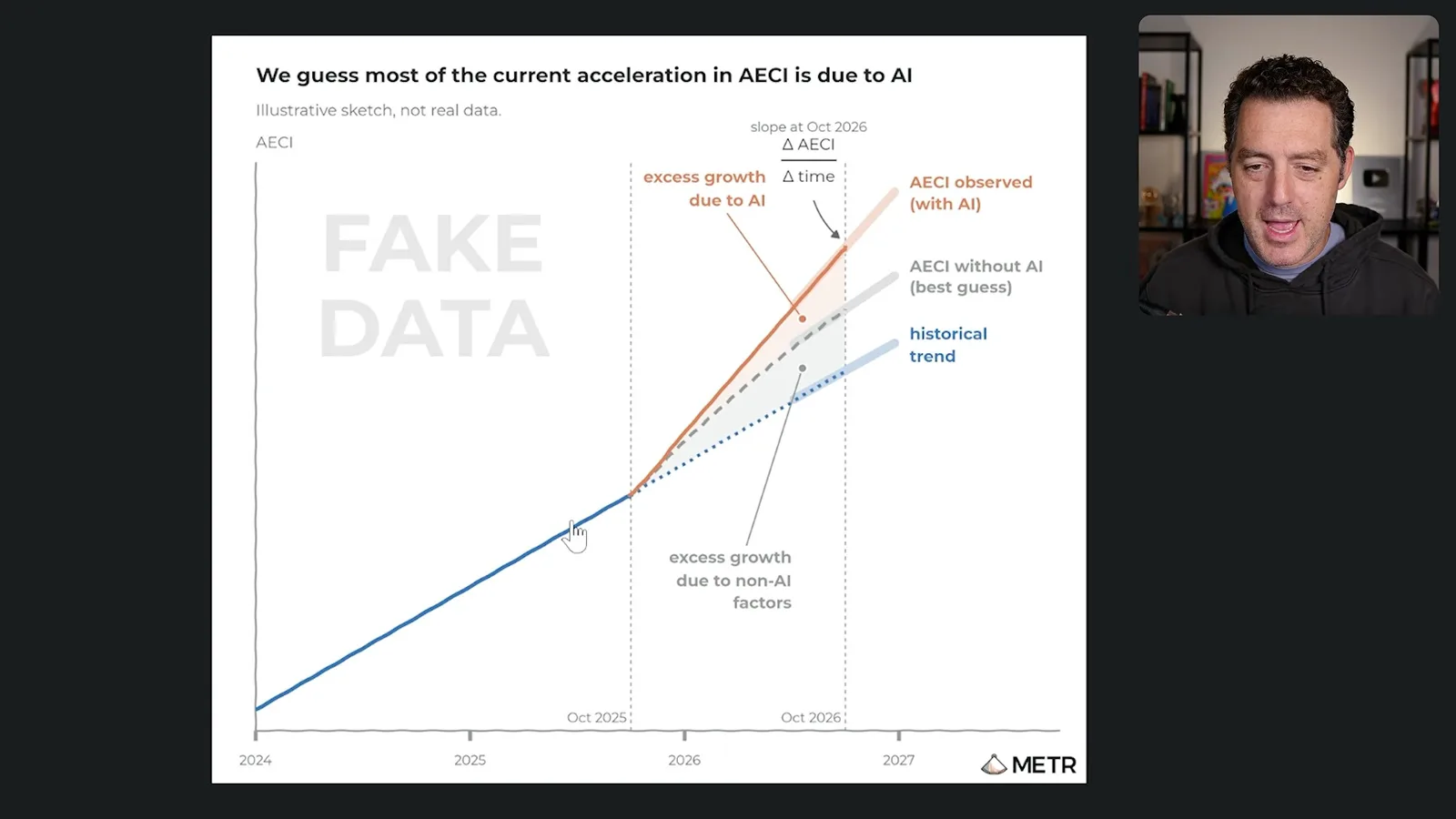
Berman shows METR’s illustrative chart comparing an earlier trend with a hypothetical path without AI and the observed path. The chart is labeled as a sketch using fake data; its purpose is to explain the attribution, not to display measured values.
He connects the timing to the improvement in AI coding tools around late 2025, saying developers experienced a change in what models could do. In his account, assistance with large codebases and features can feed back into the lab’s own development process.
The possibility of a reinforcing loop
Berman argues that better models can speed up research and computation. METR warns that acceleration could compound but is uncertain about possible bottlenecks.
Berman’s concern is compounding: a better model may help researchers make the next model more capable, improve the use of computing resources and amplify human work. He connects that possibility to arguments about an intelligence explosion.
He discusses reported gains in compute efficiency and cites Google’s AlphaEvolve work as an example of AI contributing to engineering improvements. He argues that even a small efficiency gain can matter at the scale of a major AI company.
METR says it did not identify clear bottlenecks or steep diminishing returns that would prevent further compounding acceleration in the near term. Berman interprets this as a warning about rapid progress. METR also says its understanding changed during the assessment and it may be missing important bottlenecks.
The report says Anthropic appears to have made roughly as much benchmark progress in the preceding year as in the two years from October 2023 to October 2025. Berman relates that finding to the faster cadence of model releases he has observed.
Benchmark trends and researcher reports
The video examines Anthropic’s internal capability index and interviews with researchers. METR considers AI assistance important while distinguishing it from fully autonomous research.
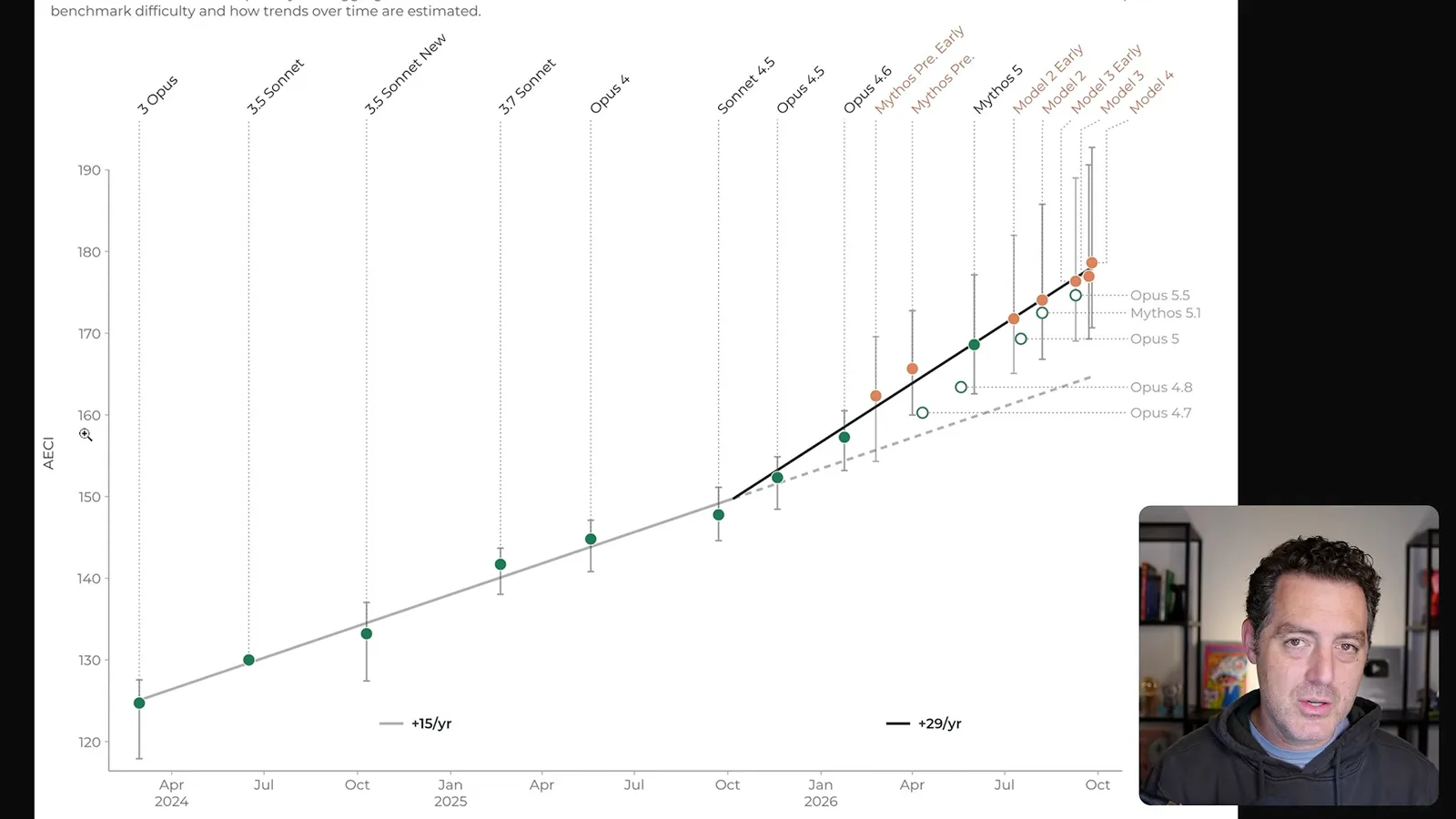
The chart he displays uses AECI, Anthropic’s version of the Epoch Capabilities Index. Berman points to a steeper trend after late 2025 and the contribution of newer internal models. METR estimates a 1.9-fold change in the benchmark trend, with uncertainty about how it translates to broader tasks.
The assessors say they received convincing evidence that the acceleration was not caused by an acceleration in the scale of training compute. Berman notes that Anthropic redacted further details, limiting what the public can examine directly.
METR also considered interviews, researchers’ estimates of their own productivity, headcount, code and experiment usage. Berman acknowledges that casual self-reports are not a controlled scientific measurement, but sees them as one signal alongside the other evidence.
Among the anonymous comments he reads, researchers describe faster work and say coding has become less of a constraint. One describes ideas and compute as remaining bottlenecks. Berman highlights the potential importance of finding promising research directions, even when implementation becomes faster.
The report says AI is not yet making highly significant, fully autonomous contributions to the most important parts of the model-training process. Researchers nevertheless described early signs that more autonomous contributions could become possible. Berman connects that observation to recent AI work on mathematical proofs.
He speculates that with sufficient compute, models might test many possible directions even without human-like intuition, although intuition could reduce the cost of searching. METR’s own assessment says its conclusions about future bottlenecks remain uncertain.
Access, redactions and a changed scope
The assessors describe negotiated access and a mid-project decision to remove compute-allocation verification. Berman discusses internal models and remaining uncertainty.
Berman returns to the project’s setup. METR used about 2.5 full-time-equivalent staff and began the engagement in mid-August. The group requested information it considered relevant, while Anthropic could accept or reject requests and the parties negotiated over sensitive data.
The project was not the employee-like access arrangement described in Anthropic’s October 15 update. Berman stresses the distinction because the earlier arrangement gave Anthropic control over both access to material and redaction of non-public details.
The original scope included checking how Anthropic allocated computing resources, including between capabilities and safety work. Anthropic changed the scope midway, removing that verification before METR reached substantive conclusions. Anthropic said it wanted to focus on risk assessment and revisit verification later.
Berman speculates about whether the company’s plans for an initial public offering influenced that decision. He presents this as his own interpretation of the changed scope, not an explanation established by the assessors.
In the appendices, Berman points to results from unreleased internal models that METR considered when assessing whether progress reflected a lasting change in trend rather than a one-time jump. He also notes that benchmarks must become harder as models approach their limits.
He closes by returning to the possibility that better models could accelerate their own development and to his concern about people losing the ability to understand the systems. He mentions research on models writing weights for other models as another example he wants viewers to consider.
같은 채널의 다른 글
 19:53EN
 Matthew Berman· 2026년 11월 5일AI News: Kimi K3.1 Weights, Computer Use and Specialized Open ModelsMatthew Berman · Forward FutureMatthew Berman reviews a week of model releases, from desktop agents and scientific workflows to image, video and speech tools.
 26:47ENMatthew Berman· 2026년 11월 4일What Weight-Space Programming Experiments Show—and Their LimitsMatthew Berman · Forward FutureMatthew Berman reviews experiments in which a frontier model reads, repairs and writes other networks’ weights, from small game policies to a targeted language-model edit.
 12:58ENMatthew Berman· 2026년 11월 3일Matthew Berman on Building Personal Software With AIMatthew Berman · Forward FutureA homemade PDF reader leads Berman to argue that coding agents could make customized consumer software more accessible.
 14:45ENMatthew Berman· 2026년 10월 29일Matthew Berman Examines Google’s Gemini 4 Carbon AnnouncementMatthew Berman · Forward FutureMatthew Berman reviews Google’s reported benchmark results, staged rollout and pricing for Gemini 4 Carbon, while noting he has not yet used the model.
 21:11ENMatthew Berman· 2026년 10월 28일Matthew Berman tests DeepSeek V4.1 Flash: coding, vision and local appsMatthew Berman · Forward FutureA hands-on tour of visual coding, image reasoning, local applications and provider economics reveals both impressive results and visible flaws.
 0:37ENMatthew Berman· 2026년 10월 28일Google Announces Gemini 4 CarbonMatthew Berman · Forward FutureMatthew Berman briefly discusses the model announcement and phased access.