30초 요약
In this September 2023 news roundup, Matthew Berman discusses Tesla's AI infrastructure and supervised Full Self-Driving demonstration, OpenAI's reported revenue and Enterprise launch, Code Llama, and a research drone that won races against champion pilots. He also covers open-model grants, Google's products, a proposed California city, generative media and the US Copyright Office's inquiry. The video is a historical snapshot: reported revenue, launch features and predictions are not current figures. The coding comparison is benchmark-specific, the driving demo required human supervision, and security measures are not a guarantee against all leaks. No sponsor segment is identified.
- 1Tesla's AI buildoutBerman discusses a reported H100 cluster and a supervised FSD v12 demonstration that included an intervention.
- 2OpenAI's businessRevenue and usage figures are historical reports; the cited web panel is not a complete accounting of ChatGPT use.
- 3Code Llama comparisonBerman cites fine-tunes that reportedly beat GPT-4 on coding tests, a benchmark-limited claim rather than a universal ranking.
- 4Swift races championsThe research drone won 15 of 25 races against three human pilots on a specified track and recorded the fastest race time.
- 5Google's AI announcementsThe roundup covers Workspace assistance, Vertex AI, TPUs and SynthID, whose watermark was initially limited in scope and not foolproof.
- 6AI and copyrightThe US Copyright Office sought comments on training, generated outputs and liability; the inquiry was not itself a final legal rule.
핵심 정리
- Tesla's 2023 FSD demonstration included a human intervention and did not establish autonomous driving without supervision.
- A 2023 ChatGPT traffic study was based on a panel and sampled prompts; it does not measure all use or imply that programming was a majority of sessions.
- A Code Llama fine-tune's reported advantage over GPT-4 on a particular coding benchmark is not proof of superiority on all coding work.
- Swift won 15 of 25 controlled races against three champion pilots and had the fastest recorded time on that course.
- Enterprise privacy policies, encryption and SOC 2 controls reduce risks but do not guarantee absolute security.
- The copyright inquiry sought public input; AI-assisted works and training uses raise distinct legal questions.
챕터별로 다듬은 전문 읽기
Tesla's AI and driving
Berman reports on a planned H100 cluster and Musk's supervised FSD demonstration. A human intervention illustrates its limitations.
This September 2023 roundup covers Tesla's AI plans, OpenAI's business, Code Llama, drone racing and generative media. The figures and product availability are reports from that week, not current specifications; my comparisons are commentary rather than comprehensive tests.
I report that Tesla was bringing online a roughly $300 million AI cluster with 10,000 NVIDIA H100 GPUs, intended in part for training Full Self-Driving. Tesla's Tim Zaman also described a real-world video training dataset and a hot-tier cache over 200 petabytes. These were company-side claims about infrastructure and capacity, not independently audited measurements in this video.
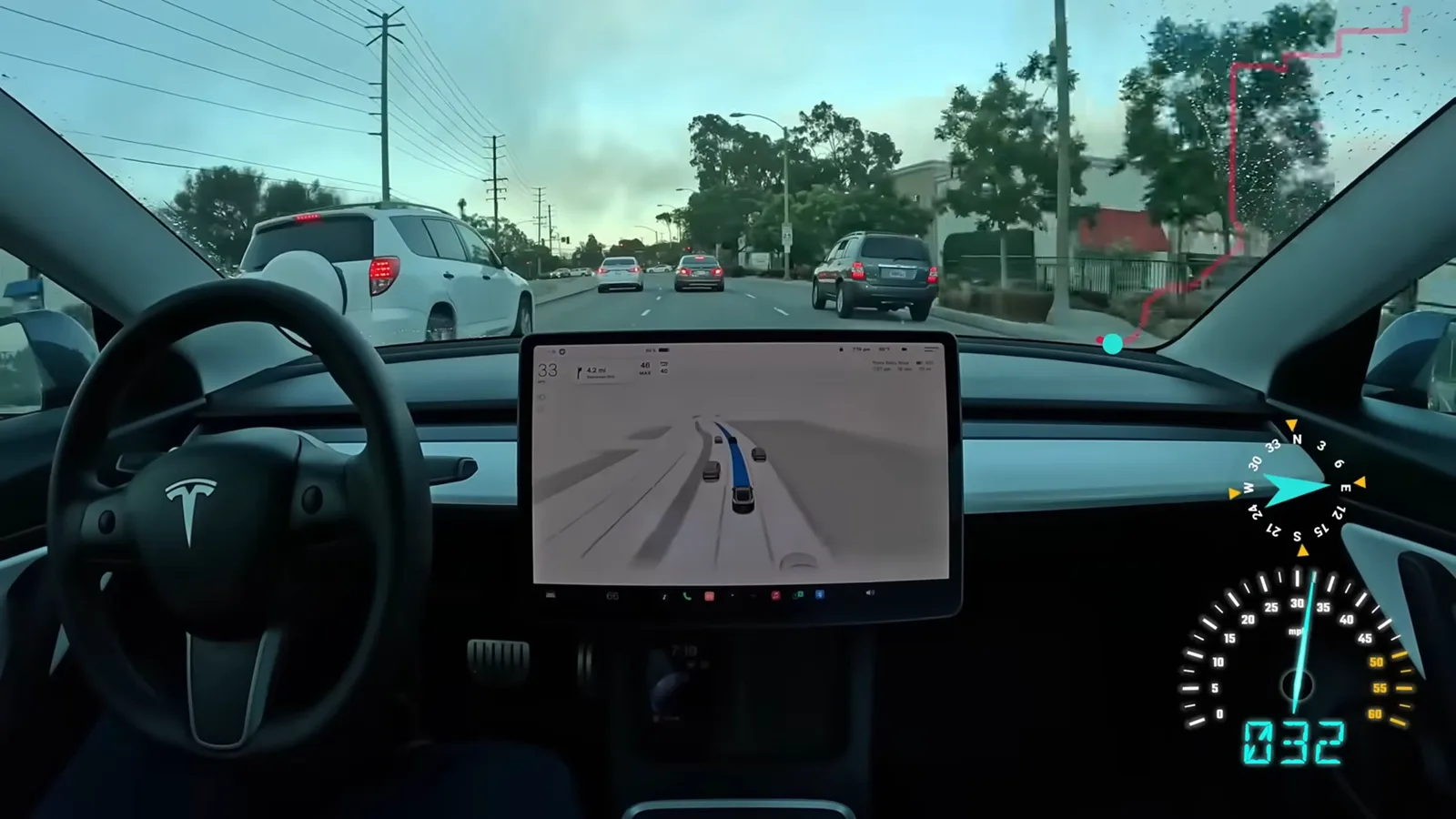
Elon Musk also streamed an early FSD v12 drive. I say the car navigated roundabouts and construction but nearly ran a red light, prompting Musk to take over. This was a supervised driver-assistance demonstration, not evidence of an autonomous system that could safely operate without a responsible human.
I discuss Tesla's move toward camera-based perception and neural networks for driving, contrasting its approach with competitors. My claim that v12 was the first camera-only version simplifies an earlier transition to Tesla Vision and should not be read as a verified account of every sensor or driving function. Musk's remark about visiting Mark Zuckerberg is a joke in the demonstration.
OpenAI and Code Llama
He discusses reported revenue, a sampled traffic study and the Enterprise launch. He then examines claims about coding-model benchmarks.
Reports at the time estimated that OpenAI was spending heavily on AI operations while reaching a revenue run rate above $1 billion over the following year, compared with reported 2022 revenue of $28 million. These were press estimates and a projected run rate, not audited annual profit or a current financial statement.
A [SparkToro and Datos analysis](https://sparktoro.com/blog/we-analyzed-millions-of-chatgpt-user-sessions-visits-are-down-29-since-may-programming-assistance-is-30-of-use/) reported a roughly 29% decline in OpenAI web traffic from May 2023 in its opt-in panel. Its classification of 4,098 selected prompts put programming at about 29%, the largest category, not a majority of all usage; the panel does not capture every way people access the service.
I mention sessions with one or five-plus prompts and common request words. The study actually describes approximately one third each for single-prompt, two-to-four-prompt and five-or-more-prompt sessions, so there was also a substantial middle group. My interpretation that usage was settling after an initial surge is a hypothesis, not a result the study proves.
I say business clients were concerned about privacy when using ChatGPT and discuss the August 2023 launch of ChatGPT Enterprise. [OpenAI's announcement](https://openai.com/index/introducing-chatgpt-enterprise/) stated that business prompts and data were not used for model training, and described encryption, SOC 2 compliance, an admin console and single sign-on.
The original Enterprise offer also advertised faster, uncapped GPT-4 access and a longer context window. I considered it compelling for businesses, but my suggestion that these controls guarantee privacy and security goes too far: contractual settings, access controls, retention, integrations and other security risks still matter. Features and terms can change.
Meta released Code Llama, a code-focused family based on Llama 2, and I highlight third-party fine-tunes reported to outperform GPT-4 on coding tests. Such results depend on the specific model, benchmark, test conditions and comparison version; they do not establish that Code Llama generally beats GPT-4. Model weights and licensing terms are distinct from unrestricted open source.
I discuss quantized variants and a reported demonstration of a 34-billion-parameter model on an M2 Ultra Mac at more than 20 tokens per second. Hardware needs depend on model size, precision and memory, so the example does not mean every computer can run every model. I link my own separate tests and installation tutorial.
Drone racing, grants and Google
Swift's controlled race results are followed by open-model grants and Google Cloud announcements. The watermark claims have limited scope.
University of Zurich researchers built Swift, an autonomous drone-racing system trained using simulation and real-world data. In the [Nature study](https://www.nature.com/articles/s41586-023-06419-4), Swift raced three champion human pilots on a defined course, winning 15 of 25 races and setting the fastest recorded time there, about half a second faster than the best human time.
The result matters because high-speed flight requires perception and control under tight physical constraints. I mention possible uses in monitoring and rescue, but the paper's race result does not establish performance in those settings or a universal drone-racing world record.
I welcome an Andreessen Horowitz grant program supporting open-source AI developers and mention model publisher Tom Jobbins, known as TheBloke, among the initial recipients. My argument is that expensive compute can make it difficult for independent developers to create or distribute models; a grant can help, though it does not eliminate those costs for the whole community.
Google announced Duet AI for Workspace and a collection of Cloud and Vertex AI updates. I repeat its claim of three billion Workspace users while questioning how that figure is counted; it should not be assumed to mean three billion paid Duet users. The roundup also mentions access to models including Llama 2 and Claude 2, TPU-based infrastructure and PaLM 2 improvements.
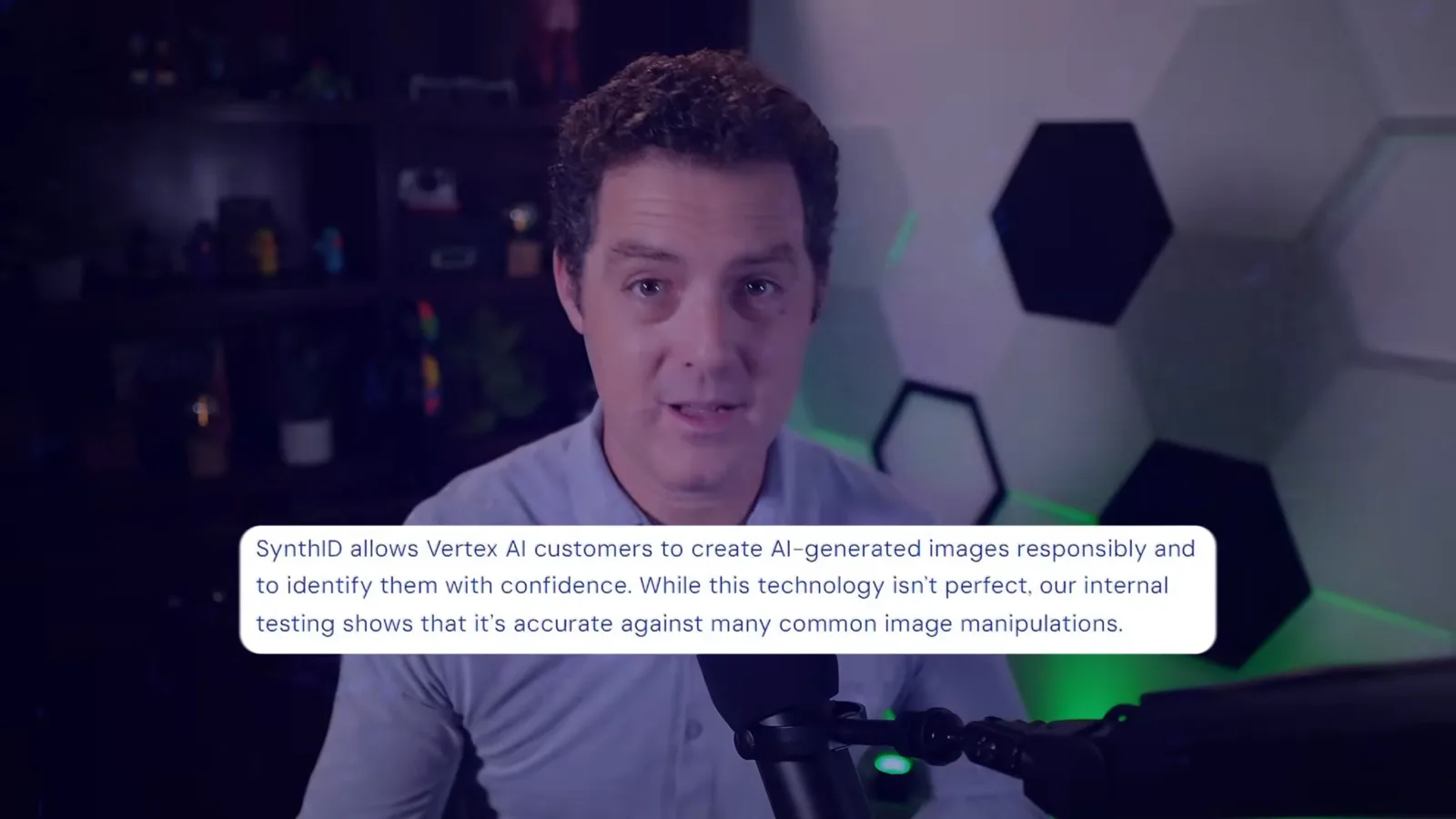
Google introduced SynthID for watermarking Imagen-generated images. [Google DeepMind](https://deepmind.google/blog/identifying-ai-generated-images-with-synthid/) described an initially limited beta and said the watermark could remain detectable after some common edits. It was not perfect, did not identify every AI-generated image, and resistance to all manipulations was not guaranteed.
A proposed city and generative media
Berman reviews a California land project, Ideogram and Runway, then discusses Apple silicon and mobile AI predictions.
Moving beyond AI, I review reporting about investors acquiring land for a proposed city in Solano County, California. Backers described walkable development and jobs, while local residents worried about secretive purchases and the impact on their communities. I hope more housing can reduce costs, but the project's claims and future outcomes were not established facts in 2023.
I discuss Ideogram's beta launch and its focus on rendering text in generated images, a longstanding difficulty for image models. I question whether that capability alone will differentiate it as competitors improve. The claim that it had fully solved text generation should be read as my impression, not a guarantee of correct text in every image.
Runway introduced a motion control for Gen-2, letting users adjust the amount of movement in generated video. I see it as another step in the rapid progress of text-to-video tools; the slider controls a particular generation setting rather than guaranteeing precise control of every motion.
I review arguments that Apple M1 and M2 machines can run some local models and return to the reported M2 Ultra Code Llama demonstration. Performance and feasibility depend on memory, model size, quantization and software, so an Apple computer is not automatically sufficient for every powerful model. Stability AI's founder also predicts phone-based ChatGPT- and GPT-4-level models on a short timeline; those are his 2023 forecasts, not established outcomes.
AI filmmaking and copyright
He highlights an AI-assisted short film and the US Copyright Office's public inquiry. The legal questions remained open and differentiated.
For the AI video of the week, I show part of ‘Glitch,’ a short made by Jeff Synthesized using Midjourney and Runway Gen-2. I compare its style favorably with Pixar and speculate about implications for studios and production costs during the writers' strike. The comparison is my opinion and does not establish that the project involved no other labor or could substitute for a studio production.
The US Copyright Office opened a [2023 inquiry](https://www.copyright.gov/newsnet/2023/1017.html) on generative AI, including training on copyrighted works, the status of outputs and related liability. I refer to an earlier court ruling on AI-created art and lawsuits alleging unauthorized use of protected works; the lawsuits are allegations, and a ruling on a work without human authorship is not a blanket prohibition on copyright for every AI-assisted work.
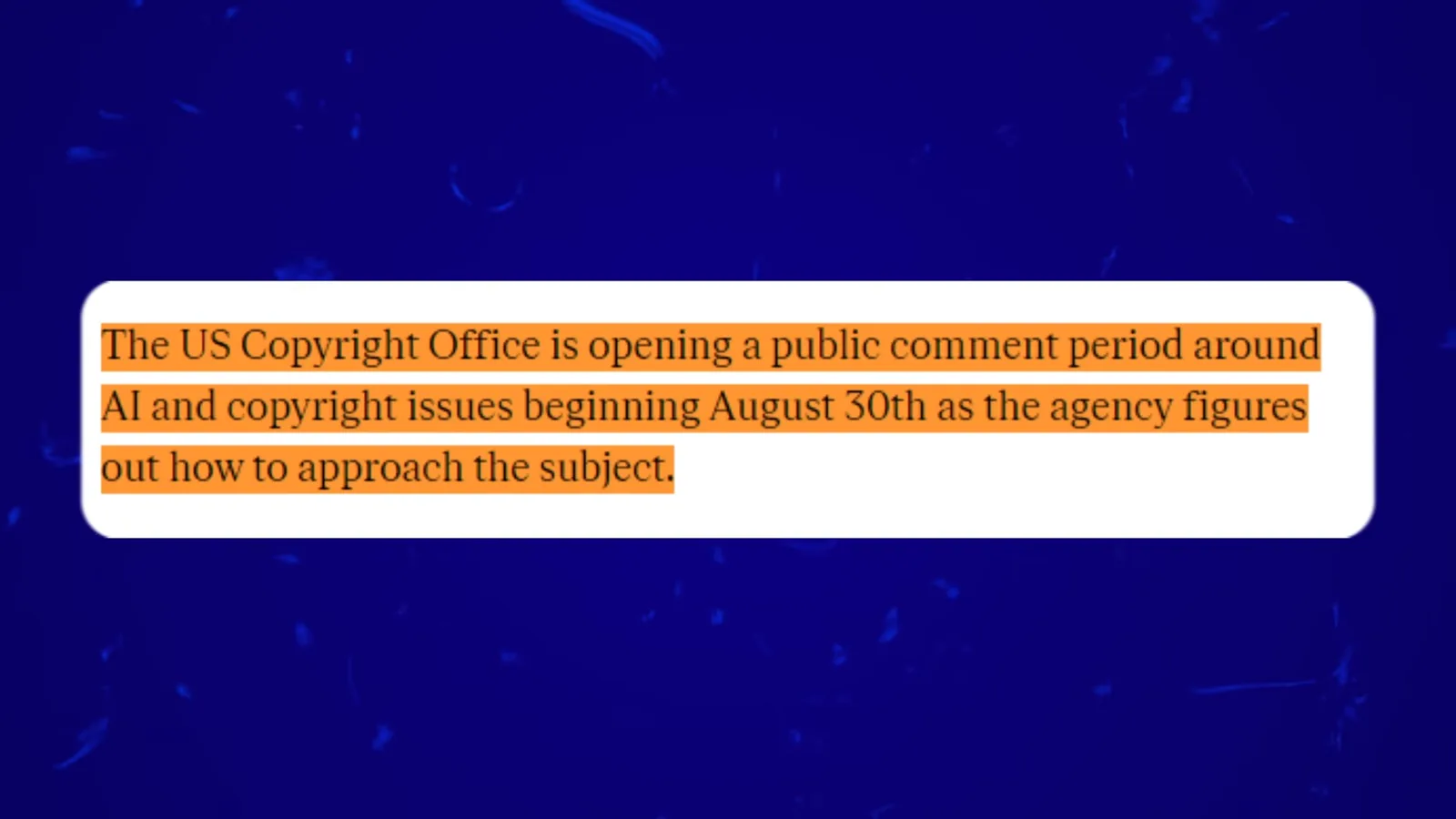
I expect copyright policy and litigation to continue developing and plan to follow the issues. The agency's request for public comment was part of a study, not a final resolution of all training, authorship or infringement questions.
같은 채널의 다른 글
 34:21EN
 Matthew Berman· 2026년 10월 27일Matthew Berman Examines Anthropic’s IPO Filing, AI Growth and GovernanceMatthew Berman, Sam Altman · Forward FutureThe presenter reviews the S-1’s financial metrics, compute strategy and voting structure while questioning the tension between rapid AI development and safety.
 0:26ENMatthew Berman· 2026년 10월 25일Sam Altman on Human Values and Problem-Solving in an AI WorldSam Altman · OpenAIIn a short interview excerpt, Altman considers the enjoyment of solving hard problems and the human role in interpreting results.
 0:36ENMatthew Berman· 2026년 10월 25일Kimi K3.1 and a Rubik’s Cube Solver DemonstrationMatthew Berman · Forward FutureMatthew Berman shows a scrambled virtual cube being solved and gives the Kimi K3.1 test a favorable assessment.
 0:21ENMatthew Berman· 2026년 10월 24일An AI-Generated Kimi Benchmark Chart Used Invented ScoresMatthew Berman · Forward FutureMatthew Berman asks for a graph of Kimi K3.1 Pro benchmarks, then discovers that the displayed figures are illustrative placeholders.
 25:50ENMatthew Berman· 2026년 10월 24일Kimi K3.1 Pro Tested: Strong 3D Demos, Uneven Results and Competitive PricingMatthew Berman · Forward FutureMatthew Berman tests the open-weight model on coding, 3D rendering and visual explanations, then compares benchmark results and prices.
 32:20ENMatthew Berman· 2026년 10월 23일Who Is Local AI For? The Costs, Trade-offs and a Hybrid FutureMatthew Berman · Forward FutureMatthew Berman weighs data control and independence against hardware cost, setup complexity and inference speed.