30초 요약
Theo argues that early purchases of computing hardware put Musk’s companies in a favorable position as AI demand strains supply. Using a Google–SpaceX agreement as a starting point, he explains the interconnected bottlenecks and offers his own predictions about costs and capacity.
- 1Compute scarcityAI demand is pressing against available computing capacity.
- 2A conditional rental dealThe displayed filing describes a ramp and approximately $920 million a month from October 2026, subject to contractual conditions.
- 3Memory is another bottleneckHBM capacity and its suppliers matter alongside GPU fabrication.
- 4Power and infrastructureElectricity generation, grid connections and construction constrain expansion.
- 5Early capacity becomes valuableTheo argues that early GPU purchases give Musk’s companies rental opportunities, while his payback calculation is only a rough estimate.
핵심 정리
- AI compute depends on coordinated access to chips, memory, storage and power.
- The displayed Google agreement includes a ramp and contractual conditions; its later monthly amount should not be treated as an immediate payment.
- Expanding manufacturing and power infrastructure requires time, capital and coordination.
- Theo’s payback estimate and forecasts about hardware costs are speculative.
챕터별로 다듬은 전문 읽기
The compute crunch
AI demand is straining capacity. Theo introduces Musk’s early GPU purchases as an example.
AI companies keep saying they do not have enough compute. Microsoft and Google executives have described capacity constraints, and Anthropic has been looking for more computing power. That makes an apparently excessive early GPU purchase look very different today: if demand keeps rising, the machines someone bought before the rush become valuable.
I want to examine why Elon Musk’s companies appear to have benefited from that shortage and why buying more GPUs is not as simple as placing an order. The bottlenecks extend through chip fabrication, memory, storage and power. A large purchase has to compete for capacity across that whole chain.
Google rents compute
The displayed agreement describes access to SpaceX compute and a phased pricing schedule. Theo asks why a company that designs TPUs still needs external capacity.
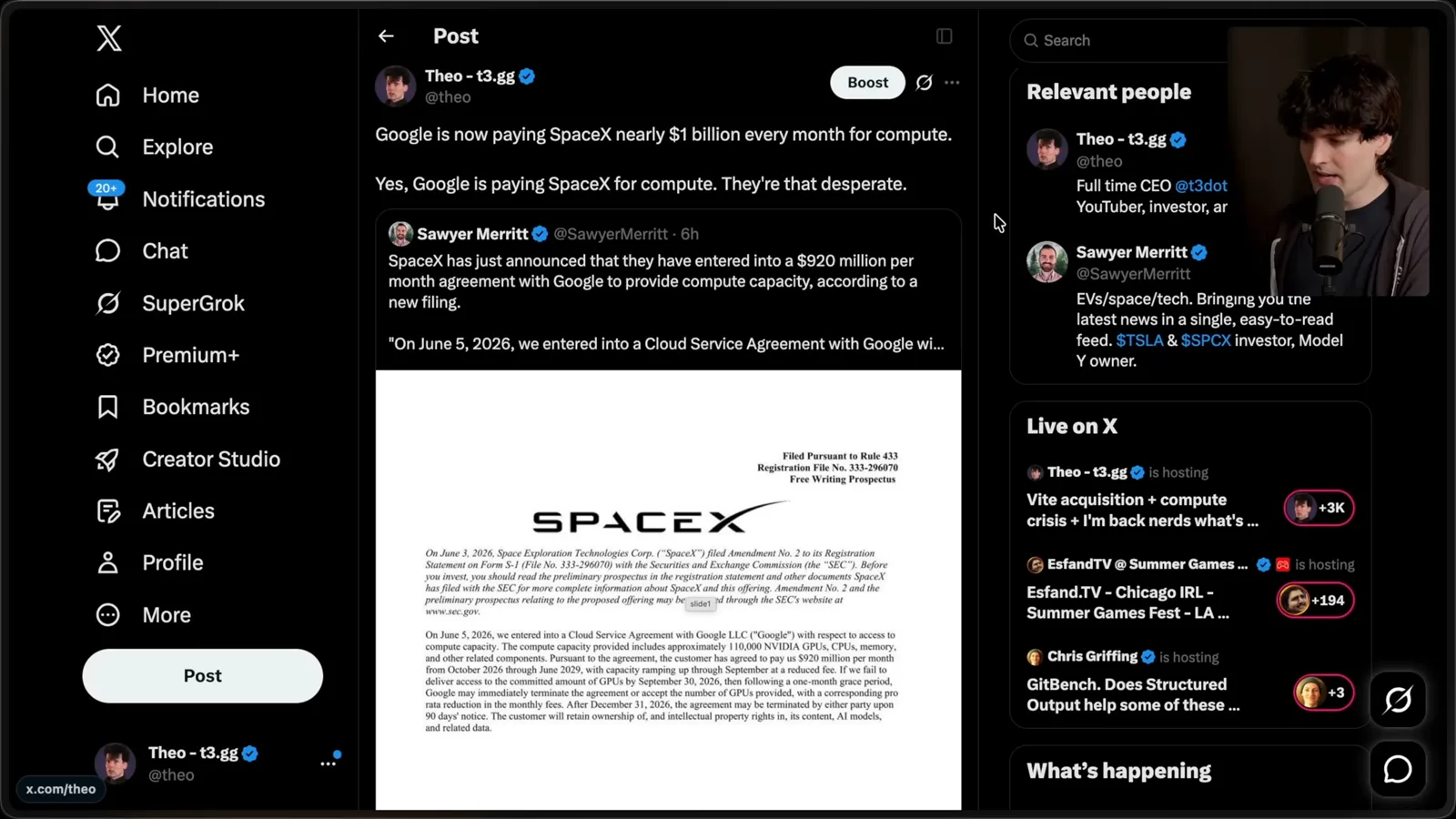
The filing shown in the video describes Google buying access to SpaceX compute. It says the arrangement involves approximately 110,000 GPUs and, after an initial ramp at reduced rates, approximately $920 million per month from October 2026 through June 2029, subject to the agreement’s conditions and termination provisions. Those are the terms shown, not proof that the full rate was already being paid in June.
Google designs its own TPUs, yet the deal illustrates why owning a chip design does not guarantee enough capacity. Training and serving AI require machines that have actually been manufactured, assembled, powered and made available in the right place. When many buyers want the same scarce inputs, even a large company may need to rent from someone else.
Chips and memory
Foundry capacity and high-bandwidth memory have their own suppliers and constraints. Theo corrects an exaggerated diagram and a company mix-up.
Start with the chip itself. Nvidia designs GPUs, but companies such as TSMC manufacture chips for customers; Apple and other designers also compete for manufacturing capacity. The foundry cannot instantly add a production line simply because a customer wants more chips. Capacity and manufacturing schedules must be planned well ahead.
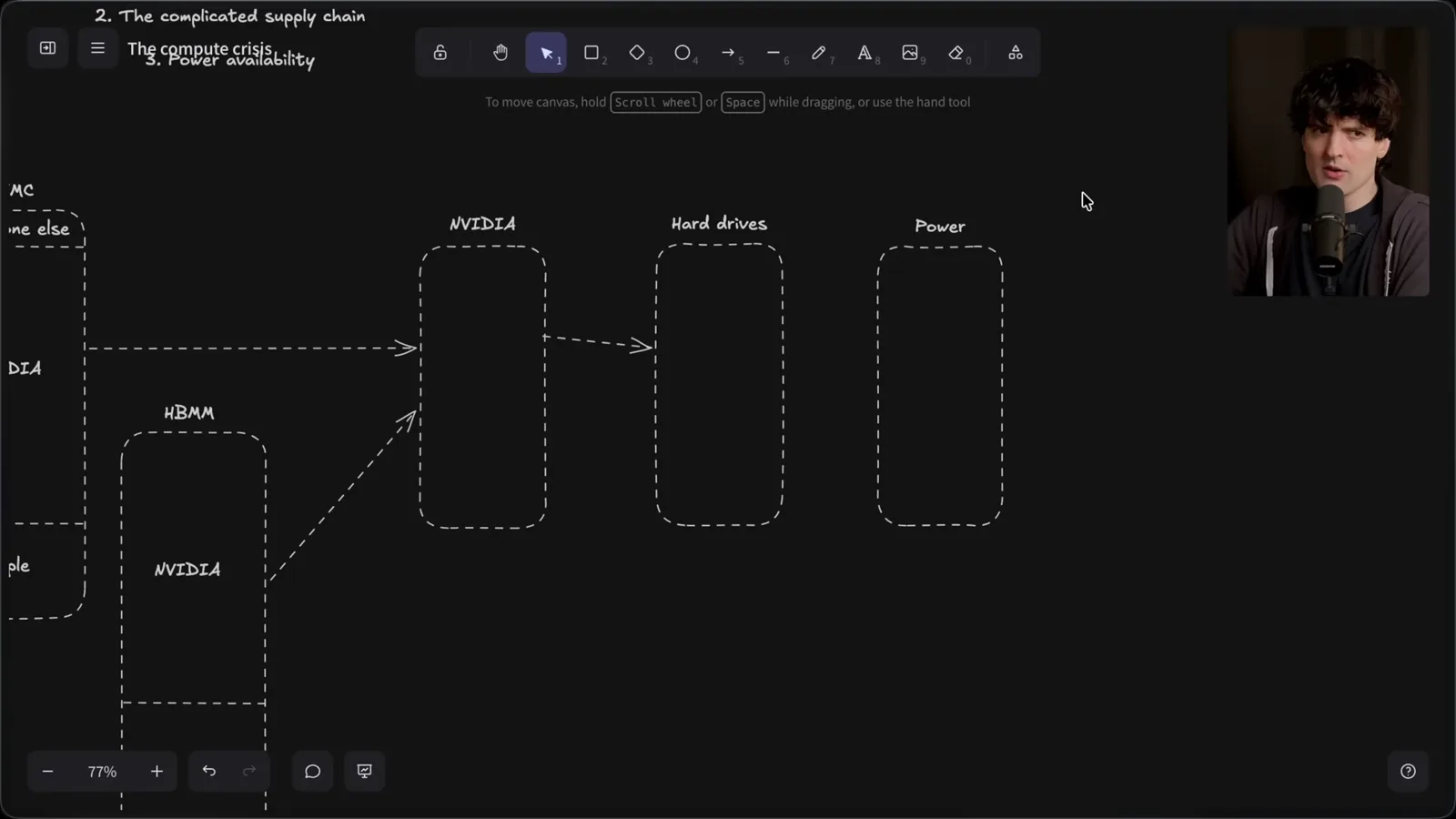
The supply-chain illustration in the video is a way to explain the relationships between customers and manufacturers, not a measured breakdown of TSMC’s production. I later correct its exaggerated Nvidia allocation and mention a much smaller approximate share. The broader point is that manufacturing commitments and competing customers make capacity hard to redirect overnight.
A GPU also needs memory, especially high-bandwidth memory for many AI accelerators. Micron, SK hynix and Samsung are major suppliers discussed here. Demand for AI memory can put pressure on investment and available manufacturing resources elsewhere, although HBM and consumer memory are distinct products and do not all use identical production lines.
This matters to people who are not building data centers. When manufacturers allocate resources toward products with strong demand and high margins, consumers can feel the consequences in availability and price. I initially mix up the companies behind Crucial, then correct myself: Crucial is a Micron brand, not an SK hynix brand.
Memory is only one part of the system. My diagram simplifies the chain, and I correct its proportions rather than asking readers to treat the drawing as market-share data. The practical issue is that a shortage in any one input can delay the finished system, even if other parts are available.
Storage and electricity
Storage prices provide a consumer example, while electricity generation and grid capacity add further constraints. A historical chart supplies context.
Storage has its own constraints. I compare a 16 TB hard drive I remember buying for around $170 with a price around $360 that I encountered later. That is an individual observation, not a universal price series, but it shows why the effects of heavy infrastructure demand can be visible far from the GPU itself.
The graphic brings together chip fabrication, memory, storage and the companies competing for them. It is a simplified map, but it helps explain why a single expensive component is not the whole story: each dependency has its own suppliers, capacity decisions and lead times.
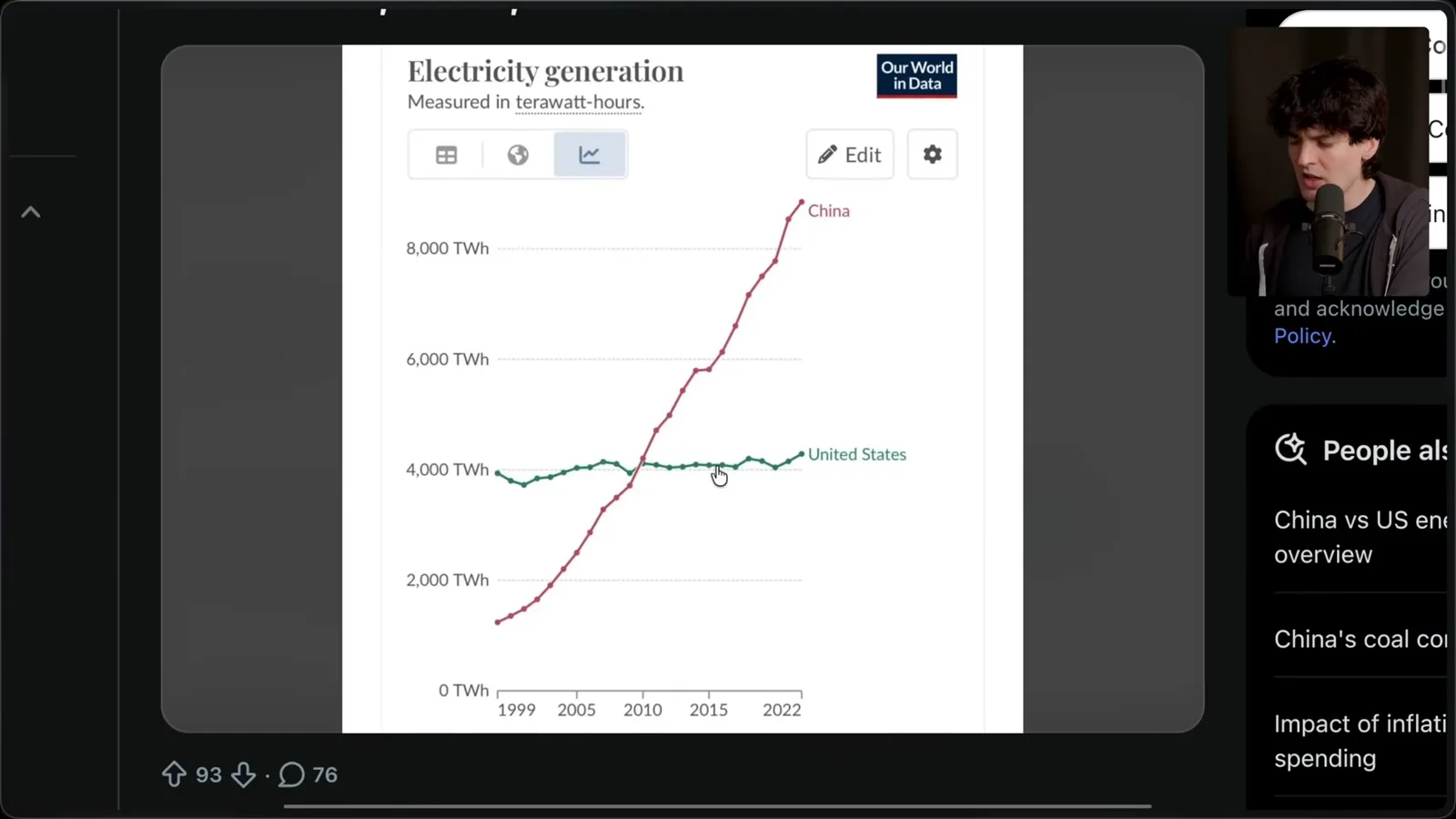
Then there is electricity. A data center needs power continuously, and expanding generation and grid capacity takes planning and construction. The historical Our World in Data chart I show compares electricity generation in China and the United States through 2022; it provides context for the discussion, not a current measure of available data-center power.
I argue that electricity supply, efficiency and cleaner generation deserve attention alongside chip supply. The demand from AI has to fit into a power system that already serves homes, businesses and industry. A company can have a purchase order for hardware and still face a separate challenge connecting and powering it.
Why supply is slow to expand
Capacity requires long-term investment and coordination across suppliers. Hardware failures illustrate the complexity of production.
Adding capacity is slow and capital intensive. Manufacturers must decide years in advance how much to build, and then depend on equipment, labor, materials and customers arriving together. I describe long timelines for expanding the supply chain; the exact duration varies by project, and not every factory takes the same number of years.
That creates a coordination problem: building one link too early can leave expensive capacity idle, while building it too late can hold back everyone downstream. Firms are betting on future demand when that demand is still uncertain. The risk is not just whether AI grows, but where shortages and surpluses emerge.
I bring up historical hardware failures to illustrate how complicated manufacturing can be: a small materials or assembly problem can affect a huge number of devices. My specific account of the cause of the Xbox red-ring failures is presented as my explanation, not as an established technical finding.
High-bandwidth memory adds further manufacturing and packaging complexity. A successful accelerator needs not only a GPU die but the memory and assembly capacity to turn it into a usable product. If one supplier expands without enough capacity in the other parts of the chain, the extra output may not solve the real bottleneck.
That is why supply cannot respond like a software feature. Companies must invest substantial sums before they know precisely what customers will want years later. Moving every supplier at once is difficult, and an optimistic forecast can leave one part of the chain with expensive unused capacity.
The value of early capacity
Theo interprets the compute deal as a benefit of early purchasing and offers a rough payback estimate. He closes with predictions about AI demand and consumer hardware.
My interpretation is that Musk’s companies bought significant computing capacity early for their own AI ambitions and can benefit from renting capacity while demand is high. The Google agreement is an example I use to support that argument. It does not mean the companies face no power, hardware or operating constraints of their own.
I speculate about how quickly the rental revenue could pay for the hardware, describing a rough four-month calculation. That is a back-of-the-envelope comparison, not a demonstrated payback period: it does not fully account for operating expenses, capital costs, ramp-up, contract conditions or the rest of the infrastructure.
Power arrangements are part of the picture as well. I discuss generation, storage and the ability to bring capacity online, including possible connections to other Musk businesses. The broader claim is that access to chips and energy together can give a provider a useful position when others are trying to expand quickly.
I expect AI labs such as OpenAI and Anthropic to continue competing for compute, and I see Nvidia benefiting while demand for its hardware remains strong. Those are my assessments of the market, not guarantees about either company’s future purchases, Nvidia’s results or the direction of prices.
Consumers may continue to see pressure on the cost of memory and storage as large buyers compete for resources. Over time, I think devices could rely more on cloud compute if powerful local hardware stays expensive. Both the price trajectory and that shift in product design remain predictions.
The lesson is to follow the whole chain rather than one headline about a GPU deal. Chipmaking, memory, storage and electricity have to arrive together, and each expands at a different pace. Whoever secured useful capacity early may have options that a late buyer cannot simply purchase immediately.
같은 채널의 다른 글
 38:47EN
 Theo - t3․gg· 2026년 10월 28일Theo’s Long-Running Agent Experiments: Verification, Compute and CostTheo Browne · Ping LabsA skateboard game and two compiler projects show how repeated checks and flexible compute can sustain agent work—and how expensive those loops can become.
 36:07ENTheo - t3․gg· 2026년 10월 27일Theo on Token Costs, Coding Agents, and the Price of AI CapabilityTheo Browne · Ping LabsA viral estimate of Lauren's AI spending prompts a closer look at cache pricing, benchmarks, and the changing work of coding agents.
 30:37ENTheo - t3․gg· 2026년 10월 26일Theo’s Three Skills for Reviewing and Shipping with Coding AgentsTheo Browne · Ping LabsHow sol-loop, full-send and full-stop encode review, verification and different levels of merge authority.
 0:43ENTheo - t3․gg· 2026년 10월 23일Theo Distinguishes Security Vulnerabilities from Active AttacksTheo Browne · Ping LabsA short explanation of why disclosed software flaws and reported attacks are different kinds of security news.
 29:22ENTheo - t3․gg· 2026년 10월 22일Theo on Security Vulnerabilities, Stolen API Keys and AITheo Browne · Ping LabsA look at the gap between vulnerability disclosure and patching, and a speculative account of why stolen inference keys may be valuable.
 31:13ENTheo - t3․gg· 2026년 10월 20일Theo on Why Smarter Models Help More Than DevelopersTheo Browne · Ping LabsFrom game modifications to compiler experiments, Theo revisits his assumptions about who benefits from more capable AI.