30초 요약
At Sana AI Summit 2026, Joel Hellermark outlines five levels of autonomy and proposes three components for enterprise AI: collaboration among people and agents, a living organizational memory, and agents that work in the background. He introduces Sana for ITSM and a Travel Agent and demonstrates a unified employee interface. Workday co-founder Aneel Bhusri joins him to discuss the limits of reasoning models in deterministic processes, the possible impact of agents on software categories, and Workday's AI plans. They announce Hellermark's appointment as chief AI officer and describe their product vision as a long journey rather than a completed transformation.
- 1Five levels of autonomyHellermark moves from manual workflows and copilots to agents, policy-bounded autonomy and a longer-term autonomous level.
- 2Three foundationsHe names shared human-agent collaboration, a self-updating company memory and always-on agents as key components.
- 3IT and travel productsHellermark introduces Sana for ITSM and a Travel Agent, then demonstrates the intended employee experience.
- 4Recruiting and approvalThe demo shows a hiring pipeline, human offer approval and a proposed policy update based on repeated decisions.
- 5Reasoning meets deterministic workBhusri says payroll and closing books require dependable deterministic processes alongside AI reasoning.
- 6A new AI roleBhusri announces Hellermark's appointment as Workday's chief AI officer and describes the moment as a reinvention of work.
핵심 정리
- Hellermark proposes a progression from manual work and copilots toward policy-bounded and more autonomous agents.
- His proposed foundations are multiplayer AI, living memory and background agents.
- The demonstration shows recruiting, IT access and travel tasks with human approvals and suggested policy changes.
- Bhusri argues that AI reasoning and deterministic enterprise processes must be combined, particularly for payroll and financial closing.
- The speakers expect a gradual path to autonomy with people checking edge cases.
- Workday announces Hellermark as its new chief AI officer during the event.
챕터별로 다듬은 전문 읽기
From copilots to autonomous agents
Hellermark presents a model of five autonomy levels. He outlines multiplayer collaboration, living memory and ambient agents as the proposed foundations.
Joel Hellermark opens by describing his interest in building teams. Studying groups such as the early Macintosh team and Xerox PARC, he saw small interdisciplinary teams working differently from traditional command-and-control organizations. He believes agentic AI creates an opportunity to rethink how companies and products are organized.
Sana uses a five-level model of autonomy to describe that transition. The starting point is manual work: tickets move among people across many enterprise systems. Copilots then draft suggestions, but employees still move among multiple interfaces.
At the third level, Hellermark says agents begin doing work and bring people in when needed. The fourth is policy-bounded autonomy, where systems use organizational knowledge and rules to automate more of a process. The proposed fifth level adds greater autonomy and self-improvement within guardrails; he says reaching it will take a long time.
His first proposed foundation is a multiplayer AI experience, in which teams of people and agents share context and route work across departments. The second is living memory: company knowledge and policies that can update, rather than systems that forget context between interactions.
The third foundation is ambient agents that work continuously in the background. Hellermark imagines them checking compliance, updating rules and developing workflows. He presents this as the product direction rather than a claim that every such workflow is already complete.
Demonstrating recruiting, IT and travel
Hellermark introduces Sana for ITSM and a Travel Agent. The demonstration follows background tasks, human approvals and proposed updates to policies.
Hellermark introduces Sana for ITSM, intended to handle employee IT requests across the lifecycle, and a Travel Agent for conversational booking and associated expenses. He then starts a demonstration of a unified interface for recruiting, travel, IT and custom agents.
In the demo, Hellermark asks the system to book a Sunday flight home. He says it uses personal memory, company policy and calendar information while continuing the task in the background. The task list also shows recruiting and a Salesforce access request.
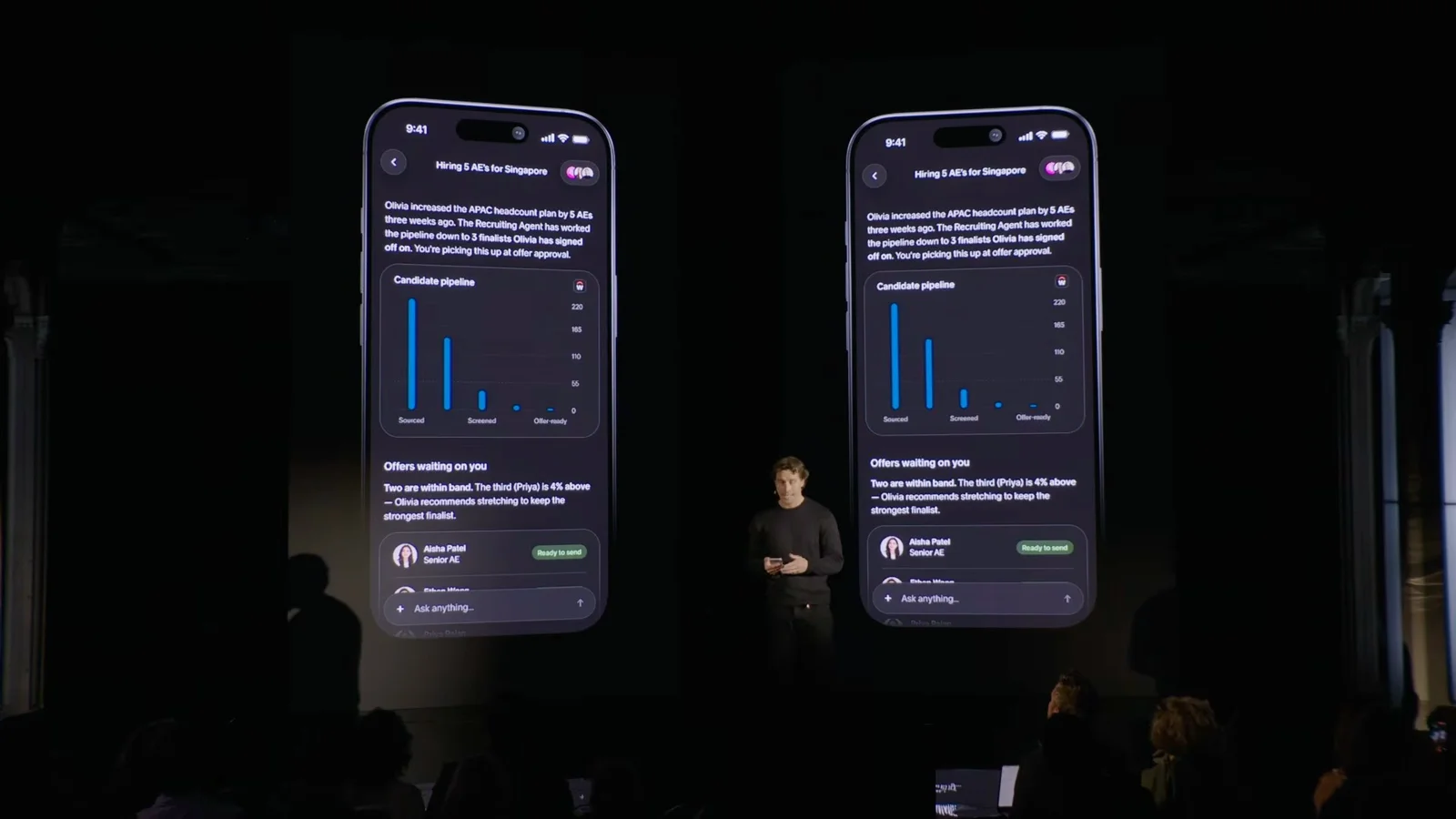
The recruiting example concerns hiring five account executives in Singapore. The interface shows a candidate pipeline and traces of actions such as job requisitions, postings and interviews. Hellermark says the agent escalates decisions, including offer letters, for a person to approve.
After an approval, the demonstration shows the system noticing a repeated decision and asking whether to update company policy for similar cases. Hellermark also reviews an out-of-band salary example. He presents this as the proposed living-memory pattern, with a human deciding whether to grant further autonomy.
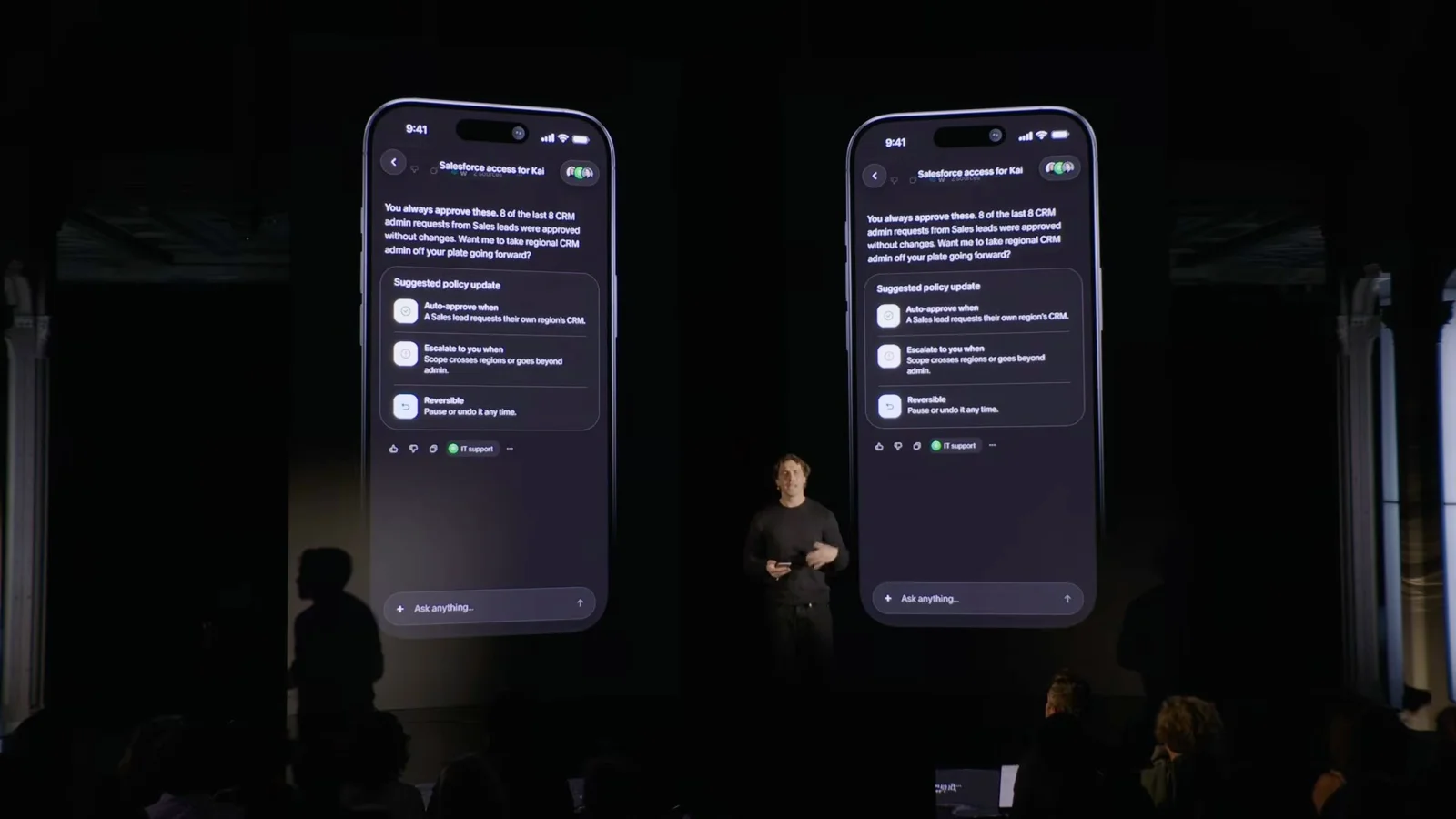
The IT example involves Salesforce access for a new sales lead. Hellermark approves the request, and the interface suggests automatically approving similar in-region requests in future while escalating broader cases. The screen says the proposed policy can be reversed.
The demonstration returns to travel: Sana suggests a flight based on the calendar, then shows expense filing and calendar work after the booking. Hellermark describes a future in which employees supervise background tasks and agents surface decisions when necessary.
Hellermark contrasts this agent-operator model with employees managing many separate copilots. He describes a shift toward proactive systems with organizational and personal memory, and calls it a re-founding moment for Workday. He then invites Workday co-founder Aneel Bhusri on stage.
Workday, AI and the SaaS transition
Aneel Bhusri joins Hellermark to discuss combining reasoning with deterministic enterprise processes. They consider which software layers agents might disrupt and how new products could develop.
The pair discuss the so-called SaaS apocalypse. Bhusri says he initially felt nervous about the implications but came to view AI and enterprise software as complementary. He calls AI a reasoning engine and says he has not seen a comparable technological shift in his career.
Bhusri argues that reasoning models alone are not well suited to deterministic processes such as payroll and closing books, where organizations need reliable, complete results. In his view, combining reasoning with established process systems is the opportunity.
He thinks software centered on static orchestration across applications may be vulnerable as agents take on workflows. Deep domain applications may face pressure later, he says, but Workday can also use models and tools such as Claude Code and Cursor to improve productivity and compete.
Asked about Sana for ITSM, Bhusri does not predict immediate market leadership. He expects a gradual path: start with a narrower product, add ticketing and workflows, then move upmarket. He expects a similar development pattern for travel.
Bhusri says Workday must succeed in AI as well as cloud computing if it is to endure across technology generations. He describes returning to work with Hellermark and colleagues, and the conversation turns to a role announcement.
A chief AI officer and a new interface
Bhusri announces Hellermark's new role. The speakers describe their longer-term vision for policy-bounded agents, knowledge and user experience.
Bhusri announces that Hellermark is being named Workday's chief AI officer, ahead of a formal announcement later that day. He describes his own role as coordinating experts through what he sees as a reinvention of work, not merely an AI feature added to an existing product.
Hellermark says the opportunity is to sell completed work as well as software. He compares progress toward autonomy with self-driving cars: edge cases took longer than many expected, and people must remain involved while systems are tested and improved.
He identifies policy and knowledge graphs as a proposed foundation for agents, describing a ‘world model of work.’ Bhusri says Workday is trying to return to startup habits while making ownership of AI vision, applications and APIs clear.
Hellermark expects boundaries among software categories to blur as shared knowledge, connections, agents and human collaboration become common foundations. He sees employee onboarding and offboarding as reasons for Workday to expand into adjacent areas such as ITSM.
He says the combined company can increase agent autonomy over time and bring products to more employees. Responding to criticism of Workday's user experience, he sets an internal ambition to make it the ‘Hermès of enterprise software.’
Hellermark points back to the demo's single interface as an example of AI changing how users interact with enterprise applications. Bhusri closes by expressing confidence in the combined teams and jokes that his advice to the new AI chief is not to screw it up.
같은 채널의 다른 글
 1:16EN
 Sana· 2026년 10월 14일팟캐스트How Volkswagen Group Middle East Uses Sana to Prepare Technicians for TrainingThierry Rochat describes using technical documents to create online courses before hands-on academy sessions.
 0:41ENSana· 2026년 9월 8일팟캐스트Sana Learn Customers Describe Bringing Training Resources TogetherA short customer montage contrasts fragmented learning resources with keeping company knowledge in one place.
 0:40ENSana· 2026년 8월 31일팟캐스트Sana Learn Customers Describe Their Partnership ExperienceIn a short montage, customers discuss implementation and the ongoing relationship with Sana.
 48:34ENSana· 2026년 8월 12일팟캐스트 · 2명Tyler Cowen on AI Adoption, Human Agency, and the Search for Beauty게스트 Tyler Cowen · 진행자 Joel HellermarkThe economist explains why AI's economic impact may arrive slowly, what people may still contribute, and why he is calling for a new aesthetic.
 0:16ENSana· 2026년 7월 21일팟캐스트Tyler Cowen on Human Presence in an AI WorldTyler Cowen predicts that charisma, physical presence and human interaction will gain importance as AI advances.
 0:23ENSana· 2026년 7월 9일팟캐스트Ethan Mollick on Measuring AI’s ImpactEthan Mollick argues that companies should allow room for new opportunities rather than relying only on old metrics.