30초 요약
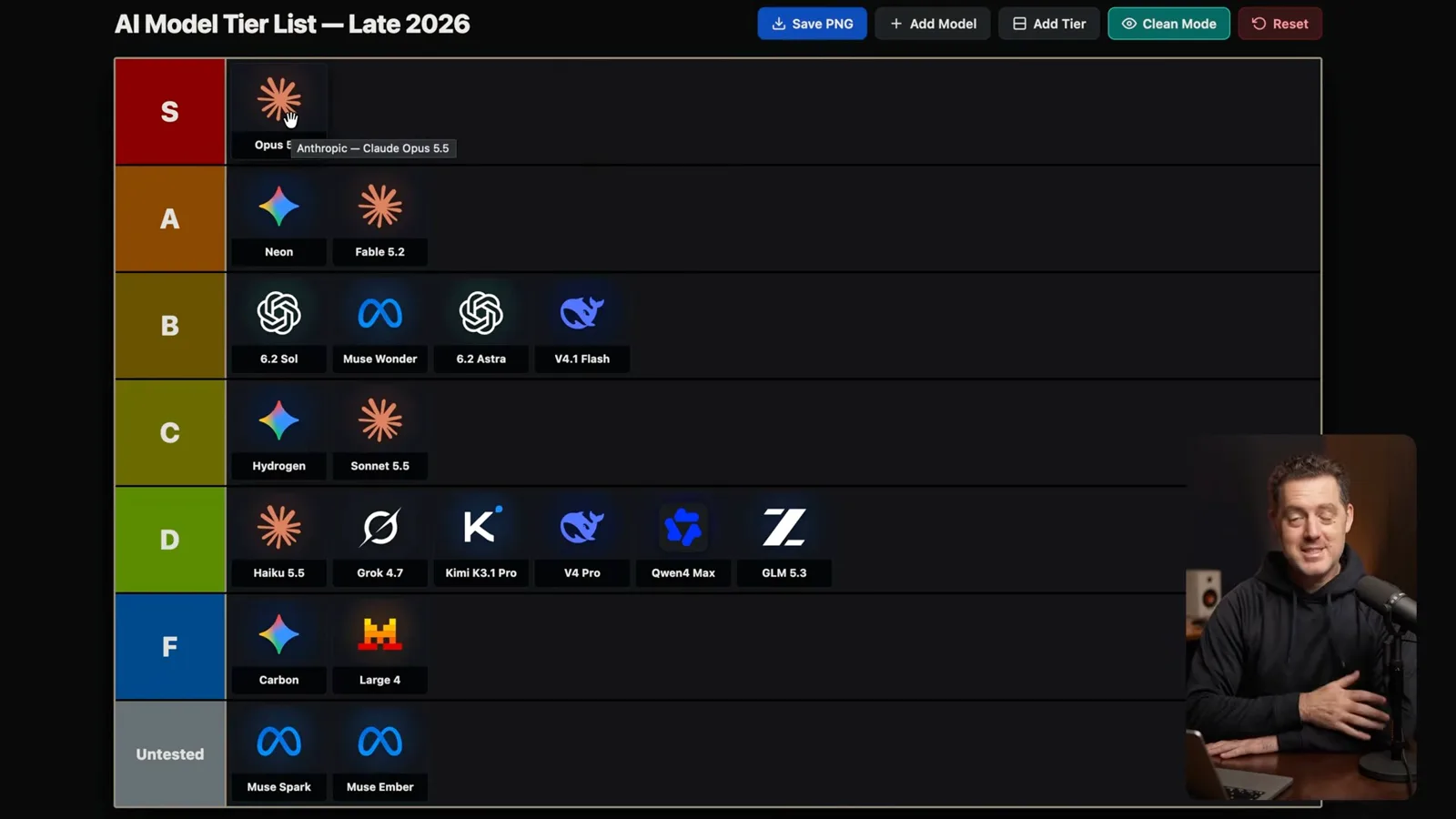
Matthew Berman ranks Claude Opus 5.5 as his favorite coding model because he trusts its combination of output quality, cost and working experience. Gemini Neon comes next: he finds it less capable on the hardest problems but more pleasant and inexpensive for easy to moderately hard tasks. He reserves Fable 5.2 for important or difficult work and checking other models. His rankings reflect his own workflow, including subscription quotas and whether he actually reaches for a model.
- 1Opus 5.5 is his most trusted everyday coding modelBerman puts it alone in S tier, citing its mix of quality, cost, subscription usage and the experience of working with it.
- 2Fable 5.2 is for difficult work rather than everyday useHe rates its output above Opus but says it is expensive and reserves it for demanding tasks and checking other models.
- 3Neon comes close to his top choice through ease and costHe finds Gemini Neon less capable on the hardest work but more pleasant to steer, and uses it for easy through moderately difficult tasks.
- 4Astra can produce good results but takes more steeringBerman ranks GPT-6.2 Astra in B tier because the effort to obtain the result matters to him, not just the final quality.
- 5Sol earns a place for browser control and video editingHe does not prefer it for coding, but values its speed and cost for computer use and editing.
- 6DeepSeek V4.1 Flash is capable and cheap, but rarely usedBerman likes it for coding and building, yet his existing subscriptions give him enough access to alternatives.
- 7Neon follows instructions in a direct, understandable wayBerman says clear communication and useful assumptions make it appealing enough that it could eventually displace Opus for him.
핵심 정리
- Berman chooses Opus 5.5 for his broadest and hardest routine work, balancing quality against cost and usability.
- He uses Gemini Neon for easy to moderately hard tasks and prefers working with it over Opus.
- Save a costly top-quality model for difficult work or a second opinion when a cheaper model is sufficient.
- Compare how much effort a model takes to steer, not only its best eventual output.
- Berman finds GPT-6.2 Sol useful for computer control and video editing, even though he does not choose it for coding.
챕터별로 다듬은 전문 읽기
Why Opus leads despite Fable’s higher output quality
Berman ranks Opus first for its balance across daily work. He reserves the more expensive Fable for demanding tasks and review, while using Haiku and Sonnet less.
I want to rank the AI models I actually use for coding. My criteria include the quality of the result, cost and how enjoyable the model is to work with.
Claude Opus 5.5 is still my favorite and my default for most work. I trust it more than the alternatives, and the combination of quality, efficiency and the usage available through my subscription puts it alone in S tier.
Fable 5.2 produces higher-quality work in my view, but it costs much more in API use and subscription quota. I place it in A tier and turn to it for the hardest or most important problems, or to check another model’s work.
I barely use Haiku 5.5. Its quality drops substantially from Opus without enough of a discount to make that trade attractive to me, so I use it only for simple tasks and put it in D tier.
Sonnet 5.5 is good at knowledge work, but I find it hard to justify when Opus is much better and the usage available is close. I use Sonnet occasionally, though I often choose other lightweight models instead; it lands in C tier.
Neon changes his view of Google models
He ranks Hydrogen above Sonnet on price and apparent capability, but finds Carbon inconsistent and slow. Neon combines a pleasant working experience with low cost.
My view of Google’s Gemini models has changed in the last few weeks. I have not used Hydrogen much, but it appears as capable as Sonnet at a lower cost, so I put it in C tier, ahead of Sonnet.
Carbon is inconsistent in my experience, struggles with long tasks and is slow. I am describing the version I used a few weeks ago; on that basis I put it in F tier.
Neon surprised me. It is not as capable as the largest models, but it is a pleasure to work with and even more pleasant than Opus. For easy to moderately hard tasks I now choose Neon; beyond that I turn to Opus.
Considering its price, ease of use and overall capability, I place Neon in A tier above Fable. Opus remains my number one for now, with Neon close behind.
OpenAI models earn different roles
Astra can reach strong results but takes effort to steer. Sol is his choice for computer use and video editing rather than coding.
GPT-6.2 Astra is OpenAI’s large model. I did not think it was as bad as some initial reactions suggested, but it was far behind Opus for me. Compared with Neon it may be somewhat stronger in raw quality, but getting that result requires a lot of effort.
If I push and prod Astra, I can usually get a good result. Ease of use is part of my ranking, though, and I am generally not using it, so I place it in B tier below Fable and Neon.
GPT-6.2 Sol is very good at computer use and controlling a browser, particularly for its speed and cost. It is also good at video editing, which matters to my daily work. I do not generally pick it for coding, but those strengths put it in B tier ahead of Astra.
Open-weight models and specialist uses
Berman finds Grok useful for conversation and research but poor for his coding work. DeepSeek Flash is capable and inexpensive, though existing subscriptions limit how often he uses it.
Grok 4.7 is strong in conversation and research. Access to X search and related tools also helps that experience, although those are not purely properties of the model. I find it poor at coding and editing, so I put it in D tier.
I have not used Mistral Large 4 extensively; the times I tried it, it was only okay for my needs. Its open weights deserve some credit, but I cannot find a use case that would move it above F tier in this list.
DeepSeek V4.1 Flash is good at coding, building and motion graphics. It is inexpensive and has open weights, so I give it B tier. I do not use it often because my other subscriptions already supply enough model access.
I tested GLM 5.3 thoroughly when it came out and found it capable, but it does not fit my workflow. There is nothing specifically broken about it; I put it in D tier because I rarely use it.
Meta and Chinese labs round out the list
He finds Muse Wonder pleasant but less capable than Neon and has not tested two smaller Muse models. Kimi leads his personal ranking among the Chinese models discussed, which remain in his D tier.
Meta’s Muse Wonder surprised me. It feels easy to work with, somewhat like Neon, although I find it less capable and less enjoyable. I put it in B tier just behind GPT-6.2 Sol and ahead of Astra and DeepSeek Flash.
I have not tested the smaller Muse Spark and Muse Ember models. Spark has open weights, but both belong in the untested tier until I have actually used them.
Among the models from Chinese labs, DeepSeek V4 Pro is good but I rarely use it, and I do not find it as strong as several closed models. I put it in D tier above GLM 5.3. Qwen4 Max goes in D tier between DeepSeek and GLM.
Kimi K3.1 Pro is, in my opinion, the best Chinese model of this group, though it also lands in D tier. Opus 5.5 remains alone at the top of my list.
Neon is immediately behind Opus. It takes a direct path to a solution, communicates clearly and follows my instructions; its assumptions often match what I wanted. If Google continues to improve it, I can imagine it eventually overtaking Opus.
같은 채널의 다른 글
 19:41EN
 Matthew Berman· 2026년 11월 24일What an AI-generated math proof would mean for human understandingMatthew Berman, Alex Kontorovich · Forward FutureMatthew Berman reports a claimed Riemann hypothesis proof and asks how people verify and use mathematical arguments they cannot easily read.
 10:59ENMatthew Berman· 2026년 11월 21일Matthew Berman Questions Anthropic’s Safety and Commercial StrategyMatthew Berman, Sam Altman, Mustafa Suleyman · Forward FutureBerman says restrictions on AI models can concentrate power even as Anthropic warns about the risks of powerful AI.
 16:03ENMatthew Berman· 2026년 11월 19일Matthew Berman: GPT-6.2 is uneven, but its computer use stands outMatthew Berman · Forward FutureAfter mixed early reviews, Berman shows an OBS repair and compares the cost of model-generated demos.
 56:20ENMatthew Berman· 2026년 11월 12일How language models learn from text and improve by trial and errorMatthew Berman, Jeremy Berman · Forward FutureAnthropic researcher Jeremy Berman uses apartment prices to explain neural networks, then builds up to language models and reinforcement learning.
 18:18ENMatthew Berman· 2026년 11월 11일Fable 5.2 leads a week of model releases, but cost changes the choiceMatthew Berman · Forward FutureMatthew Berman compares Fable and Gemini Carbon, reviews smaller models and discusses Nvidia’s investigation.
 24:18ENMatthew Berman· 2026년 11월 9일Fable 5.2 built playable demos—but several cost thousandsMatthew Berman · Forward FutureMatthew Berman shows games, creative software and simulations, with estimated API costs from $25 to $15,000.