30초 요약
Theo introduces Fable 5 as a Mythos-class model with additional safeguards and reviews early benchmark results. He cautions that refusals can affect comparisons and questions the reliability of SWE-bench Pro, while sharing his interpretation of other coding evaluations.
- 1Fable and MythosTheo says Fable offers a Mythos-class model with additional safeguards.
- 2Refusals affect scoresHe says Fable refused some benchmark tasks and reports a roughly 20-point Terminal-Bench gap versus Mythos in the comparison shown.
- 3Questioning a benchmarkHe reports a strong SWE-bench Pro result but questions whether the benchmark's existing pull requests make the score reliable.
- 4Early coding resultsTheo discusses DataCurve results and his interpretation of performance and cost on that evaluation.
핵심 정리
- Theo describes Fable 5 as a safeguarded way to access a Mythos-class model.
- Refusals on benchmark tasks can lower the score of a safeguarded model.
- Theo questions whether SWE-bench Pro adequately measures new problem-solving rather than familiarity with existing pull requests.
- He views early FrontierCodeBench and DataCurve results as promising, while individual benchmark results have limited scope.
- His cost comparison reflects the measured tasks and usage at the time, not a universal price advantage.
챕터별로 다듬은 전문 읽기
Safeguards and benchmark results
Theo introduces Fable and Mythos. He explains why refusals complicate benchmark comparisons.
We have heard about Mythos for a long time, and now we have Fable 5: a Mythos-class model with additional safeguards rather than unrestricted access to Mythos 5. I want to look at what it can do and how the early benchmarks should be interpreted.
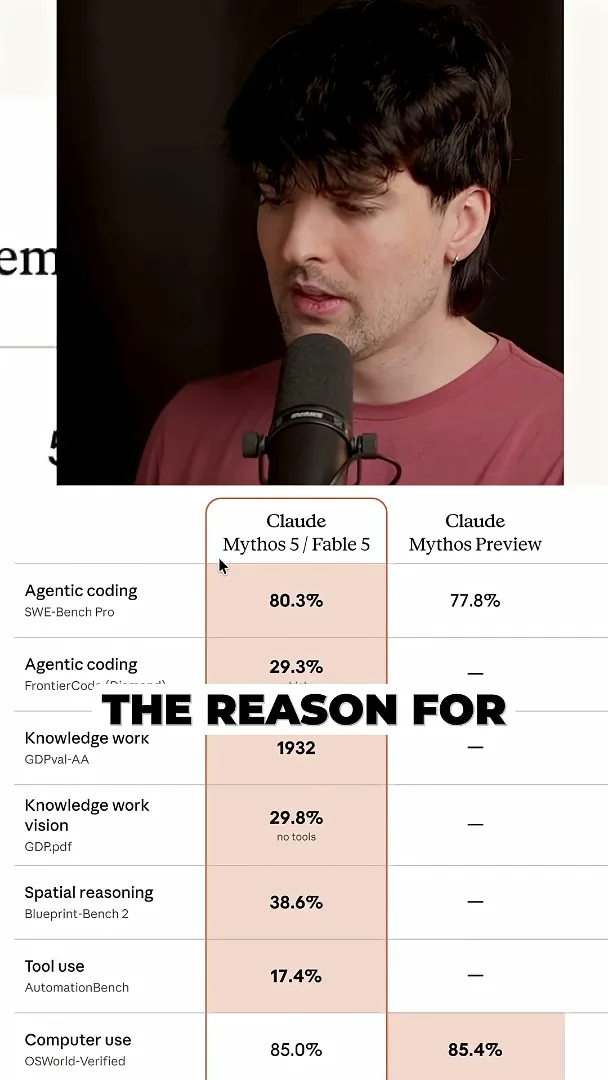
Some benchmark tables group Mythos 5 and Fable 5, but Fable refused certain tasks. I report a roughly 20-point drop on Terminal-Bench compared with the Mythos run. That makes it important to distinguish the underlying capability being measured from the effect of safeguards and refusals.
Evaluating coding performance
He questions SWE-bench Pro and reports other early coding results. He also discusses vision and task-specific cost.
The reported SWE-bench Pro score is around 80%, but I don't put much faith in that benchmark. Many tasks are based on existing pull requests, and I worry that exposure to relevant material in training could make reconstruction easier. That is my concern about the benchmark, not proof of contamination in a particular run.
I find FrontierCodeBench more interesting. I cite a roughly 30% result for Mythos compared with 13% for Opus 4.8 and 5.7% for GPT-5.5 in the comparison I saw. I also see an improvement in vision and spatial reasoning, though no single benchmark establishes overall superiority.
DataCurve shared early coding results with me. In the evaluation shown, I interpret Fable at high effort as comparable to GPT-5.5 and stronger than the Opus results at lower measured cost. Even with a higher model price, fewer tokens on those tasks can change the total cost; this is a task-specific comparison, not a promise for every workload.
같은 채널의 다른 글
 38:47EN
 Theo - t3․gg· 2026년 10월 28일Theo’s Long-Running Agent Experiments: Verification, Compute and CostTheo Browne · Ping LabsA skateboard game and two compiler projects show how repeated checks and flexible compute can sustain agent work—and how expensive those loops can become.
 36:07ENTheo - t3․gg· 2026년 10월 27일Theo on Token Costs, Coding Agents, and the Price of AI CapabilityTheo Browne · Ping LabsA viral estimate of Lauren's AI spending prompts a closer look at cache pricing, benchmarks, and the changing work of coding agents.
 30:37ENTheo - t3․gg· 2026년 10월 26일Theo’s Three Skills for Reviewing and Shipping with Coding AgentsTheo Browne · Ping LabsHow sol-loop, full-send and full-stop encode review, verification and different levels of merge authority.
 0:43ENTheo - t3․gg· 2026년 10월 23일Theo Distinguishes Security Vulnerabilities from Active AttacksTheo Browne · Ping LabsA short explanation of why disclosed software flaws and reported attacks are different kinds of security news.
 29:22ENTheo - t3․gg· 2026년 10월 22일Theo on Security Vulnerabilities, Stolen API Keys and AITheo Browne · Ping LabsA look at the gap between vulnerability disclosure and patching, and a speculative account of why stolen inference keys may be valuable.
 31:13ENTheo - t3․gg· 2026년 10월 20일Theo on Why Smarter Models Help More Than DevelopersTheo Browne · Ping LabsFrom game modifications to compiler experiments, Theo revisits his assumptions about who benefits from more capable AI.