30초 요약
A financial agent can pass its evaluations and still leave an auditor unable to defend a particular decision. Fieldguide security engineer Anirudh Veeraragavan proposes protecting human-reviewed work from silent changes, recording each execution step, tying citations to exact evidence versions and checking the evaluation data itself. In his bank-reconciliation example, an agent may draft a correction but must hand it to a person when reviewed work, conflicting runs or questionable evidence require judgment.
- 1Passing evaluations does not explain one audit decisionAn inspector can ask why a particular procedure and piece of evidence supported a conclusion, regardless of aggregate scores.
- 2Do not silently overwrite a signed human reviewEven an agent that reaches the right new conclusion can invalidate a reviewer’s signature if it changes what was reviewed.
- 3Record the inputs and outputs of individual stepsA step-by-step run record makes it possible to replay a specific operation and compare a later run with the original.
- 4A citation needs an exact identity and versionVeeraragavan recommends tying a claim to a document identifier, version and content hash so evidence can be checked against source rules.
- 5A high evaluation score can hide errors in the test setAn illustrative 97% score conceals both wrong reference answers and outdated rules that incorrectly mark missed exceptions as successes.
- 6Escalate exceptional cases with the reason visibleChanges to reviewed work, disagreement between runs and evidence that fails policy should prompt human review without turning every alert into a rubber stamp.
핵심 정리
- Keep an agent’s suggestions separate from work a person has already reviewed and signed.
- Record each step’s inputs and outputs so individual steps can be replayed and compared.
- Identify evidence by document ID, version and content hash, not just a filename.
- Audit evaluation examples for obsolete decisions and changes in rules.
- Escalate exceptions with enough context for a person to investigate rather than automatically approve.
챕터별로 다듬은 전문 읽기
The question an audit inspector will ask
A successful evaluation does not by itself justify a particular audit decision. Veeraragavan uses bank reconciliation to explain why the path from evidence to conclusion matters.
In an audit, the opinion is the product, and the opinion is only as good as the basis behind it. I am Anirudh Veeraragavan, lead security engineer at Fieldguide. The question is what a decision-making process should look like when an agent does part of that work.
Consider bank reconciliation. An auditor compares the cash on a client’s books with the bank balance and explains differences, such as deposits in transit or outstanding checks. The goal is to test whether the financial position the client reports matches the evidence.
An agent could receive the books, a list of reconciling items, supporting evidence, audit methodology and prior-year examples. Previously reviewed audits could become an evaluation set, and a human reviewer could sign off on the result. That is a reasonable way to automate tedious, high-volume work.
Suppose the evaluations look excellent, users are happy and the product ships. Then an inspection asks why one specific audit procedure and one specific piece of evidence were sufficient. An aggregate score does not answer how the agent reached that particular decision.
Financial fraud shows why the consequences can be severe. In the Peregrine Financial Group case, Veeraragavan says, the claimed bank balance exceeded $200 million while only about $5 million was actually there. He uses it to explain why financial decisions need a basis that can be defended later.
The audit profession offers a useful standard: an experienced auditor who did not perform the work should be able to understand the test, the evidence and the decision. Applied to agents, that means another auditor should be able to follow what the agent did.
Veeraragavan groups the required controls into authorization, execution control, evidence provenance and evaluation integrity. They all depend on knowing when the agent should stop and a person should decide. He illustrates them with a fictional freight company’s 2026 bank reconciliation.
Protect signed reviews and record each step
The agent may suggest a change but should not overwrite a person’s signed work. Recording steps with their inputs and outputs allows later runs to be compared.
The fictional client has about $2.9 million according to the bank and $2.7 million on its books, with 41 items explaining the difference. The examples follow two checks and two deposits through the agent’s workflow.
First, a reviewer flags a check as an exception and signs the work. Days later, new information arrives and triggers the agent, which changes the item to “no exception.” Even if the new answer is right, the signature now appears on content the person did not review.
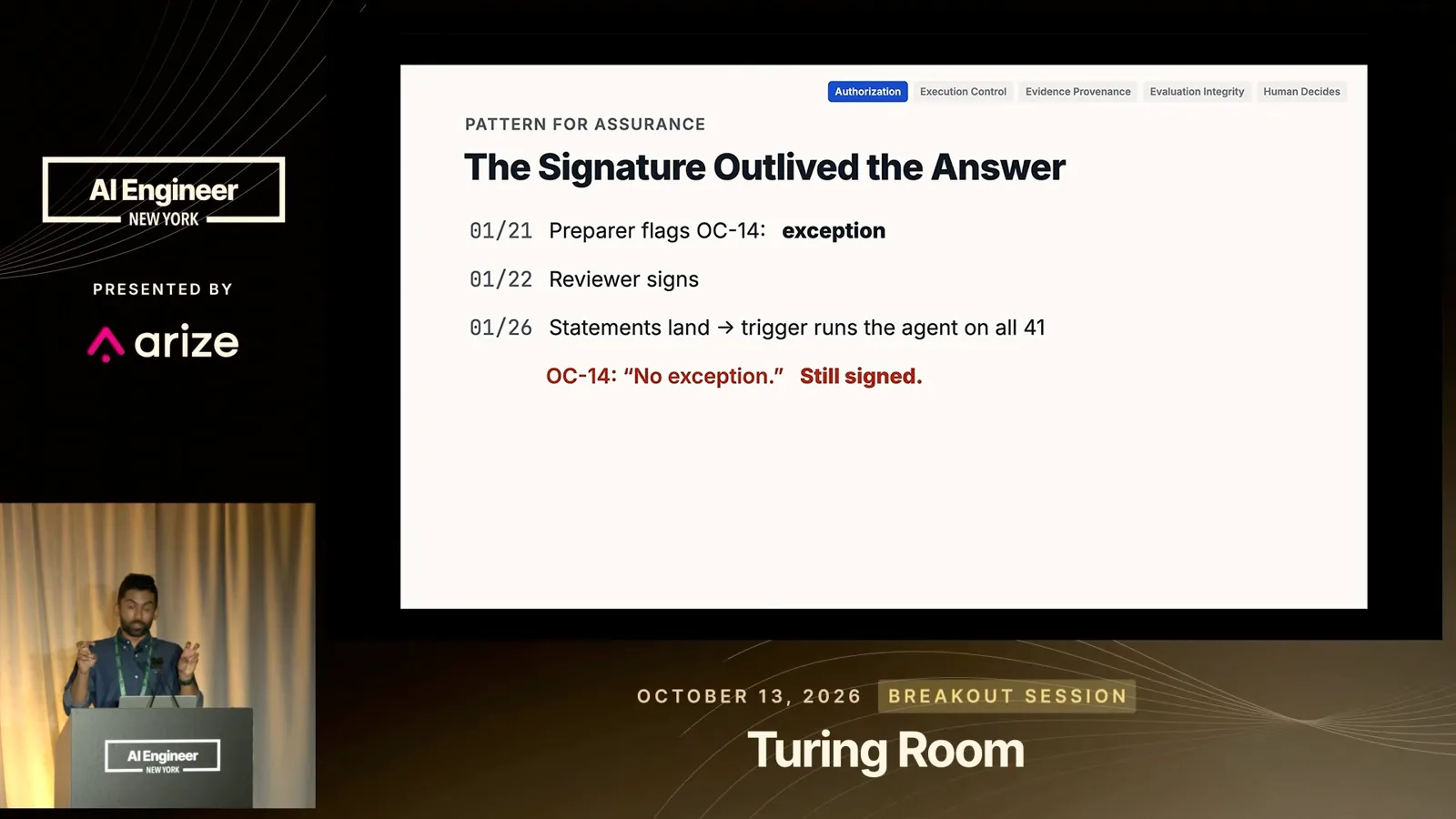
Authorization therefore depends on the object, its state and the time of the action, not just whether a tool call is permitted. An agent can draft a suggestion on an unreviewed item, but it should not silently overwrite a person’s reviewed work.
The second control is execution. Imagine rerunning the same work a year or two later and getting a different result. A generic log saying that the agent fetched evidence, reasoned and produced an answer is not enough to identify where the two runs diverged.
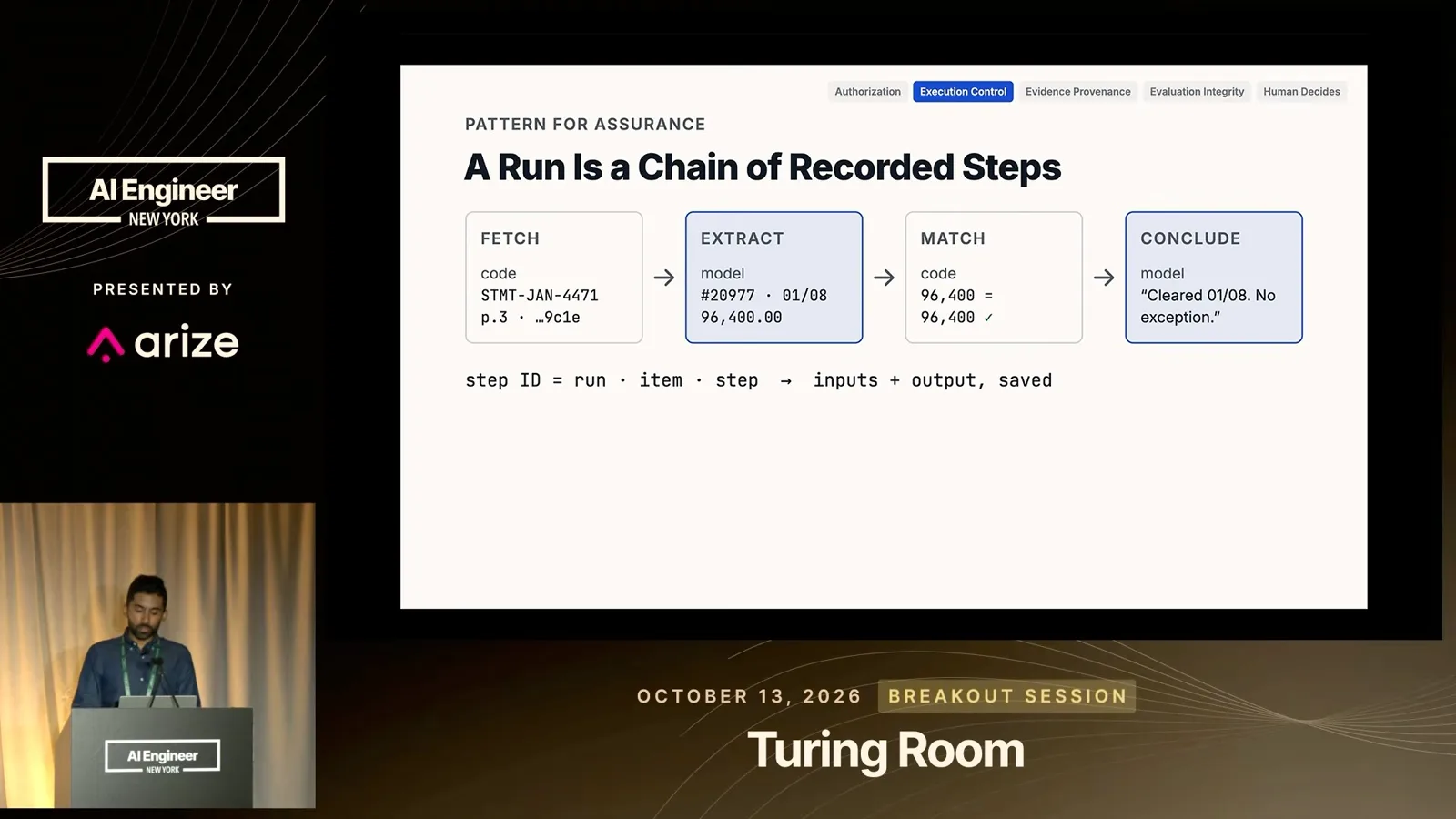
Record the run as a chain of identifiable steps, each with its inputs and outputs. Distinguish deterministic operations, such as fetching or matching, from model steps, such as extracting a field or reaching a conclusion. Then an individual step can be rerun and compared with the original.
In the example, comparing steps shows that the original run was right and the later run was wrong. The point is not merely to land on the correct answer: the record lets the reviewer show the path to it and investigate why another run differed.
Identify evidence and audit the evaluation itself
A filename is not enough to identify the evidence used. The examples in an evaluation can also be wrong or outdated, hiding failures behind a strong score.
The third control is evidence provenance. An agent cites “January bank statement, page two” while drawing a conclusion from the wrong account. In a large engagement, several documents can share that name; even a unique name does not tell a reviewer which version was used or who supplied it.
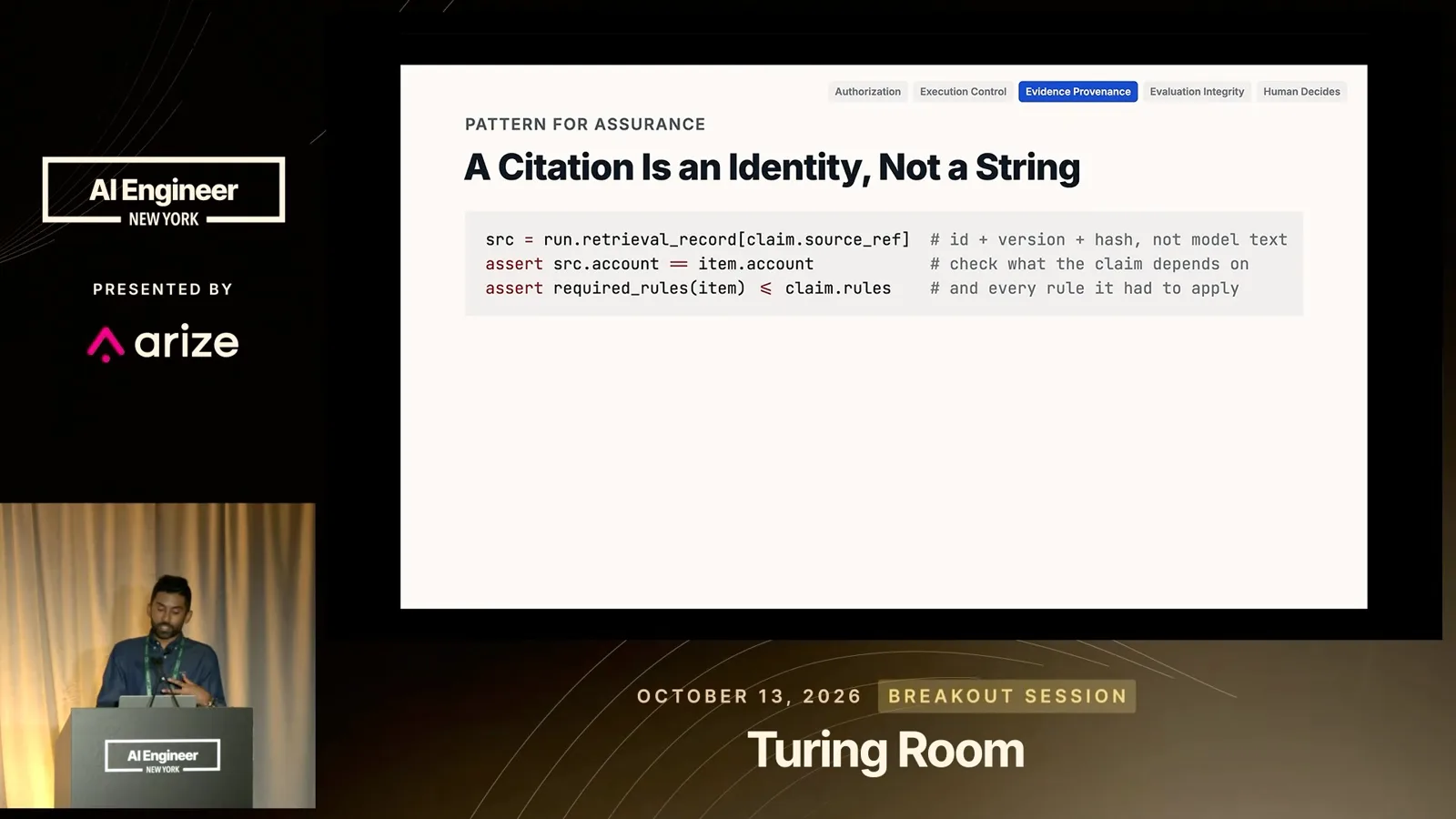
A citation should identify a specific document, version and content hash. Once the claim is tied to a concrete source, the system can enforce evidence rules—for example, accepting a statement obtained directly from the bank rather than one uploaded by the client.
Fourth, evaluate the evaluation data. A reviewed audit from last year is not necessarily a correct reference answer today. It may have been superseded, based on poor evidence or assessed under a methodology that has since changed.
In the illustrative evaluation, a 97% score hides different kinds of error. Four of nine apparent misses came from wrong reference answers, suggesting the agent did better on those examples. Twelve items marked as correct under old rules should now be exceptions, meaning the score also concealed real misses.
Stop for human judgment when a control fails
Escalations should identify what needs investigation without encouraging automatic approval. The same controls can support decisions beyond auditing, including credit and anti-money-laundering work.
The agent needs to stop and ask a human when it tries to change signed work, a new run disagrees with an old one, or evidence fails the applicable rules. The reviewer should see what is wrong and where to investigate.
Escalations should be easy to verify, not necessarily easy to approve. If a system interrupts people constantly, automation bias can turn review into habitual acceptance. Flag exceptional cases and provide enough context for a meaningful decision, even when review takes time.
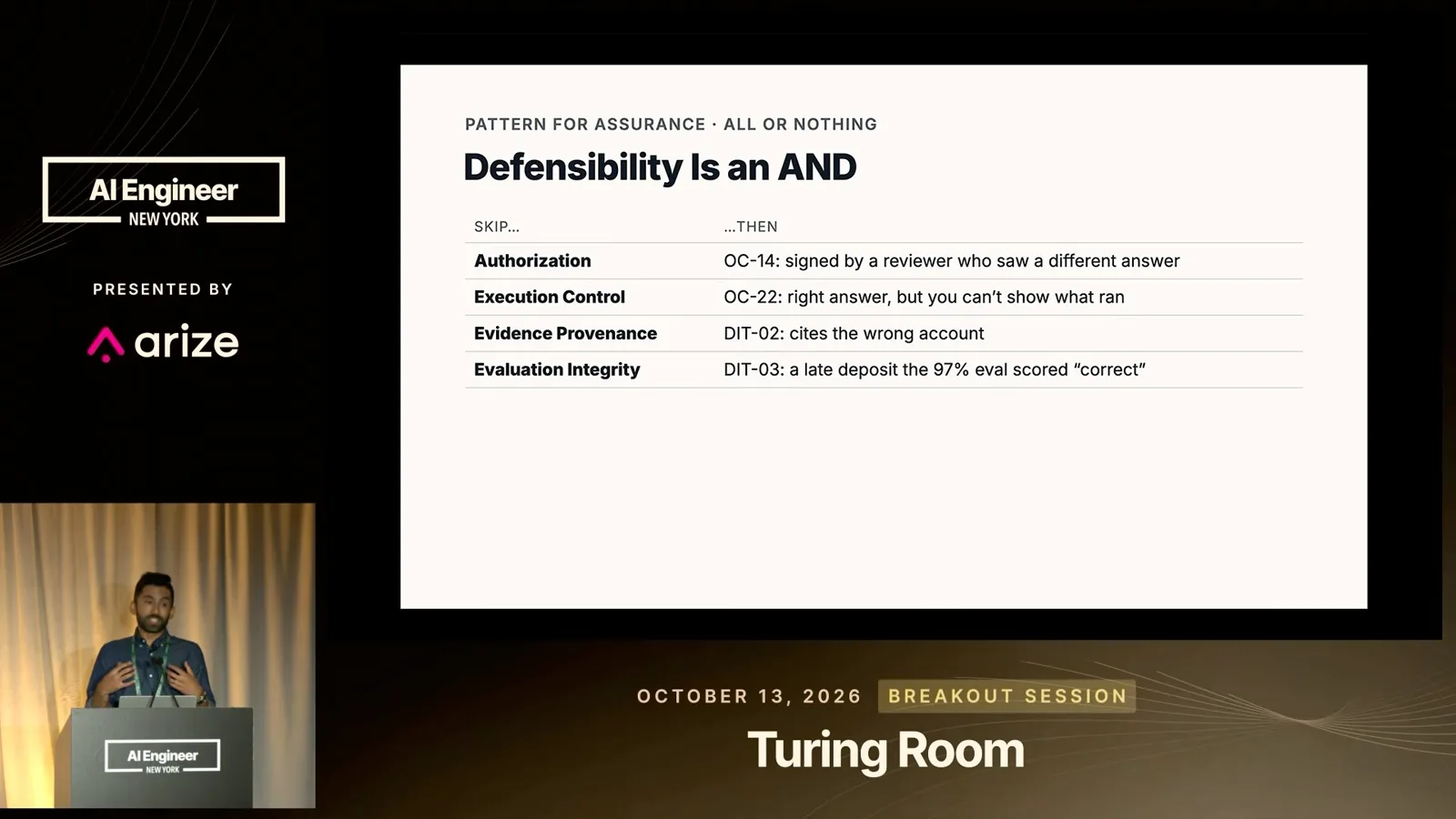
These controls work together. Without authorization, a signed answer can change underneath the reviewer. Without execution records, a correct answer cannot be reconstructed. Without evidence provenance, the source of a wrong answer can be unclear. Without sound evaluation data, a headline score can be misleading.
The same questions apply outside audit. A lender should be able to inspect why a loan was approved or declined; an anti-money-laundering team should be able to inspect the evidence behind closing or escalating an alert. For consequential financial decisions, “the model said so” is not a sufficient defense.
같은 채널의 다른 글
 31:22EN
 AI Engineer· 2026년 11월 7일Nouha Dziri on Making Coding-Agent Teams More Cost-EfficientNouha Dziri · CohereExperiments on ProgramBench and Commit0 show why the task bottleneck, lead model and coordination design matter more than simply adding agents.
 19:34ENAI Engineer· 2026년 11월 7일How Cloud Agents Help Review Changes to a Security MasterAmol Kapoor, Clifford Ressel · Nori AgenticAmol Kapoor and Clifford Ressel explain why private-asset data is difficult to reconcile and how an agent assists human reviewers.
 18:28ENAI Engineer· 2026년 11월 7일Vinoo Ganesh on Building AI Answers from Verifiable FactsVinoo Ganesh · KeplerKepler’s co-founder describes pointer-based retrieval, deterministic calculations and access controls for financial AI.
 1:04:02ENAI Engineer· 2026년 11월 6일Lance Martin: Audit Prompts, Build Better Evals and Optimize Agent CostLance Martin · AnthropicAn Anthropic engineer explains prompt caching, evaluation design, hill climbing and the architecture of reliable long-running agents.
 23:05ZHAI Engineer· 2026년 11월 6일Ryo Lu:当我们什么都能做,还知道自己想做什么吗?Ryo Lu从 AI 生成的日记工具到爵士乐团,Ryo Lu 讨论如何在更强大的工具旁保有判断、生活和与他人合作的空间。
 19:19ENAI Engineer· 2026년 11월 6일Ben Holmes: Use Agent Traces to Improve Agent SkillsBen Holmes · WarpThe Warp engineer explains how scoring conversations can uncover hidden friction and produce reviewable configuration improvements.