30초 요약
In this July 2024 roundup, Matthew Berman discusses Meta’s Llama 3.1, xAI’s training cluster, SearchGPT, Mistral Large 2, Stable Audio Open and OpenAI news. He also covers DeepMind’s AlphaProof and AlphaGeometry 2 result on IMO problems. Company claims, predictions and reported projections are identified as such. DeepMind’s silver-level comparison involved manually formalized problems and more time than human contestants; the video contains no disclosed sponsor.
- 1Llama 3.1Berman highlights the 405B release, its open weights and the positive response from Andrej Karpathy.
- 2SearchGPTOpenAI announced a temporary search prototype with sourced answers and conversational follow-ups.
- 3Mistral Large 2The 123B model combined long context with a research license and vendor-reported benchmarks.
- 4Stable Audio OpenBerman plays audio examples; the license status of training data does not guarantee unrestricted outputs.
- 5OpenAI safety questionsSenators requested details on compute, employee agreements, cybersecurity and predeployment testing.
- 6Mathematics at silver levelDeepMind’s systems solved four problems with manual formalization and more time than the human competition allowed.
핵심 정리
- Llama 3.1 and Mistral Large 2 made model weights available under different licenses with important restrictions.
- SearchGPT began as a limited temporary prototype, with features intended for later integration into ChatGPT.
- Stable Audio Open used licensed recordings, but that does not make every output automatically copyright-free.
- Senators requested information about OpenAI’s safety and employment practices; their questions are not findings of wrongdoing.
- AlphaProof and AlphaGeometry 2 scored 28 of 42 points on 2024 IMO problems under different conditions from human contestants.
- Claims about AI market dominance, future spending and self-improvement remain forecasts or reported estimates.
챕터별로 다듬은 전문 읽기
Llama 3.1 and xAI
Berman reviews Meta’s open-weight model and praise from Karpathy. He also discusses Musk’s claims about xAI’s training cluster.
This week in July 2024 brought major AI releases. I begin with Meta’s Llama 3.1, which I have covered in other videos. Andrej Karpathy praised the 405-billion-parameter model as a frontier-capability release and compared it with GPT-4 and Claude 3.5 Sonnet; those comparisons are his assessment, not a universal benchmark result.
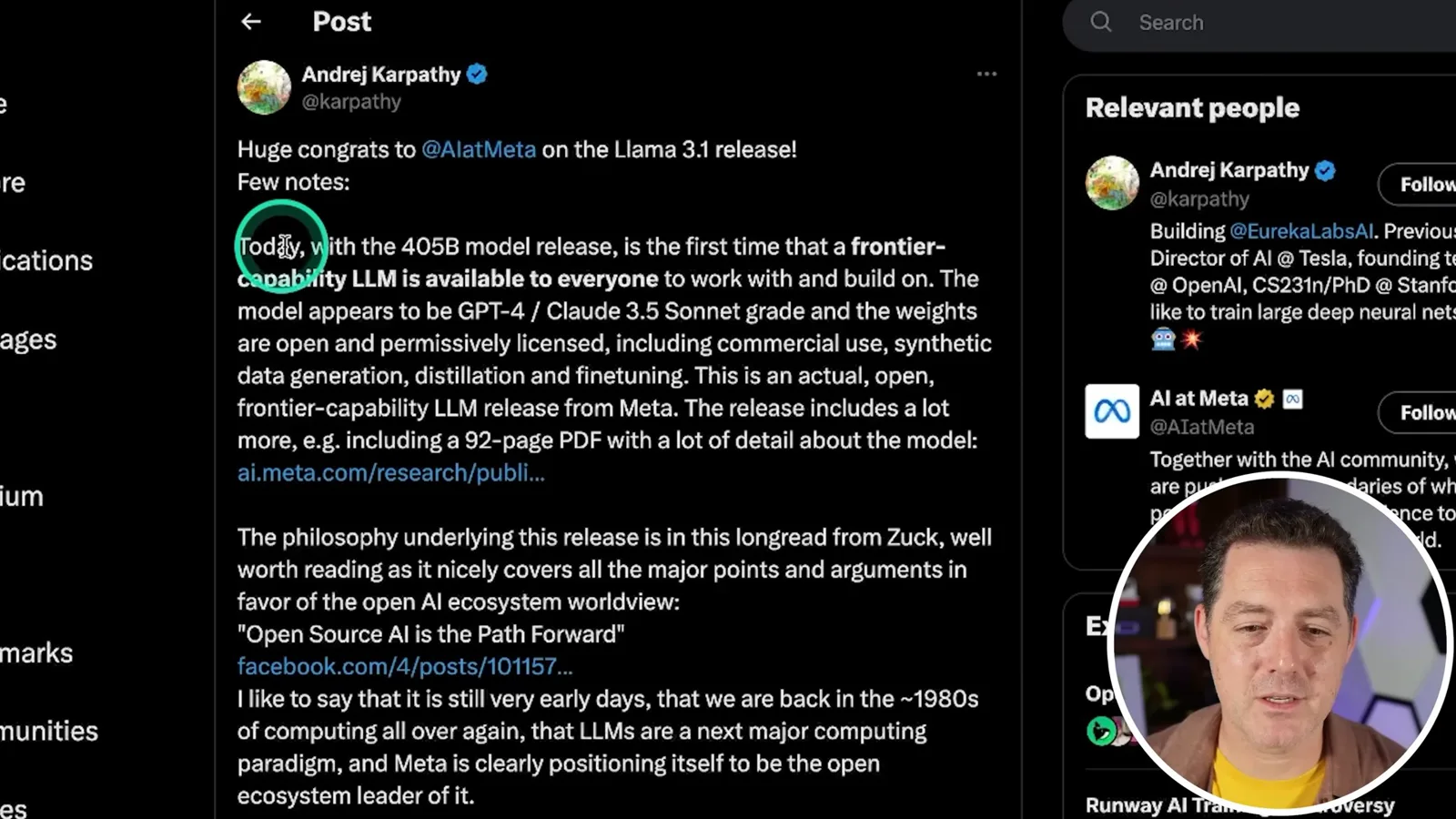
Karpathy highlighted downloadable weights and uses such as fine-tuning, distillation and synthetic data. Meta’s license permits many commercial uses but has conditions and restrictions, so “open weights” should not be confused with an unrestricted open-source license. Elon Musk also praised Mark Zuckerberg and Meta for the release.
Musk said xAI had begun training on a Memphis cluster with 100,000 liquid-cooled H100 GPUs and described it as the most powerful AI training cluster. He predicted a leading model by December 2024. These are his claims and forecast, not independently verified rankings; I note his record of ambitious timelines.
SearchGPT and Mistral Large 2
OpenAI’s search prototype raises questions of platform competition. Berman examines Mistral’s benchmark chart and license.
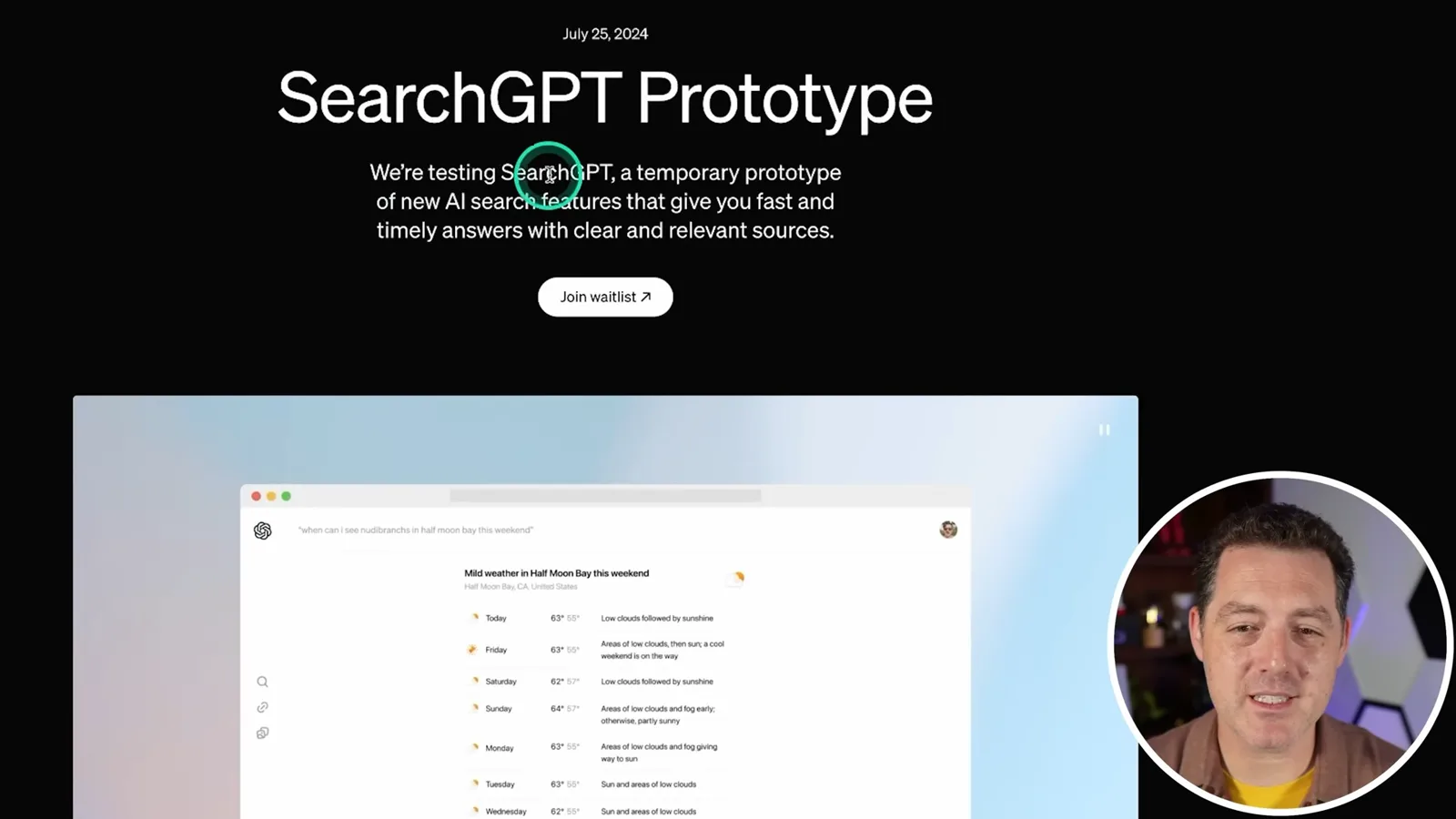
OpenAI announced [SearchGPT](https://openai.com/index/searchgpt-prototype/), a temporary search prototype combining AI answers with web information and source links. OpenAI said it was testing with a small group and intended to integrate the best features into ChatGPT. At the time I saw it as competition for Perplexity and Google and an example of platform risk when a supplier builds a competing product.
The prototype demonstration searches for music festivals in Boone, North Carolina, and supplies links to sources. Follow-up questions retain conversational context. I already use ChatGPT and other models for much of my search, although my personal usage and enthusiasm are not evidence that search answers are always accurate.
Mistral released Mistral Large 2 shortly after Llama 3.1. The company described improvements in coding, mathematics, reasoning, multilingual support and function calling. I had not yet tested it myself and intended to do a fuller evaluation.
Mistral’s charts compare its 123-billion-parameter model with larger competitors. I cite average code-generation scores of 76.9 for Mistral Large 2 and 77.9 for GPT-4o, with Llama 3.1 405B around 75 in the displayed evaluation. These are vendor-reported results under particular settings, not proof that one model wins every task.
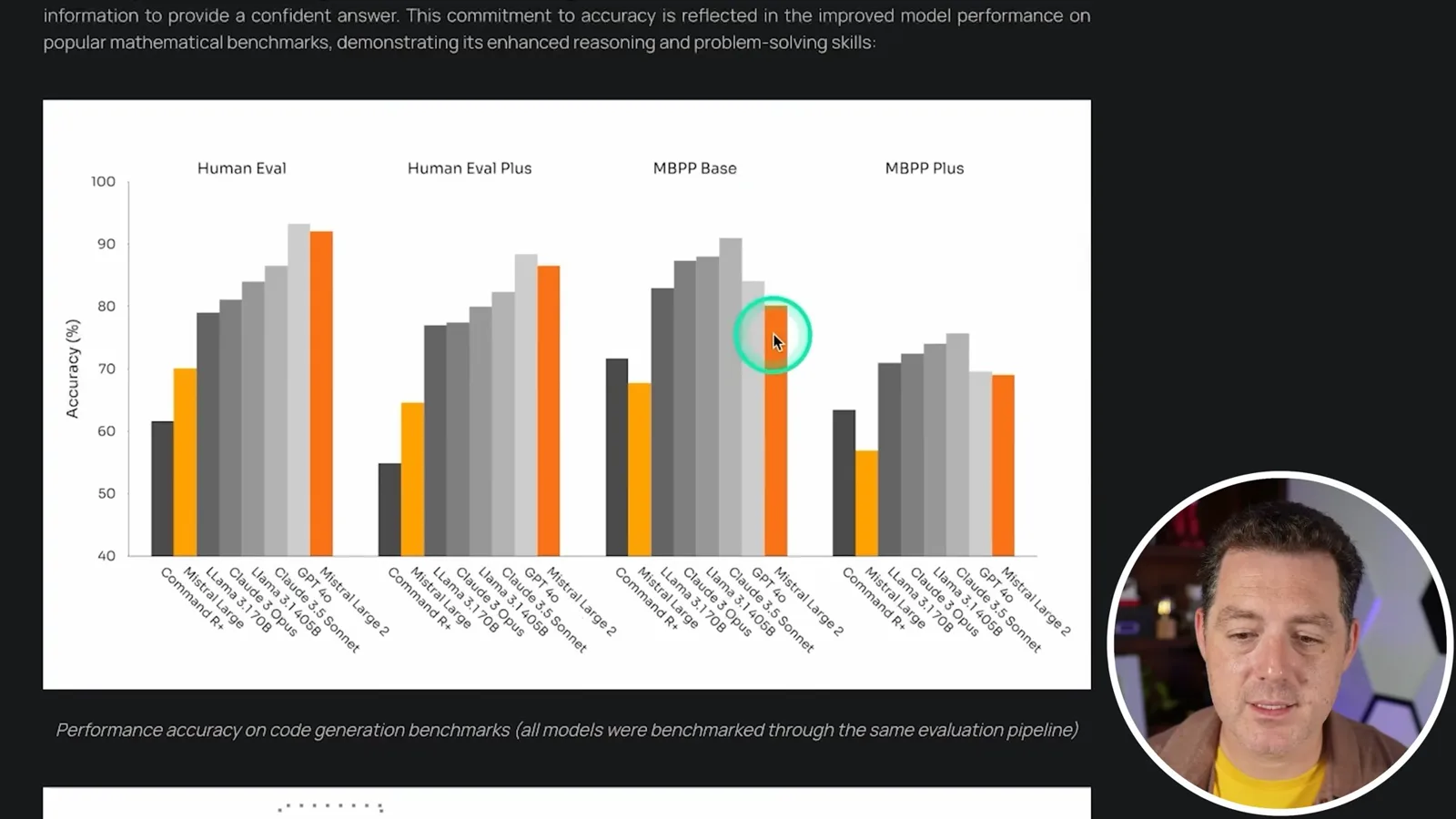
Mistral Large 2 was designed for single-node inference, with a 128,000-token context window and support for many languages. Its [research license](https://mistral.ai/news/mistral-large-2407/) allows research and noncommercial use and modification; commercial self-deployment required a separate license. Downloadable weights do not mean unrestricted commercial use.
Regional access and audio generation
Berman discusses Meta’s EU rollout decision and Stable Audio Open. He plays several sound examples.
Meta said it would withhold its forthcoming multimodal Llama model from the EU, citing regulatory uncertainty. I am disappointed and attribute the decision to overregulation, but that is my policy view and Meta’s stated rationale, not proof of a single legal cause. I also mention Apple’s then-announced EU rollout concerns and Meta’s pause in Brazil.
Stability AI published research on Stable Audio Open, an open-weight text-to-audio model producing stereo audio at 44.1 kHz, with outputs of up to about 47 seconds. I imagine combining generated sound effects, voices and video and mention local fine-tuning. Hardware needs and permitted uses depend on the model and license.
Stability reported using nearly 500,000 licensed recordings from Freesound and the Free Music Archive, with music screening in its data curation. I describe the output as copyright-free, but licensed or Creative Commons training material can still be copyrighted, and that fact does not guarantee every generated output is free of rights restrictions. Check the applicable license and circumstances.
I listen to examples including rain on a roof, a coin dropping, a hip-hop drum loop and an audio logo. The samples suggest potential uses for sound effects; they do not prove every generated result is usable without review.
OpenAI voice, chips and safety questions
The roundup turns to voice rollout expectations, chip reports and a Senate letter. Berman also discusses fine-tuning GPT-4o mini.
A report cites Sam Altman saying GPT-4o’s advanced voice alpha would begin later that month, with general availability to follow later. I look forward to testing it. This was a July 2024 rollout expectation rather than a promise about current availability.
Reuters relayed reporting that OpenAI had discussed developing an AI chip with Broadcom and was hiring people with relevant chip experience. I speculate that custom hardware and efficient inference could become a competitive advantage as models become more broadly available. Those reported discussions were not proof that a completed chip existed.
US senators wrote to OpenAI about safety and employment practices. I suggest that working with regulators could also help incumbent companies raise barriers to smaller rivals, but regulatory capture is my interpretation, not something the letter establishes.
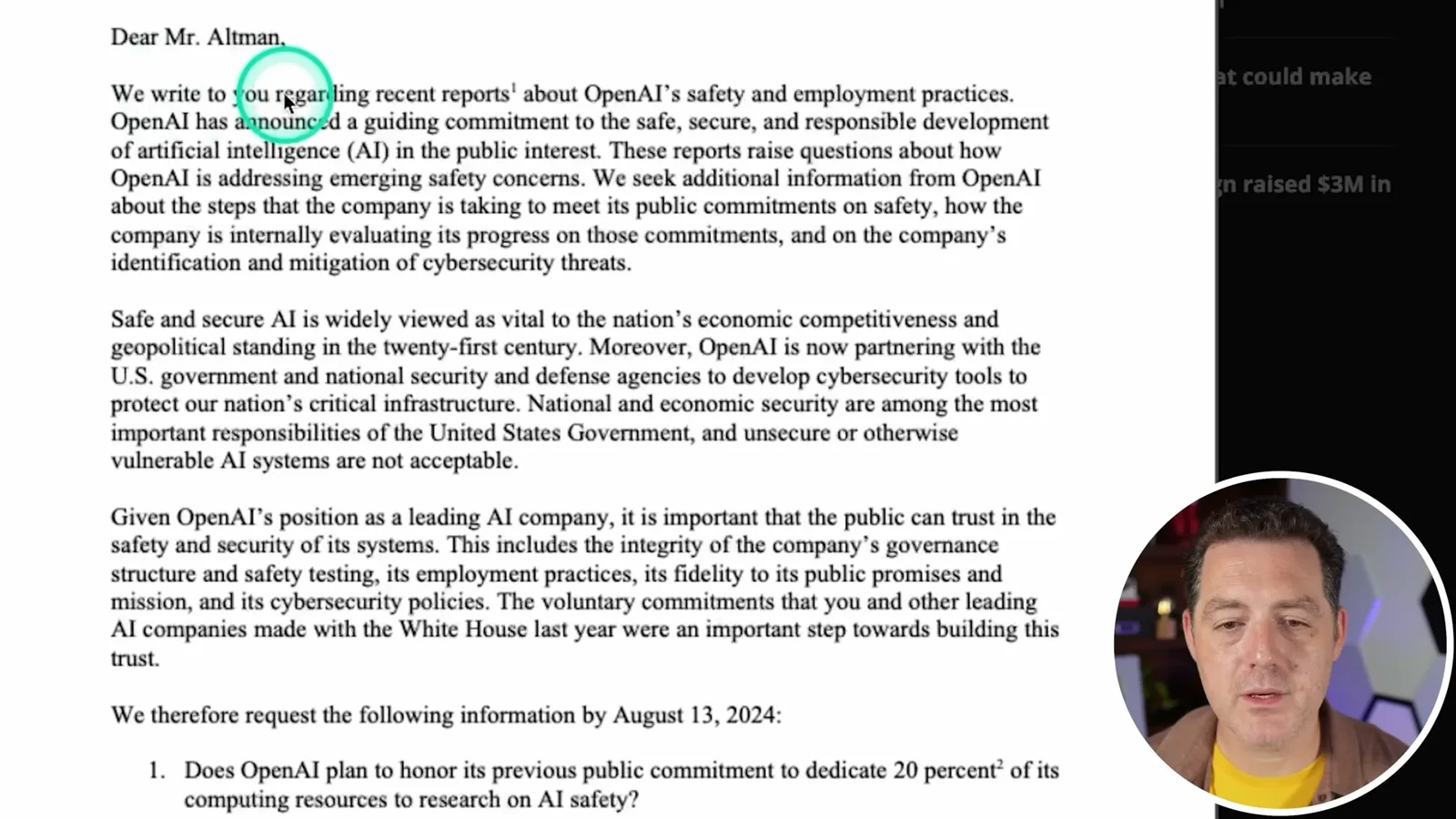
The lawmakers asked how OpenAI was meeting safety commitments, evaluating progress and mitigating cybersecurity risks. They asked whether it would honor a prior commitment to dedicate 20% of compute to safety research. I link this question to reported departures of alignment researchers; the letter asks for information rather than proving how much compute was actually allocated.
The letter also asks about nondisparagement agreements, provisions that might penalize employees raising concerns, internal reporting procedures and protection against model theft. I expect the company could only answer some security questions in broad terms without exposing sensitive details.
Another question asks whether OpenAI would provide its next foundation model to US government agencies for predeployment testing. I understand the desire for independent review but question whether the government would have enough expert staff. That is my opinion, not a finding that government testing is ineffective.
Sam Altman said GPT-4o mini fine-tuning was live. I describe it as a hosted, closed model that users could adapt for particular tasks; in my own earlier test I liked its speed and text cost, while finding image input less attractive. Those observations are specific to the service and pricing at the time.
Investments, jailbreaks and finances
Berman reviews Musk’s investment poll, a jailbreak demonstration and projected OpenAI losses. He offers his own view of model competition.
Musk proposed a $5 billion Tesla investment in xAI through a social-media poll, subject in his wording to an outside valuation. The poll showed 67.9% support among respondents. I want a clearer explanation of the business rationale; a poll is not a board approval or evidence that an investment had been completed.
I point to a jailbreak demonstration involving Llama 3.1 and examples of prohibited or unwanted responses. A demonstrated bypass raises a safety concern, but it is not a complete assessment of the model’s safeguards across conditions.
I discuss a report projecting that OpenAI could lose $5 billion in 2024, including estimated infrastructure spending, and speculate about the economics of AI investment and a possible market correction. Those are projections and my interpretation, not audited results. My claim that Microsoft owned half of OpenAI should not be treated as an established ownership figure.
I still see ChatGPT as a major consumer product but argue that model providers will need differentiators such as inference speed, multiple models or specialized customization. My view that general intelligence will become commoditized is a prediction, not a settled market outcome.
AlphaProof and the math olympiad
DeepMind’s systems solve four 2024 IMO problems at a silver-level score under different conditions from human competitors. Berman considers speculative implications for self-improvement.
Google DeepMind announced that AlphaProof and AlphaGeometry 2 together solved four of six 2024 International Mathematical Olympiad problems, earning 28 of 42 points under grading by mathematicians. This matched the silver-medal score range; the systems did not win an official medal as contestants.
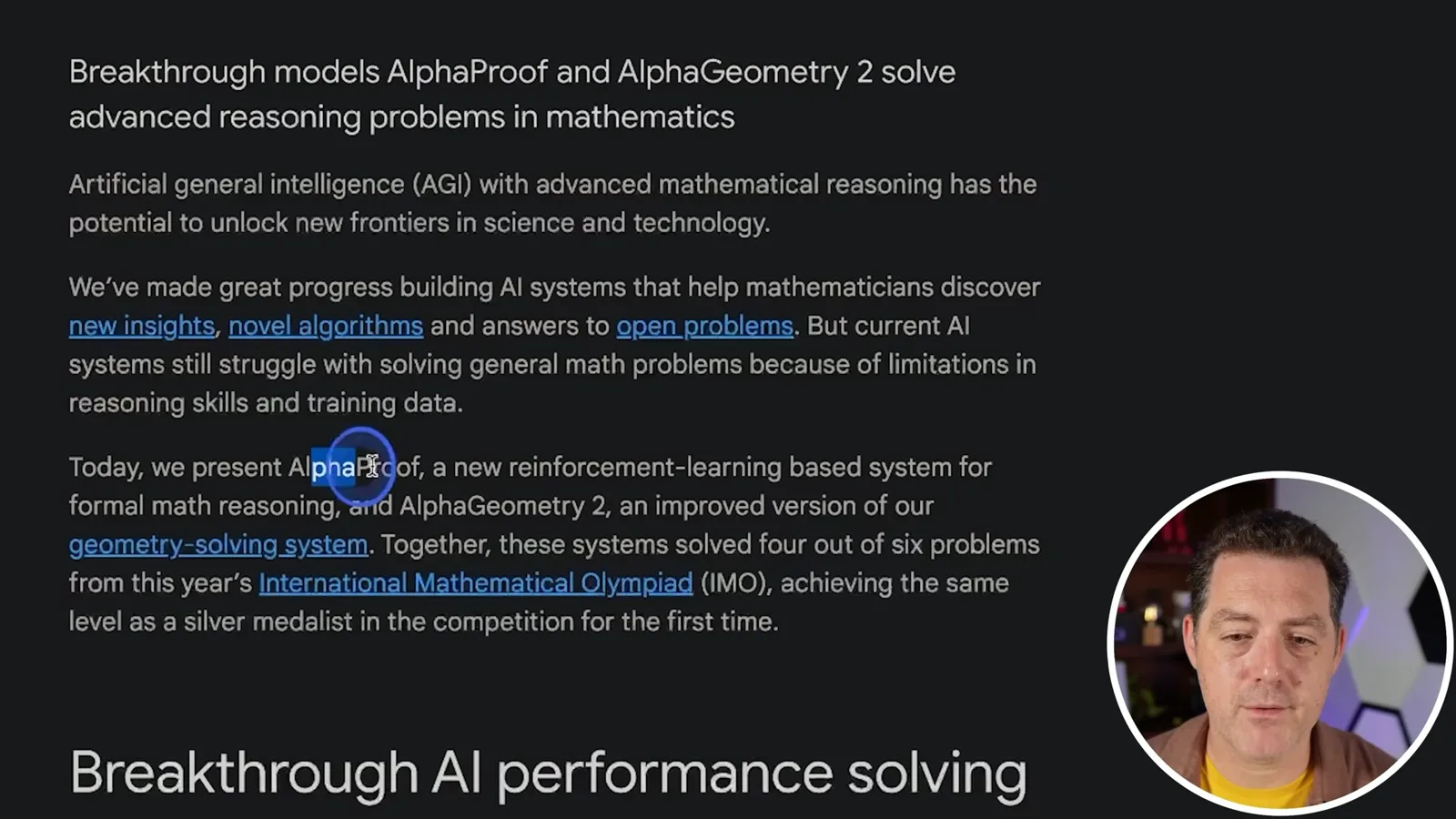
AlphaProof addressed formal mathematical reasoning and AlphaGeometry 2 solved the geometry problem. The [researchers](https://deepmind.google/blog/ai-solves-imo-problems-at-silver-medal-level/) manually translated problems into formal language, and the systems took up to three days on some solutions, unlike the two 4.5-hour sessions for human contestants. The result is impressive but not an equal-conditions competition.
I connect mathematical progress with Leopold Aschenbrenner’s argument that AI capable of improving its own techniques could accelerate further progress. New mathematics and an intelligence explosion are speculative future possibilities, not outcomes demonstrated by the IMO experiment.
같은 채널의 다른 글
 34:21EN
 Matthew Berman· 2026년 10월 27일Matthew Berman Examines Anthropic’s IPO Filing, AI Growth and GovernanceMatthew Berman, Sam Altman · Forward FutureThe presenter reviews the S-1’s financial metrics, compute strategy and voting structure while questioning the tension between rapid AI development and safety.
 0:26ENMatthew Berman· 2026년 10월 25일Sam Altman on Human Values and Problem-Solving in an AI WorldSam Altman · OpenAIIn a short interview excerpt, Altman considers the enjoyment of solving hard problems and the human role in interpreting results.
 0:36ENMatthew Berman· 2026년 10월 25일Kimi K3.1 and a Rubik’s Cube Solver DemonstrationMatthew Berman · Forward FutureMatthew Berman shows a scrambled virtual cube being solved and gives the Kimi K3.1 test a favorable assessment.
 0:21ENMatthew Berman· 2026년 10월 24일An AI-Generated Kimi Benchmark Chart Used Invented ScoresMatthew Berman · Forward FutureMatthew Berman asks for a graph of Kimi K3.1 Pro benchmarks, then discovers that the displayed figures are illustrative placeholders.
 25:50ENMatthew Berman· 2026년 10월 24일Kimi K3.1 Pro Tested: Strong 3D Demos, Uneven Results and Competitive PricingMatthew Berman · Forward FutureMatthew Berman tests the open-weight model on coding, 3D rendering and visual explanations, then compares benchmark results and prices.
 32:20ENMatthew Berman· 2026년 10월 23일Who Is Local AI For? The Costs, Trade-offs and a Hybrid FutureMatthew Berman · Forward FutureMatthew Berman weighs data control and independence against hardware cost, setup complexity and inference speed.