30초 요약
At Sana AI Summit 2024, Joel Hellermark explains the company’s focus on knowledge access and demonstrates proposed assistant capabilities. He discusses retrieval, model routing, tools, planning, suggested actions and voice; performance figures are reported by Sana.
- 1Access to knowledgeHellermark describes knowledge access as a foundational problem motivating Sana.
- 2Beyond one-pass answersHe identifies stale knowledge, tool use and multistep reasoning as challenges for assistants.
- 3Knowledge graph and routingThe 2024 product presentation describes editable knowledge graphs and routing questions to different models.
- 4Supervised automationSuggested actions are prepared in the background for a person to inspect and complete.
- 5Reported productivityThe company reports gains in selected use cases; the talk does not establish a universal productivity figure.
핵심 정리
- Hellermark frames access to knowledge as a foundational problem.
- The proposed assistant combines retrieval, tool use, planning and checking.
- Suggested workplace actions are presented for users to review and complete.
- The presentation’s benchmark and productivity numbers are company-reported, use-case-specific claims.
- The product and roadmap described are from a 2024 presentation.
챕터별로 다듬은 전문 읽기
Why knowledge access matters
Hellermark recounts the questions and stories behind Sana’s purpose.
Sana founder Joel Hellermark opens the 2024 summit by recalling Richard Hamming’s question: what is the most important problem in your field, and why are you not working on it?
He recounts a story about Buckminster Fuller and Albert Einstein identifying access to knowledge as a “meta problem.” Whether or not the anecdote is historically verified, Hellermark uses it to explain Sana’s aim of helping people find and apply knowledge.
He names customers in energy, transportation, medicine and construction and reports that one user accessed Sana 2,700 times in six months. These are company examples and reported usage figures from the 2024 presentation.
From search to agents
He reviews Sana’s product and describes limitations of one-pass assistants.
Hellermark reviews the product’s development: searching knowledge spread across systems, asking questions through chat, and adding meeting notes to a searchable knowledge base. He says a free tier was introduced to broaden access.
He argues that assistants still struggle with stale knowledge, using tools, multistep problems and comprehensive retrieval. He says semantic similarity search alone may miss relationships that a knowledge graph can help represent.
His proposed shift is from a single-pass assistant to one that plans, retrieves information, checks results and tries again when needed. Sana calls the agent solution presented at the event A-4.
A-4 capabilities
The presentation covers knowledge graphs, routing, tools, reflection and planning.
Hellermark describes an automatically derived company knowledge graph that users can correct by removing outdated information or adding missing facts. He presents this as part of the product design.
Model routing sends different questions to models suited to them, he says, aiming to balance quality and speed. He also describes tools that let an assistant work with applications such as Salesforce and recruiting systems.
Reflection and multistep reasoning let an assistant draft a plan, check intermediate results and improve its answer. He reports benchmark improvements for combinations of these techniques, though the figures are specific to the evaluation he presents.
Supervised actions and voice
Examples show meeting summaries, proposed actions, drafts and a voice preview.
Hellermark introduces supervised automation: the system anticipates a useful action and prepares it, while the user reviews and completes it. This is a proposed step beyond waiting for a prompt.
In one example, Sana finds notes from a meeting and prepares an update to Salesforce. The user can inspect the proposed action before completing it.

A home-screen catch-up flow presents summaries of missed meetings and suggested actions generated in the background. Users can inspect the summaries, ask follow-up questions and choose which actions to complete.
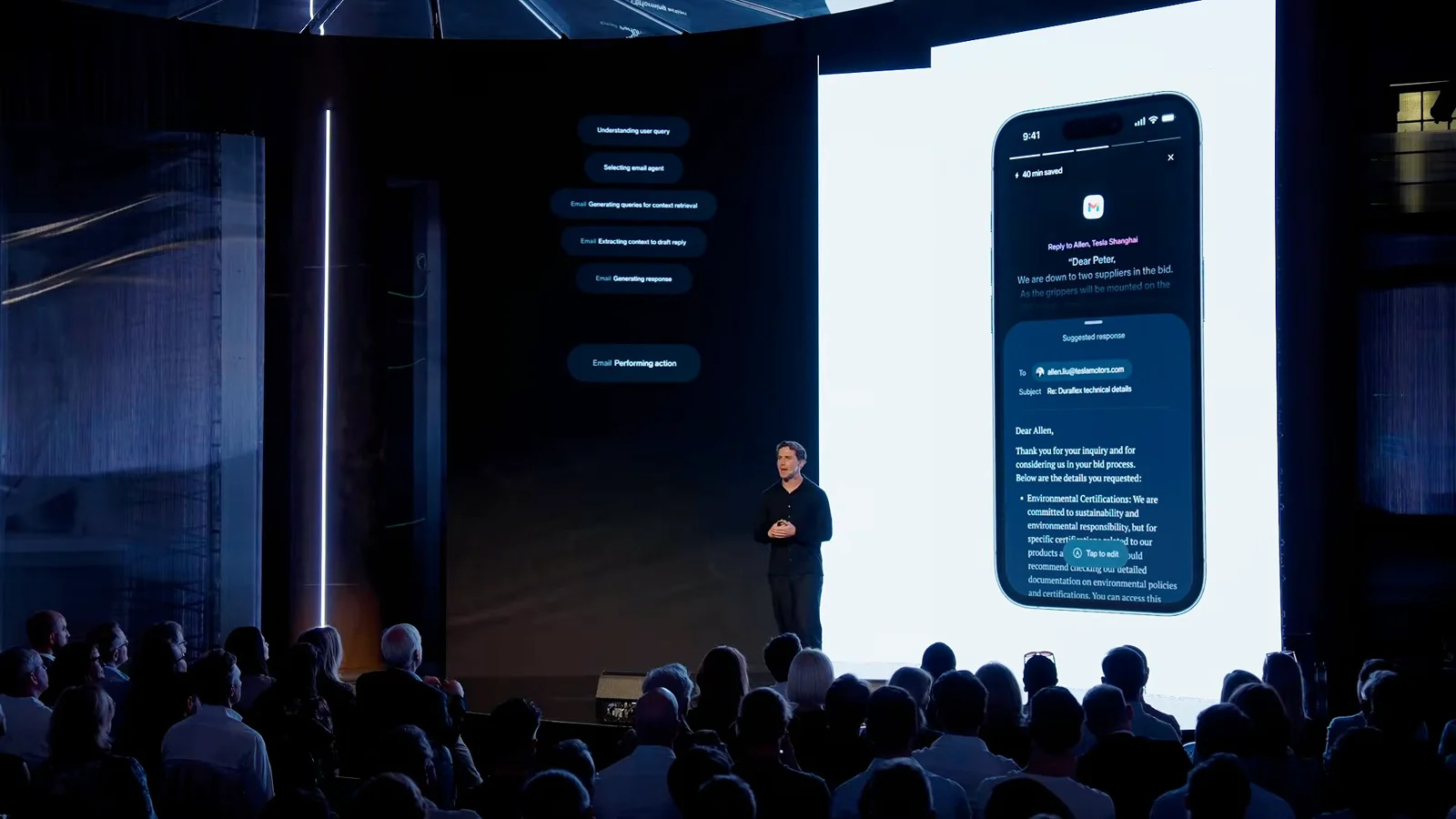
A construction-company example drafts a reply to a complex email by retrieving relevant information from several systems. Hellermark says the user can review or edit the draft before completing it.
He also shows a catch-up view synthesizing recently shared documents. The aim is to move from finding information toward helping people complete tasks that depend on it.
Hellermark previews a voice interaction built with OpenAI and jokes about giving the assistant a passive-aggressive personality. He discusses possible uses for sales representatives and researchers.
He reports early productivity gains of 30–50% across selected use cases, comparing them with historical technology adoption. These are figures presented by the company, not a universal estimate for all jobs.
Hellermark closes by encouraging organizations to use knowledge tools in support of goals such as medical research and renewable energy.
같은 채널의 다른 글
 1:16EN
 Sana· 2026년 10월 14일팟캐스트How Volkswagen Group Middle East Uses Sana to Prepare Technicians for TrainingThierry Rochat describes using technical documents to create online courses before hands-on academy sessions.
 0:41ENSana· 2026년 9월 8일팟캐스트Sana Learn Customers Describe Bringing Training Resources TogetherA short customer montage contrasts fragmented learning resources with keeping company knowledge in one place.
 0:40ENSana· 2026년 8월 31일팟캐스트Sana Learn Customers Describe Their Partnership ExperienceIn a short montage, customers discuss implementation and the ongoing relationship with Sana.
 48:34ENSana· 2026년 8월 12일팟캐스트 · 2명Tyler Cowen on AI Adoption, Human Agency, and the Search for Beauty게스트 Tyler Cowen · 진행자 Joel HellermarkThe economist explains why AI's economic impact may arrive slowly, what people may still contribute, and why he is calling for a new aesthetic.
 0:16ENSana· 2026년 7월 21일팟캐스트Tyler Cowen on Human Presence in an AI WorldTyler Cowen predicts that charisma, physical presence and human interaction will gain importance as AI advances.
 0:23ENSana· 2026년 7월 9일팟캐스트Ethan Mollick on Measuring AI’s ImpactEthan Mollick argues that companies should allow room for new opportunities rather than relying only on old metrics.