30초 요약
Matthew Berman reviews GitHub Copilot Workspace and Amazon Q product demonstrations, his experience with Rabbit R1, and Sam Altman’s views on infrastructure, iterative deployment and AI risks. He closes with a Sora music video and OpenVoice V2. The video description promotes Pinecone.
- 1Issue to reviewed codeWorkspace proposes a specification and plan, then presents a diff, preview and pull request for developer review.
- 2Java upgrade directionThe Amazon Q demonstration shows Java 8 or 11 codebases upgrading to Java 17, not to Java 8.
- 3Rabbit R1 experienceBerman reports improved battery performance on his own unit and discusses a researcher running its app on a phone.
- 4Iterative deploymentAltman argues that early releases give users and institutions time to learn and influence development.
- 5Subtle and catastrophic risksAltman says both matter but worries that less visible effects might be overlooked.
- 6Generated mediaThe roundup shows a Sora music video and a multilingual voice-cloning demonstration.
핵심 정리
- Copilot Workspace’s 2024 preview connects an issue to editable specifications, plans, code changes and review.
- Amazon Q Developer and Business were generally available in April 2024, while Q Apps was initially a preview.
- AI-generated code and business analysis still require human review and testing.
- Running Rabbit’s interface on an Android phone does not demonstrate that every hardware or cloud feature is replicated.
- Altman favored iterative deployment and worried about both subtle and catastrophic AI risks.
- Sora-generated imagery and OpenVoice demonstrations illustrate new media capabilities, with claims limited to the examples shown.
챕터별로 다듬은 전문 읽기
Copilot Workspace
Berman reviews the task-centered technical preview and a GitHub demonstration. Developers can edit plans, review code and run checks.
In this May 2024 news roundup, I look at GitHub Copilot Workspace and Amazon Q, two approaches to AI-assisted development, along with the Rabbit R1, comments from Sam Altman, a Sora music video and OpenVoice V2. The video description promotes Pinecone; it does not contain a spoken sponsor segment.
GitHub Copilot began as an editor assistant that suggests code as a developer types. Workspace expands the workflow around a task: starting from an issue or feature description, it proposes a specification, a plan and code changes. GitHub presented this as a technical preview, not a guarantee that every task could be completed autonomously.
GitHub cited a productivity increase of up to 55% from an earlier study. That figure concerns a particular controlled coding task and should not be generalized to every developer or project. I also worry that accepting generated code without inspection could spread bugs or lower-quality patterns; that is a concern, not an established result of model training.
I was less impressed by my experience of Copilot Chat than by autocomplete. Workspace is more interesting to me because it connects planning and implementation, while keeping the developer able to edit the steps and review the output.
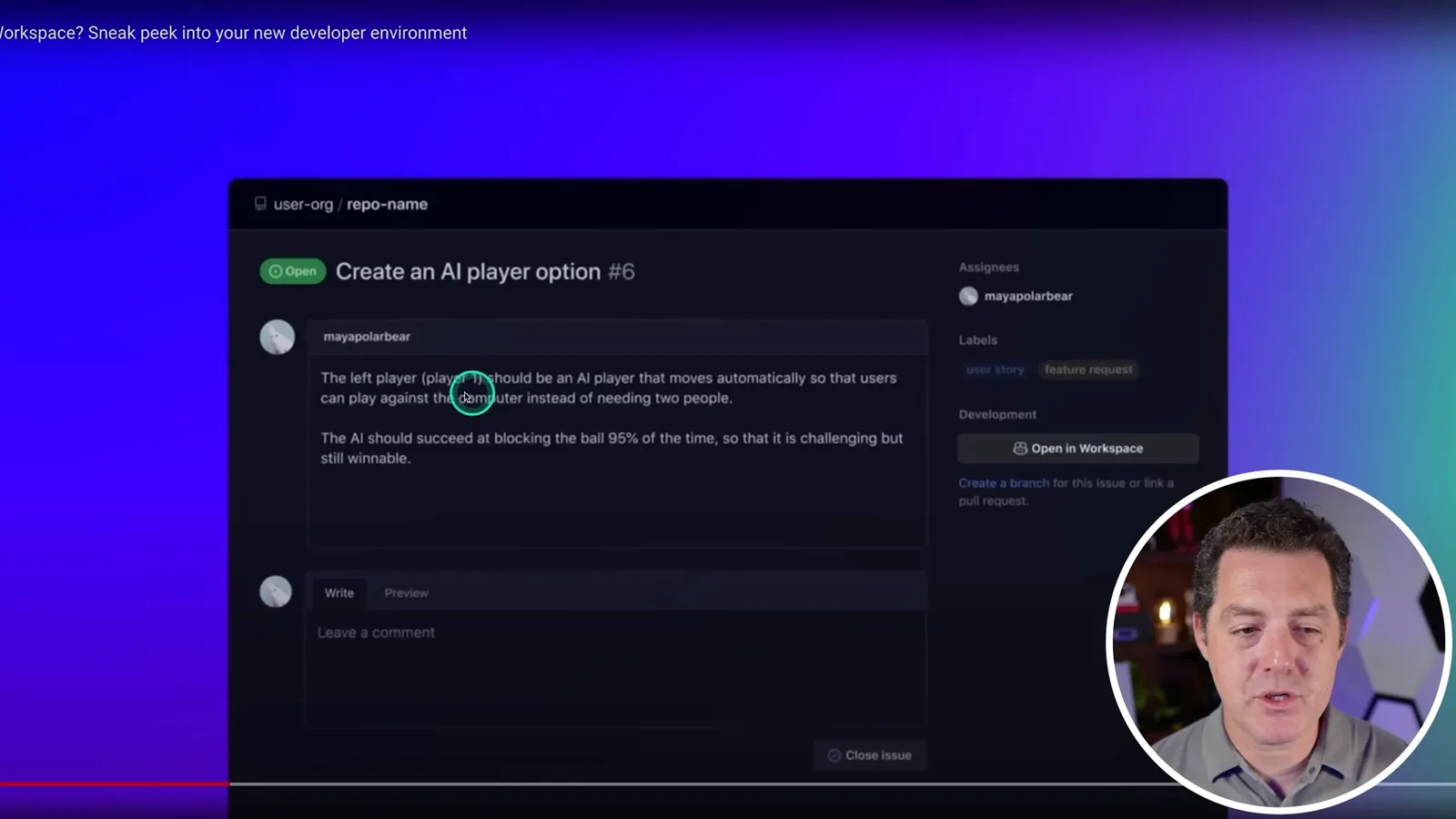
In GitHub's example, an issue asks for an AI player in a game. The user opens it in Workspace, reviews and edits a generated specification, asks for a plan and then starts implementation. The proposed changes appear as a diff, allowing the user to examine and modify them.
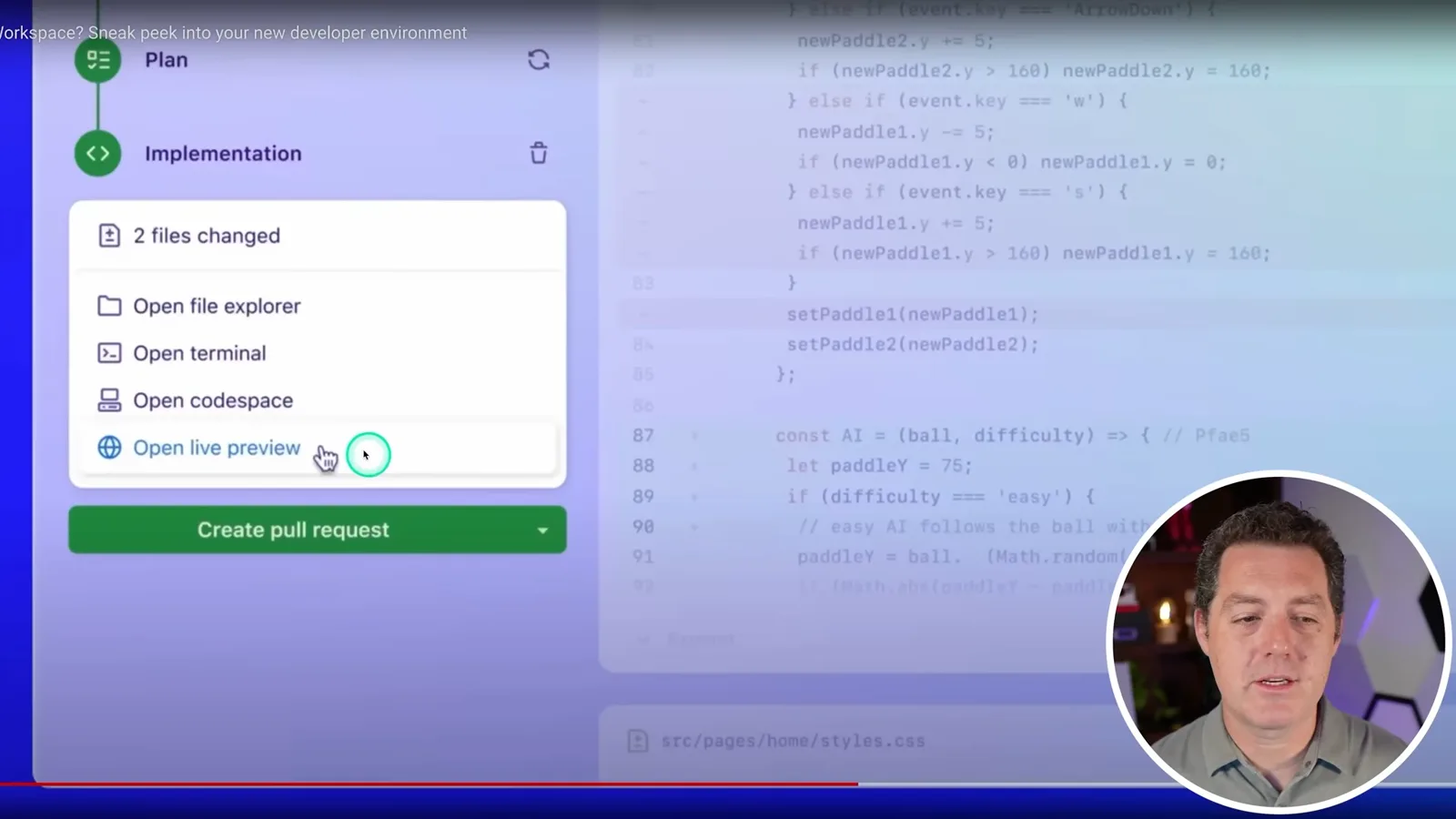
The demonstration also shows a live preview before a pull request. I see the tool as augmenting developers rather than replacing them: people still need to decide whether the specification makes sense and whether the resulting code is safe and correct.
A GitHub demonstration walks through the flow from an issue and repository context to an editable specification. The plan can add, change or remove files and describe the work expected at each step, so the developer can revise it before code is generated.
The workspace streams the changes into a diff and provides an editor and integrated terminal for running tests. A developer can open a Codespace for additional debugging, then create a pull request with a generated description and link to the workspace; normal checks and review still apply.
The interface was also designed to work on mobile. The idea of reviewing and contributing to a project from a phone is striking, though a demonstration of the workflow does not establish the quality of every generated change.
Amazon Q
The roundup examines developer assistance, business intelligence and Q Apps. Availability differed by feature in 2024.
Amazon Q takes a broader business and developer approach. AWS announced general availability of Q Developer and Q Business in April 2024, while individual capabilities had different availability; Q Apps was a preview then, rather than generally available at that time.
Amazon describes Q Developer as an assistant for coding, testing, troubleshooting, security scanning and AWS-related tasks. These are product capabilities, and AWS's claims about performance are not independent proof that generated code is always accurate. I had not tested the product myself.
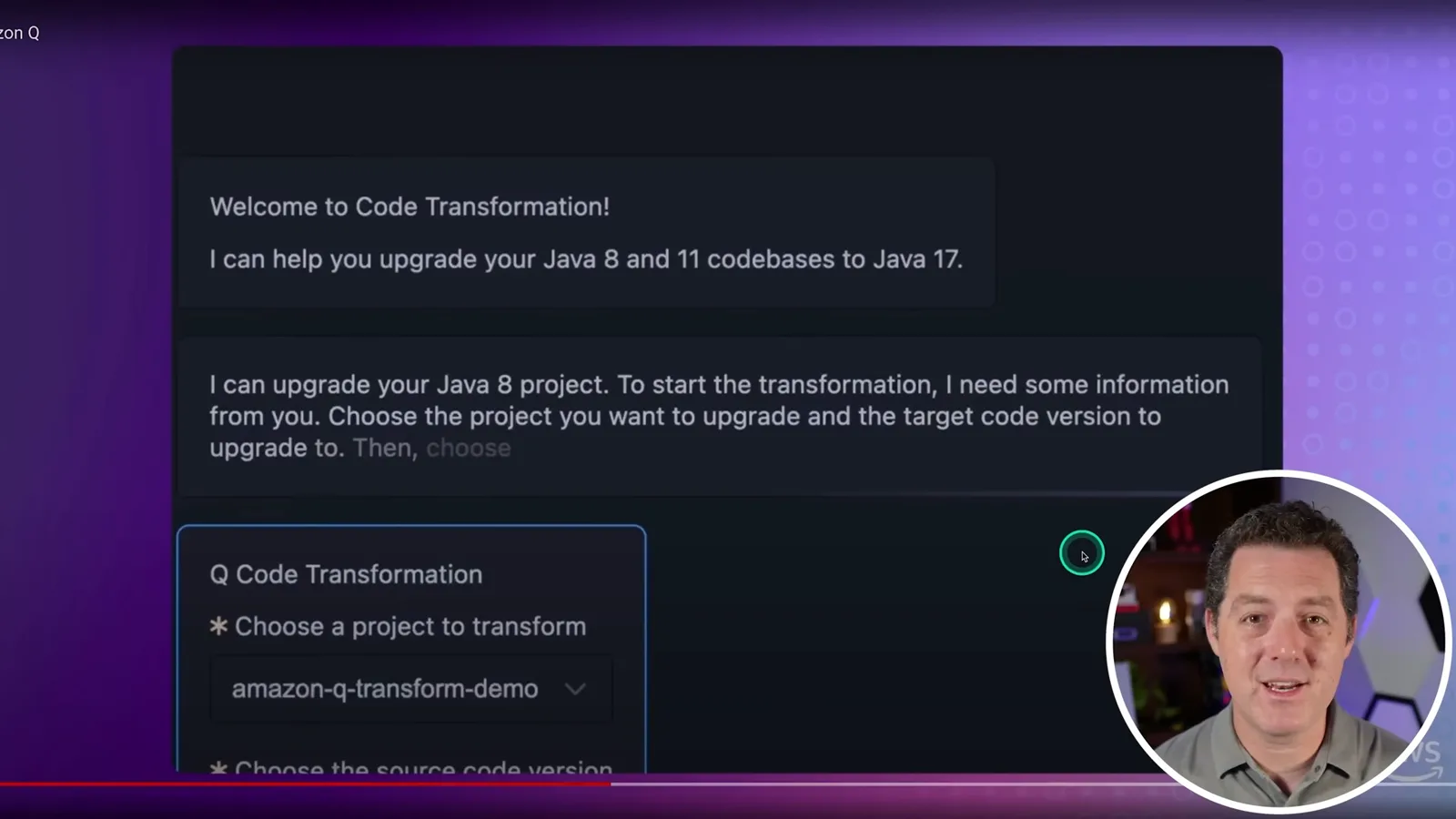
The demonstration includes a code transformation workflow. The screen specifies upgrading Java 8 or 11 projects to Java 17, rather than converting a project into Java 8; AWS's [2024 announcement](https://aws.amazon.com/blogs/aws/amazon-q-developer-now-generally-available-includes-new-capabilities-to-reimagine-developer-experience/) describes that direction.
Amazon Q in QuickSight applies natural language to business intelligence. In the demonstration a user requests a story about profitability trends and receives a report with charts and suggested metrics. The example illustrates a possible workflow, not a substitute for checking the data and analysis.
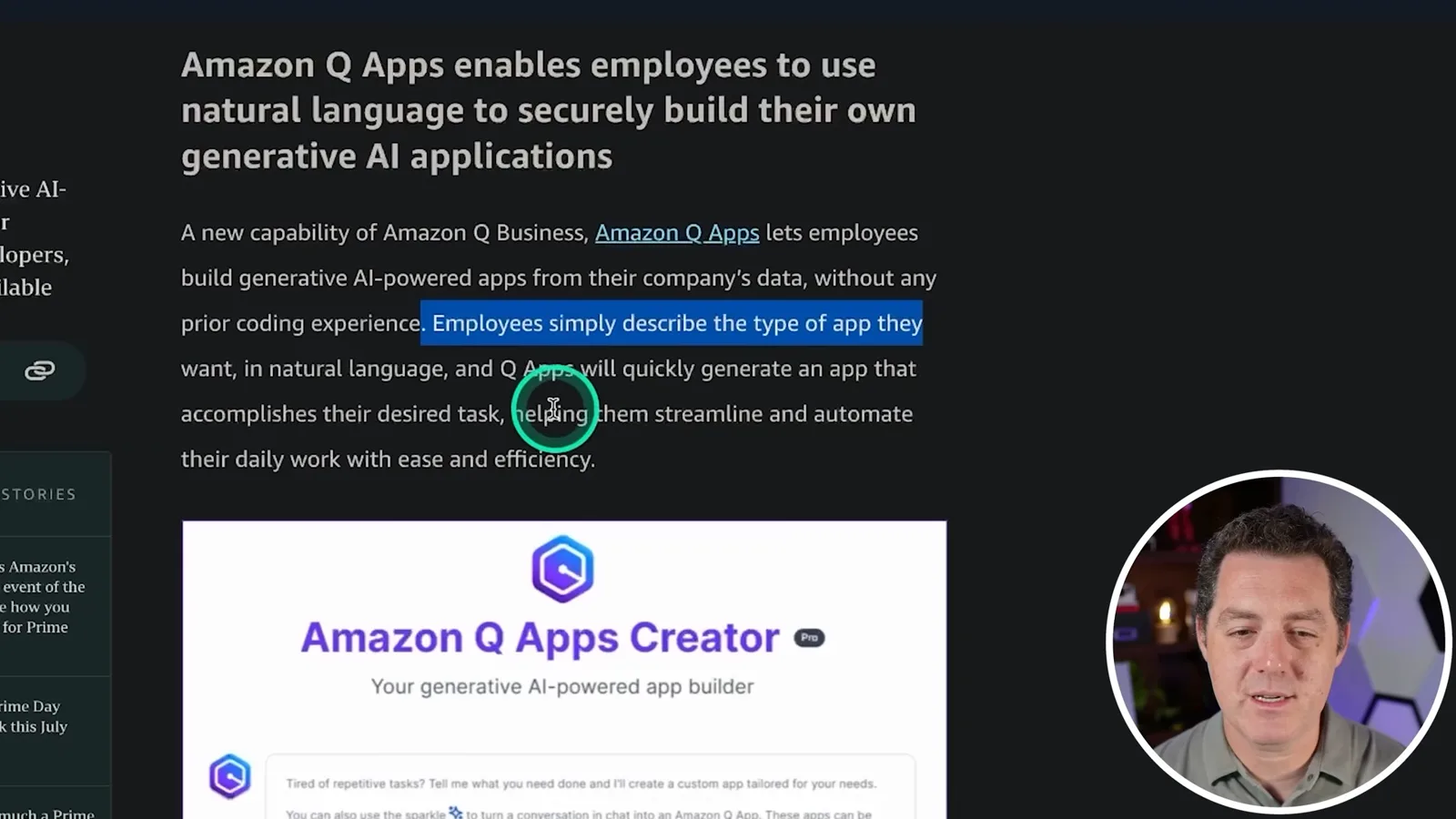
Amazon Q Apps lets employees describe a small generative AI application based on company data. The example is an onboarding planner that takes a role and a weekly, 60-day or 90-day structure and produces guidance; the resulting app can be reused. AWS later made Q Apps generally available in July 2024.
Rabbit R1
Berman shares his battery experience and discusses the Android-based interface running on a phone.
I have also been using a Rabbit R1. Its battery initially drained very quickly, but after an update my own device appeared to improve dramatically: I observed about 5% drain over two hours. That anecdote is not a controlled battery-life measurement or a promise for other devices.
A report showed Rabbit's interface running as an Android application on a phone. The device uses the Android Open Source Project, and a researcher got an extracted app working on a Pixel; this does not by itself establish that every hardware feature or backend service works independently on a phone.
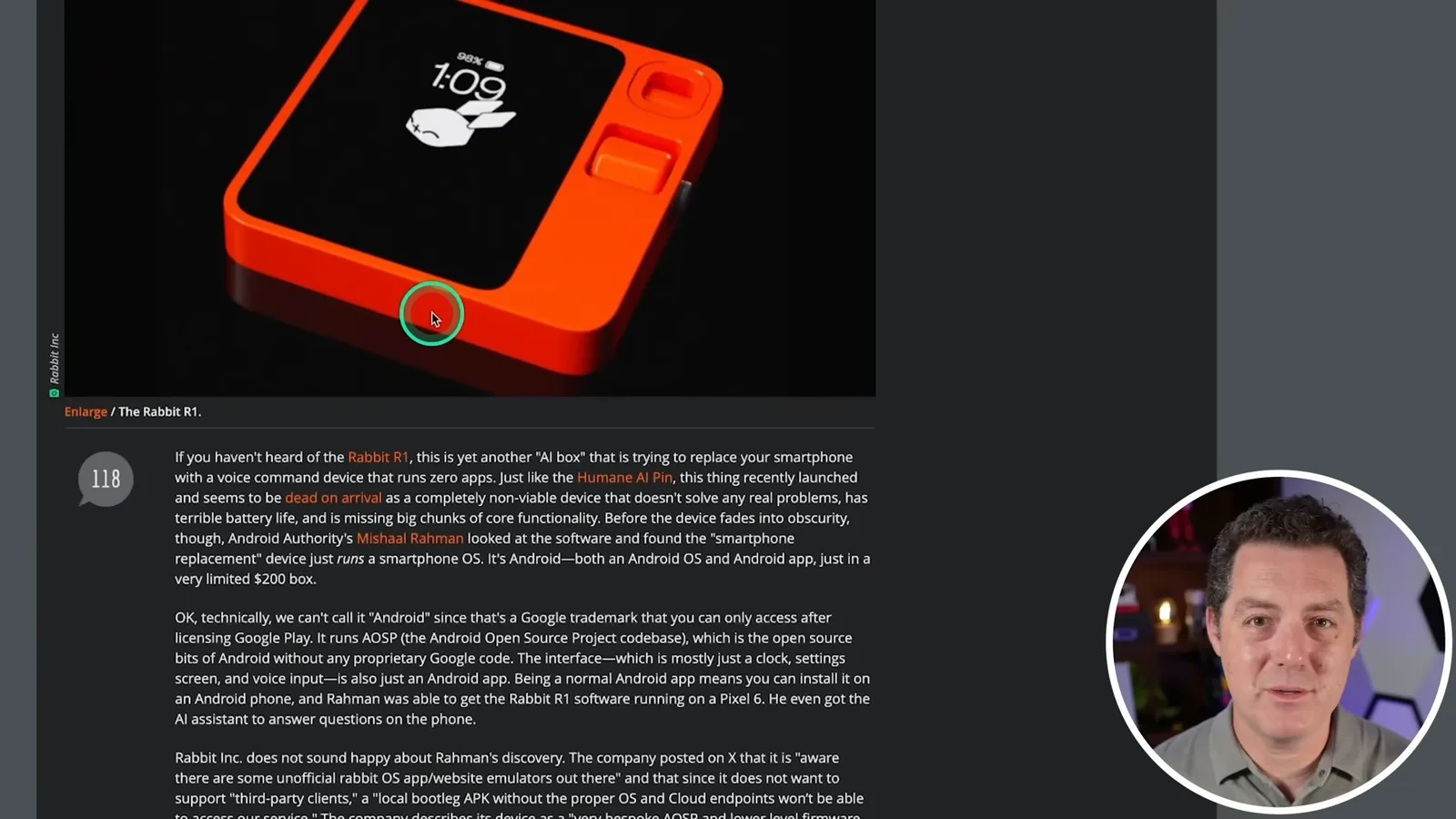
Rabbit said it was aware of unofficial emulators and did not intend to support third-party clients. I like the R1's physical design and question why the company does not also offer an app; the roughly $200 price and my positive impression are from this 2024 discussion.
Sam Altman on AI infrastructure and risk
Altman discusses compute, productizing more capable systems, iterative deployment and societal risks.
At a Stanford event, OpenAI CEO Sam Altman discusses building much larger computers. He frames AI infrastructure as an interconnected system involving energy, data centers, chips, chip design and networks, rather than a single semiconductor project.
Altman says that, if AI systems reach what he calls PhD-level intelligence and beyond, OpenAI still has to determine how best to package them as products and benefit society. This is a future-oriented aspiration and an open product question, not evidence that such general intelligence had already been achieved.
Altman calls the then-current ChatGPT mildly embarrassing and predicts that GPT-4 will be surpassed substantially by later systems. I suspect he may have seen stronger internal technology, but that is speculation rather than a confirmed description of an unreleased model.
He argues for iterative deployment: release imperfect systems, learn from feedback and let people and institutions adjust as capabilities change. He says early use can reveal where models work, where they fail and what people want from them.
Altman adds that people need time to integrate these tools and influence their development. He considers gradual deployment the best approach at the time, while acknowledging that future circumstances could change that judgment.
Asked whether catastrophic or subtle AI risks concern him more, Altman says both are serious but he worries especially about less obvious effects that people may overlook. The interviewer's example about social media and attention is an analogy, not a diagnosis or demonstrated causal finding.
He also worries about whether society can adapt quickly enough and develop a new social contract as technology changes. His view is that short-term change may be overestimated while long-term change may be underestimated; this is a forecast rather than an established outcome.
Sora and OpenVoice
Berman shows a music video made with Sora and a voice-cloning demonstration.
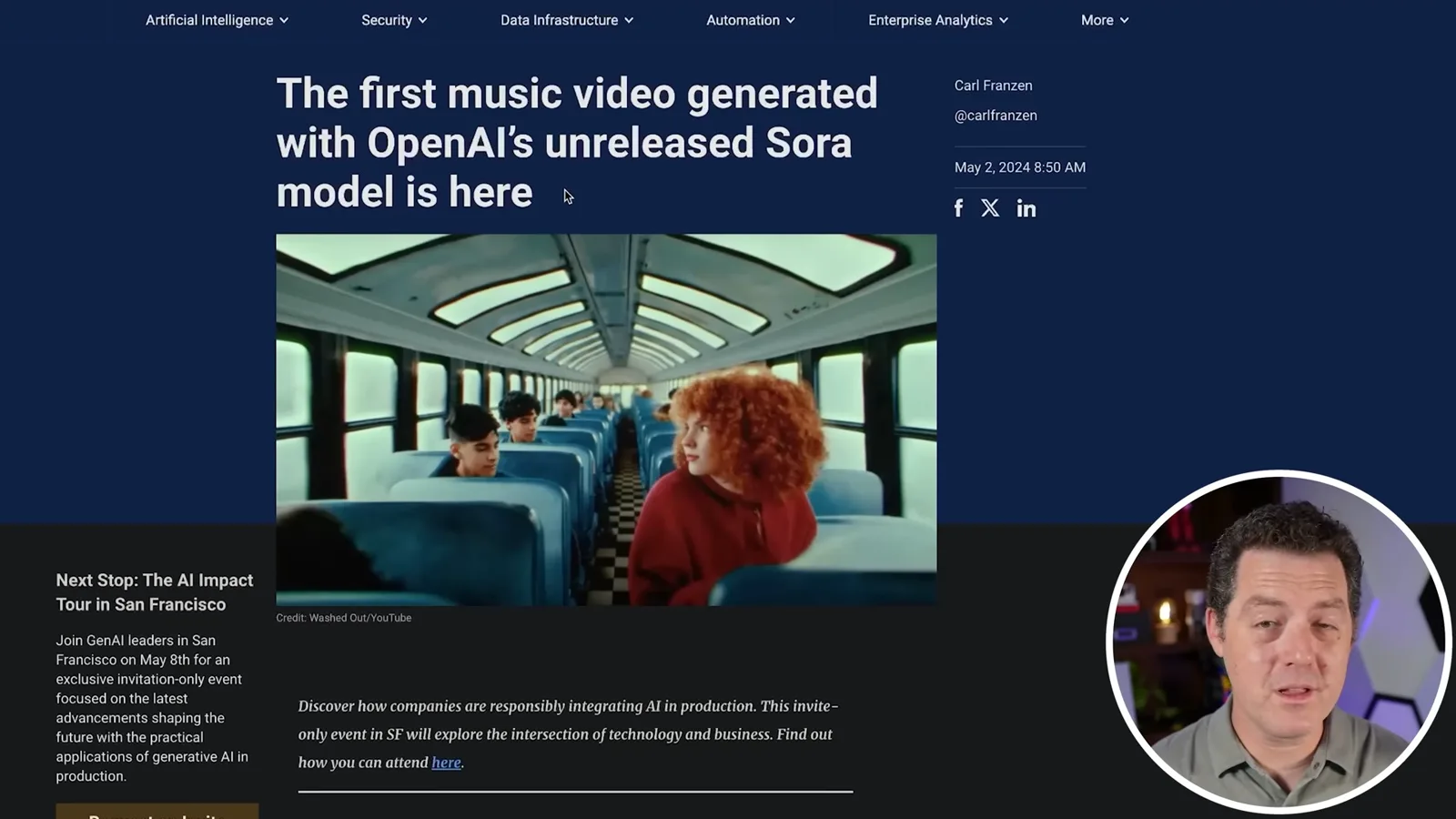
The roundup then shows an excerpt from Washed Out's “The Hardest Part,” directed and edited by Paul Trillo using OpenAI's then-unreleased Sora. The artist describes it as the first official music video made with Sora; the human director's creative and editing work remains part of the production.
Finally, MyShell's OpenVoice V2 demonstration shows voice cloning and speech in multiple languages and styles. The project supports voice transfer and multilingual generation, but the promotional claim of any voice or language should not be read as proven equal performance in every case.
The examples play different voices and phrases, and I find the demonstration impressive. I ask whether viewers would like a future installation and usage tutorial.
같은 채널의 다른 글
 34:21EN
 Matthew Berman· 2026년 10월 27일Matthew Berman Examines Anthropic’s IPO Filing, AI Growth and GovernanceMatthew Berman, Sam Altman · Forward FutureThe presenter reviews the S-1’s financial metrics, compute strategy and voting structure while questioning the tension between rapid AI development and safety.
 0:26ENMatthew Berman· 2026년 10월 25일Sam Altman on Human Values and Problem-Solving in an AI WorldSam Altman · OpenAIIn a short interview excerpt, Altman considers the enjoyment of solving hard problems and the human role in interpreting results.
 0:36ENMatthew Berman· 2026년 10월 25일Kimi K3.1 and a Rubik’s Cube Solver DemonstrationMatthew Berman · Forward FutureMatthew Berman shows a scrambled virtual cube being solved and gives the Kimi K3.1 test a favorable assessment.
 0:21ENMatthew Berman· 2026년 10월 24일An AI-Generated Kimi Benchmark Chart Used Invented ScoresMatthew Berman · Forward FutureMatthew Berman asks for a graph of Kimi K3.1 Pro benchmarks, then discovers that the displayed figures are illustrative placeholders.
 25:50ENMatthew Berman· 2026년 10월 24일Kimi K3.1 Pro Tested: Strong 3D Demos, Uneven Results and Competitive PricingMatthew Berman · Forward FutureMatthew Berman tests the open-weight model on coding, 3D rendering and visual explanations, then compares benchmark results and prices.
 32:20ENMatthew Berman· 2026년 10월 23일Who Is Local AI For? The Costs, Trade-offs and a Hybrid FutureMatthew Berman · Forward FutureMatthew Berman weighs data control and independence against hardware cost, setup complexity and inference speed.