30초 요약
In a December 2024 video, Matthew Berman watches excerpts from Demis Hassabis’s Nobel lecture and explains why the Google DeepMind CEO sees biology as a promising field for AI. They discuss suitable search problems, AlphaFold’s protein-structure predictions, the aspiration to accelerate drug discovery and a hypothetical virtual cell. Hassabis closes with an explicitly unproven conjecture about classical algorithms and natural patterns. Berman also discusses Google’s Willow quantum chip and identifies Emergence AI as the video’s sponsor.
- 1Three criteria for AIHassabis highlights combinatorial search, a clear objective and sufficient data or an efficient simulator.
- 2Predicting protein structuresAlphaFold predicts three-dimensional structures from sequences; its success does not solve every aspect of protein folding and biology.
- 3CASP resultsThe lecture shows a large rise in structure-prediction scores; GDT is a benchmark metric, not a universal percentage of all protein predictions correct.
- 4Digital biologyHassabis proposes AI as a potential way to model complex biological systems and imagines faster drug discovery and a virtual cell.
- 5Quantum error correctionGoogle reported reduced logical error rates as tested error-correction codes grew, but practical large-scale quantum computing remained a goal.
- 6A conjecture, not a proofHassabis speculates that classical learning might efficiently model patterns in nature; no proof of the conjecture or P versus NP follows.
핵심 정리
- Hassabis identifies large search spaces, clear objectives and data or accurate simulation as useful conditions for applying AI.
- AlphaFold greatly advanced protein structure prediction, but its benchmark scores do not mean all protein behavior, dynamics or drug discovery has been solved.
- Hassabis’s vision of much faster drug discovery and an entire virtual cell is an aspiration, not an established clinical outcome.
- Willow demonstrated below-threshold error correction on tested codes; it did not establish general production-ready quantum computing.
- Hassabis’s proposed classical-learning conjecture and possible complexity-theory implications remain speculative and do not resolve P versus NP.
- The video includes a paid partnership with Emergence AI.
챕터별로 다듬은 전문 읽기
Which problems suit AI?
Hassabis gives three criteria and Berman explains them through Go. Search space, objectives and data help frame the problem.
Matthew Berman introduces Demis Hassabis’s vision of “digital biology” and asks how AI might change scientific discovery. He plays excerpts from the Google DeepMind CEO’s Nobel lecture and considers why certain problems are especially suited to AI.
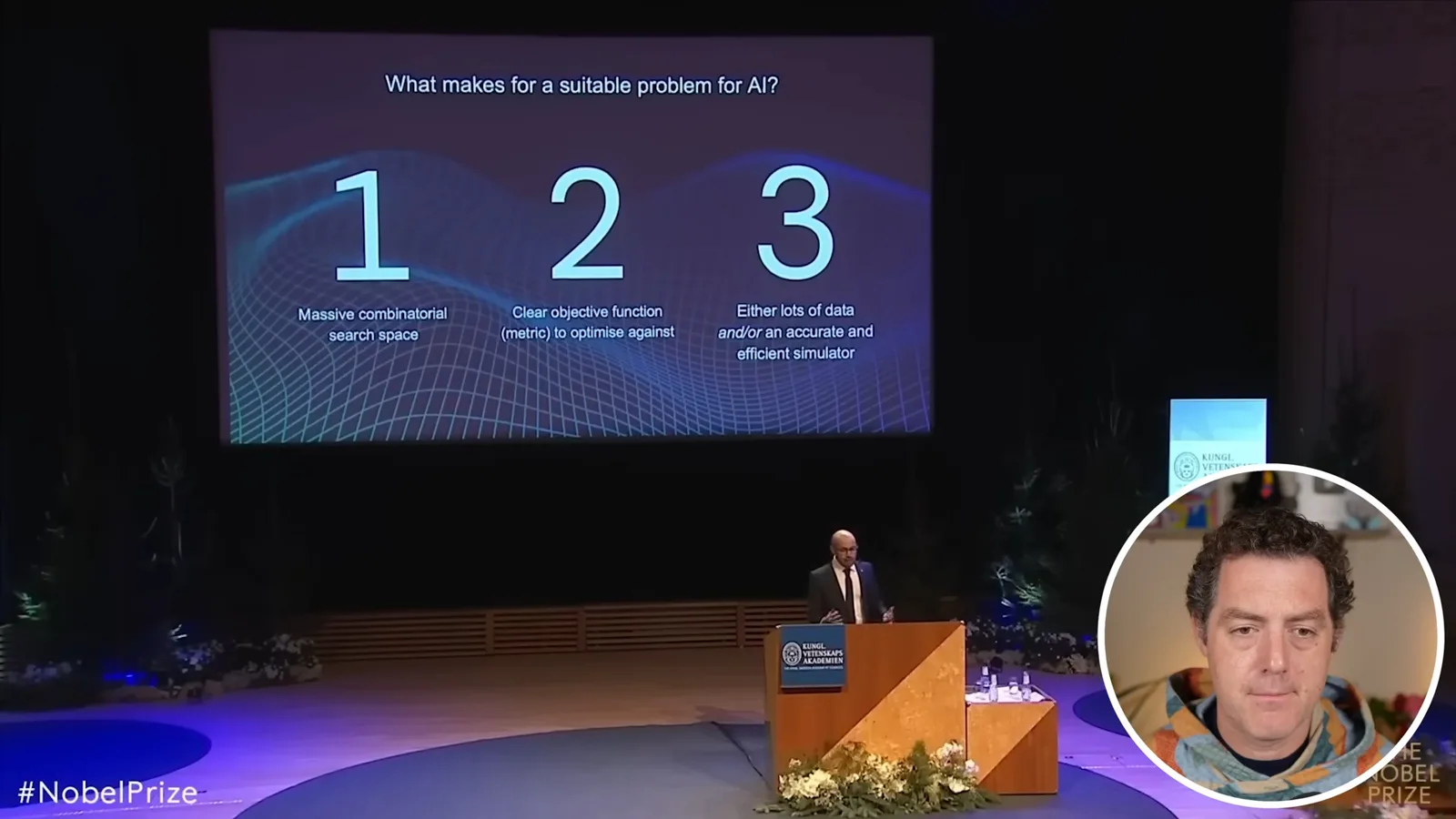
Hassabis names three useful criteria: a large combinatorial search space, a clear objective or metric to optimize, and substantial data or an accurate, efficient simulator that can generate relevant synthetic data. These are practical criteria for the class of methods he discusses, not a guarantee that every problem meeting them is solved.
Berman uses Go as an illustration. The game has an immense number of possible positions, a clear win-or-loss signal and an environment in which computers can generate games. Those properties make exhaustive search impractical but make learning and guided search attractive.
Protein structure and AlphaFold
The lecture explains the relationship between amino acid sequences and structures. Berman discusses AlphaFold and a paid Emergence AI partnership.
The discussion turns to proteins. Hassabis describes them as nanoscale biological machines involved in processes from muscle movement to neuronal activity. Their amino acid sequences fold into three-dimensional structures, and knowing a structure can help scientists investigate function, disease and potential drugs.
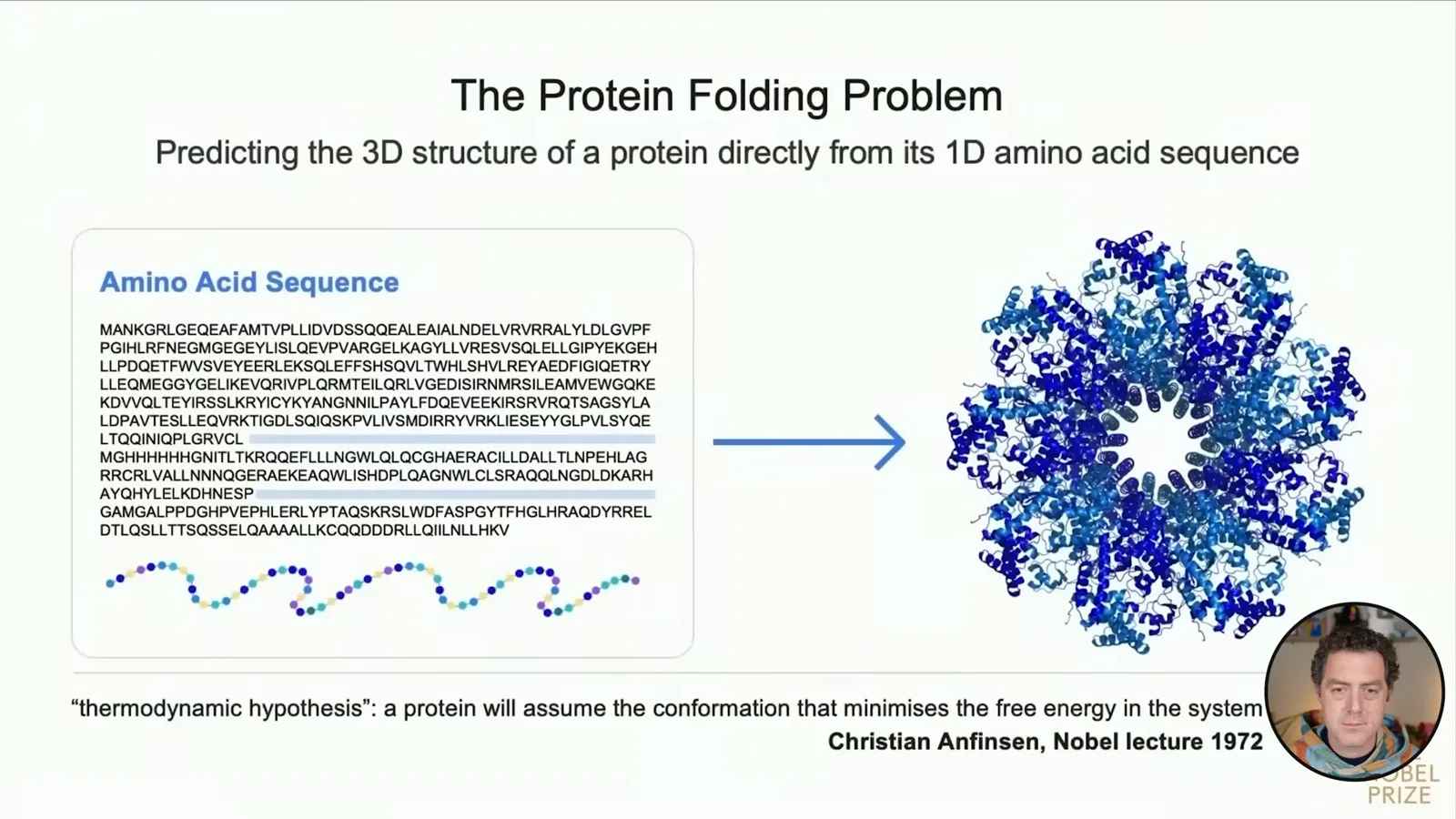
Berman describes the long-standing challenge of predicting protein structures and mentions distributed computing through Folding@home. He says AlphaFold essentially solved the problem. Its impact was substantial, but this shorthand should not be read as solving all folding pathways, dynamics, interactions or biological function; predictions can be uncertain and often require experimental validation.
The video includes a paid partnership with Emergence AI. Berman describes its multi-agent orchestration and web automation, including interaction with menus, forms and documents, as well as hosted and private-cloud options. Claims about reliability, privacy and recovery are sponsor product claims, not an independent test.
Digital biology and future discovery
A CASP chart illustrates progress in structural prediction. Hassabis describes possible faster drug discovery and the longer-term goal of simulating a cell.
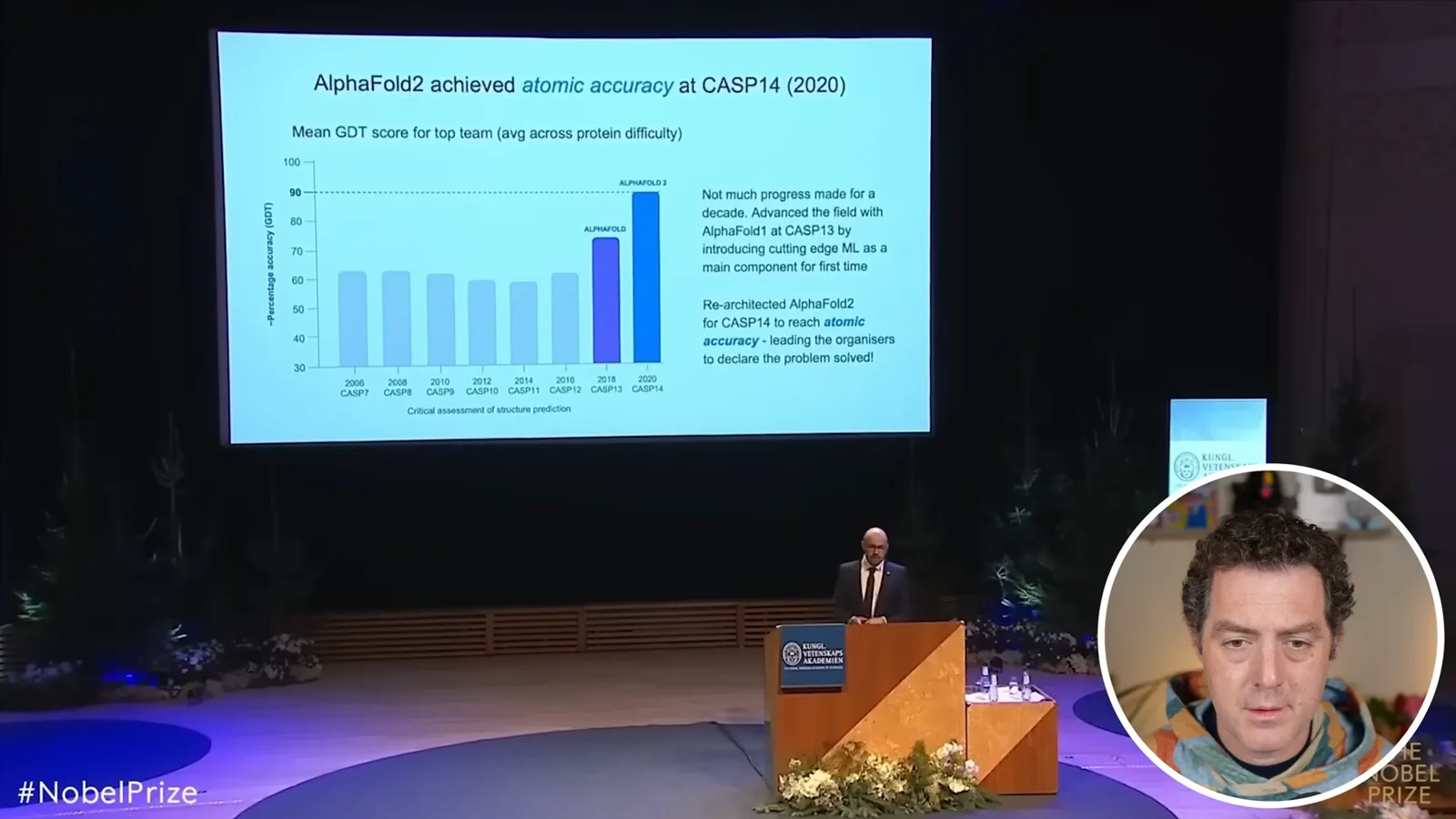
Hassabis shows a CASP chart comparing protein-structure prediction across assessment rounds. AlphaFold 2 made a substantial jump at CASP14. DeepMind reports a median 92.4 GDT score across those targets; GDT is a structural similarity measure on a specific benchmark, not a blanket claim that 92.4% of all protein predictions or biological conclusions are correct ([DeepMind](https://deepmind.google/blog/alphafold-a-solution-to-a-50-year-old-grand-challenge-in-biology/)).
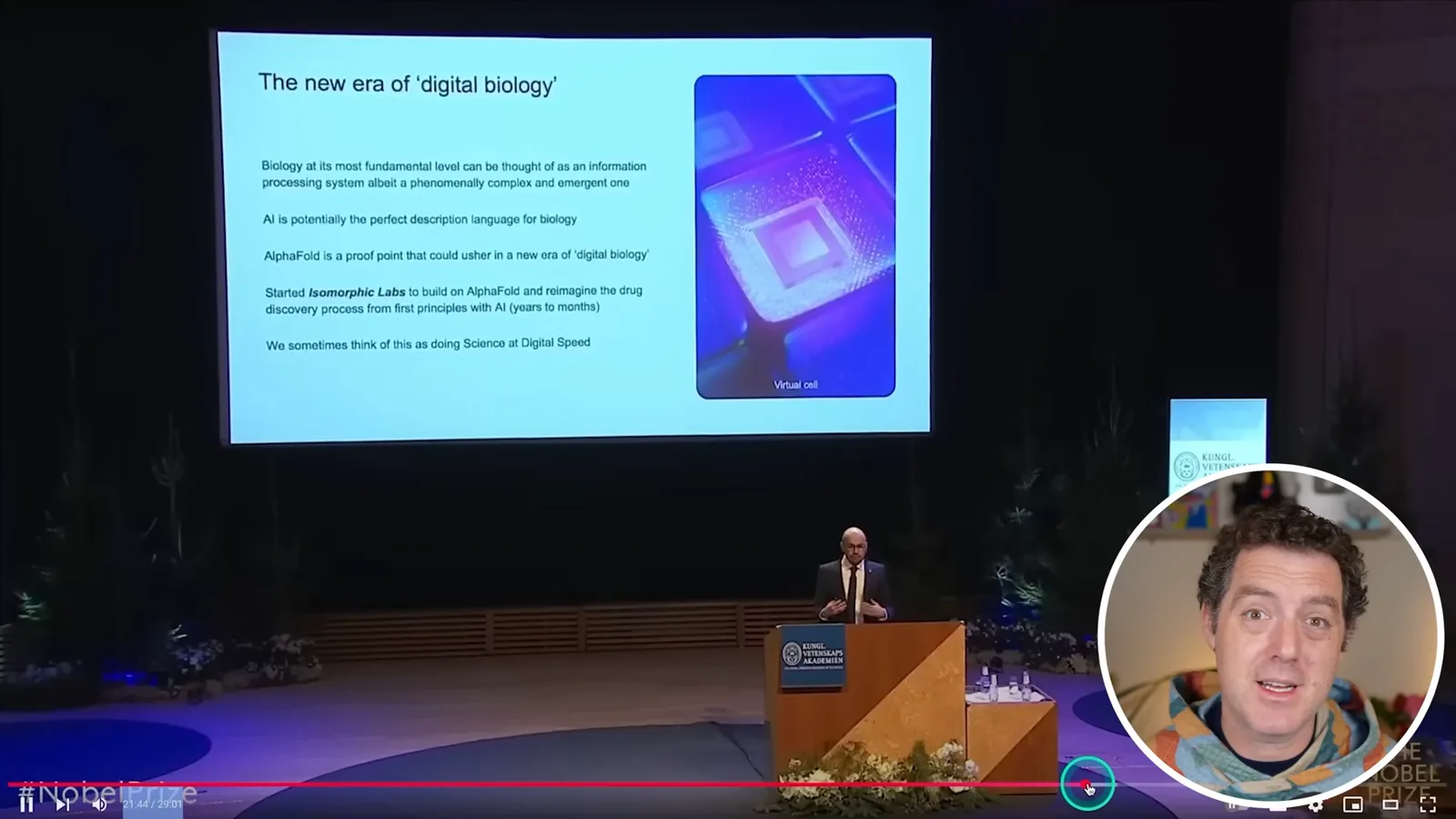
Hassabis suggests biology can be viewed as an exceptionally complex information-processing system. In his view, AI may offer a useful descriptive language for biological phenomena in a way analogous to mathematics for physics. He presents AlphaFold as a possible early proof point for a future era of digital biology, not evidence that biology has already been fully modeled.
Hassabis describes Isomorphic Labs as an effort to build on AlphaFold and rethink drug discovery with AI. He hopes discovery could eventually shrink from years to months or even weeks. Berman is excited by the possibility, but that timeline is a vision rather than a demonstrated delivery schedule; experimental and clinical validation remain necessary.
Hassabis also describes a long-standing dream of simulating an entire virtual cell, beyond individual proteins or small groups of interactions, to produce predictions useful to experimentalists. Berman recalls an earlier simulated-worm example and imagines testing interactions with drugs or viruses. A full predictive human-cell simulation is a proposed future capability, not a result established by the lecture.
Quantum computing and a classical conjecture
Berman discusses Willow, then Hassabis poses an unproven conjecture about classical learning. The video closes with Berman’s optimism about scientific and other applications.
Berman turns to quantum computing and contrasts it with classical devices using bits. He mentions Google’s Willow chip and its error-correction result. In the reported experiment, increasing the size of particular error-correction codes reduced logical error rates; this milestone does not by itself establish general-purpose, fault-tolerant production quantum computing ([Google Quantum AI](https://blog.google/innovation-and-ai/technology/research/google-willow-quantum-chip/)).
Hassabis asks what classical computing can achieve with substantial advance computation to build a useful model of a problem. He suggests such a model may make some solution spaces easier to explore. This is a research intuition, not a general proof that precomputation and learning make arbitrary hard problems efficient.
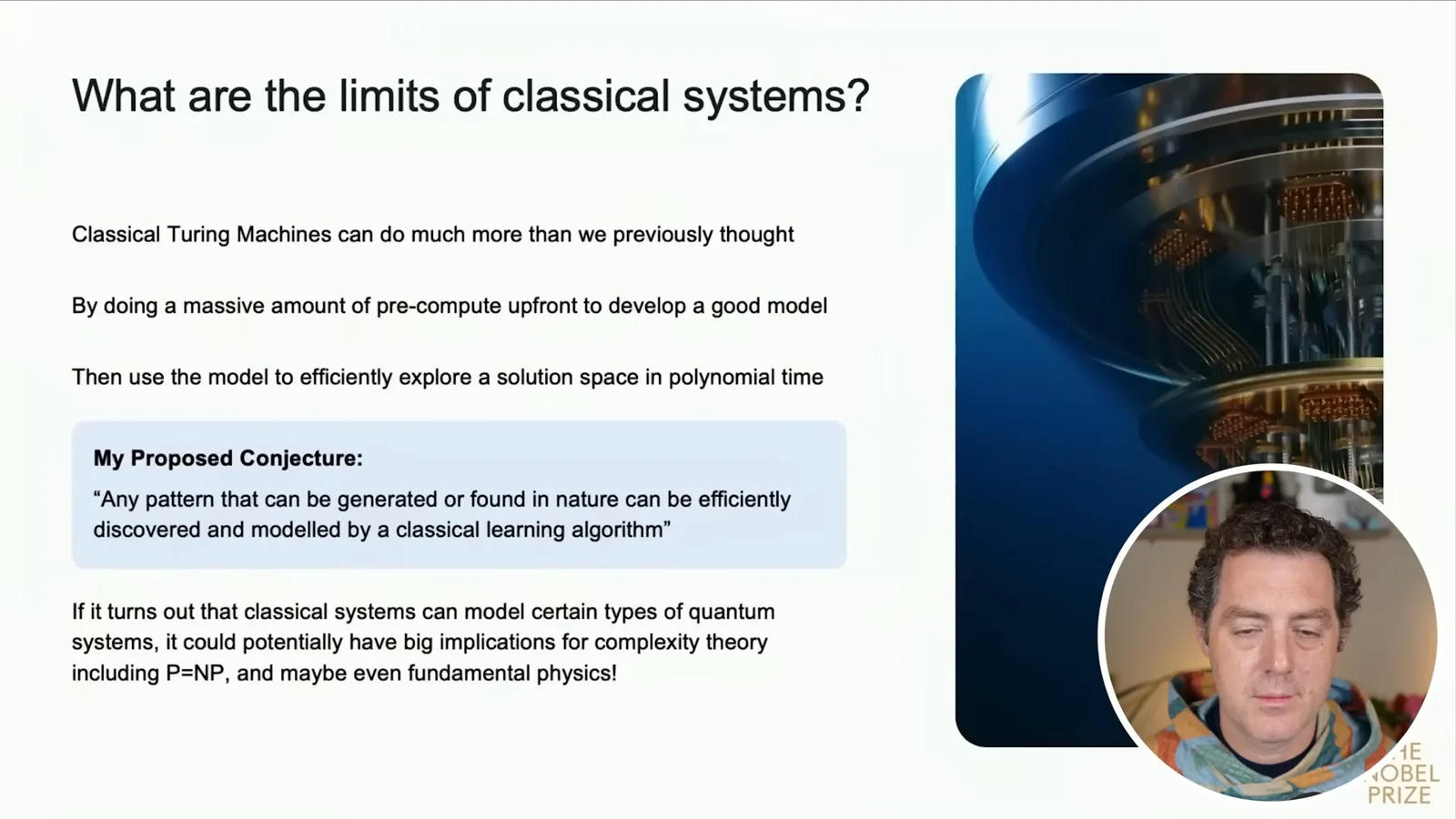
Hassabis offers a loose conjecture that patterns found in nature might be efficiently discovered and modeled by classical learning algorithms, while distinguishing abstract tasks such as factoring. He speculates that modeling certain quantum systems could have implications for complexity theory and fundamental physics. His slide explicitly calls this a conjecture; it does not prove a universal efficiency claim or resolve P versus NP.
Berman interprets the idea as using upfront computation to create predictive models that help classical computers approach previously difficult problems. He closes with optimism about personal agents, scientific discovery, mathematics, games and media, while these examples remain future possibilities rather than validated outcomes of the conjecture.
같은 채널의 다른 글
 34:21EN
 Matthew Berman· 2026년 10월 27일Matthew Berman Examines Anthropic’s IPO Filing, AI Growth and GovernanceMatthew Berman, Sam Altman · Forward FutureThe presenter reviews the S-1’s financial metrics, compute strategy and voting structure while questioning the tension between rapid AI development and safety.
 0:26ENMatthew Berman· 2026년 10월 25일Sam Altman on Human Values and Problem-Solving in an AI WorldSam Altman · OpenAIIn a short interview excerpt, Altman considers the enjoyment of solving hard problems and the human role in interpreting results.
 0:36ENMatthew Berman· 2026년 10월 25일Kimi K3.1 and a Rubik’s Cube Solver DemonstrationMatthew Berman · Forward FutureMatthew Berman shows a scrambled virtual cube being solved and gives the Kimi K3.1 test a favorable assessment.
 0:21ENMatthew Berman· 2026년 10월 24일An AI-Generated Kimi Benchmark Chart Used Invented ScoresMatthew Berman · Forward FutureMatthew Berman asks for a graph of Kimi K3.1 Pro benchmarks, then discovers that the displayed figures are illustrative placeholders.
 25:50ENMatthew Berman· 2026년 10월 24일Kimi K3.1 Pro Tested: Strong 3D Demos, Uneven Results and Competitive PricingMatthew Berman · Forward FutureMatthew Berman tests the open-weight model on coding, 3D rendering and visual explanations, then compares benchmark results and prices.
 32:20ENMatthew Berman· 2026년 10월 23일Who Is Local AI For? The Costs, Trade-offs and a Hybrid FutureMatthew Berman · Forward FutureMatthew Berman weighs data control and independence against hardware cost, setup complexity and inference speed.